Health
What does autoimmune skin disease look like on a Bernese?
Crusting or ulcers at the nose, lips, eyelids, pads or nail beds, often with loss of black pigment, and lesions that never fully resolve with antibiotics.

Quick answer
What does autoimmune skin disease look like on a Bernese?
Crusting or ulcers at the nose, lips, eyelids, pads or nail beds, often with loss of black pigment, and lesions that never fully resolve with antibiotics.
The tell is not the sore itself. It is the sore that keeps coming back after every course of treatment works and then stops working.
Owners on their third round of treatment for a skin lesion that never fully clears, and owners of Berners who have suddenly become weak, pale or exercise-intolerant without an obvious cause.
This guide is not medical advice. If your dog shows pain, sudden behavior change, or worsening symptoms, consult a licensed veterinarian.
Some links may be affiliate links. We may earn a commission at no extra cost to you. We only suggest products we believe are helpful for dog owners.
We research and check what we publish, but we do not warrant that any figure, date, price, or statement is accurate, complete, or current, and we accept no liability for any loss, cost, injury, or other harm arising from the use of this site. Use it as one reference among several. You remain responsible for your own decisions and for your dog's care - confirm anything that matters with a licensed veterinarian or another qualified professional before you act on it. Full disclaimer.
In autoimmune disease the immune system loses its ability to tell self from foreign and begins destroying the body's own cells. In dogs this shows most visibly on skin at the mucocutaneous junctions, and most dangerously in the blood, where red cells or platelets are destroyed faster than they can be replaced.
Individually these are uncommon diagnoses. Collectively, immune-mediated disease is something most large-breed practices see several times a year, and the skin forms are the ones owners most often bring in themselves after repeated failed treatment.
Two documented Bernese conditions sit in immune territory: allergies, which are an immune overreaction to harmless proteins, and histiocytosis, which is a proliferative disorder of immune cells. Neither proves the breed is broadly autoimmune-prone, but both mean a Berner with unexplained immune-looking signs deserves thorough investigation rather than reassurance.
Sun exposure on a depigmenting nose worsens facial lesions, and a dog who suns itself on a deck in summer gets more of it than one who does not. Tick exposure matters too, since tick-borne infection is a recognised mimic and trigger, and a breed bred for outdoor country walking meets more ticks than a city dog.
Go to an emergency clinic the same hour for pale, white or yellow gums, collapse, rapid breathing at rest, dark or orange urine, or pinpoint red spots on the belly or gums. Immune-mediated destruction of red cells or platelets kills quickly and is treatable when caught early. Book a routine appointment for any skin lesion that has failed two courses of treatment, for loss of pigment or crusting on the nose, or for repeated nail loss. Ask directly whether a biopsy is indicated rather than accepting a third empirical course.
Autoimmune disease punishes shortcuts more than most conditions. These are the ones that cost dogs ground.
Start here: Bernese Mountain Dog Most Common Genetic Disorders
See all Bernese Mountain DOG health problems, which breeds are prone to autoimmune diseases, or the full Bernese Mountain DOG breed guide for temperament, exercise needs and ownership costs.
Blood-cell forms need urgent hospital treatment and stabilise over days to weeks. Skin forms improve over four to eight weeks, and medication is then tapered slowly across several months with bloodwork at each step.
Remission held on the lowest effective dose, with side effects tolerable and relapses caught early at recheck rather than discovered at home in a crisis.
Cutaneous autoimmune disease favours the junctions where skin meets something else. The nose leather, the lip margins, the eyelids, the footpads and the nail beds are where lesions concentrate, and on a Bernese the black-and-rust facial pattern makes early depigmentation on the nose reasonably easy to notice. What you are looking for is loss of the normal cobbled texture, crusting, and a dull grey or pink patch where black used to be.
Pads and nails are the second area worth checking. A dog who has started licking one foot persistently, or who has lost several nails over a few weeks, is not being fussy. Nail-bed disease is uncomfortable and can be immune-mediated.
Then look past the skin. Immune-mediated attacks on red blood cells or platelets produce pale or yellow-tinged gums, weakness, a rapid heart rate, dark urine, or pinpoint bruising on the belly. These are emergencies. A large, calm breed that suddenly cannot finish a walk it did yesterday is telling you something systemic.
The thyroid is the quiet one. Immune-mediated thyroiditis destroys thyroid tissue slowly, and by the time signs appear, they look like general middle age: weight gain, a duller coat, lower energy. In a breed that is naturally calm, that decline is easy to explain away.

If you think your Bernese has autoimmune diseases, the plan is three steps: write down what you have seen and when it started, book a veterinary appointment rather than waiting for the next flare, and take video of the behaviour or symptom before you go — the thing you are worried about rarely happens in the consulting room. Screening in the parents covers hip dysplasia, elbow dysplasia, bloat (gdv).
What the vet visit should produce is a diagnosis and a written plan, not just reassurance: what is being ruled out, what the monitoring interval is, and which signs mean you come back sooner. Ask what the treatment costs across a year rather than per visit, because that is the number that decides whether you are managing this condition or reacting to it.
Between appointments, keep a short log — dates, what you saw, what changed. It is the single most useful thing an owner brings to a follow-up, and for autoimmune diseases it is often what separates a clear pattern from a guess.
Kaspar, a five-year-old Berner, developed crusting on his nose that his owner Ilse first blamed on sunburn from lying on the deck. Two courses of antibiotic ointment helped briefly. By the third visit the black leather had gone grey in patches and the surface was ulcerated at the edges. His vet took a biopsy under sedation, which returned an immune-mediated diagnosis. Kaspar started supervised medication, moved his afternoon sunbathing to a shaded part of the garden, and had monitoring bloods every few weeks. Eight months later he was on a low maintenance dose with a nose that is scarred but intact.
Key takeaway: Two rounds of treatment that half-work is the signal to change the question. A biopsy taken earlier would have saved Kaspar four months of the wrong treatment.
The breed's documented health list includes allergies and histiocytosis, both disorders of immune cells, so immune dysregulation is part of the breed picture. That is not the same as a documented predisposition to every autoimmune condition, and most Berners never develop one.
Skin forms usually need a biopsy, because the appearance alone does not distinguish autoimmune disease from infection. Blood-cell forms are diagnosed on blood smears and specific tests. Either way, a definite diagnosis comes before treatment, since immune suppression is the wrong answer for an infection.
Partial improvement usually means a secondary infection sitting on top of the real lesion cleared while the underlying process continued. Biopsy is taken from an active, untreated area, which is why vets sometimes ask you to pause topical treatment for a short window first.
Most autoimmune disease is controlled rather than cured. Many dogs reach a stable low dose or come off medication entirely and stay well, while others relapse and need lifelong therapy. Your vet will talk in terms of remission and monitoring, not a finish line.
Ultraviolet light aggravates several immune-mediated nasal and facial conditions. Limiting midday sun exposure is commonly advised, which fits this breed anyway, since a heavy double coat and poor heat tolerance already argue for shade in summer.
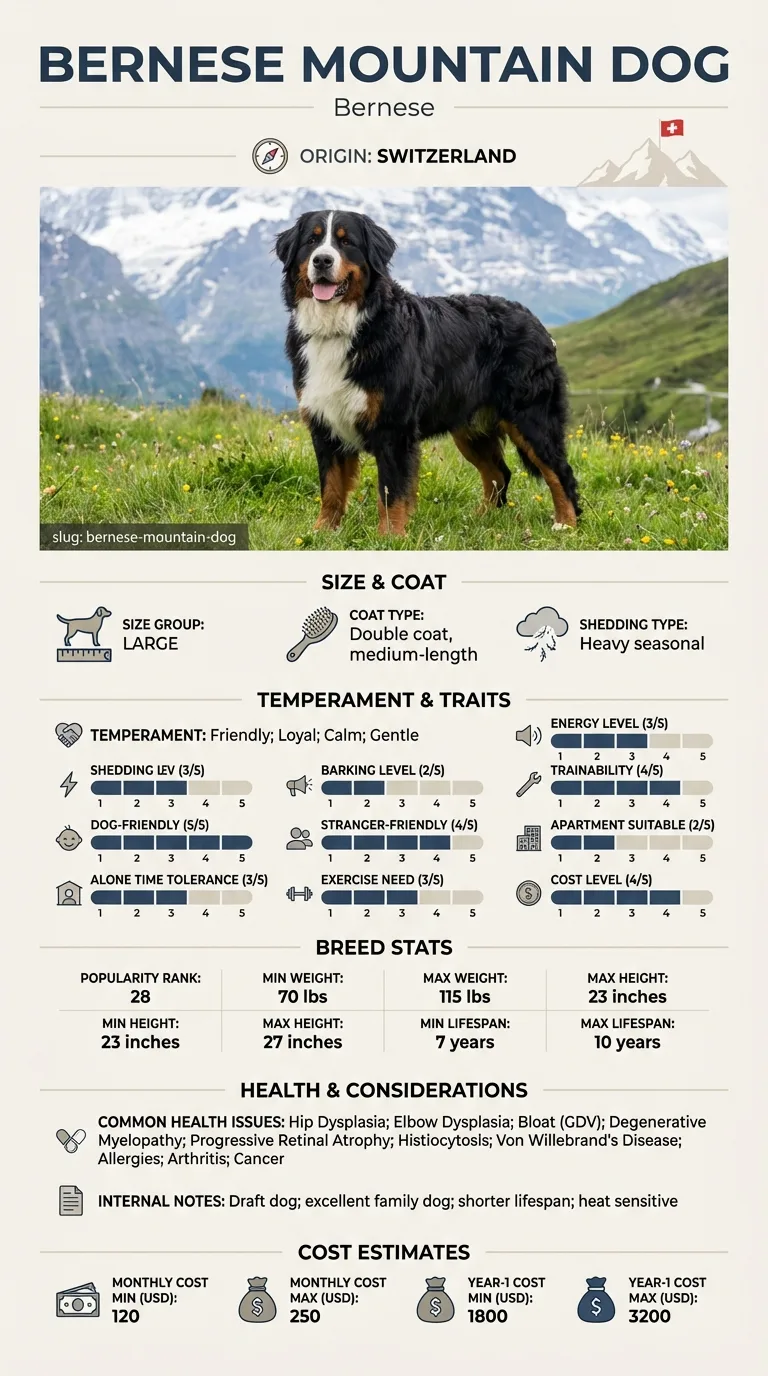
The diagnostic phase, with biopsy and bloodwork, is the expensive part upfront. After that it becomes medication plus regular monitoring bloods, which is a recurring cost. The Bernese is a higher-cost breed to own already, and this sits on top of that baseline.
Crusting or ulcers at the nose, lips, eyelids, pads or nail beds, often with loss of black pigment, and lesions that never fully resolve with antibiotics.
Pale, white or yellow-tinged gums, sudden weakness, dark or orange urine, or pinpoint bruising on the belly. Immune-mediated blood disease is an emergency.
Lift the lip at the side where the tissue is pale, or check the inner eyelid rim. Learn the normal colour now so you can compare later.
Yes, when a lesion is not responding. Without it you may spend more on repeated ineffective treatment than the biopsy would have cost.
Teach a cued pill routine with a reward that follows every time. Long courses fail more often from handling battles than from the drug itself.
A one-page prep sheet for this condition: the signs, the questions to ask, what to get priced. Unlocks here.
You get: Vet visit prep sheet
No spam. One-click unsubscribe. See our privacy policy.
Preview page 1 before you decide.