Health
Is this true BOAS?
No, this breed lacks the flat-faced anatomy behind true BOAS. The relevant senior condition is laryngeal paralysis, a different mechanism.

Quick answer
Is this true BOAS?
No, this breed lacks the flat-faced anatomy behind true BOAS. The relevant senior condition is laryngeal paralysis, a different mechanism.
A senior dog whose breathing has gotten noticeably louder or raspier isn't showing brachycephalic airway syndrome. It's more likely an age-related change in the voice box that's worth its own explanation.

This is most relevant to owners of dogs past eight or nine, when age-related laryngeal changes become more likely, and especially for owners who noticed the change gradually rather than all at once.
This guide is not medical advice. If your dog shows pain, sudden behavior change, or worsening symptoms, consult a licensed veterinarian.
Some links may be affiliate links. We may earn a commission at no extra cost to you. We only suggest products we believe are helpful for dog owners.
We research and check what we publish, but we do not warrant that any figure, date, price, or statement is accurate, complete, or current, and we accept no liability for any loss, cost, injury, or other harm arising from the use of this site. Use it as one reference among several. You remain responsible for your own decisions and for your dog's care - confirm anything that matters with a licensed veterinarian or another qualified professional before you act on it. Full disclaimer.
Check this first
Loud, harsh breathing that suddenly worsens, blue or gray gums, collapse, or a dog that seems to be struggling to get air even at rest are emergencies requiring immediate veterinary care. Dogs with laryngeal paralysis are also at meaningfully higher risk of heatstroke than unaffected dogs, since the condition reduces how efficiently they can move air to cool themselves, so any collapse or severe distress during warm weather should be treated as urgent.
This is genuinely a different condition from true BOAS, which is a fixed structural airway obstruction present from birth in flat-faced breeds. Laryngeal paralysis is typically an acquired, age-related change in the nerves controlling the voice box, and it's diagnosed with a specific exam, often under light sedation, rather than assumed from breathing sounds alone.
If any of these apply, call your vet or an emergency clinic now. The rest of this page is for the cases that are not an emergency.
This term is often searched by owners of senior dogs with noisy or labored breathing, but true BOAS doesn't apply to this breed's normal facial structure. The condition that genuinely fits this picture is laryngeal paralysis, an age-related weakening of the nerves controlling the voice box, common in aging large-breed dogs.
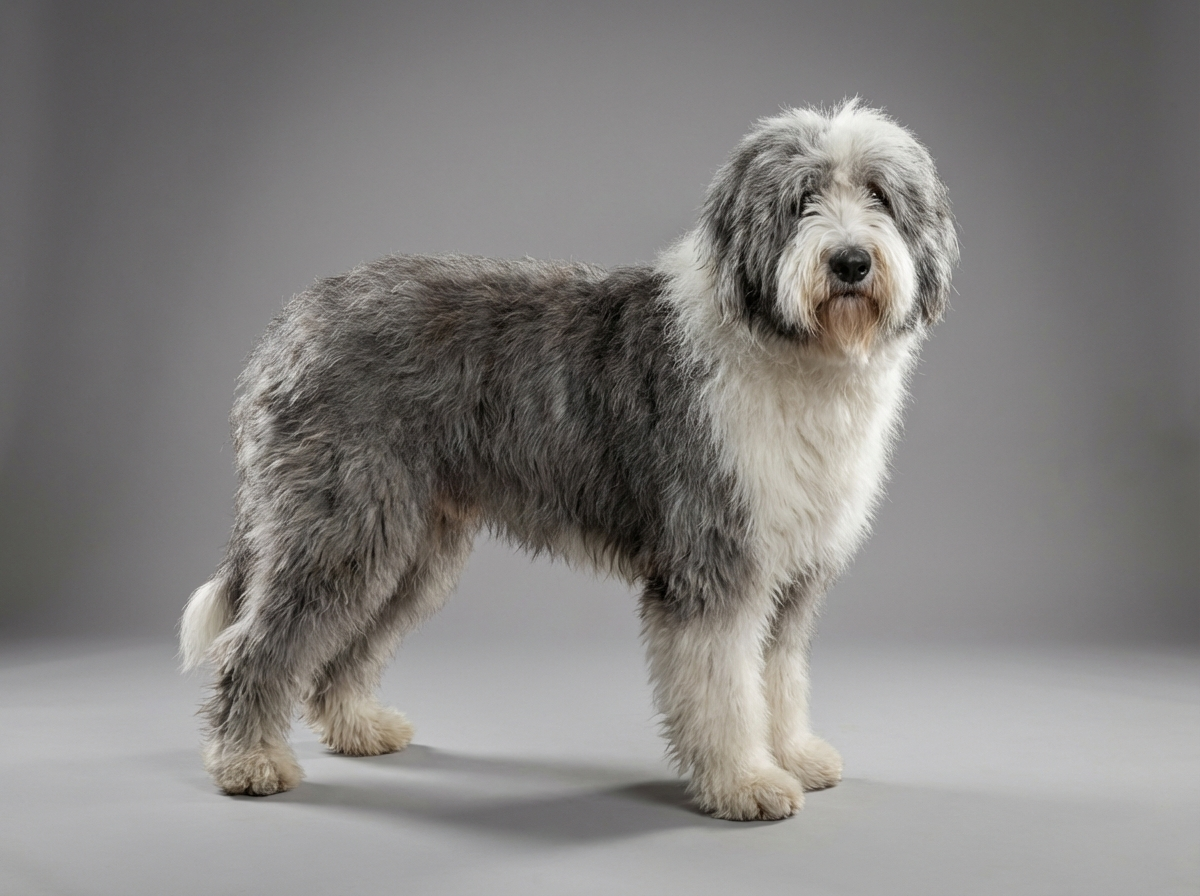
True BOAS does not occur in this breed. Laryngeal paralysis is a recognized, reasonably common condition in aging large-breed dogs generally, making it the far more realistic explanation for noisy senior breathing in an Old English Sheepdog.
This breed's normal, proportionate skull rules out true BOAS. Its status as a large breed does put it in the general category of dogs more commonly affected by age-related laryngeal paralysis, which is more frequently diagnosed in large and giant breeds than in small ones, and this breed's documented hypothyroidism risk is also worth noting, since hormonal dysfunction is sometimes associated with nerve function changes.
Heat and exertion don't cause laryngeal paralysis, but they significantly worsen its practical impact, since an already less-efficient airway has less margin for the added cooling demand that heat and exercise create.
Talk to your vet about a changed bark sound or breathing that's become noisier during exercise or excitement. Seek emergency care for breathing distress at rest, blue or gray gums, or collapse, especially in warm weather.
Because this condition develops gradually in older dogs, it's easy to under- or over-react to it.
See all OLD English Sheepdog health problems, which breeds are prone to brachycephalic obstructive airway syndrome boas, or the full OLD English Sheepdog breed guide for temperament, exercise needs and ownership costs.
Laryngeal paralysis is typically a slowly progressive condition. Many dogs are managed successfully with lifestyle adjustments for months to years; if surgery becomes necessary, recovery typically takes several weeks.
Success looks like a dog that stays comfortable and safe during moderate activity and heat, with symptoms monitored and managed proactively rather than allowed to progress unaddressed.
Samson, a ten-year-old Old English Sheepdog, had always had a deep, booming bark. Over a few months, it became noticeably raspier, though his owner didn't think much of it until his breathing also sounded louder during an evening game of fetch. A vet exam under light sedation confirmed laryngeal paralysis. With exercise moved to cooler parts of the day and closely monitored, Samson continued his normal routine for over a year with the condition managed through lifestyle changes alone, no surgery needed.
Key takeaway: A changing bark can be the earliest, easiest-to-miss sign of this condition, well worth mentioning at a vet visit even before breathing itself sounds obviously different.
No, true BOAS requires the flat-faced skull structure this breed doesn't have. What can develop in aging large dogs is a separate condition, laryngeal paralysis, which can sound similar but has a different cause and diagnosis.
It's a condition where the nerves controlling the muscles that open the voice box (larynx) during breathing weaken or stop working properly, over time restricting airflow, especially during exertion or excitement. It's most common in older large-breed dogs.
A change in bark sound, becoming raspier or weaker, along with louder or harsher-sounding breathing during exercise or excitement, often before any obvious struggle is visible at rest.
Typically with a specific exam under light sedation that allows the vet to directly observe whether the voice box opens normally during breathing, since it can't be reliably assessed just by listening from outside.
No. Many mild to moderate cases are managed for a considerable time with lifestyle changes like heat avoidance and weight management. Surgery is generally reserved for more severe cases significantly affecting quality of life.
The affected airway moves air less efficiently, which directly reduces a dog's ability to cool down through panting, making heatstroke a much higher risk for affected dogs than for unaffected ones of the same breed.
No, that's a different structural condition affecting the windpipe, mostly in small breeds. Laryngeal paralysis affects the voice box specifically and is more typically seen in aging large-breed dogs like this one.
No, this breed lacks the flat-faced anatomy behind true BOAS. The relevant senior condition is laryngeal paralysis, a different mechanism.
A raspier or weaker bark, often before noisy breathing during exercise becomes obvious.
Yes, affected dogs cool down less efficiently and are at higher risk of heatstroke, so heat management becomes more important.
No, many cases are managed with lifestyle adjustments for a considerable time before surgery, if it's ever needed, is considered.
With a specific exam under light sedation to directly observe the voice box during breathing.
A one-page prep sheet for this condition: the signs, the questions to ask, what to get priced. Unlocks here.
You get: Vet visit prep sheet
No spam. One-click unsubscribe. See our privacy policy.
Preview page 1 before you decide.