Health
How is this different from a sudden collapse?
This is a gradual decline in stamina over weeks to months, not a sudden dramatic event during exercise.

Quick answer
How is this different from a sudden collapse?
This is a gradual decline in stamina over weeks to months, not a sudden dramatic event during exercise.
A dog that gradually wants to do less, rather than one that collapses dramatically, is telling you something different, and it's worth figuring out which of a few realistic explanations actually fits.
This is most relevant to owners who've noticed a gradual decline in their dog's enthusiasm for walks or play, especially in middle-aged to senior dogs where several of this breed's documented conditions become more likely.
This guide is not medical advice. If your dog shows pain, sudden behavior change, or worsening symptoms, consult a licensed veterinarian.
Some links may be affiliate links. We may earn a commission at no extra cost to you. We only suggest products we believe are helpful for dog owners.
We research and check what we publish, but we do not warrant that any figure, date, price, or statement is accurate, complete, or current, and we accept no liability for any loss, cost, injury, or other harm arising from the use of this site. Use it as one reference among several. You remain responsible for your own decisions and for your dog's care - confirm anything that matters with a licensed veterinarian or another qualified professional before you act on it. Full disclaimer.
Check this first
Gradual, mild reduction in exercise tolerance over weeks to months is not an emergency and is well-suited to a routine vet visit with bloodwork and a joint exam. A sudden, dramatic collapse during exercise is a different, acute presentation requiring immediate veterinary attention, discussed separately, rather than gradual intolerance.
Pale or bluish gums, labored breathing at rest, or fainting alongside reduced exercise tolerance are signs that warrant prompt attention sooner than a routine visit, since they suggest a more significant underlying issue than simple fatigue or joint discomfort.
If any of these apply, call your vet or an emergency clinic now. The rest of this page is for the cases that are not an emergency.
Exercise intolerance in this breed is a gradual decline in stamina and enthusiasm for activity, distinct from a sudden collapse event. The most realistic causes trace to this breed's two documented conditions, hip dysplasia and hypothyroidism, along with simple heat sensitivity from its heavy double coat.
Given this breed's two separately documented conditions that both commonly cause reduced activity tolerance, gradual exercise intolerance is a fairly common concern by middle age and beyond.
This breed carries two separately documented conditions that both commonly reduce exercise tolerance through very different mechanisms: hip dysplasia, causing joint discomfort during activity, and hypothyroidism, causing general metabolic fatigue. Its dense double coat adds a third, heat-related factor on top of both.
Warm weather, excess body weight, and hard exercise surfaces all compound whichever underlying cause is present, making environmental adjustments a genuinely useful part of managing exercise intolerance regardless of the root cause.
Talk to your vet about a gradual decline in exercise tolerance over weeks to months. Seek prompt care for pale or bluish gums, labored breathing at rest, or fainting alongside reduced tolerance.
Because several different documented conditions in this breed can all present as reduced activity tolerance, jumping to one explanation without checking the others can delay the right diagnosis.
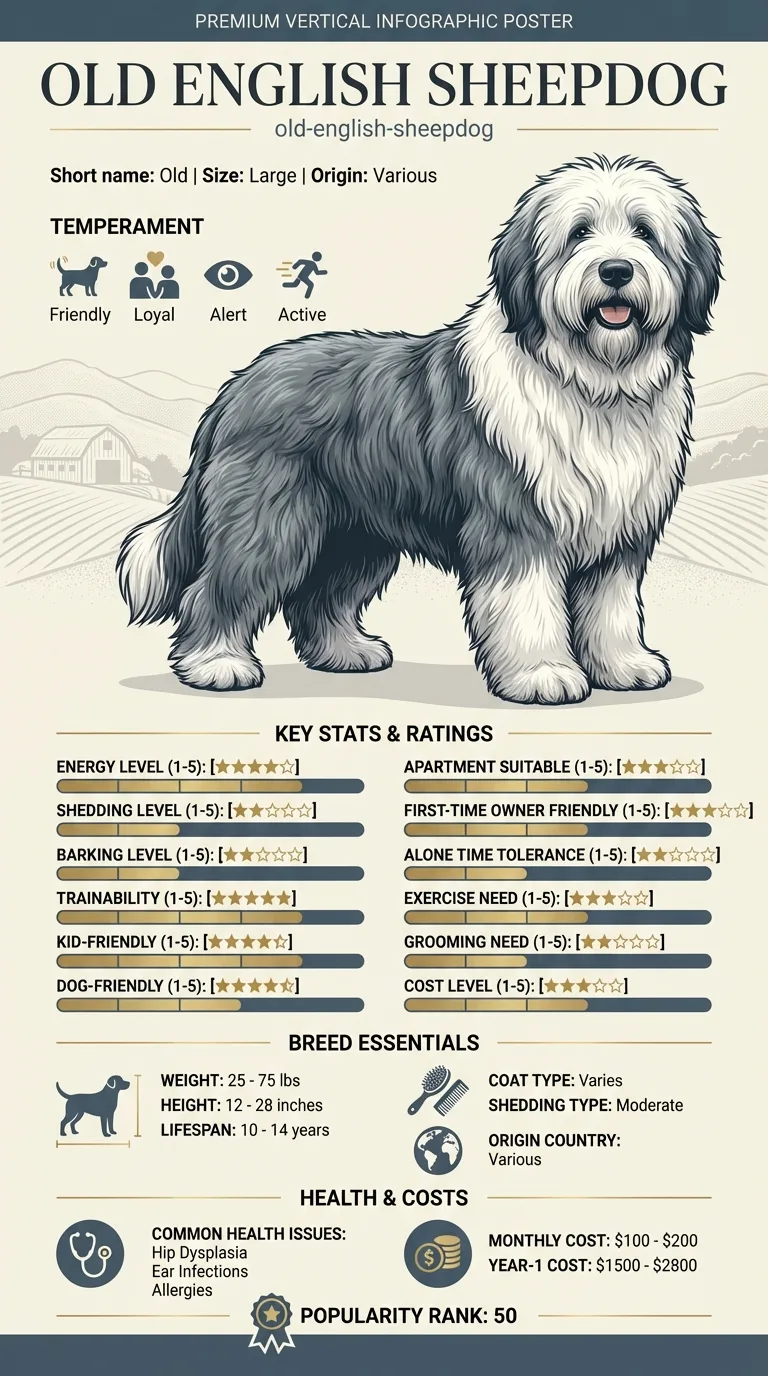
See all OLD English Sheepdog health problems, which breeds are prone to exercise intolerance, or the full OLD English Sheepdog breed guide for temperament, exercise needs and ownership costs.
A diagnostic workup, joint exam and bloodwork, typically resolves into a clear picture within a single vet visit. Improvement, once an underlying cause is treated, generally takes a few weeks to a couple of months depending on the specific condition.
Success looks like identifying which of this breed's realistic causes is actually driving the decline, and seeing stamina and enthusiasm improve once that specific cause is properly managed.
Murphy, an eight-year-old Old English Sheepdog, had gradually gone from eager on his daily walks to stopping and sitting down partway through. His owner assumed it was his hips, given the breed's documented dysplasia risk, and requested joint X-rays. The X-rays showed only mild changes that didn't fully explain his decline, so his vet also ran bloodwork, which revealed an underactive thyroid. Once thyroid treatment started, Murphy's stamina noticeably improved within about six weeks, alongside a modest joint supplement for the mild arthritis that was present but hadn't been the whole story.
Key takeaway: This breed has two well-documented, very different reasons for reduced stamina. Checking both, rather than assuming one, gets to the full picture faster.
Exercise-induced collapse is a sudden, dramatic event during or right after intense activity. Exercise intolerance is a gradual pattern of reduced stamina and enthusiasm over weeks to months, a meaningfully different presentation with different likely causes.
This breed's documented hip dysplasia, leading to joint discomfort, and documented hypothyroidism, causing general fatigue, are the two most realistic explanations, along with simple heat sensitivity from the heavy double coat.
Joint-related intolerance often worsens with specific activities like jumping or stairs and may improve somewhat with rest. Thyroid-related fatigue tends to be more constant and often comes with other signs like weight gain or coat changes. A vet exam and bloodwork can distinguish the two more reliably than guessing.
Yes, this breed's heavy coat makes heat-related intolerance a real and common factor, especially in warm weather, though it's worth ruling out joint and thyroid causes too, especially if intolerance persists in cool weather.
Not entirely; modified, appropriate exercise remains valuable for most causes of exercise intolerance. Complete inactivity can worsen weight gain and joint conditioning, making the underlying issue harder to manage.
A physical and joint exam, bloodwork including thyroid testing, and sometimes X-rays if joint disease is suspected, together give a fairly complete picture of the likely cause.
It's more common in middle-aged and senior dogs given the conditions involved, but any of these causes can technically occur earlier, which is why investigating rather than assuming 'just aging' matters.
This is a gradual decline in stamina over weeks to months, not a sudden dramatic event during exercise.
This breed's documented hip dysplasia and documented hypothyroidism are the two most realistic explanations.
Yes, this breed's heavy coat makes heat sensitivity a real factor, though other causes are worth ruling out too.
No, modified rather than eliminated exercise is usually the better approach for most underlying causes.
A joint exam, bloodwork including thyroid testing, and possibly X-rays.
A one-page prep sheet for this condition: the signs, the questions to ask, what to get priced. Unlocks here.
You get: Vet visit prep sheet
No spam. One-click unsubscribe. See our privacy policy.
Preview page 1 before you decide.