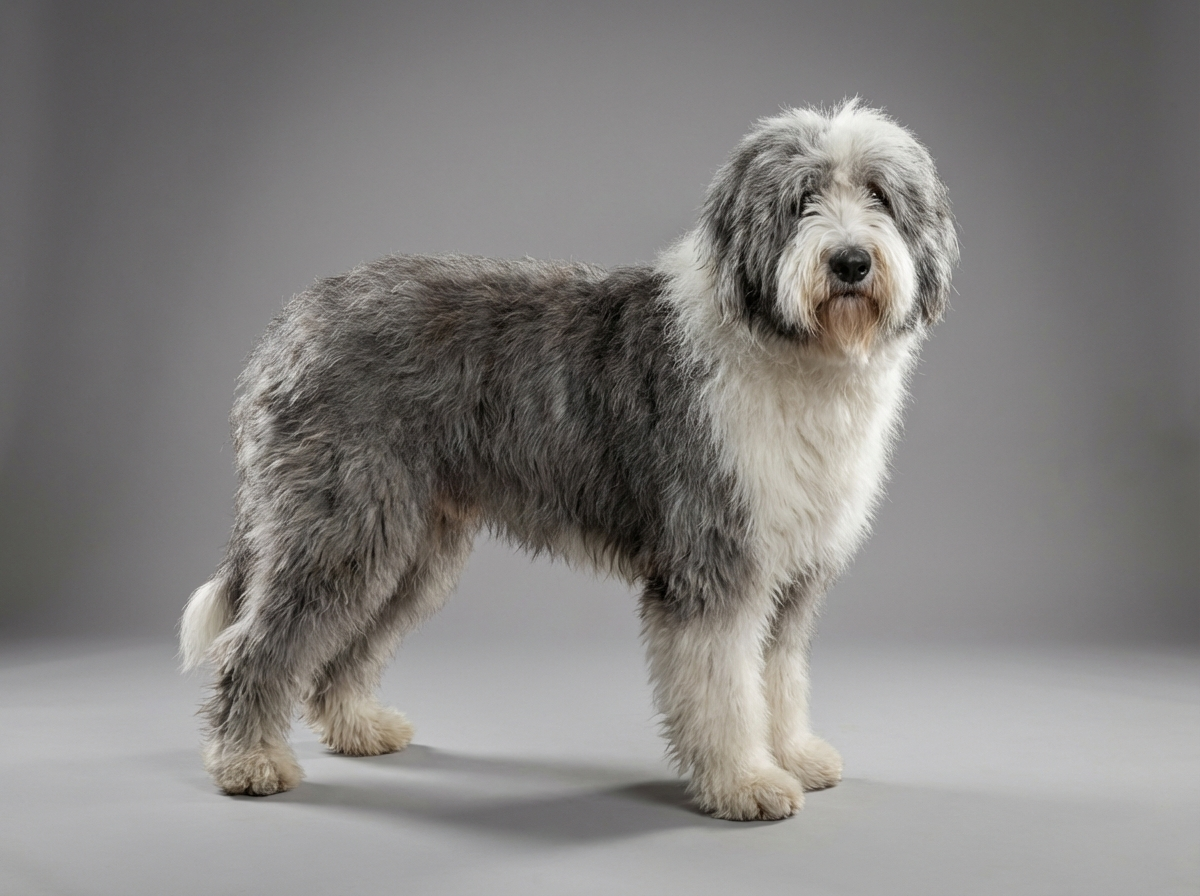
Health
Is this breed brachycephalic?
No, Old English Sheepdogs have a normal, proportionate muzzle and are not a brachycephalic breed.

Quick answer
Is this breed brachycephalic?
No, Old English Sheepdogs have a normal, proportionate muzzle and are not a brachycephalic breed.
If your Old English Sheepdog is panting hard and seems to be struggling to breathe on a warm day, it's very unlikely to be BOAS. It's far more likely to be heat stress from a coat built for cold pastures, not summer sidewalks.
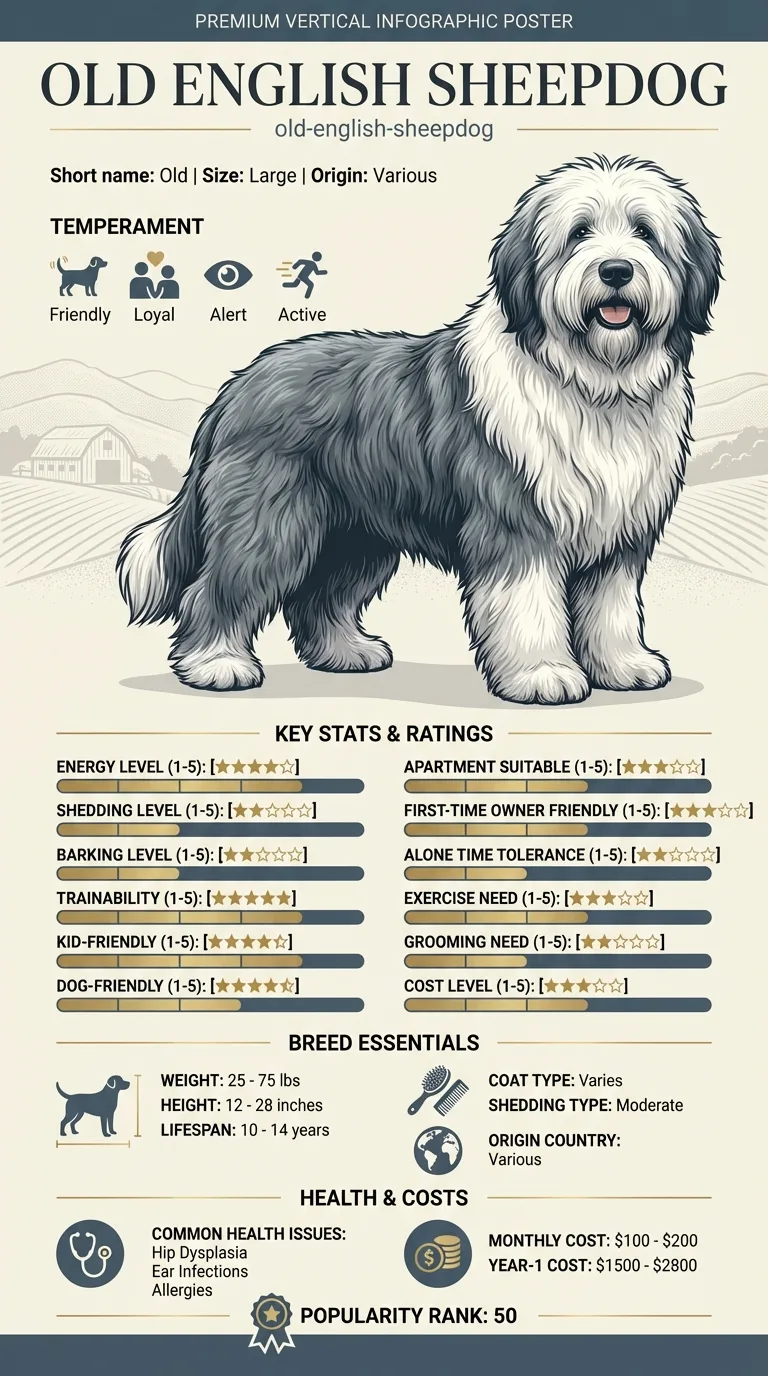
This affects owners exercising their dog in warm weather, and anyone who's read a generic breathing-problem checklist and isn't sure whether the flat-faced-breed warnings apply to their long-muzzled dog.
This guide is not medical advice. If your dog shows pain, sudden behavior change, or worsening symptoms, consult a licensed veterinarian.
Some links may be affiliate links. We may earn a commission at no extra cost to you. We only suggest products we believe are helpful for dog owners.
We research and check what we publish, but we do not warrant that any figure, date, price, or statement is accurate, complete, or current, and we accept no liability for any loss, cost, injury, or other harm arising from the use of this site. Use it as one reference among several. You remain responsible for your own decisions and for your dog's care - confirm anything that matters with a licensed veterinarian or another qualified professional before you act on it. Full disclaimer.
Check this first
Heavy panting that doesn't slow down with rest and shade, bright red or purple gums, wobbliness, vomiting, or collapse during or after exercise in warm weather are signs of heat stress progressing toward heatstroke, a genuine emergency requiring immediate cooling and veterinary care.
Because this breed is not brachycephalic, the specific anatomical airway obstruction that makes true BOAS dogs collapse from breathing alone, without heat as a factor, isn't the underlying mechanism here. That's actually useful information for your vet: if your dog is struggling to breathe, heat and exertion are the more likely drivers to investigate first, alongside ruling out other causes like a cardiac or other underlying issue if it happens even in cool weather at rest.
If any of these apply, call your vet or an emergency clinic now. The rest of this page is for the cases that are not an emergency.
True BOAS is a structural airway condition specific to flat-faced, brachycephalic breeds, which Old English Sheepdogs are not. What owners of this breed actually encounter is heat-driven breathing distress during exercise, caused by a dense double coat that traps body heat, a real but mechanically different problem from BOAS.
True BOAS does not occur in this breed. Heat-driven breathing distress during exercise in warm weather is a genuinely common concern for heavily-coated breeds generally, including this one.
This breed's normal, proportionate skull and muzzle mean it lacks the anatomical airway restrictions that cause true BOAS in flat-faced breeds. What it does have is a dense double coat, originally suited to cold, working conditions, that traps body heat efficiently, which becomes a liability during exercise in warm weather.
Warm or humid weather, exercise during peak daytime heat, and a poorly maintained or matted coat all combine to make heat dissipation harder for this breed specifically.
Talk to your vet if labored breathing occurs at rest or in cool weather unrelated to exertion. Seek emergency care immediately for panting that doesn't ease with rest and shade, bright red or purple gums, wobbliness, vomiting, or collapse during or after heat exposure.
Because the underlying issue here is heat and coat insulation rather than skull structure, the mistakes that matter most are different from true BOAS management.
See all OLD English Sheepdog health problems, which breeds are prone to brachycephalic airway syndrome boas, or the full OLD English Sheepdog breed guide for temperament, exercise needs and ownership costs.
Mild heat stress typically resolves within 15-30 minutes of rest, shade, and water. True heatstroke requires immediate veterinary treatment and recovery can take several days depending on severity.
Success looks like exercise scheduled around cooler hours, a well-maintained coat, and a dog that never progresses past mild, easily-resolved panting during activity.
If you think your Old has brachycephalic airway syndrome (boas), the plan is three steps: write down what you have seen and when it started, book a veterinary appointment rather than waiting for the next flare, and take video of the behaviour or symptom before you go — the thing you are worried about rarely happens in the consulting room. Screening in the parents covers hip dysplasia, cataracts, hypothyroidism.
What the vet visit should produce is a diagnosis and a written plan, not just reassurance: what is being ruled out, what the monitoring interval is, and which signs mean you come back sooner. Ask what the treatment costs across a year rather than per visit, because that is the number that decides whether you are managing this condition or reacting to it.
Between appointments, keep a short log — dates, what you saw, what changed. It is the single most useful thing an owner brings to a follow-up, and for brachycephalic airway syndrome (boas) it is often what separates a clear pattern from a guess.
Chief, a four-year-old Old English Sheepdog, was playing fetch at noon on a warm summer day when his panting turned heavy and he started moving more slowly, eventually lying down and refusing to get up. His owner, having read that flat-faced breeds struggle with breathing, worried it was a structural airway problem. At the emergency vet, it became clear Chief's issue was heat stress, not a structural airway condition his breed doesn't have. He was cooled and monitored, recovering within a few hours. His owner switched all warm-weather exercise to early mornings and evenings going forward.
Key takeaway: In this breed, breathing trouble during exercise is almost always about heat and coat, not skull shape. Fixing the schedule, not the anatomy, is what actually prevents it.
No, true brachycephalic obstructive airway syndrome is tied to the flat, shortened skull structure of breeds like Bulldogs and Pugs. Old English Sheepdogs have a normal, proportionate muzzle and aren't a brachycephalic breed.
This is much more likely to be heat-driven breathing distress from this breed's dense double coat trapping body heat, rather than a structural airway problem. The coat that keeps them warm working outdoors in cold climates works against them in summer heat.
Normal panting eases with rest, shade, and water within a few minutes. Panting that stays heavy, becomes noisier, or is paired with bright red gums, wobbliness, or reluctance to keep moving points toward overheating rather than ordinary exercise panting.
A well-maintained, properly de-shedded coat, rather than a matted or overly thick one, allows better airflow to the skin and can help with heat regulation, though the double coat itself shouldn't be shaved down to the skin, which can affect its natural insulating and protective function.
Early morning or evening, when temperatures are lower, is generally safer for this breed than midday heat, especially for any sustained activity.
Yes, if it progresses without intervention, it can develop into heatstroke, which is a genuine medical emergency requiring immediate cooling and veterinary treatment.
Labored breathing at rest in cool weather, unrelated to exercise or heat, is less likely to be heat-driven and deserves a vet visit to rule out other causes, since this breed's usual breathing-distress pattern is tied to heat and exertion rather than anatomy.
No, Old English Sheepdogs have a normal, proportionate muzzle and are not a brachycephalic breed.
Heat trapped by the dense double coat during exercise, not a structural airway defect.
Early morning or evening, avoiding the hottest part of the day.
Heavy panting that doesn't ease with rest and shade, bright red gums, wobbliness, or collapse.
Regular de-shedding and trimming helps more than shaving to the skin, which can interfere with the coat's natural function.
A one-page prep sheet for this condition: the signs, the questions to ask, what to get priced. Unlocks here.
You get: Vet visit prep sheet
No spam. One-click unsubscribe. See our privacy policy.
Preview page 1 before you decide.