Health
What does gastropexy actually prevent?
The stomach twisting (volvulus), not gas buildup (bloat) itself.

Quick answer
What does gastropexy actually prevent?
The stomach twisting (volvulus), not gas buildup (bloat) itself.
Deciding whether to prevent an emergency you haven't had yet is a different kind of decision than reacting to one, and it deserves its own deliberate thought process.
This is most relevant to owners of young to middle-aged dogs weighing a purely elective procedure, often alongside a spay, neuter, or another planned surgery, before bloat has ever become a real, in-the-moment concern.
This guide is not medical advice. If your dog shows pain, sudden behavior change, or worsening symptoms, consult a licensed veterinarian.
Some links may be affiliate links. We may earn a commission at no extra cost to you. We only suggest products we believe are helpful for dog owners.
We research and check what we publish, but we do not warrant that any figure, date, price, or statement is accurate, complete, or current, and we accept no liability for any loss, cost, injury, or other harm arising from the use of this site. Use it as one reference among several. You remain responsible for your own decisions and for your dog's care - confirm anything that matters with a licensed veterinarian or another qualified professional before you act on it. Full disclaimer.
Check this first
This page focuses on the proactive, non-urgent decision of whether to pursue preventive surgery. If you are currently watching a dog with a firm or distended abdomen, unproductive retching, or restlessness after a meal, stop reading this page and go to an emergency vet immediately; that is a different, time-critical situation covered in detail elsewhere.
The value of thinking through the gastropexy decision now, while there's no urgency, is precisely that it removes the need to make a rushed, high-stakes decision later, during an actual emergency, about a related but separate surgical question.
If any of these apply, call your vet or an emergency clinic now. The rest of this page is for the cases that are not an emergency.
This page addresses the proactive decision of whether to pursue a preventive gastropexy given this breed's documented bloat risk, distinct from recognizing or treating an active bloat emergency, which is covered separately. It's an elective, forward-looking conversation rather than a reactive one.
Bloat itself is documented among this breed's common health issues, making the preventive gastropexy conversation a genuinely relevant one for many owners of this breed, even though pursuing the procedure remains an individual choice.
This breed's documented bloat risk, tied to its large, deep-chested build, is the underlying reason this preventive procedure is worth considering here specifically, more so than it would be for a small or shallow-chested breed without that documented risk.
Cost, timing alongside other planned procedures, and individual owner risk tolerance are the practical, non-medical factors that most influence when and whether this elective decision is made.
Talk to your vet at a routine wellness visit about whether preventive gastropexy makes sense for your specific dog, ideally well before any planned surgery where it could be combined.
This is a genuinely personal decision, but a few common reasoning errors are worth avoiding either direction.
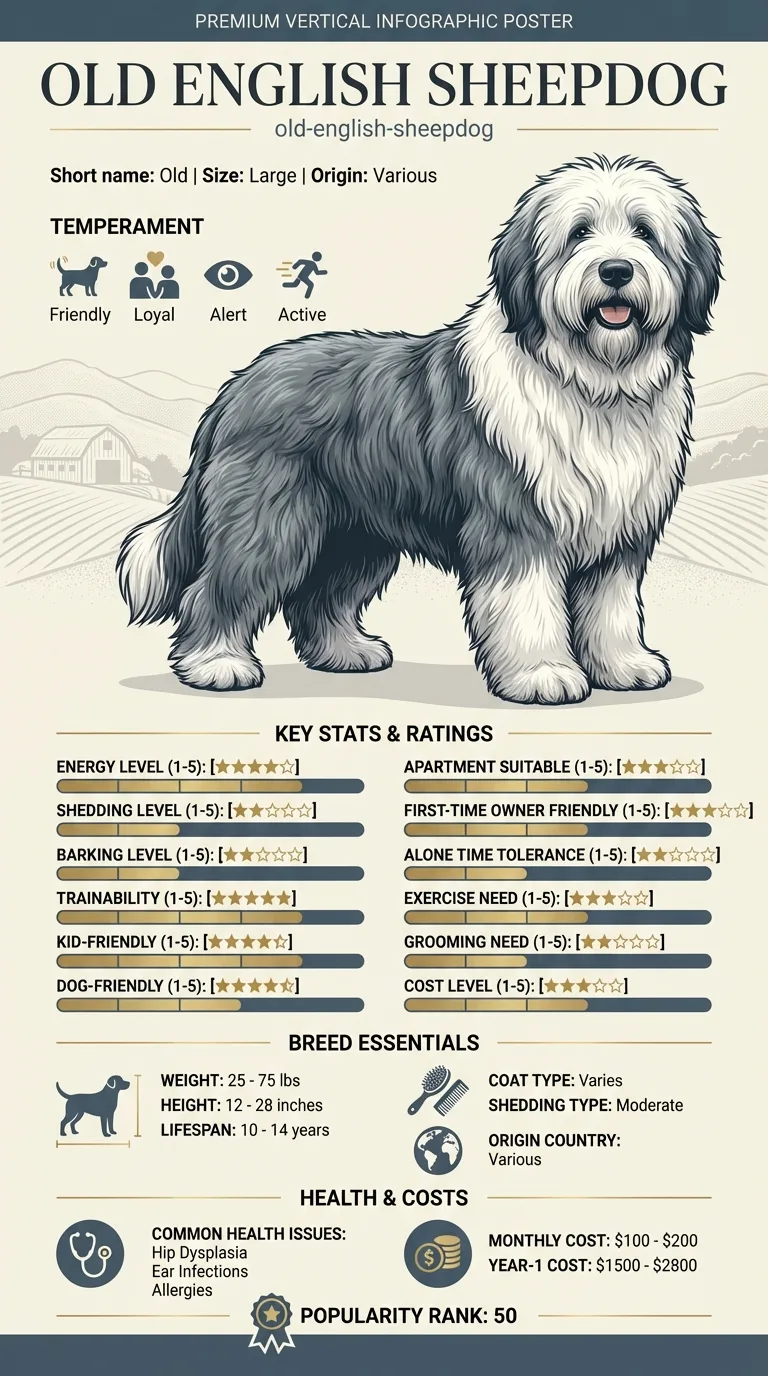
See all OLD English Sheepdog health problems, which breeds are prone to gastric dilatation volvulus gdvbloat, or the full OLD English Sheepdog breed guide for temperament, exercise needs and ownership costs.
This is a decision that can be made at any routine visit, with the procedure itself typically requiring a standard surgical recovery period of one to two weeks if pursued as a stand-alone surgery, or the same recovery as the combined procedure if done alongside another surgery.
Success looks like a deliberate, informed decision made proactively, whichever way it goes, rather than the question only coming up for the first time during an actual emergency.
Willa's owner had read about this breed's documented bloat risk and asked her vet about preventive gastropexy well before her scheduled spay surgery. Her vet confirmed it could be added during the same procedure, with a modest additional cost and no separate anesthesia event required. Willa's owner went ahead, and while she still follows sensible feeding practices, the higher-stakes twist scenario is no longer something she has to worry about happening to Willa specifically.
Key takeaway: Raising this question before a planned surgery, rather than after a scare, often makes it a simpler, more efficient decision than it would otherwise be.
It prevents the stomach from twisting (volvulus), the part of bloat that cuts off blood supply and makes it rapidly life-threatening. It doesn't prevent the stomach from filling with gas (bloat) in the first place.
Given the documented bloat risk in this breed, it's a reasonable option to discuss with your vet, who can help weigh your specific dog's individual risk factors alongside the general breed-level documented risk.
Many owners choose to have it done alongside another already-planned surgery, such as a spay or neuter, since this can reduce the additional cost and anesthesia exposure compared to a separate, stand-alone procedure.
Costs vary by region and whether it's combined with another surgery, but as a stand-alone procedure it often runs from several hundred to over a thousand dollars, generally less when combined with an already-planned surgery.
It significantly reduces the most dangerous outcome (the twist), but sensible feeding practices remain worthwhile regardless, since gas buildup itself can still occur.
It's a well-established procedure with a good safety record when performed by an experienced veterinary surgeon, though as with any surgery, it carries the general risks associated with anesthesia and any operation.
This is exactly the kind of situation worth raising with your vet, since adding a gastropexy during an already-planned abdominal procedure is often more efficient than doing it as a separate surgery later.
The stomach twisting (volvulus), not gas buildup (bloat) itself.
Yes, given the documented bloat risk, it's worth a conversation with your vet about your dog's individual risk factors.
Often alongside another already-planned surgery like a spay or neuter.
Several hundred to over a thousand dollars stand-alone, often less when combined with another procedure.
No, sensible feeding practices remain worthwhile even after the procedure.
A one-page prep sheet for this condition: the signs, the questions to ask, what to get priced. Unlocks here.
You get: Vet visit prep sheet
No spam. One-click unsubscribe. See our privacy policy.
Preview page 1 before you decide.