Health
What's the earliest sign of PRA in a dog?
Reduced night vision, such as new hesitation in dim lighting or at dusk, is almost always the first noticeable sign.

Quick answer
What's the earliest sign of PRA in a dog?
Reduced night vision, such as new hesitation in dim lighting or at dusk, is almost always the first noticeable sign.
A dog losing night vision first and daytime vision much later means an owner might not notice anything is wrong for a long stretch, simply because the dog is still navigating a brightly lit living room just fine.
Owners noticing new hesitance in dim lighting or at dusk, and owners processing a confirmed diagnosis trying to understand what the actual timeline to full blindness looks like.
This guide is not medical advice. If your dog shows pain, sudden behavior change, or worsening symptoms, consult a licensed veterinarian.
Some links may be affiliate links. We may earn a commission at no extra cost to you. We only suggest products we believe are helpful for dog owners.
We research and check what we publish, but we do not warrant that any figure, date, price, or statement is accurate, complete, or current, and we accept no liability for any loss, cost, injury, or other harm arising from the use of this site. Use it as one reference among several. You remain responsible for your own decisions and for your dog's care - confirm anything that matters with a licensed veterinarian or another qualified professional before you act on it. Full disclaimer.
Progressive retinal atrophy is a genetic condition causing gradual, painless degeneration of the retina's light-sensing cells, typically starting with night vision loss and progressing over months to years toward full blindness. It's an irreversible condition with no current cure, but most affected dogs adapt remarkably well to gradual vision loss, particularly with consistent home layout and routine support from their owners.
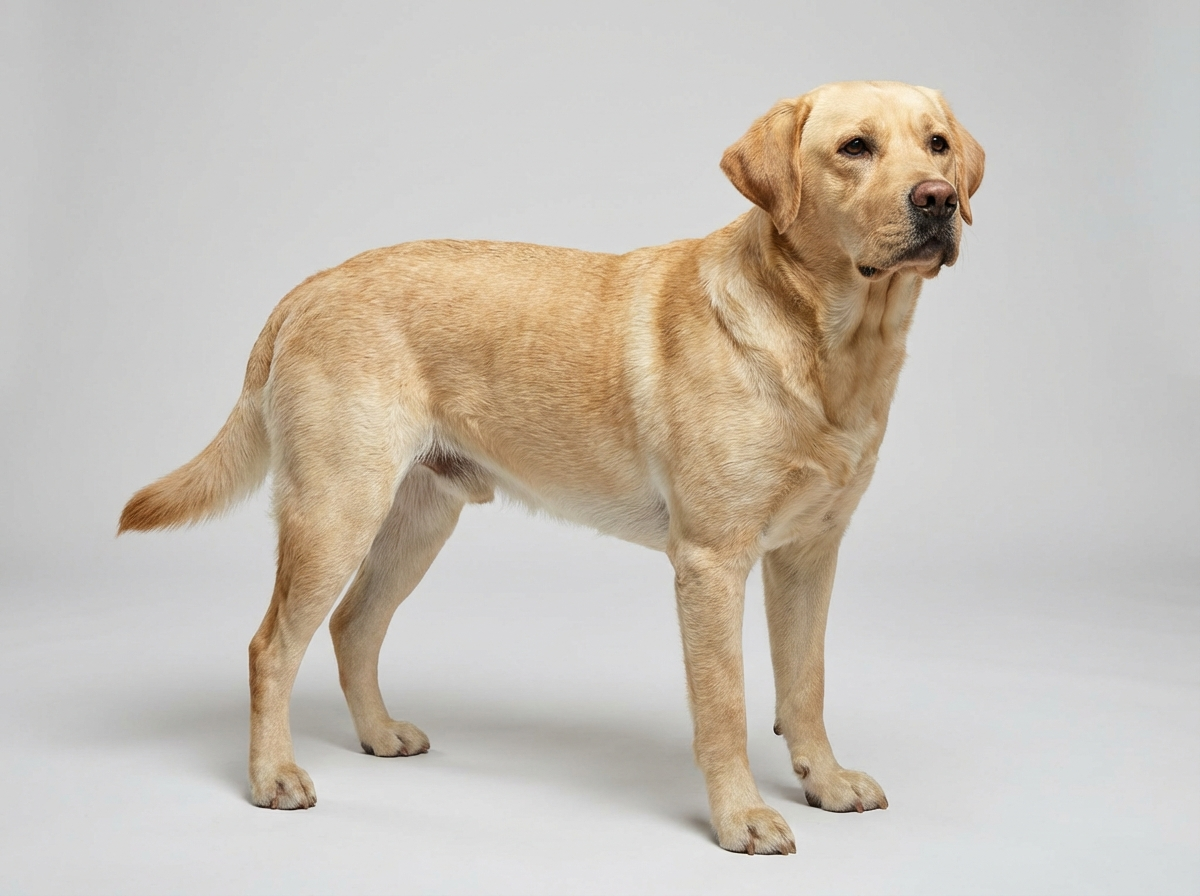
PRA is a well-documented inherited condition in Labrador Retrievers, common enough that responsible breeders test for known genetic markers where testing is available, though not every form has an identified genetic test yet.
Labradors carry documented genetic predisposition toward certain forms of PRA, which is why breed health organizations track and, where possible, test for known markers in this breed specifically. Their long 10 to 12 year lifespan means the gradual degeneration this condition causes has ample time to progress from an early, barely noticeable stage to more significant vision loss over the course of the dog's life.
There's no significant environmental trigger for PRA — it's a primarily genetic condition that progresses on its own timeline regardless of diet, lighting exposure, or general care, which distinguishes it from conditions where lifestyle factors meaningfully influence onset or severity.
Schedule an eye exam for any new hesitance in dim lighting, increased bumping into objects, or reluctance to go outside at dusk — this isn't an emergency, but early diagnosis helps you plan ahead for the adaptation process rather than being caught off guard by faster-than-expected progression.
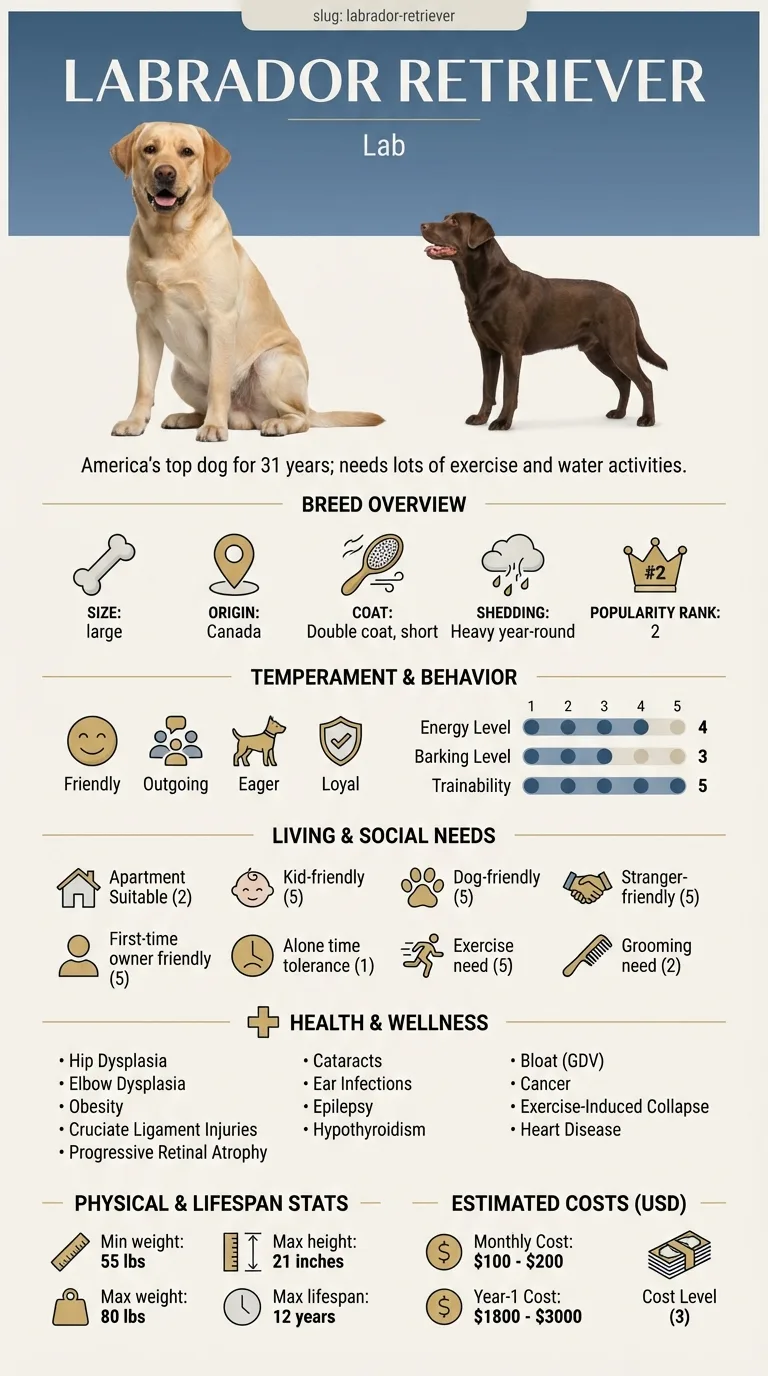
See all Labrador Retriever health problems, which breeds are prone to progressive retinal atrophy pra, or the full Labrador Retriever breed guide for temperament, exercise needs and ownership costs.
Progression from early night-vision loss to significant daytime vision decline commonly spans one to several years, though the exact pace varies by individual dog and specific genetic form involved. There's no treatment timeline in the traditional sense, since this is a condition to adapt to rather than treat toward resolution.
Success means a confident, well-adapted dog navigating a familiar environment despite vision loss, continuing to enjoy walks, play, and daily routines — not restored vision, since no current treatment reverses the underlying retinal degeneration.
PRA affects the rod cells in the retina before the cone cells, and rods are specifically responsible for vision in low light, which is exactly why the earliest sign is almost always reduced night vision — hesitating at the top of dark stairs, becoming reluctant to go outside at dusk, or bumping into furniture only when the lights are dim. Daytime vision, which relies more on cone cells, is typically preserved much longer, sometimes for a year or more after night vision has clearly declined.
As the condition progresses, cone cell function eventually declines too, and daytime vision gradually deteriorates in the same way, usually over a longer timeline than the initial rod-driven night blindness. Full blindness is the eventual endpoint for most confirmed PRA cases, though the pace varies significantly between individual dogs and between the specific genetic forms of PRA involved.
Diagnosis is typically confirmed through an electroretinogram (ERG), which measures retinal electrical activity directly, sometimes alongside genetic testing if a known mutation has been identified for the specific form involved. There's no treatment that reverses or halts the degeneration itself, which shifts the practical focus toward supporting the dog through a gradual adaptation process rather than searching for a cure.

Since there's no way to stop the progression, the practical focus shifts to supporting the dog's confidence as vision changes.
Owner Devon first noticed his four-year-old Lab, Scout, pausing unusually long at the top of the basement stairs each evening before finally continuing down, though Scout showed no hesitation at all during the day. An eye exam and ERG confirmed early-stage PRA affecting his rod cells first, exactly as expected for the condition. Devon added a night light near the stairs and kept the house layout consistent going forward. Over the following eighteen months, Scout's daytime vision gradually declined too, and by his sixth birthday he was functionally blind — but remained a confident, happy dog navigating the house and yard by memory and scent, still enjoying his daily walks on familiar routes.
Key takeaway: A dog that hesitates specifically in dim light while acting completely normal during the day is showing a textbook early PRA pattern, worth an eye exam even though the daytime behavior looks entirely unremarkable.
Reduced night vision is almost always the earliest sign, showing up as hesitation on stairs in dim light, reluctance to go outside at dusk, or bumping into furniture only when lighting is low, since rod cells responsible for night vision are affected first.
Progression varies significantly between individual dogs and specific genetic forms, but it typically unfolds over months to a few years, usually starting with night vision loss and later progressing to daytime vision decline and eventually full blindness.
No, PRA is not a painful condition — it's a gradual, painless degeneration of the retina's light-sensing cells, which is part of why it can go unnoticed by owners for longer than more obviously symptomatic conditions.
An electroretinogram (ERG), which measures the retina's electrical response to light, is the standard diagnostic test, sometimes combined with genetic testing if a known mutation has been identified for the specific form of PRA suspected.
No, there's currently no treatment that reverses or halts the retinal degeneration in most forms of PRA. Management focuses on supporting the dog's adaptation to gradual vision loss rather than restoring vision.
Yes, generally very well, especially when the loss is gradual as it is with PRA, since dogs rely heavily on smell, hearing, and memory of familiar spaces, allowing many affected dogs to continue normal daily activities with some adjustment.
For forms of PRA with an identified genetic marker, testing breeding stock before pairing can meaningfully reduce the risk of producing affected puppies, though not every form of PRA has a known genetic test available yet.
Reduced night vision, such as new hesitation in dim lighting or at dusk, is almost always the first noticeable sign.
No, it's a painless, gradual degeneration of the retina rather than a source of physical discomfort.
No, there's currently no treatment that reverses or halts progression in most forms of PRA.
Generally very well, relying on smell, hearing, and memory of familiar spaces, especially with a gradual progression like PRA.
An electroretinogram (ERG), which measures the retina's electrical response to light, is the standard diagnostic test.
A one-page prep sheet for this condition: the signs, the questions to ask, what to get priced. Unlocks here.
You get: Vet visit prep sheet
No spam. One-click unsubscribe. See our privacy policy.
Preview page 1 before you decide.
Early access list
The free prep sheet covers the same-day warning signs, a symptom log and the questions to ask. We are considering a fuller kit that adds a cost worksheet for the usual tests and treatments (US price ranges with their sources) and a plain-English guide to ways of covering the bill. It is not built yet; this list tells us whether it is worth building.
One email, no spam, unsubscribe anytime. Information only, not veterinary advice.