Health
What's the earliest sign of PRA?
Difficulty seeing in low light or at night, often noticed before any daytime vision problems.

Quick answer
What's the earliest sign of PRA?
Difficulty seeing in low light or at night, often noticed before any daytime vision problems.
A dog that's started bumping into furniture at dusk, or that seems suddenly reluctant to go down dark hallways, may be showing the earliest sign of a slow, genetic loss of vision.
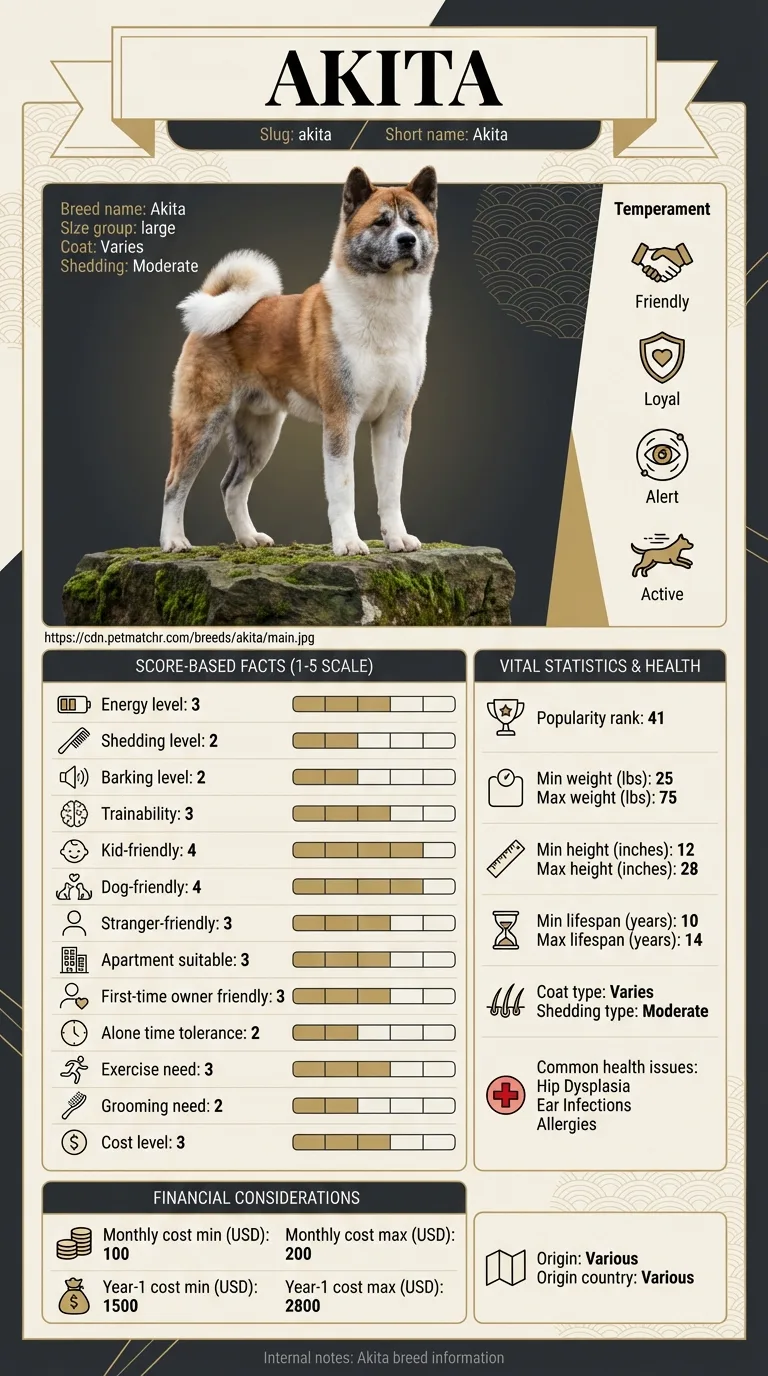
Owners of adult Akitas noticing early night-vision changes, and prospective owners or breeders wanting to understand genetic testing options, are the audience here.
This guide is not medical advice. If your dog shows pain, sudden behavior change, or worsening symptoms, consult a licensed veterinarian.
Some links may be affiliate links. We may earn a commission at no extra cost to you. We only suggest products we believe are helpful for dog owners.
We research and check what we publish, but we do not warrant that any figure, date, price, or statement is accurate, complete, or current, and we accept no liability for any loss, cost, injury, or other harm arising from the use of this site. Use it as one reference among several. You remain responsible for your own decisions and for your dog's care - confirm anything that matters with a licensed veterinarian or another qualified professional before you act on it. Full disclaimer.
Check this first
Sudden, complete vision loss occurring over hours to a day or two is genuinely different from typical PRA progression and warrants prompt veterinary evaluation, since sudden blindness can have other causes, including some that are treatable if caught quickly, unlike PRA's gradual course.
The gradual night-vision changes and slow overall vision decline typical of PRA are not an emergency — they warrant a scheduled ophthalmology evaluation to confirm the diagnosis and, importantly, to rule out other causes of vision change that might be treatable.
Because PRA specifically has no treatment that halts or reverses it, the value of prompt veterinary evaluation lies mainly in confirming the diagnosis accurately (via an electroretinogram) and ruling out anything else that might actually be treatable, rather than urgency for its own sake.
If any of these apply, call your vet or an emergency clinic now. The rest of this page is for the cases that are not an emergency.
Progressive retinal atrophy is an inherited, progressive degeneration of the retina's light-sensing cells, specifically named among the Akita's documented common health issues. It typically starts with reduced night vision and progresses gradually toward significant vision loss, with genetic testing available to help inform breeding decisions.
PRA is specifically listed among the Akita's documented common health issues, making it a meaningful consideration for this breed, and genetic testing availability has made proactive breeding decisions more accessible than in the past.
The Akita carries a documented genetic predisposition to PRA as part of its overall eye health profile. Because this is a purely inherited condition, family history and genetic testing status are the most relevant pieces of information for assessing an individual dog's risk, more so than any lifestyle or environmental factor.
PRA itself isn't influenced by environment or lifestyle since it's a genetic condition, but how well a dog adapts to progressive vision loss is meaningfully affected by its home environment — a stable, consistent layout supports much better adaptation than a frequently changing one.
Schedule an ophthalmology evaluation for gradually developing night-vision difficulty or general vision decline. Seek prompt veterinary care for sudden, complete vision loss over hours to a day or two, which is different from typical PRA progression and may have another, sometimes treatable, cause.
Because PRA has a well-understood genetic and progressive pattern, certain habits either miss it early or add unnecessary distress once it's diagnosed.
See all Akita health problems, which breeds are prone to progressive retinal atrophy pra, or the full Akita breed guide for temperament, exercise needs and ownership costs.
PRA typically progresses over months to a couple of years from the first noticeable signs to significant vision loss, though the exact pace varies by the specific genetic form and individual dog.
Success is a dog that adapts confidently to progressive vision loss through a consistent environment and established verbal cues, maintaining a good quality of life and confident navigation despite reduced or absent vision.
If you think your Akita has progressive retinal atrophy (pra), the plan is three steps: write down what you have seen and when it started, book a veterinary appointment rather than waiting for the next flare, and take video of the behaviour or symptom before you go — the thing you are worried about rarely happens in the consulting room. Screening in the parents covers hip dysplasia, progressive retinal atrophy, hypothyroidism.
What the vet visit should produce is a diagnosis and a written plan, not just reassurance: what is being ruled out, what the monitoring interval is, and which signs mean you come back sooner. Ask what the treatment costs across a year rather than per visit, because that is the number that decides whether you are managing this condition or reacting to it.
Between appointments, keep a short log — dates, what you saw, what changed. It is the single most useful thing an owner brings to a follow-up, and for progressive retinal atrophy (pra) it is often what separates a clear pattern from a guess.
Wendy noticed her six-year-old Akita, Momiji, had started hesitating at the back door after dark and seemed to bump into a side table occasionally in dim light, in her home in Eugene. A veterinary ophthalmologist confirmed PRA via electroretinogram testing. Knowing vision loss would likely progress over the following year or two, Wendy kept her furniture layout consistent, added verbal cues like 'step' and 'chair' during daily walks around the house, and avoided rearranging anything. As Momiji's vision declined further over the following eighteen months, she continued navigating her familiar home with confidence.
Key takeaway: Early recognition of night-vision changes allows time to prepare a stable environment and teach helpful cues well before vision loss becomes significant, making the transition far less disruptive for the dog.
Difficulty seeing in low light or at night, often showing up as hesitation to go outside after dark or bumping into furniture in dim rooms, is usually the earliest noticeable sign, since night vision is typically affected before daytime vision.
An electroretinogram, performed by a veterinary ophthalmologist, measures the retina's electrical response to light and can confirm PRA, sometimes before vision loss becomes obvious to the owner.
Yes, for several documented genetic forms of PRA, testing is available through veterinary genetic laboratories, and it's widely recommended for breeding dogs to reduce the risk of producing affected puppies.
Currently there's no proven treatment that halts or reverses PRA progression; management focuses on supporting the dog's quality of life and safety as vision changes.
This varies by the specific form and individual dog, but it commonly progresses over months to a couple of years from first noticeable signs to significant vision loss.
Dogs typically adapt remarkably well, relying heavily on memory of familiar spaces, along with smell and hearing, especially when the home layout stays consistent and new obstacles are avoided.
An electroretinogram exam with a veterinary ophthalmologist typically runs $300 to $600; genetic testing for known mutations, when available, is often more affordable, commonly in the range of $60 to $150.
Difficulty seeing in low light or at night, often noticed before any daytime vision problems.
No — there's currently no treatment that halts or reverses PRA progression.
Yes, for several documented genetic forms, and it's recommended for breeding dogs.
An electroretinogram typically runs $300 to $600; genetic testing is often more affordable.
Yes — most dogs adapt remarkably well using memory, smell, and hearing, especially in a consistent home layout.
A one-page prep sheet for this condition: the signs, the questions to ask, what to get priced. Unlocks here.
You get: Vet visit prep sheet
No spam. One-click unsubscribe. See our privacy policy.
Preview page 1 before you decide.