Training
Malinois or Labrador for a typical household?
The Labrador. It scores 5/5 for first-time owners and family fit, while the Malinois's 1/5 first-timer rating reflects its working-dog background.

Quick answer
Malinois or Labrador for a typical household?
The Labrador. It scores 5/5 for first-time owners and family fit, while the Malinois's 1/5 first-timer rating reflects its working-dog background.
Belgian Malinois or Labrador Retriever? On paper they differ most on good for first-time owners, and on the scales Labrador Retriever is the heavier at 55–80 lbs. Here is how the two compare on everything that shapes an ordinary week.
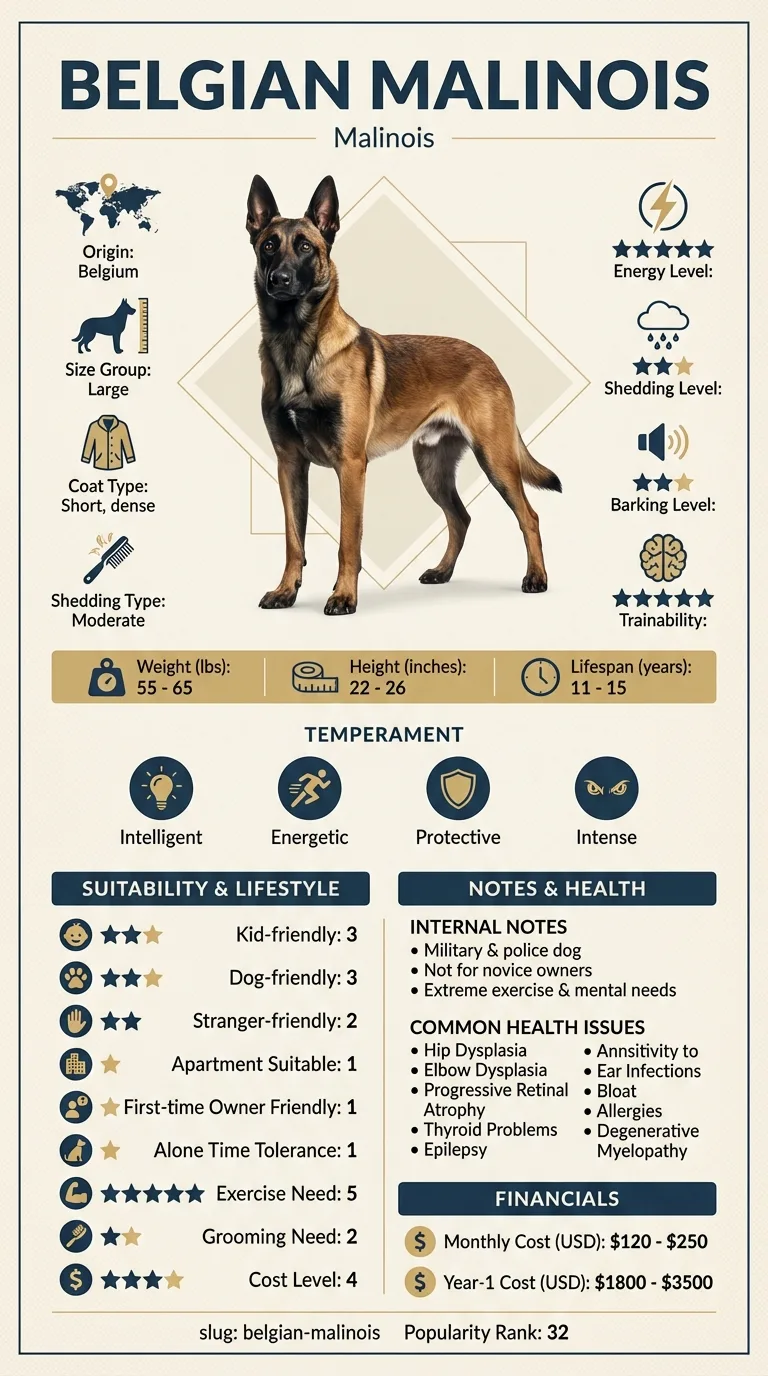
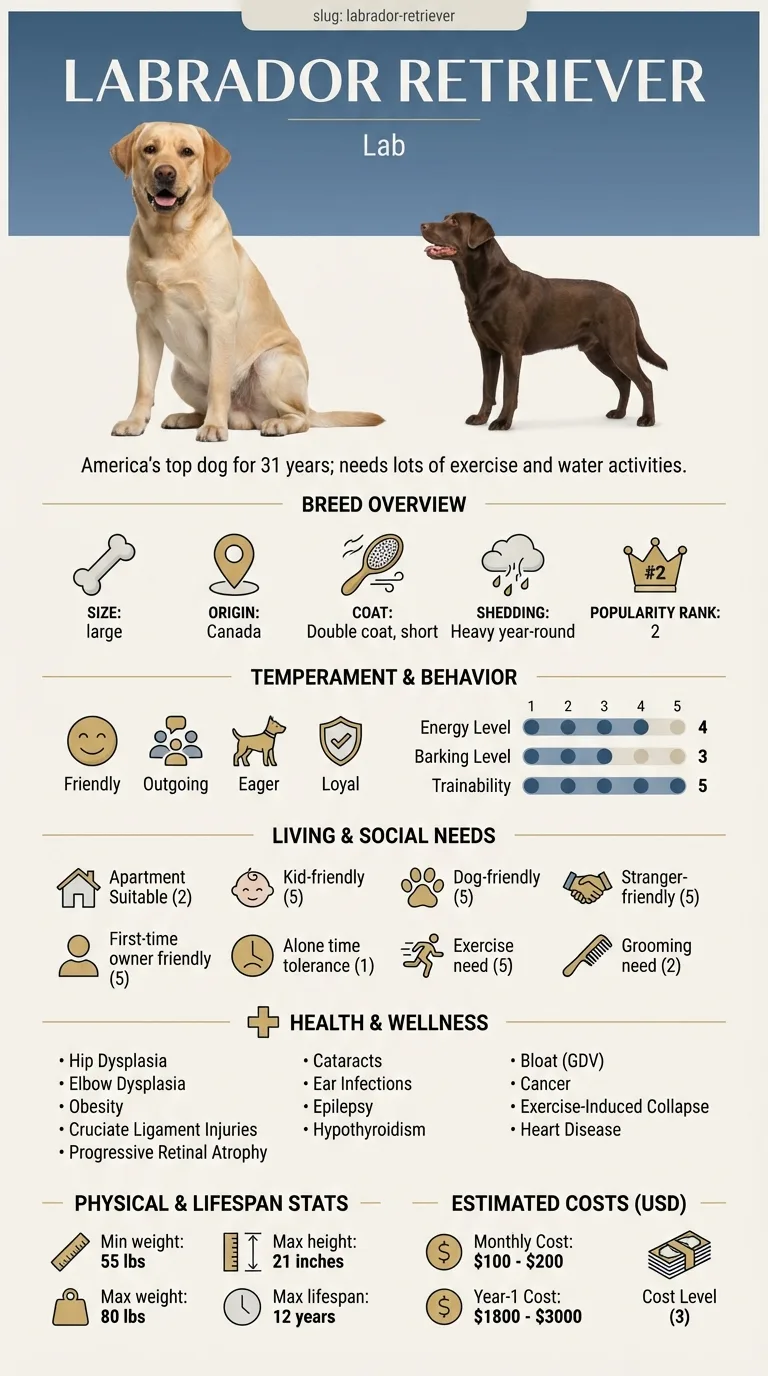
This is for someone already down to Belgian Malinois and Labrador Retriever and deciding between them. For this pair the decision usually turns on good for first-time owners and friendly to strangers, so those are covered first and in most detail. Anyone choosing from a flat has a clear answer here: Labrador Retriever rates 2/5 against 1/5. It is written for the decision rather than the breed history.
Between Belgian Malinois and Labrador Retriever, good for first-time owners is what separates them, and Labrador Retriever is the lower-effort dog of the two to keep.
Choose Belgian Malinois if shedding is a problem in your house, a smaller dog suits your car, your home or your back and you want a dog that is more watchful with visitors.
Choose Labrador Retriever if this is your first dog, there are young children at home and you already have another dog.
| Feature | belgian malinois | labrador retriever | Winner |
|---|---|---|---|
| Size class | large | large | Equal |
| Weight | 55–65 lbs | 55–80 lbs | Equal |
| Height | 22–26 in | 21–24 in | Equal |
| Lifespan | 11–15 years | 10–12 years | belgian malinois |
| Exercise need | Very high (5/5) | Very high (5/5) | Equal |
| Grooming need | Low (2/5) | Low (2/5) | Equal |
| Shedding | Moderate (3/5) | High (4/5) | belgian malinois |
| Energy level | Very high (5/5) | High (4/5) | Equal |
| Barking | Moderate (3/5) | Moderate (3/5) | Equal |
| Apartment suitability | Very low (1/5) | Low (2/5) | labrador retriever |
| Good for first-time owners | Very low (1/5) | Very high (5/5) | labrador retriever |
| Tolerates being alone | Very low (1/5) | Very low (1/5) | Equal |
| Trainability | Very high (5/5) | Very high (5/5) | Equal |
| Good with kids | Moderate (3/5) | Very high (5/5) | labrador retriever |
| Good with other dogs | Moderate (3/5) | Very high (5/5) | labrador retriever |
| Friendly to strangers | Low (2/5) | Very high (5/5) | labrador retriever |
| Cost level | High (4/5) | Moderate (3/5) | labrador retriever |
| Coat | Short, dense | Double coat, short | Equal |
| Origin | Belgium | Canada | Equal |
| Typical monthly cost | $120–$250 | $100–$200 | Equal |
| Typical first-year cost | $1,800–$3,500 | $1,800–$3,000 | Equal |
Both are large breeds, but the Labrador's weight range runs higher, 55-80 lbs against the Malinois's tighter 55-65 lb window, so a big male Lab can outweigh a Malinois by 15-20 lbs. Height is close, 21-24 in versus 22-26 in. Neither breed is small enough to disappear in a tight space. Coat type differs too: the Malinois carries a short dense single coat while the Lab's is a short double coat built for cold-water retrieving, a structural difference that also explains some of the shedding gap covered next.
The Malinois edges out the Lab here: 5/5 exercise and energy versus the Lab's 5/5 exercise but 4/5 energy, a small but real difference that shows up in how each dog behaves indoors after a walk. A tired Lab settles; a tired Malinois often still wants a task. Both need daily, serious exercise, a stroll around the block won't cut it for either.
Grooming is a wash, both rate 2/5, low-maintenance, short coats. Shedding isn't: the Lab sheds more (4/5, high) than the Malinois (3/5, moderate), which matters if you're vacuuming furniture weekly. Neither coat needs trimming, just regular brushing during shed season. The Lab's double coat pushes out a heavier undercoat twice a year, so expect noticeably more hair around shedding season than the Malinois's single coat produces even at its worst.
Barking is identical at 3/5 for both. Apartment suitability tilts slightly toward the Lab (2/5 vs the Malinois's 1/5), but slightly better still isn't good; both dogs tolerate being alone very poorly (1/5 each), so this comparison is really about which house, not which apartment, fits better. Neither dog was bred with apartment life in mind, the Malinois for protection work that needs room to patrol, the Lab for field work that needs room to run, so a house with a yard suits both far better than a unit with shared walls.
Trainability is tied at 5/5, both learn fast. First-time-owner suitability is where they split hard: the Lab rates 5/5, about as forgiving a breed as exists, while the Malinois sits at 1/5 and is a genuinely poor choice for someone without prior working-dog experience. That gap isn't about intelligence, both breeds are equally quick studies, it's about drive: a Lab misdirects extra energy into mild mischief, while an under-worked Malinois can become genuinely difficult to manage.
The Lab outscores the Malinois with kids (5/5 vs 3/5), other dogs (5/5 vs 3/5), and strangers (5/5 vs 2/5), three of the widest gaps in this entire comparison. A Malinois isn't unsafe with a family, but it's selective about who it warms up to, and a Lab simply isn't. These aren't marginal gaps, three to four points out of five is about as decisive a difference as this dataset produces anywhere, and it lines up with how each breed was actually bred to behave around people outside its own family.
The Malinois lives longer on paper, 11-15 years against the Lab's 10-12, and its ten-condition health list still skips some of the Lab's more serious entries like cancer and heart disease. Both share hip and elbow dysplasia, PRA, ear infections, epilepsy, and bloat; the Lab's list additionally carries obesity and cruciate ligament injuries, both tied to its appetite and joint load.
The Malinois costs more to keep, high (4/5) against the Lab's moderate (3/5), and that shows in the numbers: $120-$250 a month versus $100-$200, up to $3,500 in year one against the Lab's $3,000 ceiling. Over a decade that gap adds up, before even factoring in the specialized training a working-line Malinois often needs. If cost is weighing heavily on your decision, that few-hundred-dollar gap is real but modest set against the much larger differences in temperament and first-time-owner fit covered elsewhere in this comparison.
Belgian Malinois weighs 55–65 lbs and lives 11–15 years; Labrador Retriever weighs 55–80 lbs and lives 10–12 years. The two diverge most on good for first-time owners, friendly to strangers and good with kids and 1 other rated axes. They are level on tolerates being alone, barking and exercise need, so those cannot decide it. In the table, a "winner" means easier for an ordinary household — not better. Size, coat and origin are recorded without a verdict. Because both breeds are scored the same way, the gaps are reliable even where the absolute numbers are rough.

Considerably. The Lab rates 5/5 for first-time owners, the Malinois just 1/5, despite both being equally trainable at 5/5 each.
The Labrador, rated high (4/5) versus the Malinois's moderate (3/5). Expect more hair on furniture and clothes with the Lab.
The Malinois, typically 11-15 years against the Lab's 10-12. It's a modest gap, but it's consistent with the Malinois avoiding some of the Lab's more serious health entries like cancer.
Close but not identical. The Lab's weight range tops out higher (80 lbs vs 65 lbs), though both stand roughly the same height.
About $20-$50 more per month and up to $500 more in the first year, driven by its high (4/5) cost rating versus the Lab's moderate (3/5).
Yes. Hip and elbow dysplasia, PRA, ear infections, epilepsy, and bloat appear on both lists, though the Lab's list also includes cancer and heart disease.
The Labrador by a wide margin, 5/5 versus the Malinois's 2/5. The Malinois is bred to be more reserved outside its family.
The Labrador. It scores 5/5 for first-time owners and family fit, while the Malinois's 1/5 first-timer rating reflects its working-dog background.
About $20-$50/month higher for the Malinois ($120-$250 vs $100-$200).
The Malinois, marginally. Both need serious daily activity, but the Malinois's energy rates 5/5 against the Lab's 4/5.
The Malinois, 11-15 years versus the Lab's 10-12.
Secure checkout on Stripe. We never see your card.
7-day money-back guarantee. Instant access.
Health information here is general and is not veterinary advice. If your dog shows pain, sudden behaviour change, or worsening symptoms, consult a licensed veterinarian.
Some links on this site are affiliate links. We may earn a commission at no extra cost to you, and we only suggest products we believe are helpful for dog owners.
We research and check what we publish, but we do not warrant that any figure, date, price, or statement is accurate, complete, or current, and we accept no liability for any loss, cost, injury, or other harm arising from the use of this site. Use it as one reference among several. You remain responsible for your own decisions and for your dog's care - confirm anything that matters with a licensed veterinarian or another qualified professional before you act on it. Full disclaimer.
Match your lifestyle to the right dog.
Take quizNot sure which breed is right for you? Take our 2-minute quiz to find out.
Take the quiz