Behavior
What is the very first sign?
Hesitation in dim light. A dog who will not go out into a dark garden or stops at the top of unlit stairs is reporting failing rod cells, not developing nerves.

Quick answer
What is the very first sign?
Hesitation in dim light. A dog who will not go out into a dark garden or stops at the top of unlit stairs is reporting failing rod cells, not developing nerves.
That is why the first thing an owner notices is not blindness. It is a dog who suddenly does not want to go out into a dark garden he has used every night for six years.
Owners who have noticed hesitancy in low light and want to know what is coming, and owners who have just received the diagnosis and are looking for something to do about it.
This guide is not medical advice. If your dog shows pain, sudden behavior change, or worsening symptoms, consult a licensed veterinarian.
Some links may be affiliate links. We may earn a commission at no extra cost to you. We only suggest products we believe are helpful for dog owners.
We research and check what we publish, but we do not warrant that any figure, date, price, or statement is accurate, complete, or current, and we accept no liability for any loss, cost, injury, or other harm arising from the use of this site. Use it as one reference among several. You remain responsible for your own decisions and for your dog's care - confirm anything that matters with a licensed veterinarian or another qualified professional before you act on it. Full disclaimer.
Progressive retinal atrophy is an inherited degeneration of the light-sensing cells at the back of the eye. The rod cells responsible for dim-light vision typically fail first, producing night blindness, followed by gradual loss of daylight vision over months to years. It is painless, affects both eyes, and there is no treatment. It is documented among the Bernese Mountain Dog's recognised health issues.
This condition sits explicitly on the Bernese Mountain Dog's documented list of common health issues, which distinguishes it from many eye problems that merely occur across breeds. It is far from universal in the breed, and dogs from lines with generations of eye certification are at substantially lower risk, but it is common enough that eye screening is standard practice among responsible Bernese breeders.
This is a purely genetic condition and the Bernese connection is one of inheritance rather than of build or lifestyle. Like several of the breed's documented problems, it reflects the narrow founder population from which the breed was assembled in the Swiss cantons, which concentrates recessive variants. Nothing about the dog's size, coat, temperament or activity influences whether he develops it, which is unusual among this breed's health issues and makes breeder screening the only meaningful preventive lever.
The environment does not cause or accelerate the disease, but it entirely determines how disabling it is. A dog living in a stable, uncluttered home with fixed furniture, consistent flooring textures and secured hazards copes remarkably well. The same dog in a household that frequently rearranges rooms, or that moves house during the progression, struggles far more. Lighting matters in the early phase: leaving a hall light on can extend a dog's confidence by months.
This condition itself is never an emergency, and the appropriate response to gradual visual decline is a prompt but routine ophthalmology appointment. What does require same-day care is any eye that becomes painful, red or cloudy over hours, or an eye that looks enlarged, because a dog with retinal disease can still develop unrelated urgent problems such as raised pressure or a corneal injury, and a dog who cannot see is more likely to injure his eyes on obstacles. Sudden rather than gradual sight loss is also urgent, since it suggests a different cause entirely.
See all Bernese Mountain DOG health problems, which breeds are prone to progressive retinal atrophy pra, or the full Bernese Mountain DOG breed guide for temperament, exercise needs and ownership costs.
From the first hesitation in dim light to substantially reduced daylight vision commonly takes one to three years, though it varies. There is no intervention that changes that trajectory. What can be compressed usefully is the preparation: a household that teaches cues and adapts the home within the first few months of diagnosis will find the later stages markedly easier than one that waits until the dog is already bumping into things.
Success is a blind dog who behaves like a sighted one in his own home: walking confidently between rooms, finding his bed and bowl, greeting people without startling, and still enjoying a daily walk on a familiar route. That outcome is genuinely common in this breed, whose calm temperament and good trainability make adaptation easier than in a more anxious or reactive dog. What success is not is preserved vision, and no amount of intervention will change that.
The sequence is predictable and knowing it helps enormously, because each stage gives you something to prepare for.
It begins with night vision. The dog hesitates at the top of unlit stairs, stops at the threshold of a dark room, or will not go out into the garden after sunset without company. Owners almost always interpret this as a behavioural change, a new nervousness, or stubbornness, and it is very common for months to pass before anyone connects it to the eyes.
Next comes reduced peripheral awareness. The dog begins to bump into things at the edges of his path, particularly furniture legs and door frames, while still navigating confidently down the middle of a familiar room.
Then day vision declines. Unfamiliar environments become difficult first, because the dog can no longer supplement failing sight with memory. A dog who manages perfectly at home may be visibly lost in a friend's house.
Finally, vision is essentially gone. Many owners are surprised by how late they realised, because a dog in a familiar house with fixed furniture navigates from memory extremely well.
One visible sign accompanies all of this: the pupils become dilated and the eyes take on a greenish or yellowish reflective quality in low light, because more light is reaching the back of a retina that can no longer use it. Some dogs also develop secondary cataracts as the degeneration advances.
The entire course typically runs over months to a few years. It is painless throughout.
There is no treatment for this condition, which makes preparation the only thing an owner can actually do. Fortunately, it works very well.

Emil was five when his family noticed he had stopped following them into the unlit conservatory in the evenings. He would stand at the door and wait. In daylight the room was one of his favourite places. An ophthalmology examination found retinal changes in both eyes, and the diagnosis was progressive retinal atrophy. His family were told plainly that there was no treatment. What they did instead was work. Over the following six months, while Emil could still see well in daylight, they taught him step up, step down, wait, and slow, all with food and short sessions. They fixed the furniture, laid a coir mat at the bottom of the stairs and a rubber one at the top, and put a night light in the hall. Emil is nine now and has almost no useful vision. He still walks the same route every morning and still finds his own way to the kitchen.
Key takeaway: The most valuable months in this condition are the ones while the dog can still see. Verbal navigation cues taught early are learned in days; taught after sight is gone, they take weeks and a much less confident dog.
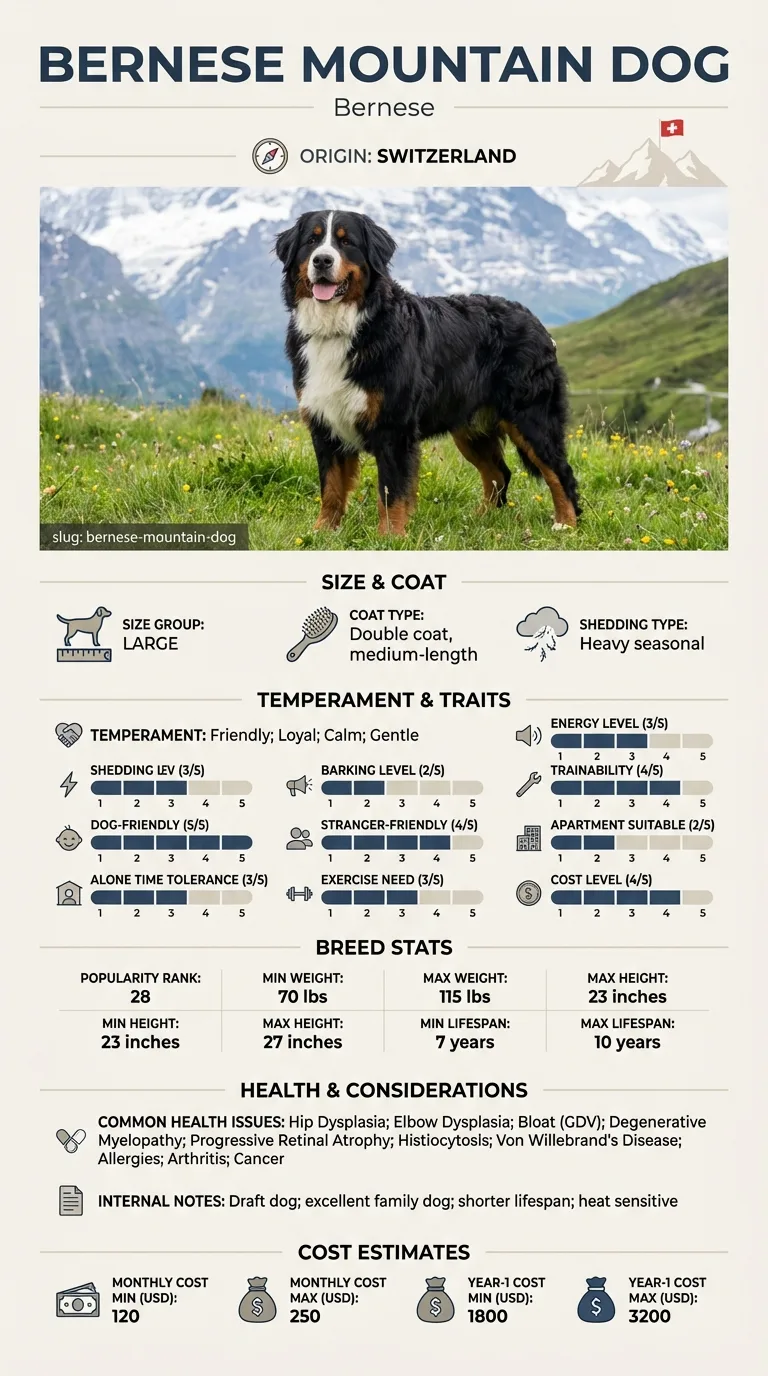
It is documented among this breed's core health issues, alongside hip and elbow dysplasia, bloat, degenerative myelopathy, histiocytosis, von Willebrand's disease, allergies, arthritis and cancer. That places it firmly on the list a Bernese owner should know about, and it is why eye certification is part of responsible breeding in the breed.
No. There is currently no treatment that halts, slows or reverses retinal degeneration in dogs, and supplements or diets marketed as doing so are not supported by evidence. What veterinary ophthalmology offers is accurate diagnosis, monitoring for secondary complications such as cataracts, and honest guidance on adaptation.
It varies by the specific form and by the individual, but most dogs progress over months to a few years rather than weeks. That relatively slow pace is genuinely useful, because it gives time to teach navigation cues and adapt the home while the dog still has enough vision to learn easily.
No, and this is worth emphasising because owners often assume otherwise. The retina degenerates without inflammation or pressure. A dog with this condition is not suffering; he is losing a sense. Pain in an affected eye means something else is happening, such as a secondary complication, and needs veterinary assessment.
By an ophthalmic examination in which the back of the eye is visualised, showing characteristic changes to the retinal blood vessels and reflective layer. An electroretinogram, which measures the electrical response of the retina to light, can confirm loss of function earlier than the changes become visible. Genetic testing exists for some forms.
Yes, and he should be. A blind dog who is kept indoors loses fitness and mental stimulation. Walk familiar routes, use a harness rather than a collar so you can guide gently, keep him on lead in unfamiliar places, and let him use his nose, which becomes his primary tool for enjoying a walk.
Hesitation in dim light. A dog who will not go out into a dark garden or stops at the top of unlit stairs is reporting failing rod cells, not developing nerves.
No. The degeneration is entirely painless. If an affected eye becomes painful, something else is going on and it needs veterinary assessment.
Teach verbal navigation cues while the dog can still see. Step up, step down, wait and slow are far easier to learn before vision is gone.
No, the opposite. A blind dog navigates from a memorised map, and rearranging a room invalidates it. Keep layout fixed and tell visitors.
A one-page prep sheet for this condition: the signs, the questions to ask, what to get priced. Unlocks here.
You get: Vet visit prep sheet
No spam. One-click unsubscribe. See our privacy policy.
See a sample page before you decide.
Early access list
The free prep sheet covers the same-day warning signs, a symptom log and the questions to ask. We are considering a fuller kit that adds a cost worksheet for the usual tests and treatments (US price ranges with their sources) and a plain-English guide to ways of covering the bill. It is not built yet; this list tells us whether it is worth building.
One email, no spam, unsubscribe anytime. Information only, not veterinary advice.