Health
Is a Labrador's long health-issue list a red flag?
Not on its own; it partly reflects how extensively this popular breed has been researched and tested rather than uniquely poor underlying health.

Quick answer
Is a Labrador's long health-issue list a red flag?
Not on its own; it partly reflects how extensively this popular breed has been researched and tested rather than uniquely poor underlying health.
A long list of documented health concerns for a breed doesn't automatically mean that breed is less healthy, sometimes it means that breed has simply been studied and tested more thoroughly than almost any other.
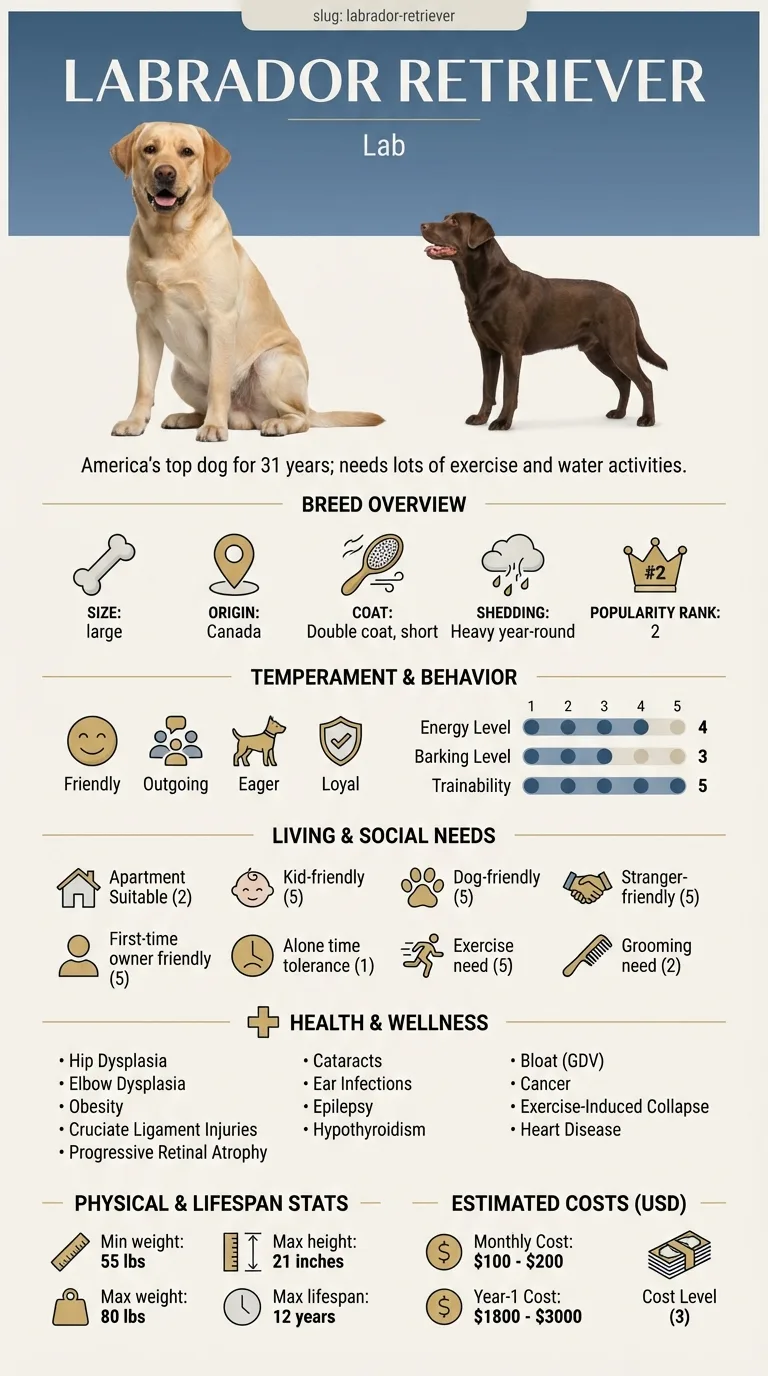
Owners comparing genetic health panels across breeds, or those startled by how many conditions come up in Labrador-specific searches, benefit most from understanding this honest, statistically informed context.
This guide is not medical advice. If your dog shows pain, sudden behavior change, or worsening symptoms, consult a licensed veterinarian.
Some links may be affiliate links. We may earn a commission at no extra cost to you. We only suggest products we believe are helpful for dog owners.
We research and check what we publish, but we do not warrant that any figure, date, price, or statement is accurate, complete, or current, and we accept no liability for any loss, cost, injury, or other harm arising from the use of this site. Use it as one reference among several. You remain responsible for your own decisions and for your dog's care - confirm anything that matters with a licensed veterinarian or another qualified professional before you act on it. Full disclaimer.
Labrador Retrievers show up with an unusually long list of documented health concerns, but this partly reflects the breed's massive population size and decades of research and genetic testing investment rather than proof of uniquely poor underlying health. This is a case of ascertainment bias: more thorough looking surfaces more documented findings, not necessarily worse biology, and the practical upside is unusually comprehensive, well-validated genetic testing available for this breed.
The volume of documented genetic findings for this breed is itself well established in genetic research literature, though it should be understood as reflecting research intensity as much as, or more than, biological risk relative to other breeds.
Labrador Retrievers' documented genetic health profile is shaped both by real biological risk factors and by this breed's exceptional population size and decades of dedicated genetic research, together producing an unusually detailed, well-characterized list of conditions compared to less-studied breeds.
Environment doesn't drive this pattern directly since it reflects research history rather than lifestyle; however, individual owners' choices, like whether to pursue genetic testing, still shape how much of this available information becomes personally useful for a given dog.
Talk to your vet about which genetic tests are actually worth pursuing for your individual dog and how to interpret results in the context of your dog's overall health, rather than treating a comprehensive panel as a checklist of expected problems.
See all Labrador Retriever health problems, which breeds are prone to genetic load, or the full Labrador Retriever breed guide for temperament, exercise needs and ownership costs.
Understanding this context is a one-time conceptual shift rather than an ongoing process. Genetic testing itself typically returns results within one to two weeks of sample submission.
Success is reading this breed's genetic health information accurately, neither dismissing real, documented risks nor assuming a long condition list means Labradors are broadly less healthy than other breeds, and using genetic testing as one practical, informative tool among several.
Labrador Retrievers have been the most or second-most popular dog breed in the United States for decades, meaning an enormous population of dogs has been bred, tested, and studied compared to rarer breeds. Genetic researchers and testing companies have correspondingly invested heavily in mapping this breed's DNA, since a bigger customer and research base makes commercial and academic sense. The practical effect is what statisticians call ascertainment bias: a breed this extensively tested surfaces more documented variants not necessarily because its biology carries more problems than a less-studied breed, but because far more looking has actually happened. A rare breed with a tiny, understudied population could carry just as many undiscovered genetic risks, simply without the same research investment to find them.
This context doesn't mean Labrador health concerns aren't real, conditions like hip dysplasia, EIC, and PRA are genuinely documented and worth taking seriously. What it does mean is that the sheer volume of documented conditions for this breed shouldn't be read as proof this breed is unusually unhealthy compared to others; it's at least partly a reflection of how thoroughly it's been studied. The practical upside is real too: because so much research exists, genetic testing panels for this breed are unusually comprehensive and well-validated, giving owners and breeders more actionable, reliable information than is available for many less-studied breeds.

If you think your Lab has genetic load, the plan is three steps: write down what you have seen and when it started, book a veterinary appointment rather than waiting for the next flare, and take video of the behaviour or symptom before you go — the thing you are worried about rarely happens in the consulting room. Screening in the parents covers hip dysplasia, elbow dysplasia, obesity.
What the vet visit should produce is a diagnosis and a written plan, not just reassurance: what is being ruled out, what the monitoring interval is, and which signs mean you come back sooner. Ask what the treatment costs across a year rather than per visit, because that is the number that decides whether you are managing this condition or reacting to it.
Between appointments, keep a short log — dates, what you saw, what changed. It is the single most useful thing an owner brings to a follow-up, and for genetic load it is often what separates a clear pattern from a guess.
Sable's owner ran a full genetic health panel out of curiosity before breeding her Labrador and was initially alarmed at how many conditions appeared on the results compared to a friend's rare-breed dog's much shorter panel. A conversation with her vet clarified that the difference reflected how much more extensively Labradors have been studied and tested, not necessarily that Sable's breed carried more actual risk than her friend's dog. With that context, Sable's owner used the results practically: confirming Sable was clear for EIC and the POMC obesity mutation, and factoring a mild PRA carrier status into her breeding decisions, rather than feeling generally alarmed by the panel's length.
Key takeaway: A long list of documented Labrador health concerns reflects this breed's exceptional research history as much as its biology, and understanding that context turns genetic testing into a genuinely useful tool rather than a source of undue worry.
Not necessarily more problems in an absolute sense; this breed has simply been studied and genetically tested far more extensively than most, given its enormous population size and decades of research investment, which surfaces more documented variants without necessarily meaning worse underlying biology.
This breed's massive, long-standing popularity has made it a major focus for both academic research and commercial genetic testing companies, resulting in an unusually well-developed testing panel compared to rarer breeds.
Not on its own. A long documented list partly reflects thorough research rather than uniquely poor health, and many of the conditions listed have real, actionable genetic tests and management strategies precisely because of that research investment.
Not necessarily; a rare, understudied breed could carry just as many genetic risks without the research investment to identify and document them, making a direct health comparison based on documented condition counts alone misleading.
Yes, given how comprehensive and well-validated this breed's testing panels are, genetic testing offers genuinely useful, actionable information for individual health awareness and breeding decisions.
Not overstated, but it's worth reading breed health content, this one included, with the understanding that a documented condition list reflects both real biology and research intensity, rather than assuming every listed condition affects every dog.
Focus on the conditions with strong, direct documentation and available testing, and use genetic panels as one tool among several, alongside a vet's clinical judgment, rather than treating a long results list as a diagnosis or prediction.
Not on its own; it partly reflects how extensively this popular breed has been researched and tested rather than uniquely poor underlying health.
Its massive population size and decades of popularity have made it a major focus for both academic and commercial genetic research.
Not necessarily, they likely have similar underlying risks with less research investment to document them, making direct comparisons misleading.
Yes, given how comprehensive and validated Labrador-specific panels are, most owners find the information genuinely useful for the cost.
Understanding why the list is long, research intensity as much as biology, should ease unnecessary worry while still taking the well-documented, testable conditions seriously.
A one-page prep sheet for this condition: the signs, the questions to ask, what to get priced. Unlocks here.
You get: Vet visit prep sheet
No spam. One-click unsubscribe. See our privacy policy.
Preview page 1 before you decide.