Akita or Labrador: The Dog That Trusts Everyone, or No One
Quick answer
Akita vs Labrador Retriever: which should I choose?
The Labrador if you want a family dog, can commit two hours a day and someone is usually home. The Akita if you want a guardian and a dog that copes with an empty house — it rates 3/5 for solitude against the Labrador's 1/5.
The Labrador rates 5/5 with strangers — the only breed in this batch to do so — along with 5/5 with children, 5/5 with other dogs and 5/5 for first-time owners. The Akita rates 2/5, 3/5, 2/5 and 1/5. If you want a dog that guards anything at all, the Labrador is the wrong animal, and it is honest to say so plainly.
This page is for someone weighing the most popular family dog in the world against a large guardian. It covers the sociability gap, the Labrador's exercise requirement, its genuinely unusual appetite problem, time alone, shedding and cost.
Quick verdict
The Labrador is easier than the Akita in every respect except two — it needs far more exercise and it cannot be left alone — and it guards nothing whatsoever.
Choose akita if...
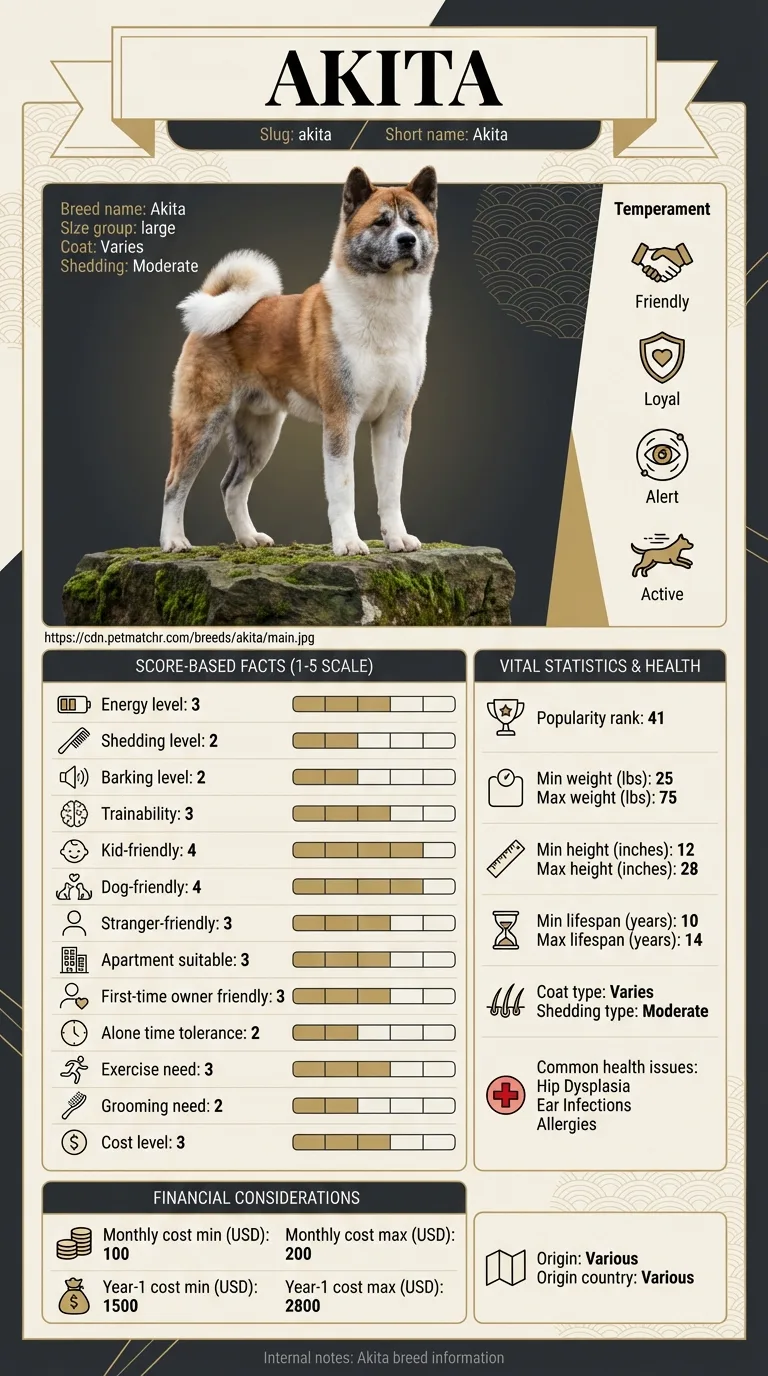
Choose the Akita if you want a guardian, a quieter house or a dog that copes with a working day. It barks at 2/5 against the Labrador's 3/5, needs 3/5 exercise against 5/5, and tolerates being alone at 3/5 against 1/5. You are accepting 1/5 for first-time owners, 2/5 with other dogs and strangers, and 5/5 shedding.
Choose labrador retriever if...
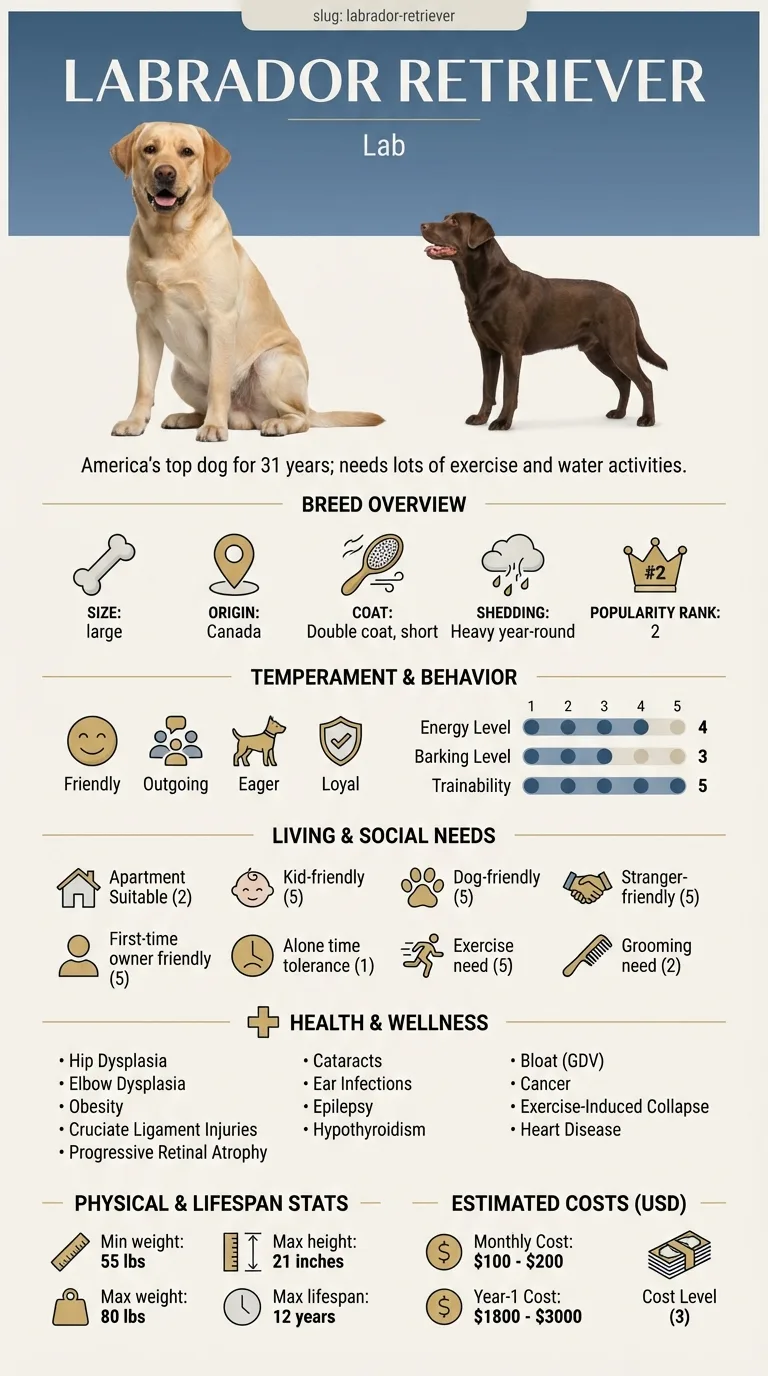
Choose the Labrador if you want a family dog and someone is usually home. It rates 5/5 for trainability, children, other dogs, strangers and first-time owners, grooms at only 2/5, and costs $100–$200 a month. You are accepting 5/5 exercise, a 1/5 tolerance for solitude, heavy year-round shedding and a serious tendency to obesity.
Head-to-head comparison
Feature
akita
labrador retriever
Winner
Weight
70–130 lbs
55–80 lbs
Equal
Height
24–28 in
21–24 in
Equal
Lifespan
10–13 years
10–12 years
akita
Coat
Dense double coat
Short double coat
Equal
Grooming need
Moderate (3/5)
Low (2/5)
labrador retriever
Shedding
Very high (5/5)
High (4/5)
labrador retriever
Energy level
Moderate (3/5)
High (4/5)
Equal
Exercise need
Moderate (3/5)
Very high (5/5)
akita
Trainability
Moderate (3/5)
Very high (5/5)
labrador retriever
Barking
Low (2/5)
Moderate (3/5)
akita
Good with kids
Moderate (3/5)
Very high (5/5)
labrador retriever
Good with other dogs
Low (2/5)
Very high (5/5)
labrador retriever
Friendly to strangers
Low (2/5)
Very high (5/5)
labrador retriever
Apartment suitability
Low (2/5)
Low (2/5)
Equal
Good for first-time owners
Very low (1/5)
Very high (5/5)
labrador retriever
Tolerates being alone
Moderate (3/5)
Very low (1/5)
akita
Typical monthly cost
$110–$240
$100–$200
labrador retriever
Typical first-year cost
$1,700–$3,200
$1,800–$3,000
Equal
Deep dive
5/5 exercise and a very slow adolescence
A Labrador needs around two hours a day, and swimming or retrieving is what genuinely satisfies it — this is a water dog that was built to work all day in cold water.
The complication is timing. Labradors mature slowly, and a two-year-old is still adolescent in temperament while being fully grown in body. That combination — 80 pounds, enormous enthusiasm and no judgement — is what makes the second year harder than the first.
An under-exercised Labrador does not usually become destructive in the way a terrier or a collie does. It becomes fat, mouthy and bouncy. Which sounds gentler and is in fact the more serious outcome, for reasons the next section explains.
The good news is that 5/5 trainability makes all of this tractable. Labradors are the most reliably trainable large breed available, and a well-handled one is superb.
The Akita at 3/5 needs forty-five to sixty minutes of walking, has no requirement for a job, and does not deteriorate without one.
Why Labradors are hungry in a way other dogs are not
Obesity appears as its own item on the Labrador's condition list, ahead of several actual diseases, and that placement is correct.
There is a genetic explanation. A deletion in a gene involved in appetite regulation is unusually common in Labradors, and dogs carrying it are measurably more food-motivated and less able to register fullness. The same variant appears at high frequency in assistance-dog lines, where food motivation is useful for training — which is part of how it became so widespread.
A Labrador that is always hungry is therefore not badly behaved and not badly trained. It is doing what its biology is telling it to do, and the responsibility for portion control sits entirely with the owner.
This matters because obesity loads everything else on the list. Hip and elbow dysplasia, cruciate ligament injuries and arthritis are all made substantially worse by excess weight, and cruciate rupture in an overweight Labrador is one of the most common orthopaedic surgeries in general practice.
Weigh the food. Do not free-feed. Use part of the daily ration for training rather than adding treats on top.
The Akita is not a notably greedy breed and does not carry this problem.
A 1/5 tolerance for being left
The Labrador's 1/5 for solitude sits oddly beside its reputation as an easy dog, but it is accurate. Retrievers were bred to work in close company with a person all day, and the breed's whole temperament is oriented outward toward people.
Left for long unbroken stretches, a Labrador vocalises, chews — often destructively, given the size of the jaw — and can become genuinely distressed rather than merely bored.
The standard prevention is the same as for any closely bonded breed: graduated absences from the first week, a genuinely tired dog before you leave, and a walker or day care if the household is out all day. A well-exercised Labrador copes far better than an under-exercised one, so the exercise and solitude problems are partly the same problem.
The Akita at 3/5 does not need company. It will sleep. This is the single most practical advantage it has over almost every breed in this batch, and for a full-time working household it may be decisive.
On noise the Akita is quieter too, 2/5 against 3/5.
The rest of the list, and the money
Beyond obesity, the Labrador carries hip and elbow dysplasia, cruciate ligament injuries, progressive retinal atrophy, cataracts, ear infections, epilepsy, hypothyroidism, exercise-induced collapse, heart disease, cancer and bloat.
Two of those have DNA tests worth asking about by name: progressive retinal atrophy and exercise-induced collapse, in which an affected dog collapses after five to twenty minutes of intense excited exercise and usually recovers within half an hour. Hip and elbow scores should be produced as numbers, not described.
Ear care is routine rather than optional — drop ears on a dog that swims constantly means drying them every time.
On money the two are close: $100–$200 a month against $110–$240, and $1,800–$3,000 against $1,700–$3,200 in the first year. Grooming favours the Labrador at 2/5 against 3/5, though it sheds heavily year-round at 4/5 where the Akita concentrates 5/5 shedding into two annual periods.
Lifespan runs 10 to 13 years against 10 to 12.
Akita vs Labrador Retriever: five 5/5s against a guardian
The Labrador holds five separate 5/5 ratings on this table: trainability, children, other dogs, strangers and first-time owners. No other breed in this batch does.
That 5/5 with strangers is worth stating for what it means practically. A Labrador will greet a burglar warmly and show him where things are kept. It is not a deterrent, it is not a watchdog, and anyone buying one for security is buying the wrong dog.
The Akita is the inverse instrument. Its 2/5 with strangers is territorial rather than nervous — it assesses, decides and settles — and its presence alone does the work.
Apartments tie at 2/5, for different reasons: the Labrador's is 5/5 exercise, the Akita's is size and shedding.
The two rows where the Akita wins outright are solitude, 3/5 against 1/5, and exercise, 3/5 against 5/5. For a household that works full time, those two rows carry more weight than all five 5/5s.
Akita or Labrador: The Dog That Trusts Everyone, or No One - Akita vs Labrador Retriever: five 5/5s against a guardian
Frequently asked questions
Is a Labrador a good guard dog?
No, and it is worth being direct about it. The Labrador rates 5/5 with strangers, the highest possible, and it was bred to hand game to people without suspicion. It will greet an intruder as a visitor. If deterrence matters to you, the Akita at 2/5 is the breed doing that job.
Why are Labradors so prone to being overweight?
Partly genetics. A deletion in a gene involved in appetite regulation is unusually common in the breed, and dogs carrying it are more food-motivated and less able to register fullness. It is not bad training. Weigh the food, avoid free-feeding, and use part of the daily ration for training rather than adding treats.
How much exercise does a Labrador need?
Around two hours a day at 5/5 exercise, and swimming or retrieving satisfies it best — it is a water dog by origin. Labradors also mature slowly, so an eighty-pound two-year-old still behaves like an adolescent. The Akita at 3/5 wants forty-five to sixty minutes of walking.
Can a Labrador be left alone during a working day?
Not without cover. It rates 1/5 for solitude, the lowest on the scale, and long absences produce vocalising, destructive chewing and genuine distress. A well-exercised Labrador copes far better than a tired-out one, so the solutions overlap: absence training, a proper walk before leaving, and a midday walker.
Which sheds more?
The Akita at 5/5 against the Labrador's 4/5, but the pattern differs. The Labrador sheds short stiff hair every day of the year — it works into carpet and car seats and is remarkably persistent — while the Akita is undemanding for ten months and then blows a dense undercoat in clumps.
What is exercise-induced collapse?
An inherited condition in which a dog that is normal at rest collapses after five to twenty minutes of intense excited exercise, usually recovering within half an hour, though a minority of episodes are fatal. There is a DNA test and it should be part of any Labrador purchase conversation.
Which is better for a first-time owner?
The Labrador at 5/5 against the Akita's 1/5 — the widest possible gap — provided you can meet the exercise and someone is around during the day. It is the most reliably trainable large breed available. The Akita is independent, wary and forms its adult views at around two years old.
Akita vs Labrador Retriever: which should I choose?
The Labrador if you want a family dog, can commit two hours a day and someone is usually home. The Akita if you want a guardian and a dog that copes with an empty house — it rates 3/5 for solitude against the Labrador's 1/5.
Costs
How much does each cost per month?
The Labrador runs $100–$200 a month and the Akita $110–$240, with first-year totals of $1,800–$3,000 and $1,700–$3,200 — close enough to treat as equivalent.
Behavior
Which is friendlier with other dogs?
The Labrador at 5/5 against the Akita's 2/5, and it is one of the most reliably dog-social breeds there is. Akita intolerance is frequently same-sex and typically appears at social maturity around two years old.
Health
What should I ask a Labrador breeder?
Hip and elbow scores as numbers, eye certification, and DNA results for progressive retinal atrophy and exercise-induced collapse. Ask what the parents weigh, since weight management starts with realistic expectations.
Related DogBreedCompass guides
Akita breed guide – The Akita profile covers guardian temperament and the long socialisation window the breed needs.
Health information here is general and is not veterinary advice. If your dog shows pain, sudden behaviour change, or worsening symptoms, consult a licensed veterinarian.
Some links on this site are affiliate links. We may earn a commission at no extra cost to you, and we only suggest products we believe are helpful for dog owners.
We research and check what we publish, but we do not warrant that any figure, date, price, or statement is accurate, complete, or current, and we accept no liability for any loss, cost, injury, or other harm arising from the use of this site. Use it as one reference among several. You remain responsible for your own decisions and for your dog's care - confirm anything that matters with a licensed veterinarian or another qualified professional before you act on it. Full disclaimer.