Health
How many documented health conditions does this breed carry?
At least ten, spanning joints, eyes, the immune system, seizures, and drug metabolism.

Quick answer
How many documented health conditions does this breed carry?
At least ten, spanning joints, eyes, the immune system, seizures, and drug metabolism.
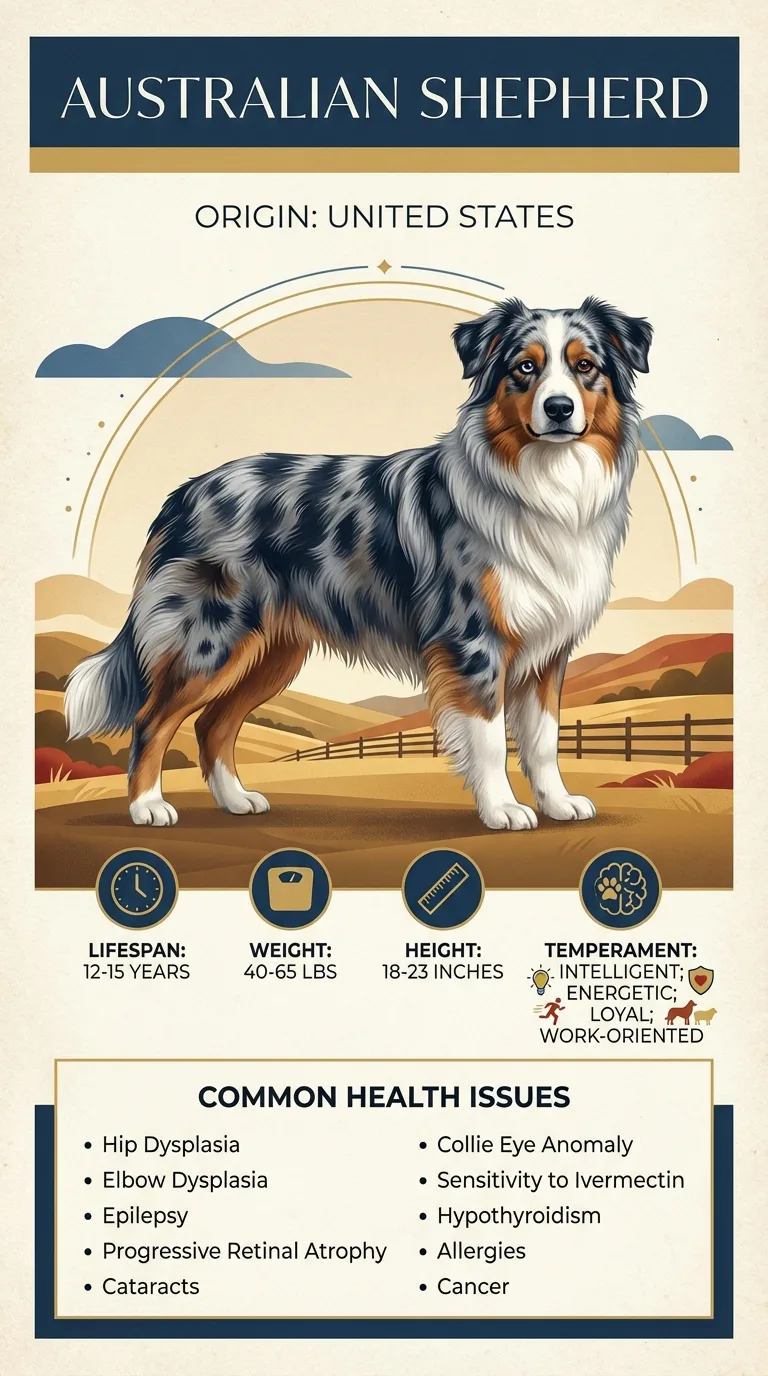
Hip dysplasia, elbow dysplasia, epilepsy, three separate documented eye conditions, a known drug sensitivity, hypothyroidism, allergies, and cancer — that's a genuinely long list for one breed to carry, and it's worth understanding what that breadth means practically.
Prospective owners comparing breeds, and current owners trying to make sense of why their Aussie seems to need more veterinary attention than a friend's mixed-breed dog, both benefit from understanding this bigger-picture context.
This guide is not medical advice. If your dog shows pain, sudden behavior change, or worsening symptoms, consult a licensed veterinarian.
Some links may be affiliate links. We may earn a commission at no extra cost to you. We only suggest products we believe are helpful for dog owners.
We research and check what we publish, but we do not warrant that any figure, date, price, or statement is accurate, complete, or current, and we accept no liability for any loss, cost, injury, or other harm arising from the use of this site. Use it as one reference among several. You remain responsible for your own decisions and for your dog's care - confirm anything that matters with a licensed veterinarian or another qualified professional before you act on it. Full disclaimer.
Genetic load describes the overall breadth of hereditary conditions a breed carries, and this breed's documented list is notably wide, spanning joints, eyes, the immune system, seizure activity, and drug metabolism. Rather than any single dominant disease, the defining feature here is how many different body systems carry some documented hereditary risk at once.
This breed's documented health profile lists conditions across five distinct body systems, a genuinely broad footprint that owners researching the breed should understand as a defining feature rather than a series of unrelated coincidences.
This breed's documented conditions span independent genetic pathways — orthopedic, ocular, neurological, immune, and pharmacogenetic — suggesting the breadth stems from multiple distinct inherited traits concentrated within the breed's gene pool rather than one shared underlying cause.
While the underlying risks are genetic, environmental management still matters significantly: proactive screening, weight control, and appropriate drug selection can meaningfully reduce how much any individual documented risk actually affects a given dog's quality of life.
Talk to your vet about a comprehensive screening plan early in your dog's life, covering joints, eyes, thyroid function, and drug sensitivity. Any new symptom across these systems deserves attention rather than being dismissed, given this breed's broad documented risk profile.
See all Australian Shepherd health problems, which breeds are prone to genetic load, or the full Australian Shepherd breed guide for temperament, exercise needs and ownership costs.
Understanding your dog's individual risk profile is an ongoing process across their lifetime, starting with early testing and continuing through periodic screening as they age.
Success means proactive awareness and management rather than reactive treatment after a condition has already progressed, which is realistic and achievable given how well-documented this breed's risk profile is.
This breadth, rather than any single condition, is what genetic load actually describes: not one severe disease, but risk distributed across many different systems at once.
A broad documented list doesn't mean any individual dog will develop every condition on it, or even most of them. It does mean that, statistically, an Australian Shepherd owner has a higher chance of encountering at least one of these issues over the dog's lifetime than an owner of a breed with a shorter documented list.
Practically, this argues for proactive screening across multiple systems rather than watching for just one thing: joint X-rays, eye exams, thyroid panels, and awareness of drug sensitivity before any surgery all matter here in a way they might not for a breed with a narrower health profile. It also means budgeting realistically for veterinary care across the dog's life rather than assuming minimal ongoing costs.

When Aiden adopted his Aussie puppy, Juniper, he researched the breed's documented health list and built a proactive screening schedule with his vet rather than waiting for problems to appear. Hip and elbow X-rays at a year old came back clear, an eye exam flagged nothing concerning, and a drug-sensitivity test confirmed Juniper carried the mutation, which Aiden noted for any future surgery. Three years in, Juniper hasn't developed any of the documented conditions, but Aiden credits the proactive approach with giving him genuine peace of mind rather than just hoping for the best.
Key takeaway: A broad documented health list isn't a reason for anxiety, it's a roadmap for exactly what to screen for and when, which turns an overwhelming list into a manageable, actionable plan.
It refers to the overall breadth and burden of documented hereditary conditions a breed carries, considered together rather than looking at just one condition in isolation.
No, it means there's a higher statistical chance of encountering at least one documented condition over the dog's lifetime, not that any individual dog is guaranteed to develop multiple issues.
A wide gene pool combined with selective breeding for working ability over generations can concentrate certain hereditary traits, though the exact reasons behind any breed's specific documented list involve many factors.
It's useful context for realistic expectations and budgeting rather than a reason to avoid the breed, since responsible screening and proactive care manage most of these documented risks effectively.
Testing for specific known mutations, like the ivermectin sensitivity marker, gives concrete information a vet can use for real decisions, rather than relying on the general documented list alone.
Not necessarily — with proactive screening and management of documented conditions, many Australian Shepherds live full lives within the breed's typical range.
At least ten, spanning joints, eyes, the immune system, seizures, and drug metabolism.
No, it means a higher statistical chance of at least one issue over a lifetime, not a guarantee of multiple conditions.
Joint X-rays, eye exams, thyroid panels, and drug-sensitivity testing all matter given the breadth of this breed's documented conditions.
Yes, budgeting for proactive screening and potential management across multiple systems is more realistic than assuming minimal veterinary costs.
Yes, testing for specific known mutations gives concrete, actionable information beyond the general documented list.
A one-page prep sheet for this condition: the signs, the questions to ask, what to get priced. Unlocks here.
You get: Vet visit prep sheet
No spam. One-click unsubscribe. See our privacy policy.
See a sample page before you decide.
Early access list
The free prep sheet covers the same-day warning signs, a symptom log and the questions to ask. We are considering a fuller kit that adds a cost worksheet for the usual tests and treatments (US price ranges with their sources) and a plain-English guide to ways of covering the bill. It is not built yet; this list tells us whether it is worth building.
One email, no spam, unsubscribe anytime. Information only, not veterinary advice.