Health
What's checked during a BOAS assessment?
Nostril width, muzzle proportion, and breathing sounds at rest and after mild exercise are the main external checks a vet performs.

Quick answer
What's checked during a BOAS assessment?
Nostril width, muzzle proportion, and breathing sounds at rest and after mild exercise are the main external checks a vet performs.
If you've asked your vet 'could this be BOAS,' here's exactly what they're checking for during that exam, and why the answer for this breed is almost always no.
This is most useful for owners who've had the BOAS conversation with a vet and want to understand what was actually assessed, and for owners preparing for a vet visit who want to know what to expect from a thorough airway check.
This guide is not medical advice. If your dog shows pain, sudden behavior change, or worsening symptoms, consult a licensed veterinarian.
Some links may be affiliate links. We may earn a commission at no extra cost to you. We only suggest products we believe are helpful for dog owners.
We research and check what we publish, but we do not warrant that any figure, date, price, or statement is accurate, complete, or current, and we accept no liability for any loss, cost, injury, or other harm arising from the use of this site. Use it as one reference among several. You remain responsible for your own decisions and for your dog's care - confirm anything that matters with a licensed veterinarian or another qualified professional before you act on it. Full disclaimer.
Check this first
If a vet exam does find something unexpected — narrowed nostrils, throat swelling, or genuinely obstructed-sounding breathing — that's a different and more serious conversation than a routine BOAS screening for this breed, and it would warrant prompt follow-up, possibly including imaging or a specialist referral, regardless of whether it technically fits the BOAS label.
Severe, sudden breathing distress — blue or grey gums, collapse, or a dog that can't catch its breath even at rest — is always an emergency requiring immediate care, independent of what the underlying cause turns out to be. Don't wait for a scheduled appointment if you're seeing this.
The much more common outcome of a BOAS-focused exam in this breed is a straightforward normal finding: open nostrils, proportionate muzzle, quiet breathing at rest and after mild exertion. That's a genuinely reassuring result, not an incomplete one — it means the specific structural risk factors simply aren't present, and any breathing effort you've noticed has a different, usually manageable explanation.
If any of these apply, call your vet or an emergency clinic now. The rest of this page is for the cases that are not an emergency.
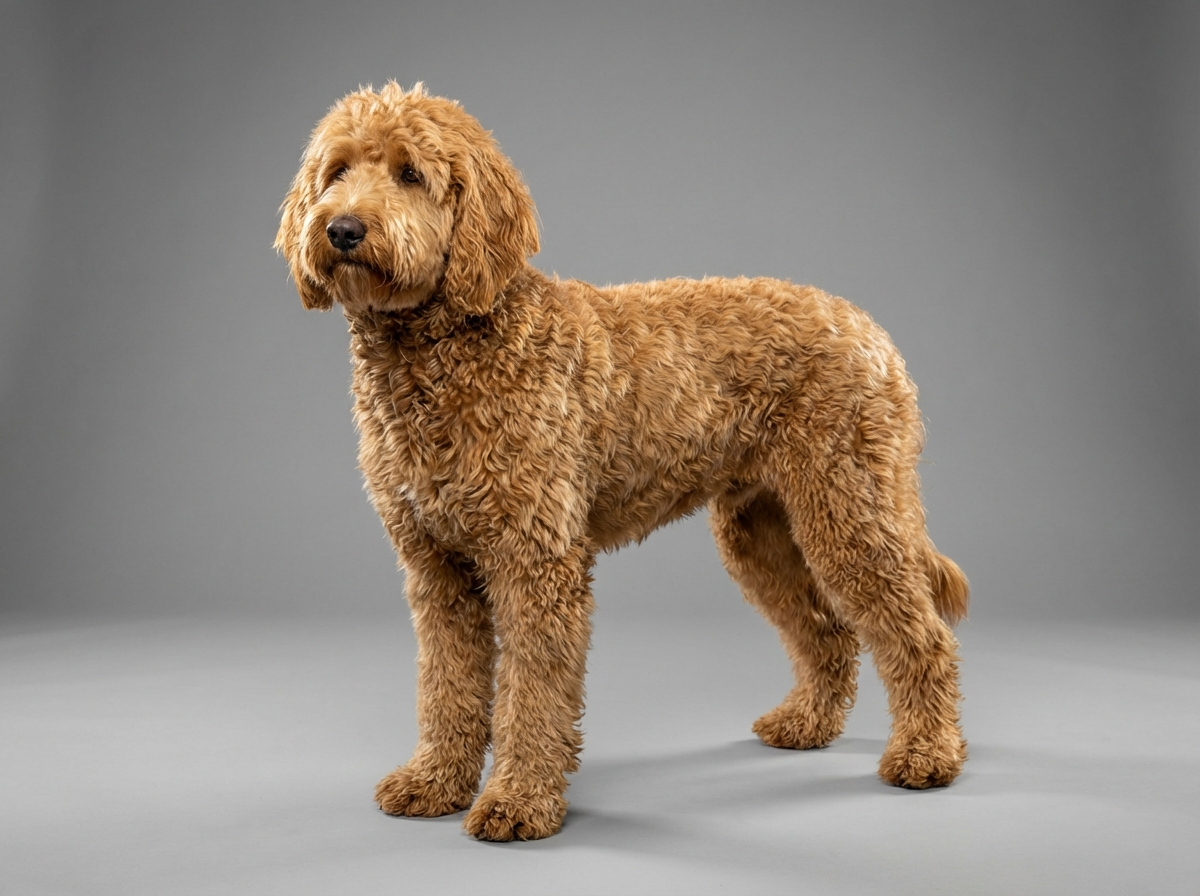
When a vet formally assesses a dog for Brachycephalic Obstructive Airway Syndrome, the exam checks specific, measurable anatomical points: nostril width, muzzle-to-skull proportion, and resting and post-exercise breathing sounds. For a Goldendoodle, these checks reliably come back normal, because neither parent breed contributes the flattened muzzle conformation the syndrome depends on.
A BOAS-focused exam is not a standard or necessary screening for this breed given its documented normal muzzle anatomy, though it's a reasonable, quick check for a vet to perform if an owner specifically raises the concern.
Golden Retriever and Poodle ancestry both contribute proportionate muzzle length relative to skull width, which is the core anatomical measurement a BOAS exam assesses. Because neither parent breed carries the flattened conformation that defines brachycephaly, the exam findings for this breed are expected to be normal.
Heat, humidity, and exercise intensity are the environmental factors that most influence how hard any dog breathes, brachycephalic or not, and are the more likely explanation for any breathing effort an owner notices in this breed.
Talk to your vet if you want a specific breathing concern formally assessed, or if breathing effort seems to be worsening over time or happening even at rest. A routine visit is generally sufficient for this exam in a dog without severe symptoms.
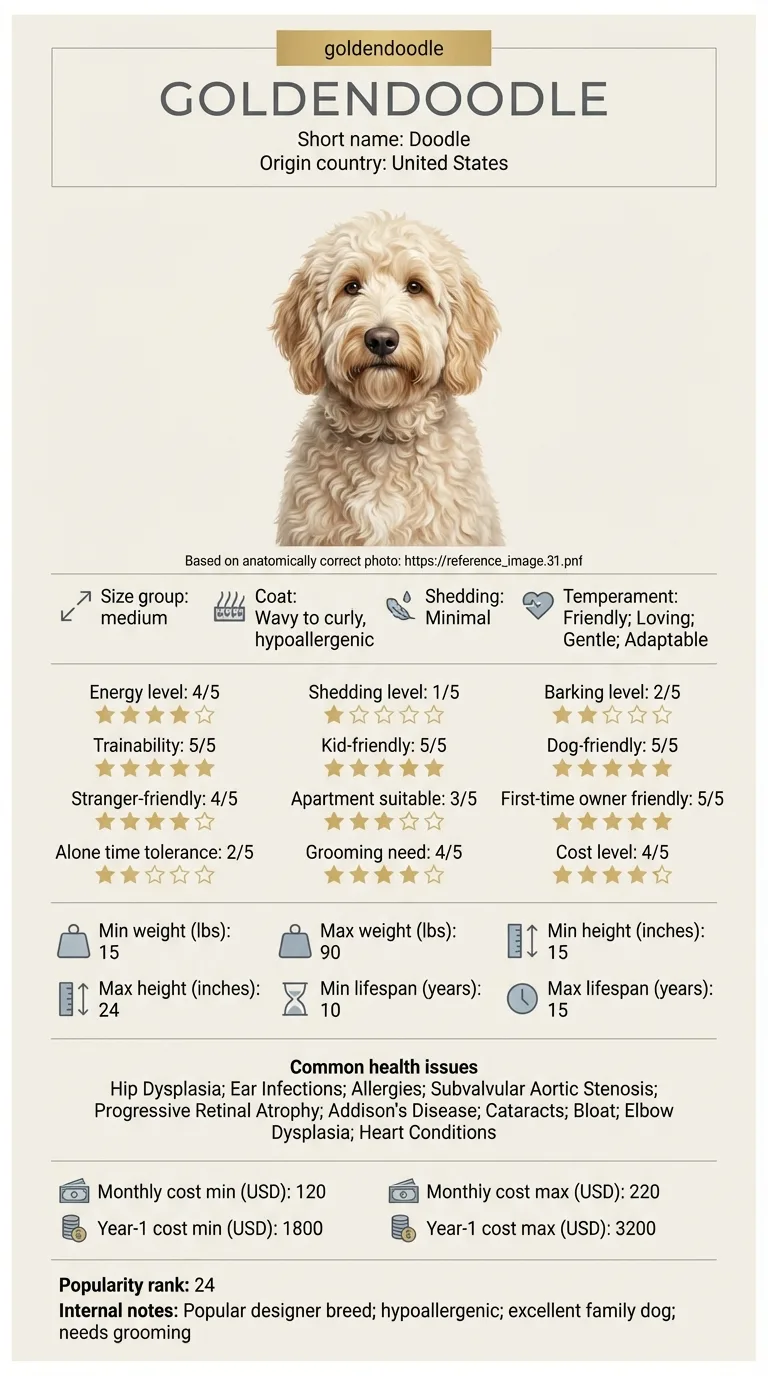
See all Goldendoodle health problems, which breeds are prone to brachycephalic obstructive airway syndrome boas, or the full Goldendoodle breed guide for temperament, exercise needs and ownership costs.
The external BOAS assessment takes just a few minutes as part of a standard vet visit, with results and next steps, if any, available immediately.
Success looks like a clear, documented normal finding that puts the specific BOAS concern to rest, freeing you to address the actual cause of any breathing effort you noticed, whether that's heat, fitness, or something else entirely.
A vet working through a BOAS assessment typically checks each of these specific points, and here's what's normally found in this breed.
After noticing her Goldendoodle Rosie breathing a little heavily after a warm-weather hike, Nadia asked her vet directly whether it could be BOAS. Rather than dismissing the question, her vet walked through the exam step by step: checking Rosie's nostrils, muzzle proportion, and listening to her breathing at rest and after a short walk around the clinic. Everything came back normal, exactly as expected for the breed. Her vet then asked about Rosie's coat maintenance and fitness routine, which led to the real explanation — a thick summer coat that hadn't been trimmed yet and a hike that was more strenuous than Rosie's current conditioning level.
Key takeaway: Asking a vet to specifically check for BOAS, rather than guessing from a symptom alone, gives a concrete answer — and for this breed, that answer reliably points you toward the actual, more likely cause instead.
Nostril width, muzzle-to-skull proportion, resting and post-exercise breathing sounds, and a history of heat and exercise tolerance are the main components of an external BOAS-focused exam.
A full internal assessment of the soft palate and throat structures does require sedation, but this is generally only pursued if the external exam and history raise a specific concern, not as routine screening for this breed.
Open, wide nostrils, a proportionate muzzle length relative to skull width, and quiet breathing at rest and after mild activity — this is the typical, expected finding given the breed's non-brachycephalic ancestry.
A thorough vet takes owner concerns seriously and rules things out directly rather than assuming, which is good practice — the exam itself is quick and non-invasive at the external level.
Occasional soft snoring during deep sleep is common in many dogs regardless of muzzle shape and isn't itself diagnostic of BOAS. Persistent, loud, obstructed-sounding breathing while awake is a different and more concerning pattern.
A sedated airway exam, sometimes combined with imaging, typically runs a few hundred dollars, though this level of workup is uncommon to need for this breed absent a specific concerning finding.
Typically nothing further is needed — a normal result means ongoing panting or breathing effort you noticed has a different cause, like heat, fitness level, or coat density, worth addressing on its own terms.
Nostril width, muzzle proportion, and breathing sounds at rest and after mild exercise are the main external checks a vet performs.
The external assessment is quick and non-invasive. A full internal exam under sedation is only pursued if something specific raises concern.
Normal, open nostrils and quiet breathing, consistent with a proportionate, non-brachycephalic muzzle.
It's reasonable to mention any breathing concern you've noticed, and your vet can quickly assess the relevant anatomy during a routine visit.
A standard wellness exam that includes this kind of assessment is typically within the range of a normal vet visit fee.
A one-page prep sheet for this condition: the signs, the questions to ask, what to get priced. Unlocks here.
You get: Vet visit prep sheet
No spam. One-click unsubscribe. See our privacy policy.
Preview page 1 before you decide.