Health
What's the fastest sign my Goldendoodle has an eye injury?
Squinting or holding one eye shut right after outdoor activity is the clearest early sign — check that eye closely the same day.

Quick answer
What's the fastest sign my Goldendoodle has an eye injury?
Squinting or holding one eye shut right after outdoor activity is the clearest early sign — check that eye closely the same day.
This page is about eye injuries from everyday outdoor activity, not the hereditary eye disorders some Goldendoodles are born with — that's covered separately.
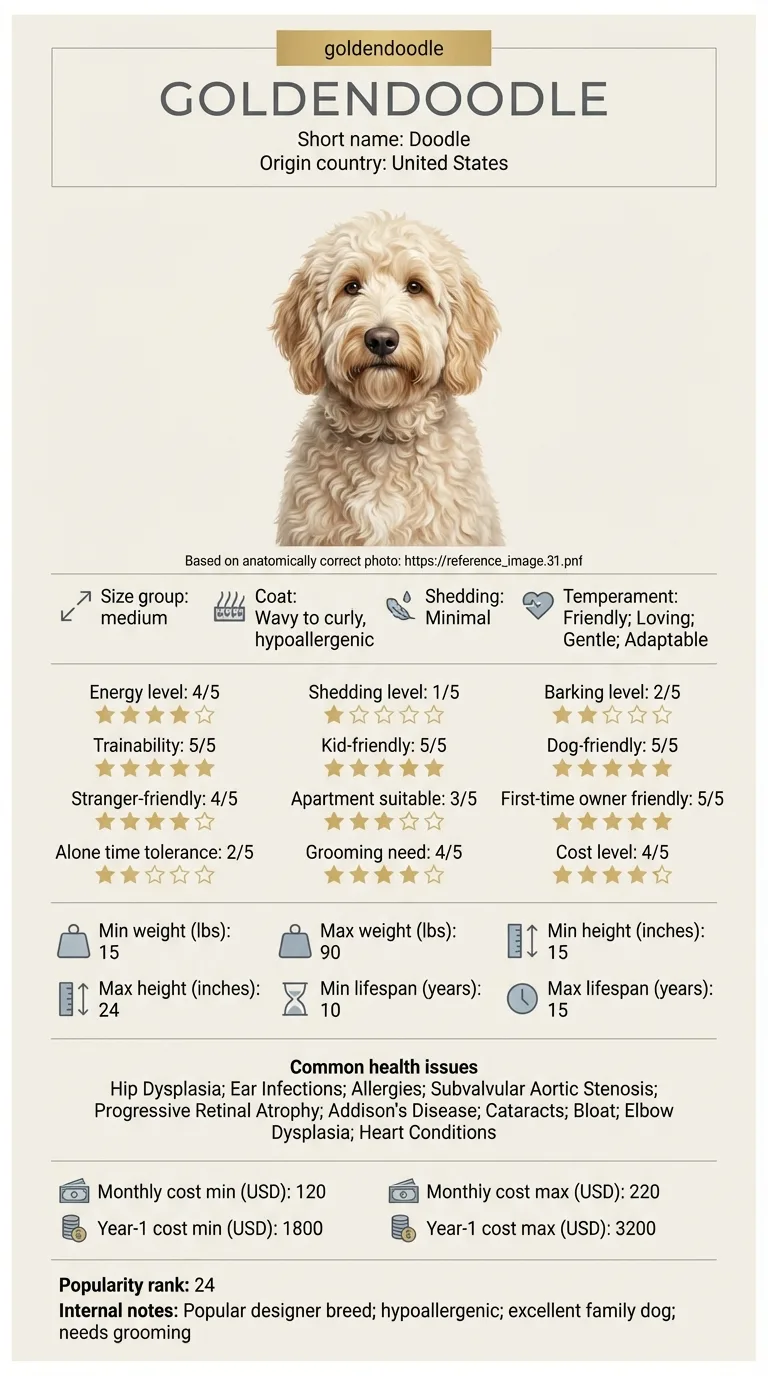
Owners with a genuinely active Goldendoodle: dogs that fetch daily, swim in lakes or rivers, or spend a lot of time off-leash in wooded or overgrown areas are the ones most likely to see a scratched cornea or a piece of debris caught under an eyelid.
This guide is not medical advice. If your dog shows pain, sudden behavior change, or worsening symptoms, consult a licensed veterinarian.
Some links may be affiliate links. We may earn a commission at no extra cost to you. We only suggest products we believe are helpful for dog owners.
We research and check what we publish, but we do not warrant that any figure, date, price, or statement is accurate, complete, or current, and we accept no liability for any loss, cost, injury, or other harm arising from the use of this site. Use it as one reference among several. You remain responsible for your own decisions and for your dog's care - confirm anything that matters with a licensed veterinarian or another qualified professional before you act on it. Full disclaimer.
Check this first
Any eye change right after fetch, a swim, or a walk through brush deserves a same-day look. Squinting, pawing at one eye, visible redness, cloudiness, or discharge signal something is physically wrong, and a shallow scratch can become a deeper ulcer within a day or two if it isn't protected.
A foreign body like a grass seed trapped under the eyelid keeps scraping the eye with every blink until it's removed — that's a same-day-vet situation, not something to manage at home with a rinse and a wait.
Milder cases — a little watery discharge with no squinting, no redness, and a dog acting otherwise normal — can be monitored for a few hours. If it hasn't cleared by the next check, or squinting or pawing starts, call the vet.
The general rule here: any eye symptom paired with pain behavior (squinting, pawing, keeping the eye shut) should be seen the same day, because the cost of being wrong is a damaged cornea.
If any of these apply, call your vet or an emergency clinic now. The rest of this page is for the cases that are not an emergency.
This covers external, traumatic eye problems in Goldendoodles: corneal scratches from brush or swimming, foreign bodies like grass seeds under the eyelid, and irritation from this breed's own longer facial hair. These are injury-driven, not inherited eye disease.
There's no breed-specific injury rate documented for Goldendoodles, but a dog with a high outdoor exercise drive and longer facial hair — both true of this breed — faces more everyday chances for a scratch or trapped debris than a lower-energy, short-coated dog would.
Goldendoodles come from two breeds built for outdoor work — the Golden Retriever's fetching drive and the Poodle's athleticism — and this breed's high exercise need means most individuals spend real time running, swimming, and pushing through brush. The wavy-to-curly coat's longer facial furnishings also put more hair near the eye, which can curl inward or trap moisture after a swim or bath.
Grass seeds, thorny brush, silty lake water, and dusty trails are the direct sources of scratches and trapped debris, and wind exposure from car rides adds another everyday opportunity for contact with the eye's surface.
Call the same day if you see squinting, pawing or rubbing at one eye, visible redness, cloudiness, or any discharge after outdoor activity — these signs point to a scratch, ulcer, or trapped foreign body that can worsen quickly if left untreated.
Most eye injuries in an active Goldendoodle start small. These are the habits that let a scratch or a piece of trapped debris turn into something more serious.
See all Goldendoodle health problems, which breeds are prone to eye problems, or the full Goldendoodle breed guide for temperament, exercise needs and ownership costs.
A simple scratch treated early with vet-prescribed drops typically improves within a few days to a week. A trapped foreign body usually resolves quickly once removed, though the eye may stay sensitive for several days afterward.
Success looks like catching irritation early enough that it never becomes a deep ulcer — a dog whose eyes get checked after outdoor activity, whose facial hair stays trimmed back, and whose squinting or redness gets a same-day look instead of a wait-and-see approach.
Renata Alves took her Goldendoodle Finn on his usual after-work run through a field trail outside Missoula, MT. By dinner, Finn was pawing at his left eye and holding it half shut. Renata called an emergency vet line rather than waiting until morning. The vet found a grass seed lodged under his lower eyelid, already scraping a scratch into the cornea with every blink. It was removed that evening, and Finn went home with drops. Renata now checks his eyes every time they come back from that trail.
Key takeaway: A same-day call turned what could have been a deepening ulcer into a same-evening fix — waiting until morning would have meant several more hours of a seed scraping Finn's eye.
There's no documented unique injury-prone eye structure, but this breed's active, retriever-heritage lifestyle puts their eyes in contact with debris more often than a less active dog's, and longer facial hair adds another source of irritation.
This page covers external causes: scratches, foreign bodies, and hair irritation from outdoor activity. Hereditary conditions like progressive retinal atrophy or cataracts are a separate topic with a different cause and management path.
Yes, treat it as same-day. Squinting after outdoor activity is one of the clearest signs of a corneal scratch or trapped debris, and both can worsen quickly if the eye keeps blinking against whatever is irritating it.
Yes. Grass seeds, awns, and small plant debris can slide under the upper or lower eyelid during a run through tall grass or brush and stay lodged there, scraping the eye's surface with every blink until a vet removes them.
Use blunt-tipped scissors to hold hair away from the eye while trimming small amounts, never pointing scissors toward the eye. Many owners leave this precise area to a groomer instead.
Swimming itself isn't inherently harmful, but lake and pond water carries silt, algae, and plant debris that can irritate the eyes, and matted wet facial hair can rub against the cornea afterward. Rinsing the face and checking both eyes after a swim reduces the risk.
A saline rinse can help with mild surface debris, but if the dog is squinting or the debris is visibly stuck under the eyelid, home flushing isn't a substitute for a vet removing it safely.
Squinting or holding one eye shut right after outdoor activity is the clearest early sign — check that eye closely the same day.
A quick look after every hike, swim, or session of fetch in brush is enough for most active Goldendoodles; no special daily routine is needed beyond that.
A simple scratch may just need vet-prescribed drops, while a foreign body removal or a deeper ulcer typically costs more and may need a follow-up visit — costs vary by clinic and severity.
A reliable recall and a solid 'leave it' cue help redirect a dog away from dense brush or debris-heavy water edges before an injury happens.
Yes — expect pawing at the face, rubbing against furniture or the ground, reluctance to have the face touched, or general irritability until the discomfort is addressed.
A one-page prep sheet for this condition: the signs, the questions to ask, what to get priced. Unlocks here.
You get: Vet visit prep sheet
No spam. One-click unsubscribe. See our privacy policy.
Preview page 1 before you decide.