Health
Is BOAS a real risk for Goldendoodles?
No, it's not a documented risk. BOAS describes airway obstructions specific to flat-faced skull shapes that this breed's ancestry doesn't include.

Quick answer
Is BOAS a real risk for Goldendoodles?
No, it's not a documented risk. BOAS describes airway obstructions specific to flat-faced skull shapes that this breed's ancestry doesn't include.
If you've seen 'BOAS' mentioned for Goldendoodles, it's worth knowing this term describes a specific skull shape this breed doesn't have — the breathing effort you might actually be noticing has a different, unrelated explanation.
This mostly comes up for owners who've read general brachycephalic breed warnings online and are trying to work out whether they apply, and for owners of Goldendoodles who pant heavily in heat and want to understand whether that's a structural airway problem or something else.
This guide is not medical advice. If your dog shows pain, sudden behavior change, or worsening symptoms, consult a licensed veterinarian.
Some links may be affiliate links. We may earn a commission at no extra cost to you. We only suggest products we believe are helpful for dog owners.
We research and check what we publish, but we do not warrant that any figure, date, price, or statement is accurate, complete, or current, and we accept no liability for any loss, cost, injury, or other harm arising from the use of this site. Use it as one reference among several. You remain responsible for your own decisions and for your dog's care - confirm anything that matters with a licensed veterinarian or another qualified professional before you act on it. Full disclaimer.
Check this first
Regardless of muzzle shape, any dog showing loud, labored breathing, blue-tinged or grey gums, collapse, or an inability to cool down after exertion in heat is having a breathing emergency and needs immediate veterinary care. This is true for a Goldendoodle exactly as it's true for a Bulldog — the underlying anatomical cause differs, but the urgency of the symptom does not.
What's more likely behind heavy panting or breathing effort in a Goldendoodle is heat retention from a dense, curly coat, being overweight, being out of shape for the level of exercise attempted, or an unrelated condition like a laryngeal or tracheal issue that isn't connected to brachycephaly at all. Persistent noisy breathing that doesn't resolve with rest and cooling down deserves a vet exam to identify the actual cause rather than being assumed to be a brachycephalic airway problem.
A Goldendoodle panting hard after vigorous play on a hot day, that recovers within a reasonable rest period once shaded and given water, is showing a normal thermoregulation response, not a structural airway emergency — the distinction is whether the effort resolves with rest or continues to worsen.
If any of these apply, call your vet or an emergency clinic now. The rest of this page is for the cases that are not an emergency.
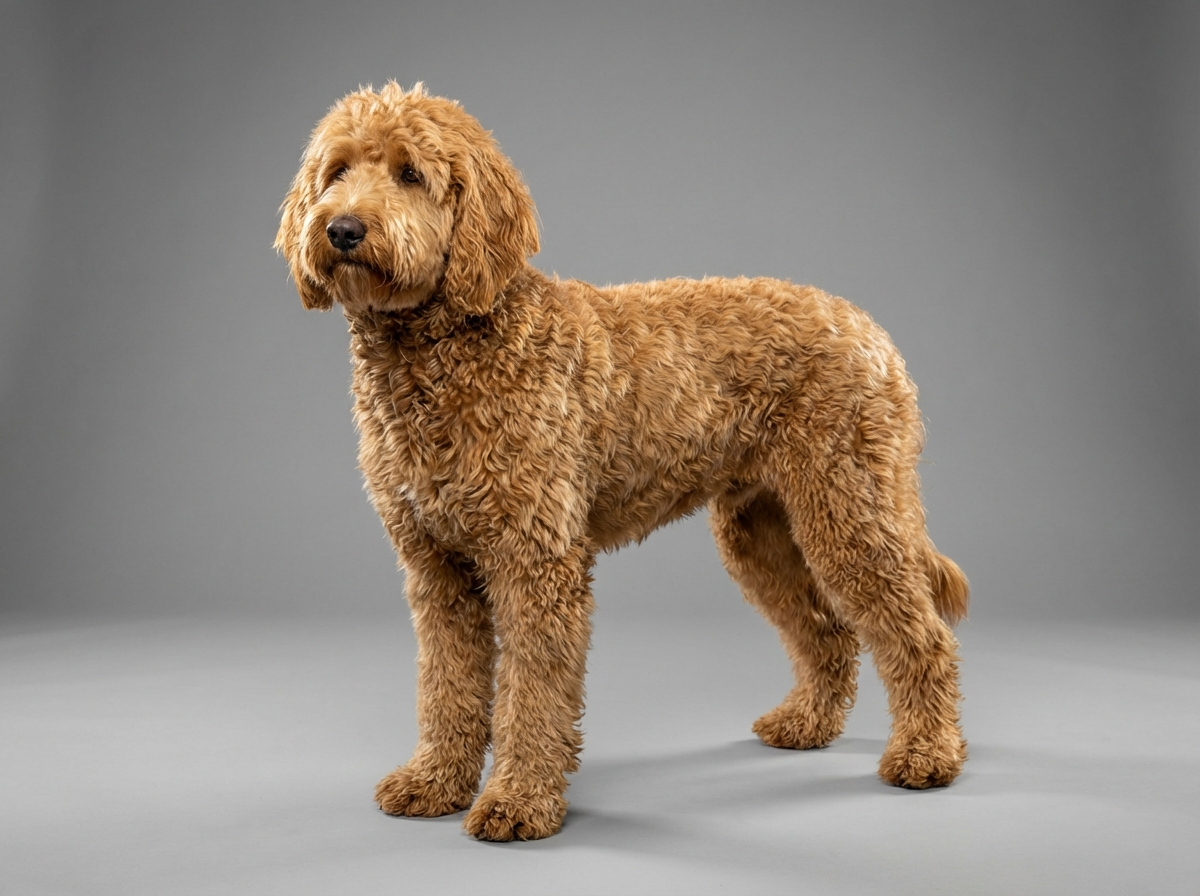
Brachycephalic Airway Syndrome describes a specific set of structural airway abnormalities — narrowed nostrils, an elongated soft palate, and related tissue changes — found in flat-faced dog breeds. A Goldendoodle inherits a normal, proportionate muzzle from both Golden Retriever and Poodle ancestry, neither brachycephalic, so this specific syndrome is not a realistic diagnosis here. Breathing effort or panting in this breed almost always traces to a different, unrelated cause.
True BOAS is essentially undocumented in this breed, since the anatomical prerequisites for the syndrome aren't part of its inherited structure. Heat-related panting and exercise caution, by contrast, are a realistic and common consideration for the breed's coat type.
Neither Golden Retriever nor Poodle lines carry the flattened muzzle conformation that defines brachycephalic breeds, so a Goldendoodle does not inherit the structural airway traits — narrowed nostrils, excess soft palate tissue — that cause BOAS. What the breed does inherit is a dense, low-shedding coat that retains heat more than a short, flat coat would.
Ambient heat and humidity are the main environmental factors affecting this breed's breathing effort and panting, working through heat retention in the coat rather than through any airway obstruction.
Talk to your vet if breathing effort or noisy breathing doesn't resolve with rest and cooling, if it's getting worse over time, or if you notice it happening even at rest. These patterns suggest an unrelated cause worth properly diagnosing rather than assuming a brachycephalic explanation that doesn't fit this breed's anatomy.
See all Goldendoodle health problems, which breeds are prone to brachycephalic airway syndrome boas, or the full Goldendoodle breed guide for temperament, exercise needs and ownership costs.
Normal heat-related panting resolves within minutes of rest, shade, and water. Any breathing issue that doesn't follow that pattern warrants a vet visit rather than a wait-and-see timeline.
Success looks like recognizing that this breed's heat and exercise caution comes from coat type, not airway anatomy, and managing accordingly — not searching for a brachycephalic explanation that doesn't apply here.
The syndrome is defined by specific, physical structural abnormalities, not by panting or heat sensitivity alone.
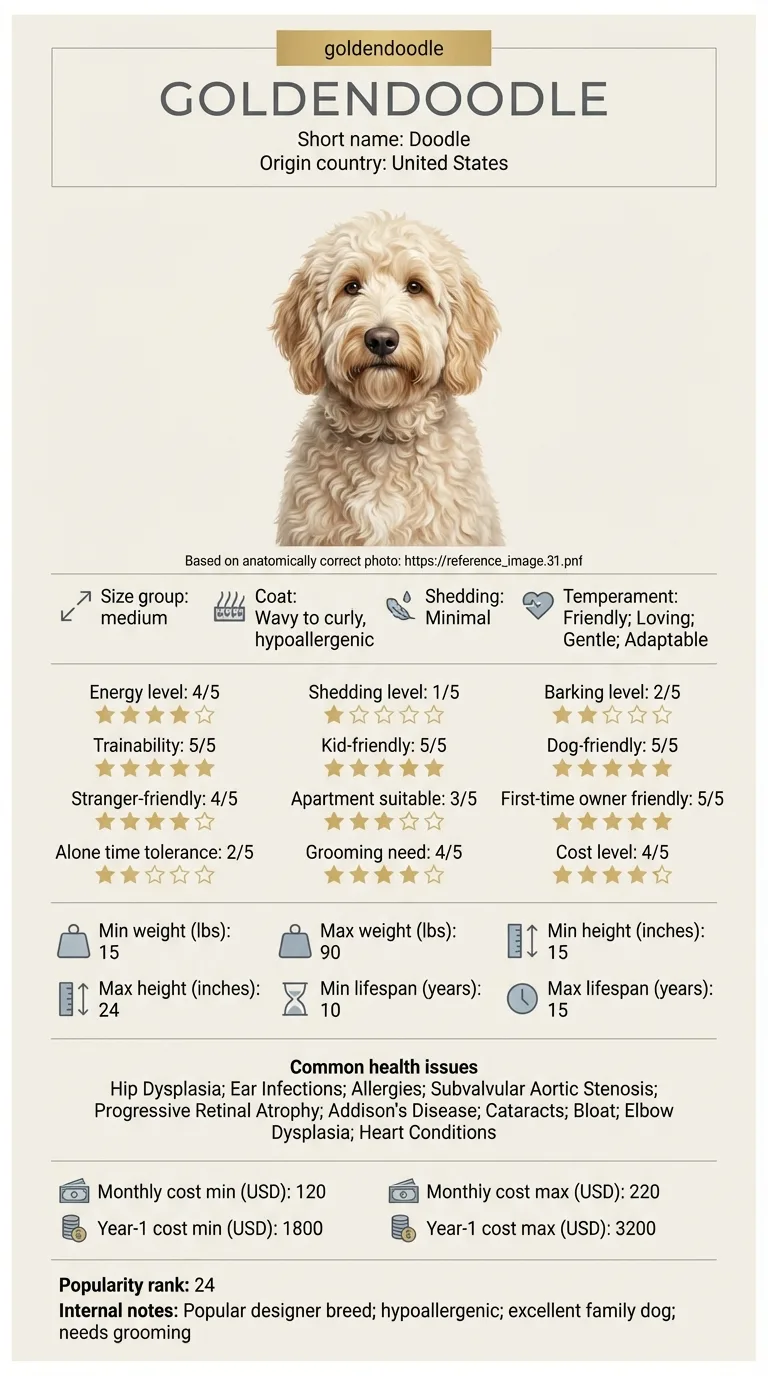
If you think your Doodle has brachycephalic airway syndrome (boas), the plan is three steps: write down what you have seen and when it started, book a veterinary appointment rather than waiting for the next flare, and take video of the behaviour or symptom before you go — the thing you are worried about rarely happens in the consulting room. Screening in the parents covers hip dysplasia, ear infections, allergies.
What the vet visit should produce is a diagnosis and a written plan, not just reassurance: what is being ruled out, what the monitoring interval is, and which signs mean you come back sooner. Ask what the treatment costs across a year rather than per visit, because that is the number that decides whether you are managing this condition or reacting to it.
Between appointments, keep a short log — dates, what you saw, what changed. It is the single most useful thing an owner brings to a follow-up, and for brachycephalic airway syndrome (boas) it is often what separates a clear pattern from a guess.
After reading a general list of 'brachycephalic breeds to watch for airway problems' that vaguely mentioned doodles, Farah became convinced her Goldendoodle Bailey might have BOAS after he panted hard on a summer walk. Her vet examined Bailey's nostrils, throat, and breathing pattern and found completely normal anatomy for the breed — no narrowed nostrils, no excess soft palate tissue. The actual cause of Bailey's heavy panting was his thick coat combined with a hot, humid afternoon walk. Farah adjusted their walk times to early morning and had Bailey's coat trimmed shorter for summer, and the heavy panting eased considerably.
Key takeaway: Generic 'brachycephalic breed' lists online don't always specify anatomy accurately — a proper vet exam, not a list, is what actually confirms whether a breathing concern has a structural cause.
It would be genuinely unusual, since BOAS describes structural airway abnormalities tied to a flattened muzzle, and neither Golden Retriever nor Poodle ancestry carries that skull shape. It's not a documented risk for this breed.
A dense, curly coat retains heat more than a short, flat coat, which can make a Goldendoodle pant more heavily in heat than a similarly built dog with less coat, without any airway obstruction being involved.
Bulldogs, French Bulldogs, Pugs, Boston Terriers, and other flat-faced breeds are the ones with the documented anatomical traits — narrowed nostrils, elongated soft palate, and related structural changes — that define the syndrome.
Ordinary panting that resolves with rest is normal. Persistent noisy or labored breathing that doesn't improve with rest and cooling should be evaluated by a vet, since it could point to an unrelated cause rather than brachycephaly.
No. Grooming style is purely cosmetic and doesn't change the underlying skull or airway anatomy at all, even if a rounded face trim visually resembles a flatter-faced look.
No, heat sensitivity here relates to coat density and heat retention, an entirely different mechanism from the airway obstruction that causes heat intolerance in truly brachycephalic breeds.
A physical exam checking nostril size, throat structure, and breathing sounds, along with a history of when breathing effort occurs, is generally sufficient to confirm the normal anatomy expected for this breed.
No, it's not a documented risk. BOAS describes airway obstructions specific to flat-faced skull shapes that this breed's ancestry doesn't include.
Coat density and heat retention, being out of shape or overweight, or an unrelated throat or airway issue — not a brachycephalic airway obstruction.
Yes, moderating exercise intensity and timing during hot weather is a reasonable precaution for a heavily coated breed, regardless of muzzle shape.
A standard physical exam is usually within the range of a routine vet visit, with additional imaging costing more if a structural issue is actually suspected.
A shorter, well-maintained summer trim can help with heat management by reducing coat insulation, separate from any airway consideration.
A one-page prep sheet for this condition: the signs, the questions to ask, what to get priced. Unlocks here.
You get: Vet visit prep sheet
No spam. One-click unsubscribe. See our privacy policy.
See a sample page before you decide.
Early access list
The free prep sheet covers the same-day warning signs, a symptom log and the questions to ask. We are considering a fuller kit that adds a cost worksheet for the usual tests and treatments (US price ranges with their sources) and a plain-English guide to ways of covering the bill. It is not built yet; this list tells us whether it is worth building.
One email, no spam, unsubscribe anytime. Information only, not veterinary advice.