Health
Is cardiomyopathy one specific disease?
No, it's a category meaning heart-muscle disease broadly, with dilated cardiomyopathy being the most relevant specific type in dogs.

Quick answer
Is cardiomyopathy one specific disease?
No, it's a category meaning heart-muscle disease broadly, with dilated cardiomyopathy being the most relevant specific type in dogs.
Before assuming a diagnosis, it helps to know that 'cardiomyopathy' is an umbrella term covering several genuinely different heart-muscle conditions, and getting the specific one right changes everything about management.
This is most useful for owners who've heard the word 'cardiomyopathy' from a vet or online and want to understand what it actually means before assuming the worst, and for owners trying to understand why a genetic test result for their mixed-breed dog comes with more uncertainty than it might for a purebred littermate.
This guide is not medical advice. If your dog shows pain, sudden behavior change, or worsening symptoms, consult a licensed veterinarian.
Some links may be affiliate links. We may earn a commission at no extra cost to you. We only suggest products we believe are helpful for dog owners.
We research and check what we publish, but we do not warrant that any figure, date, price, or statement is accurate, complete, or current, and we accept no liability for any loss, cost, injury, or other harm arising from the use of this site. Use it as one reference among several. You remain responsible for your own decisions and for your dog's care - confirm anything that matters with a licensed veterinarian or another qualified professional before you act on it. Full disclaimer.
Check this first
Regardless of the specific subtype, advanced cardiomyopathy can produce the same dangerous symptoms: labored breathing at rest, a swollen abdomen from fluid buildup, collapse, or pale or blue-tinged gums. These require emergency veterinary care immediately, since they can indicate the heart is failing to pump effectively and fluid is backing up into the lungs or abdomen.
A new diagnosis based on an incidental murmur or mild symptoms like reduced exercise tolerance is a different, less urgent situation — it calls for a structured diagnostic workup, typically an echocardiogram and ECG, scheduled within a reasonable timeframe rather than as a same-day emergency.
Once a specific type of cardiomyopathy is diagnosed and a management plan is started, watch for any new decline — worsening cough, increased breathing effort, or reduced energy — since these can signal the disease progressing and usually warrant a prompt recheck rather than waiting for the next scheduled follow-up.
If any of these apply, call your vet or an emergency clinic now. The rest of this page is for the cases that are not an emergency.
Cardiomyopathy is an umbrella term for heart-muscle disease, distinct from valve problems or rhythm disorders, and the diagnostic process is about identifying the specific subtype rather than treating the word as one single condition. In a crossbred dog, genetic testing panels developed for purebred at-risk breeds carry more uncertainty, making a thorough echocardiogram-based workup the more reliable path to an accurate diagnosis.
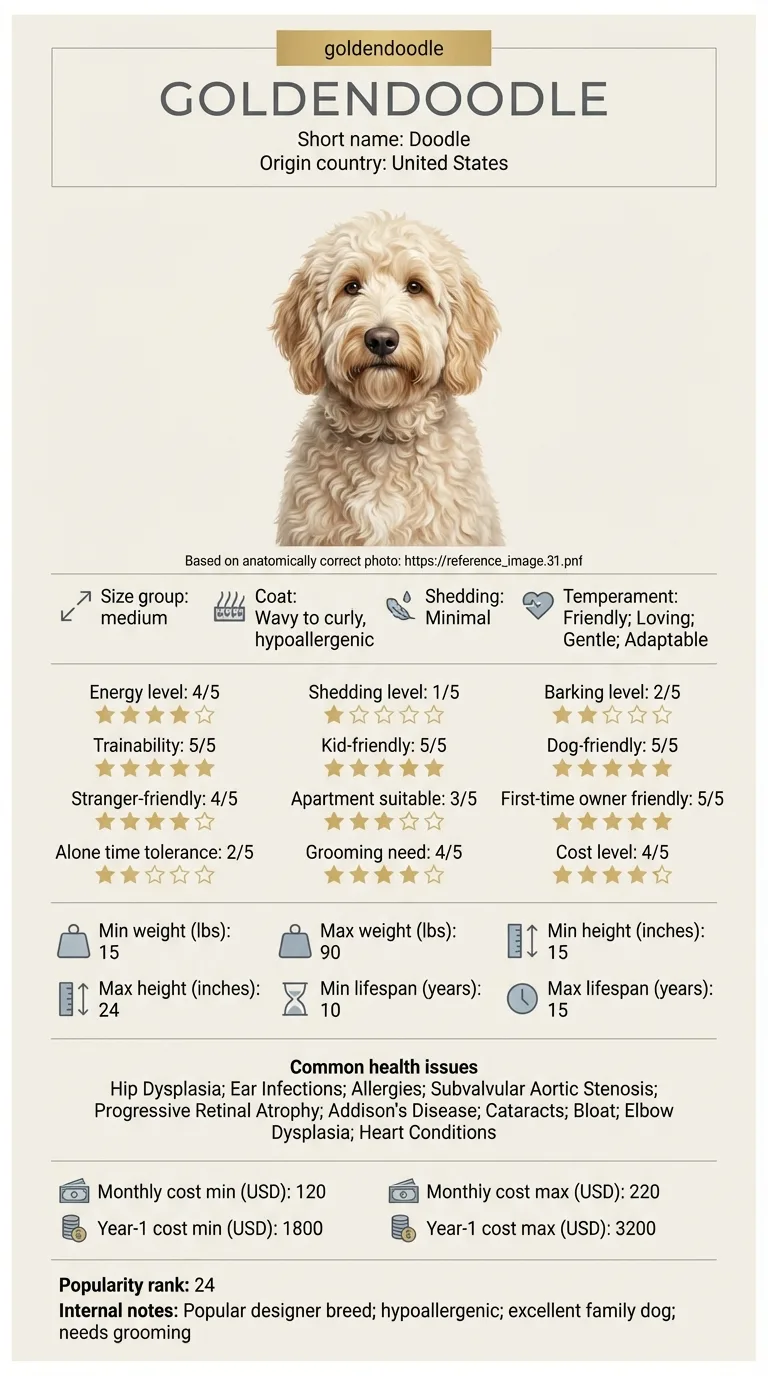
Heart conditions broadly are documented as a common health issue in this breed, though cardiomyopathy specifically requires diagnostic confirmation to distinguish from the more directly documented valve-related risk, subvalvular aortic stenosis.
This breed's documented cardiac risk is primarily subvalvular aortic stenosis, a valve-area structural issue inherited through Golden Retriever lines, which is mechanically distinct from cardiomyopathy. When true heart-muscle disease does occur, it follows the same general dilated cardiomyopathy pattern seen across medium and large breed dogs rather than a documented Goldendoodle-specific muscle disease pathway.
Diet composition has been investigated as a contributing environmental factor in some dilated cardiomyopathy cases across multiple breeds, which is why a full nutritional history is part of a proper workup regardless of the dog's specific ancestry.
Talk to your vet about any new murmur, reduced exercise tolerance, or unexplained fatigue, and request a full diagnostic workup rather than assuming a specific cause. Seek emergency care immediately for labored breathing at rest, abdominal swelling, collapse, or pale or blue-tinged gums.
See all Goldendoodle health problems, which breeds are prone to cardiomyopathy, or the full Goldendoodle breed guide for temperament, exercise needs and ownership costs.
A full diagnostic workup, including echocardiogram and ECG, typically produces a clear answer within one to two visits, sometimes with a referral to a veterinary cardiologist for more complex or uncertain findings.
Success looks like an accurate, specific diagnosis — knowing exactly which condition is actually present — rather than treating 'cardiomyopathy' as a vague, catch-all worry that never gets resolved into an actual management plan.
The diagnostic process is about ruling things in and out systematically, not applying the word as a single label.
After an online search, Talia was convinced her Goldendoodle Finn had cardiomyopathy based on his occasional cough and low energy. Her vet ran a full workup, including an echocardiogram and ECG, and found Finn's heart muscle was completely normal — the actual issue was a mild, previously undiagnosed subvalvular aortic stenosis, a valve-area condition documented in this breed. Talia had assumed the wrong category entirely based on a vague online description. With the correct diagnosis, Finn's vet set up an appropriate monitoring schedule specific to SAS, which turned out to be far more manageable than the muscle-disease outcome Talia had feared.
Key takeaway: Getting the specific diagnosis right, rather than assuming a broad category label from symptoms alone, changes both the treatment plan and the realistic outlook.
It refers specifically to disease of the heart muscle itself, distinct from valve disease or electrical rhythm disorders, even though all three can cause overlapping symptoms like fatigue or breathing difficulty.
Primarily through an echocardiogram, which directly visualizes heart chamber size and muscle function, often alongside an ECG to separately assess electrical rhythm and bloodwork to check for nutritional or other contributing factors.
Dilated cardiomyopathy is the general condition, and diet has been investigated as one possible contributing factor in some cases across various breeds, though not every case of dilated cardiomyopathy is diet-related.
Genetic panels exist for specific purebred at-risk breeds, but their predictive value is less established in a crossbred dog, since the combined or diluted genetic background changes how reliably those markers apply.
No, they're mechanically different. SAS is a structural narrowing affecting blood flow through a valve area; cardiomyopathy is a disease of the heart muscle itself. Both can be picked up on an echocardiogram, but they're distinct diagnoses.
Treatment is tailored to the specific type and severity, often including medication to support heart function, dietary review, and regular follow-up echocardiograms to track progression.
This is set individually by your cardiologist or vet based on severity and stability, but regular monitoring, often every several months to a year, is standard once a diagnosis is confirmed.
No, it's a category meaning heart-muscle disease broadly, with dilated cardiomyopathy being the most relevant specific type in dogs.
An echocardiogram directly shows whether the heart muscle itself or a valve structure is the source of the problem.
An echocardiogram and ECG together commonly run several hundred dollars, with ongoing monitoring adding to that over time.
Yes, a full diet history is a standard part of the diagnostic workup, since some cases have a nutritional component worth identifying.
Less reliable than for purebred at-risk breeds, since existing panels weren't developed or validated against crossbred genetic backgrounds.
A one-page prep sheet for this condition: the signs, the questions to ask, what to get priced. Unlocks here.
You get: Vet visit prep sheet
No spam. One-click unsubscribe. See our privacy policy.
Preview page 1 before you decide.