Behavior
Which should most people pick?
The Goldendoodle is the more forgiving all-around choice — better with kids, easier for new owners, and more apartment-tolerant, though at a higher grooming cost.

Quick answer
Which should most people pick?
The Goldendoodle is the more forgiving all-around choice — better with kids, easier for new owners, and more apartment-tolerant, though at a higher grooming cost.
German Shorthaired Pointer or Goldendoodle? On paper they differ most on good for first-time owners, and on the scales German Shorthaired Pointer is the heavier at 45–70 lbs. Here is how the two compare on everything that shapes an ordinary week.
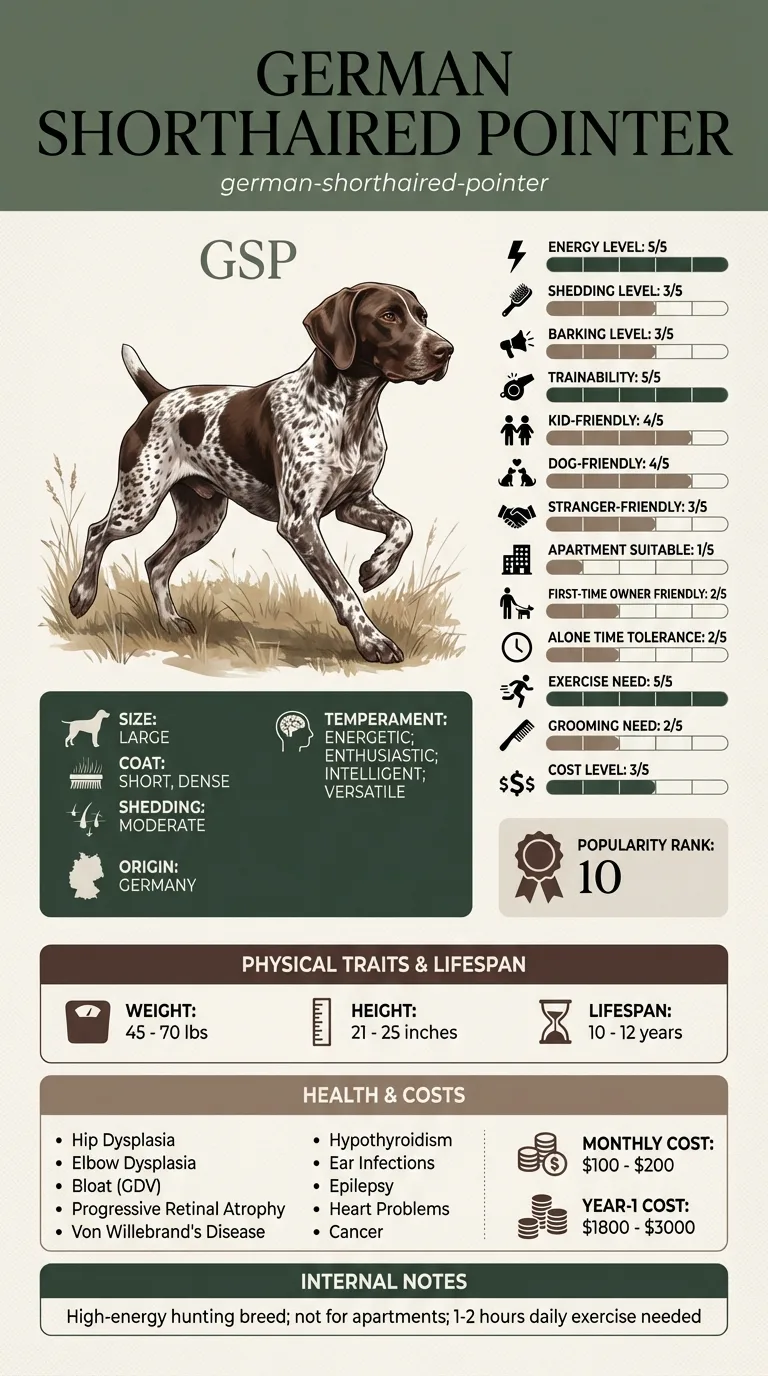
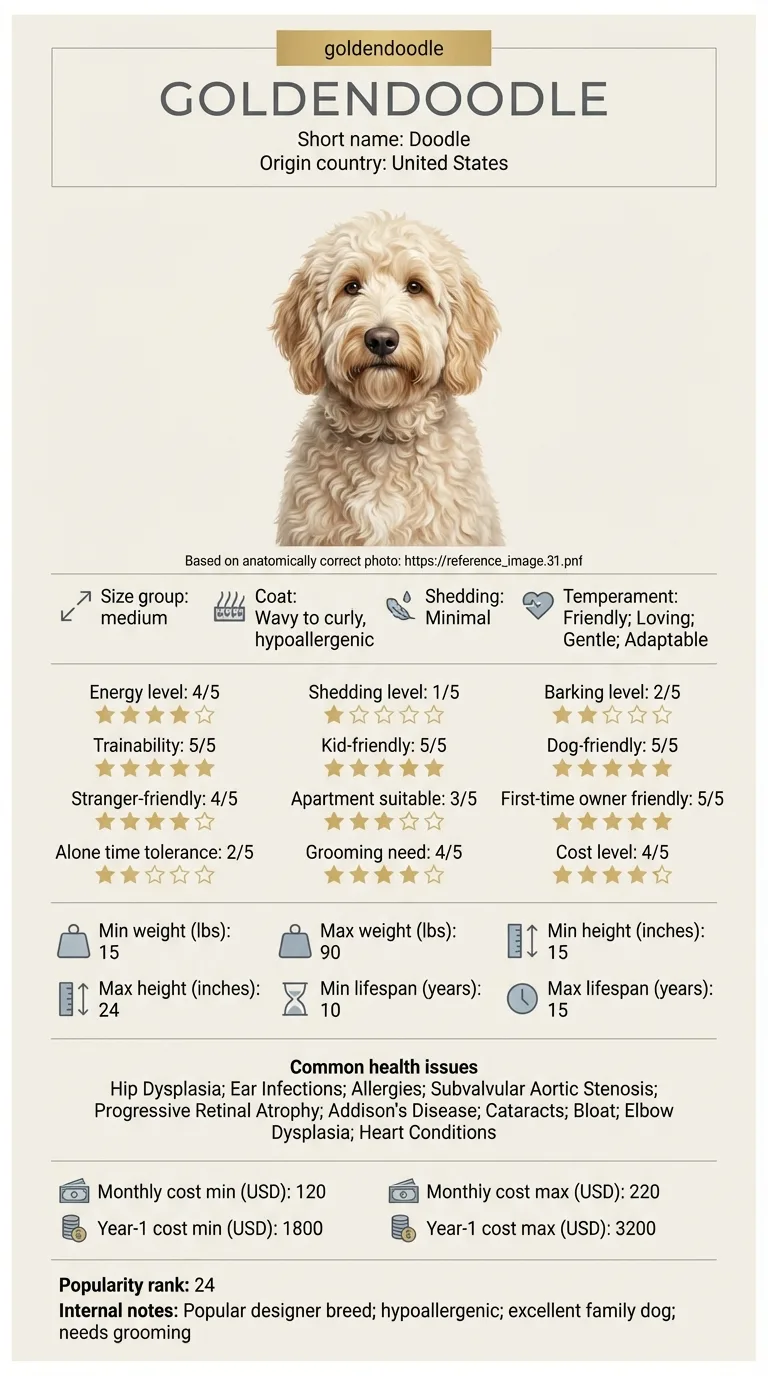
This is for someone already down to German Shorthaired Pointer and Goldendoodle and deciding between them. For this pair the decision usually turns on good for first-time owners and grooming need, so those are covered first and in most detail. Anyone choosing from a flat has a clear answer here: Goldendoodle rates 3/5 against 1/5. The focus throughout is on daily consequences rather than breed background.
Between German Shorthaired Pointer and Goldendoodle, good for first-time owners is what separates them, and Goldendoodle is the lower-effort dog of the two to keep.
Choose German Shorthaired Pointer if you do not want a standing grooming appointment, you want a dog that can keep up with an active routine and you want a dog that is more watchful with visitors.
Choose Goldendoodle if you are in a flat or a smaller home, this is your first dog and shedding is a problem in your house.
| Feature | german shorthaired pointer | goldendoodle | Winner |
|---|---|---|---|
| Size class | large | medium | Equal |
| Weight | 45–70 lbs | 15–90 lbs | Equal |
| Height | 21–25 in | 15–24 in | Equal |
| Lifespan | 10–12 years | 10–15 years | goldendoodle |
| Exercise need | Very high (5/5) | High (4/5) | goldendoodle |
| Grooming need | Low (2/5) | High (4/5) | german shorthaired pointer |
| Shedding | Moderate (3/5) | Very low (1/5) | goldendoodle |
| Energy level | Very high (5/5) | High (4/5) | Equal |
| Barking | Moderate (3/5) | Low (2/5) | goldendoodle |
| Apartment suitability | Very low (1/5) | Moderate (3/5) | goldendoodle |
| Good for first-time owners | Low (2/5) | Very high (5/5) | goldendoodle |
| Tolerates being alone | Low (2/5) | Low (2/5) | Equal |
| Trainability | Very high (5/5) | Very high (5/5) | Equal |
| Good with kids | High (4/5) | Very high (5/5) | goldendoodle |
| Good with other dogs | High (4/5) | Very high (5/5) | goldendoodle |
| Friendly to strangers | Moderate (3/5) | High (4/5) | goldendoodle |
| Cost level | Moderate (3/5) | High (4/5) | german shorthaired pointer |
| Coat | Short, dense | Wavy to curly, hypoallergenic | Equal |
| Origin | Germany | United States | Equal |
| Typical monthly cost | $100–$200 | $120–$220 | Equal |
| Typical first-year cost | $1,800–$3,000 | $1,800–$3,200 | Equal |
The German Shorthaired Pointer is a fixed quantity: 45-70 lbs, 21-25 inches at the shoulder, built for miles in the field. The Goldendoodle is a moving target, with a 15-90 lb range that spans mini, medium, and standard lines depending on the Poodle parent used. If you want to know exactly what you're getting at 8 weeks, the GSP is the safer bet. With a Goldendoodle, ask the breeder which size line you're buying before you fall for a puppy photo.
Both dogs land near the top of the exercise scale, GSP at 5/5 and Goldendoodle at 4/5, so neither is a couch companion. The half-point gap matters less than it looks: a GSP bred for all-day bird hunting wants sustained running, not just a walk, while a Goldendoodle's high energy is more social and play-driven. A tired GSP is a good GSP; a bored one will find its own entertainment, usually destructive.
This is where the two swap places. The GSP's short coat needs almost nothing (2/5 grooming) but sheds moderately (3/5) year-round. The Goldendoodle needs real upkeep (4/5) — brushing several times a week and regular trims to keep the wavy-to-curly coat from matting — but sheds very little (1/5) and is often marketed as hypoallergenic. Pick your chore: brushing a Doodle or vacuuming after a Pointer.
Neither breed is built for apartment life, but the GSP rates dead last at 1/5 while the Goldendoodle is at least moderate (3/5). Both bark at similar-to-lower levels (GSP moderate, Goldendoodle low) and both struggle with being left alone, scoring low (2/5) on tolerating solitude. If you work long hours in a small unit, this pairing has one clear loser, and it's the Pointer.
Both breeds score a perfect 5/5 on trainability, so neither will fight you on obedience work. The real difference shows up in the first-time-owner rating: GSP at 2/5, Goldendoodle at 5/5. That gap isn't about smarts, it's about intensity — a GSP's drive and exercise demands can overwhelm someone without a dog-handling background, while the Doodle's temperament forgives more mistakes.
The Goldendoodle edges out the GSP across the board here: very high with kids (5/5) versus high (4/5), very high with other dogs (5/5) versus high (4/5), and friendlier to strangers (4/5 versus 3/5). None of these gaps are dramatic — the GSP is still a solidly social dog — but if you're weighing a houseful of visiting kids and dogs, the Doodle has the numbers.
The Goldendoodle's 10-15 year lifespan gives it more ceiling than the GSP's 10-12. Both share a real health overlap: hip dysplasia, elbow dysplasia, bloat, and progressive retinal atrophy show up on both lists. The GSP adds Von Willebrand's Disease and epilepsy to its risk sheet; the Goldendoodle carries Addison's Disease and subvalvular aortic stenosis on its own. Ask breeders for testing on whichever conditions apply.
Monthly costs sit close together — $100-200 for the GSP versus $120-220 for the Goldendoodle — and first-year costs overlap almost entirely ($1,800-3,000 versus $1,800-3,200). The GSP rates a step cheaper overall (moderate versus high cost level), which mostly reflects the Doodle's grooming bills rather than food or vet care. Budget for a groomer if you go with the Doodle.
German Shorthaired Pointer weighs 45–70 lbs and lives 10–12 years; Goldendoodle weighs 15–90 lbs and lives 10–15 years. The two diverge most on good for first-time owners, grooming need and apartment suitability and 1 other rated axes. They are level on tolerates being alone and trainability, so those cannot decide it. The table below marks a winner only where one breed is genuinely easier for a typical owner; size and origin are facts rather than merits and stay level. Ratings come from one source applied to both breeds, so they are meaningful against each other rather than as absolute scores.

The GSP is a consistent 45-70 lbs and 21-25 inches. The Goldendoodle's size varies enormously by line, from 15 lbs on the mini end up to 90 lbs on the standard end, so you need to check which type you're actually buying.
The Goldendoodle, by a wide margin — it rates very low (1/5) on shedding versus the GSP's moderate (3/5). That's the main reason people pick the Doodle over a pointer breed.
The Goldendoodle rates very high (5/5) for first-time owners; the GSP rates low (2/5). The GSP's exercise demands and intensity are a lot to manage without prior dog experience.
Not comfortably, but the Goldendoodle is the better option at moderate (3/5) apartment suitability versus the GSP's very low (1/5). Both still need real daily exercise regardless of square footage.
Plan on $100-200 a month for the GSP and $120-220 for the Goldendoodle. The gap mostly comes down to grooming — the Doodle's coat needs professional maintenance the Pointer's doesn't.
Yes — hip dysplasia, elbow dysplasia, bloat, and progressive retinal atrophy appear on both breeds' lists. Ask any breeder for hip and eye clearances regardless of which one you choose.
Both score a perfect 5/5 on trainability, so this isn't a deciding factor. The difference in owner suitability comes from energy and temperament, not intelligence.
The Goldendoodle is the more forgiving all-around choice — better with kids, easier for new owners, and more apartment-tolerant, though at a higher grooming cost.
Close: $100-200 for the GSP versus $120-220 for the Goldendoodle, with the gap driven by grooming.
Both need a lot — GSP rates 5/5, Goldendoodle 4/5. Neither is suited to a low-activity household.
The Goldendoodle, typically 10-15 years versus the GSP's 10-12.
Secure checkout on Stripe. We never see your card.
7-day money-back guarantee. Instant access.
Health information here is general and is not veterinary advice. If your dog shows pain, sudden behaviour change, or worsening symptoms, consult a licensed veterinarian.
Some links on this site are affiliate links. We may earn a commission at no extra cost to you, and we only suggest products we believe are helpful for dog owners.
We research and check what we publish, but we do not warrant that any figure, date, price, or statement is accurate, complete, or current, and we accept no liability for any loss, cost, injury, or other harm arising from the use of this site. Use it as one reference among several. You remain responsible for your own decisions and for your dog's care - confirm anything that matters with a licensed veterinarian or another qualified professional before you act on it. Full disclaimer.
Match your lifestyle to the right dog.
Take quizNot sure which breed is right for you? Take our 2-minute quiz to find out.
Take the quiz