Health
Is ARVC a documented Goldendoodle health issue?
No. ARVC is documented in Boxers with a specific known mutation; there's no comparable documented history in Golden Retriever or Poodle lines that make up a Goldendoodle.

Quick answer
Is ARVC a documented Goldendoodle health issue?
No. ARVC is documented in Boxers with a specific known mutation; there's no comparable documented history in Golden Retriever or Poodle lines that make up a Goldendoodle.
If a search result or a worried forum post mentioned ARVC for your Goldendoodle, it's worth knowing this isn't a condition with any documented breed connection here — but the symptoms that prompt the question are still worth taking seriously.
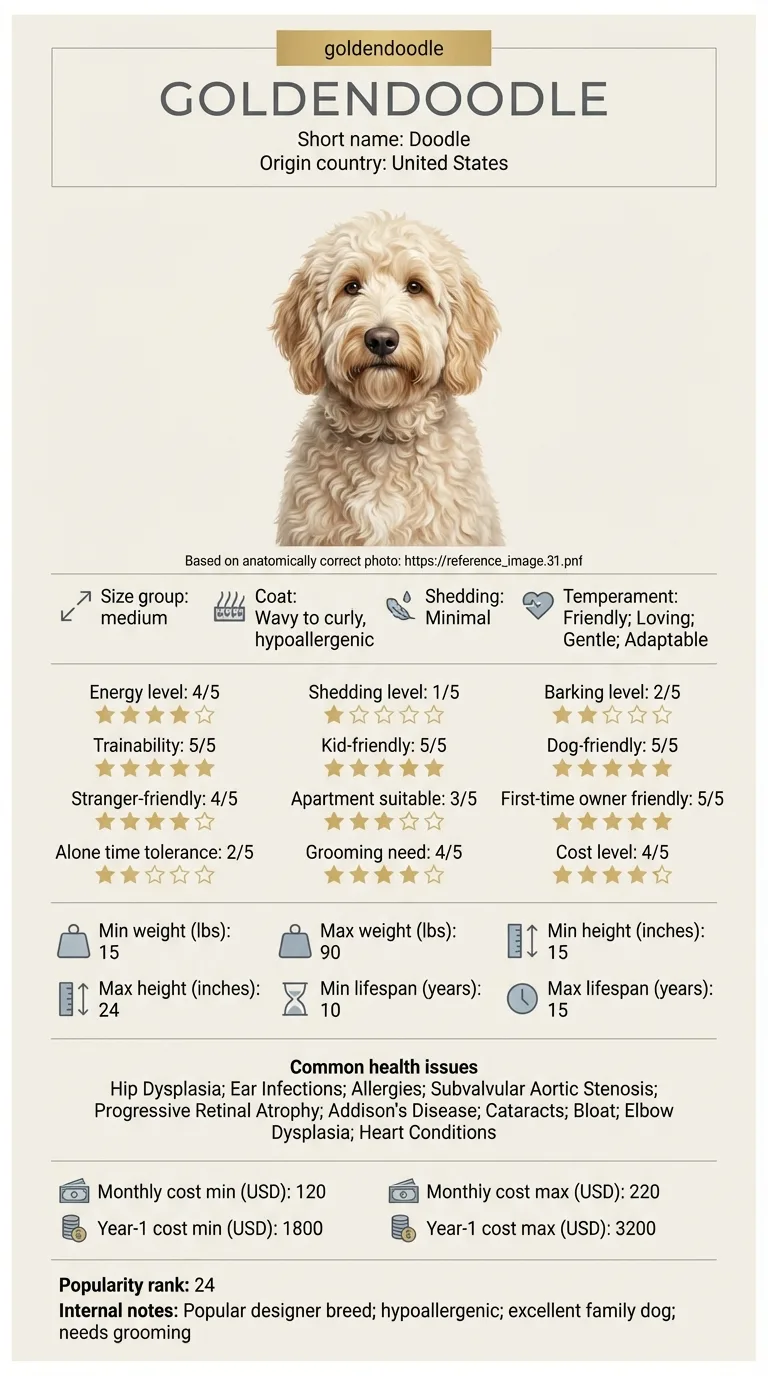
This mostly affects owners who noticed an irregular heartbeat, fainting spell, or exercise intolerance in their Goldendoodle and went searching for answers, landing on information about a breed-specific disease that doesn't actually apply to their dog's ancestry.
This guide is not medical advice. If your dog shows pain, sudden behavior change, or worsening symptoms, consult a licensed veterinarian.
Some links may be affiliate links. We may earn a commission at no extra cost to you. We only suggest products we believe are helpful for dog owners.
We research and check what we publish, but we do not warrant that any figure, date, price, or statement is accurate, complete, or current, and we accept no liability for any loss, cost, injury, or other harm arising from the use of this site. Use it as one reference among several. You remain responsible for your own decisions and for your dog's care - confirm anything that matters with a licensed veterinarian or another qualified professional before you act on it. Full disclaimer.
Check this first
Regardless of which specific diagnosis eventually applies, certain symptoms in any dog's heart mean the same thing: get to a vet now. Fainting or collapse, especially during or right after exercise or excitement, is one of the clearest signs of a cardiac rhythm problem and should never be dismissed as the dog 'just being dramatic' or 'overheated.' Pale or blue-tinged gums, labored breathing at rest, or a sudden inability to get up are emergencies requiring immediate veterinary attention.
An irregular heartbeat noticed during a routine exam, without any of those more severe signs, is not itself an emergency but does need a diagnostic workup — typically an ECG and echocardiogram — to identify what's actually happening rather than guessing at a specific label. This is the more common scenario: a vet hears something during a stethoscope exam and refers the dog for imaging before any diagnosis, ARVC or otherwise, is confirmed.
A single brief episode of unsteadiness that resolves on its own is still worth reporting to your vet promptly, even if it doesn't feel like a true emergency in the moment — cardiac arrhythmias can be intermittent, meaning a normal exam later doesn't rule out a real underlying issue.
If any of these apply, call your vet or an emergency clinic now. The rest of this page is for the cases that are not an emergency.
Arrhythmogenic right ventricular cardiomyopathy is a real, serious heart disease, but it has no documented history in the Golden Retriever or Poodle bloodlines that make up a Goldendoodle. Owners usually arrive at this term after noticing fainting, collapse, or an irregular heartbeat and searching for an explanation, when the more likely underlying cause is this breed's actual documented cardiac risk, subvalvular aortic stenosis, or a non-cardiac cause entirely.
ARVC itself is rare even in the breeds where it is documented, and there is no established prevalence data for it in Goldendoodles because it isn't a known risk in this breed's ancestry. The symptoms that lead owners to this search, however, are common enough that a proper veterinary workup is worthwhile whenever they appear.
Golden Retriever and Poodle lines do not carry the documented genetic mutation associated with ARVC in Boxers. What Golden Retriever ancestry does carry is a documented risk of subvalvular aortic stenosis, a structurally different heart problem that can produce some overlapping symptoms like exercise intolerance or fainting, which is likely why the two get confused by owners searching online.
Heat, overexertion, and excitement can all trigger fainting-type episodes regardless of the underlying cause, cardiac or otherwise, which is why the circumstances around an episode matter as much as the episode itself when a vet is working out the real cause.
Talk to your vet immediately after any fainting, collapse, or breathing difficulty, and promptly after noticing an irregular heartbeat even without other symptoms. Don't wait to see if it happens again — intermittent cardiac issues can be present even when a routine exam looks normal.
See all Goldendoodle health problems, which breeds are prone to arrhythmogenic right ventricular cardiomyopathy arvc, or the full Goldendoodle breed guide for temperament, exercise needs and ownership costs.
A full cardiac workup, including ECG and echocardiogram, usually produces a diagnosis or a clear next step within one to two visits, sometimes with a referral to a veterinary cardiologist for more complex cases.
Success looks like an accurate diagnosis of what's actually happening — whether that's SAS, a different arrhythmia, or a non-cardiac cause — rather than confirming or ruling out a specific disease that was never a likely fit for this breed to begin with.
Before assuming this specific diagnosis applies, it helps to know what actually separates it from more likely explanations.
After her Goldendoodle Charlie fainted briefly during a game of fetch, Monica searched his symptoms online and landed on pages about ARVC, assuming the worst. She brought Charlie in expecting a grim diagnosis. Her vet explained that ARVC wasn't a realistic fit for Charlie's breed background and instead ran an ECG and echocardiogram, which found mild subvalvular aortic stenosis — a manageable, monitorable condition rather than the progressive disease Monica had been reading about. Charlie was cleared for moderate activity with periodic rechecks.
Key takeaway: A scary symptom and a scary search result don't automatically mean the rare, breed-mismatched diagnosis — a proper workup usually points somewhere more likely and more manageable.
It's not impossible for any dog to develop an unusual heart condition, but ARVC has no documented association with Golden Retriever or Poodle lines. It's a Boxer-associated disease with a specific identified genetic mutation not found in this breed's ancestry.
Subvalvular aortic stenosis is the cardiac condition with a real documented connection to this breed, inherited through Golden Retriever lineage. It's a structural issue, not an arrhythmia disease like ARVC.
Not necessarily, and it's more likely to point toward a murmur-related condition or a different, more common arrhythmia. An ECG and echocardiogram are what actually determine the specific diagnosis, rather than the term 'irregular heartbeat' on its own.
Fainting and collapse are non-specific symptoms that many different cardiac and non-cardiac conditions can cause, and search results often surface disease names regardless of breed relevance. The symptom is worth investigating; the specific ARVC label usually isn't the right starting assumption for this breed.
Typically through a combination of a stethoscope exam, an ECG to assess rhythm, and an echocardiogram to look at heart structure. A 24-hour Holter monitor is sometimes used for intermittent arrhythmias that don't show up during a short in-clinic recording.
No. Fainting can also stem from low blood sugar, heat-related overexertion, or neurological causes. That's exactly why a proper veterinary workup matters instead of assuming a specific cause from a symptom alone.
A stethoscope check at routine wellness visits is standard and reasonable for any dog, and it's how many murmurs are first caught in this breed before symptoms appear.
No. ARVC is documented in Boxers with a specific known mutation; there's no comparable documented history in Golden Retriever or Poodle lines that make up a Goldendoodle.
Subvalvular aortic stenosis, a congenital narrowing below the aortic valve inherited through Golden Retriever ancestry, is the breed's real documented cardiac risk.
An ECG and echocardiogram together commonly run several hundred dollars, with a 24-hour Holter monitor adding more if intermittent arrhythmia is suspected.
Yes, until a vet has evaluated the cause. Restricting strenuous activity is a reasonable precaution while a cardiac workup is pending.
In dogs with an underlying cardiac issue, yes — excitement and exertion are common triggers for arrhythmia-related fainting, which is part of why the timing of an episode matters to a vet.
A one-page prep sheet for this condition: the signs, the questions to ask, what to get priced. Unlocks here.
You get: Vet visit prep sheet
No spam. One-click unsubscribe. See our privacy policy.
Preview page 1 before you decide.