Behavior
Why are Goldendoodles prone to separation anxiety?
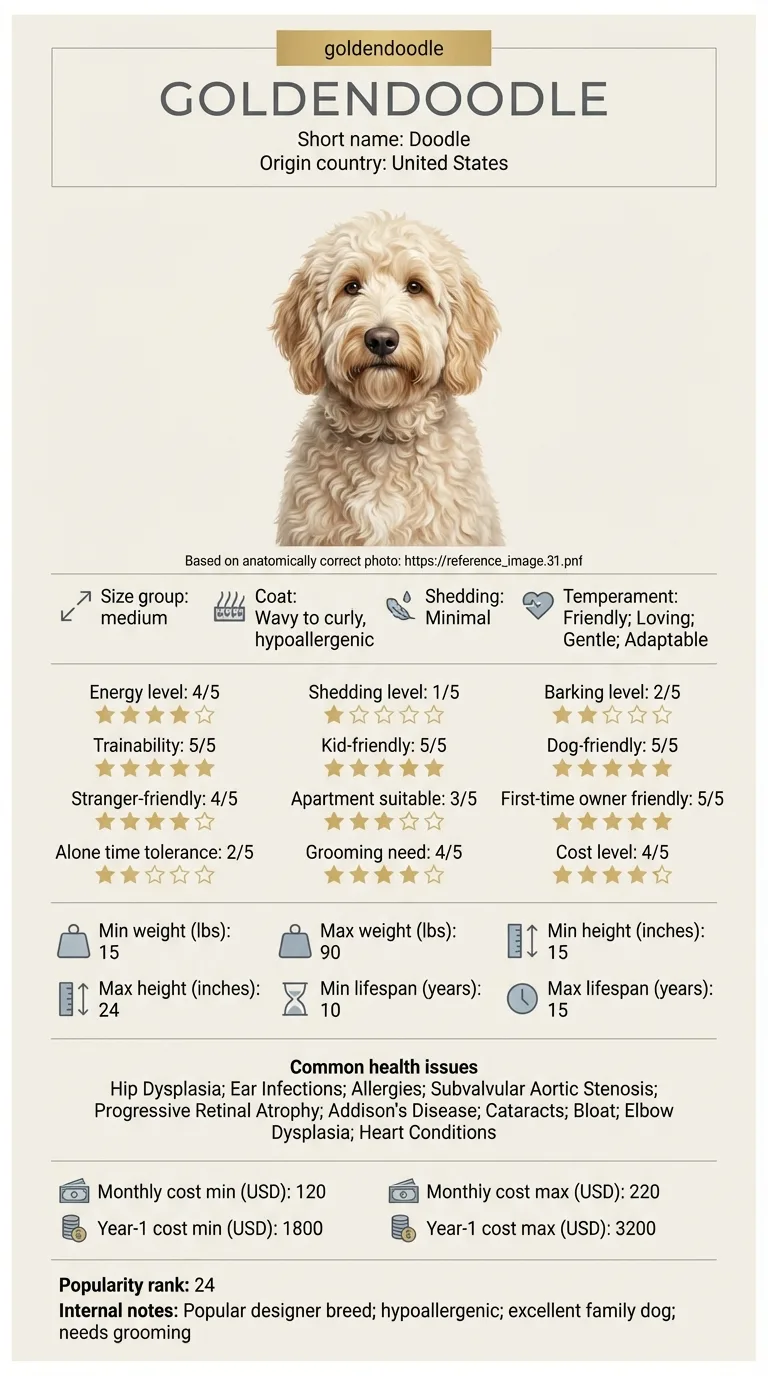
Both parent breeds are strongly people-oriented, giving Goldendoodles comparatively low documented alone-time tolerance as a temperament trait.

Quick answer
Why are Goldendoodles prone to separation anxiety?
Both parent breeds are strongly people-oriented, giving Goldendoodles comparatively low documented alone-time tolerance as a temperament trait.
The same bond that makes a Goldendoodle follow you from room to room is exactly what makes an empty house so hard for some of them to tolerate.
This affects owners whose Goldendoodle shows distress specifically tied to departures — barking, destructive behavior, house-soiling despite being fully house-trained, or frantic greeting behavior — rather than a dog that's simply generally under-exercised or bored.
This guide is not medical advice. If your dog shows pain, sudden behavior change, or worsening symptoms, consult a licensed veterinarian.
Some links may be affiliate links. We may earn a commission at no extra cost to you. We only suggest products we believe are helpful for dog owners.
We research and check what we publish, but we do not warrant that any figure, date, price, or statement is accurate, complete, or current, and we accept no liability for any loss, cost, injury, or other harm arising from the use of this site. Use it as one reference among several. You remain responsible for your own decisions and for your dog's care - confirm anything that matters with a licensed veterinarian or another qualified professional before you act on it. Full disclaimer.
Separation anxiety in Goldendoodles is genuine distress tied to being left alone, rooted in the breed's documented low alone-time tolerance, a direct result of the strongly people-oriented temperament both Golden Retrievers and Poodles are known for. Building genuine tolerance for solitude through gradual, structured desensitization, rather than expecting a quick fix, is the most effective approach.
Separation anxiety, described as distress when left alone, is documented as a concern in this breed, consistent with its comparatively low alone-time tolerance rating relative to more independent breeds.
Both Golden Retrievers and Poodles were developed with strong human-companionship orientations, and Goldendoodles inherit that combined temperament trait, reflected directly in the breed's documented low alone-time tolerance compared to more independent breed types.
Sudden schedule changes, inconsistent departure routines, overly dramatic goodbyes and greetings, and insufficient gradual practice building tolerance for absences all contribute to how severely this underlying temperament trait manifests as actual separation distress.
A certified separation anxiety trainer or veterinary behaviorist is genuinely worth considering for moderate to severe cases, since this specific type of anxiety often benefits from a structured, professionally guided desensitization protocol beyond general obedience training.
Consult your vet if separation-related distress is severe, includes self-injury, or isn't improving with consistent training, since a veterinary behaviorist can assess whether anti-anxiety medication alongside training would help. This is not typically an emergency situation.
See all Goldendoodle health problems, which breeds are prone to separation anxiety, or the full Goldendoodle breed guide for temperament, exercise needs and ownership costs.
Gradual desensitization protocols typically show measurable progress within a few weeks of consistent daily practice, though full resolution for more severe cases can take several months of structured work, sometimes alongside medication.
Success looks like a dog that can be left alone for a reasonable, realistic duration without significant distress — not necessarily a dog that's indifferent to your absence, since some preference for company is simply part of this breed's genuine temperament.
Both parent breeds were developed for close human partnership — Golden Retrievers as attentive retrieving and companion dogs, Poodles as highly people-focused working and companion dogs — and Goldendoodles inherit that combined orientation toward human connection strongly. This isn't a flaw introduced by poor training; it's a genuine temperament trait that shows up consistently across the breed, which is part of why alone-time tolerance is documented as comparatively low here relative to more independent breeds.
True separation anxiety is distinguishable from general destructive boredom by its timing and pattern: it typically starts within minutes of departure, is directed at exit points like doors and windows, and often includes vocalization, elimination despite being house-trained, or self-injury from attempts to escape confinement. A bored dog's destructive behavior, by contrast, tends to be more distributed throughout an absence and less tied specifically to the moment of departure itself.
Because this tendency is genuinely rooted in temperament rather than a training failure, addressing it well means building genuine tolerance for solitude gradually, rather than assuming a dog will simply adjust on its own over time, or, at the other extreme, assuming the dog can never be left alone at all. Most dogs, even those strongly predisposed to this trait, can build meaningfully more independence with a structured, patient approach.
Because this tendency is real rather than a training failure, the goal is building tolerance gradually rather than expecting an immediate fix.

If you think your Doodle has separation anxiety, the plan is three steps: write down what you have seen and when it started, book a veterinary appointment rather than waiting for the next flare, and take video of the behaviour or symptom before you go — the thing you are worried about rarely happens in the consulting room. Screening in the parents covers hip dysplasia, ear infections, allergies.
What the vet visit should produce is a diagnosis and a written plan, not just reassurance: what is being ruled out, what the monitoring interval is, and which signs mean you come back sooner. Ask what the treatment costs across a year rather than per visit, because that is the number that decides whether you are managing this condition or reacting to it.
Between appointments, keep a short log — dates, what you saw, what changed. It is the single most useful thing an owner brings to a follow-up, and for separation anxiety it is often what separates a clear pattern from a guess.
Yuki's Goldendoodle, Biscuit, would bark and scratch at the door within seconds of Yuki leaving for work, and a pet camera confirmed the distress continued for much of the day rather than settling down. Working with a certified separation anxiety trainer, Yuki started practicing departures that lasted only a few seconds at first, gradually working up in tiny increments over several weeks, always stopping and starting over if Biscuit showed any sign of distress at a given duration. Yuki also stopped making a fuss over leaving or arriving home, keeping both moments deliberately low-key. After about two months of consistent practice, Biscuit could comfortably handle a full workday alone, confirmed by camera footage showing him settling down to nap within minutes of Yuki's departure.
Key takeaway: Building tolerance in tiny, boring increments, rather than expecting Biscuit to simply adjust to a full day alone all at once, is what actually got him there.
Alone-time tolerance is documented as comparatively low in this breed, reflecting the strongly people-oriented temperament inherited from both Golden Retriever and Poodle lines, which makes separation distress a more frequently reported concern here than in more independent breeds.
True separation anxiety typically starts within minutes of departure, focuses on exit points, and often includes vocalization or house-soiling despite training. Boredom-driven destruction tends to be spread more evenly throughout an absence and isn't tied specifically to the moment of leaving.
Many dogs improve substantially with a structured, gradual desensitization approach, though some level of preference for company may always remain a trait of this breed's temperament rather than something eliminated entirely.
This can help some dogs, but it's not a guaranteed fix, since separation anxiety is often specifically about the absence of a particular person rather than being alone in general, so a second dog's company doesn't always resolve it.
It depends on the individual dog — some dogs find a properly introduced crate a secure den-like space that reduces anxiety, while others, especially if the crate wasn't introduced gradually and positively, can find confinement itself more distressing.
For moderate to severe cases where behavioral training alone isn't producing meaningful progress, discussing anti-anxiety medication with your vet, often alongside a certified behaviorist's training plan, is a reasonable and commonly effective combined approach.
Both parent breeds are strongly people-oriented, giving Goldendoodles comparatively low documented alone-time tolerance as a temperament trait.
Extremely short practice departures, building duration gradually only as your dog stays calm, is the standard effective starting point.
Yes — a certified separation anxiety trainer or veterinary behaviorist can meaningfully speed progress for moderate to severe cases.
A certified separation anxiety trainer or behaviorist consultation commonly runs into the low hundreds for an initial assessment and plan.
Mild cases sometimes improve with consistent gradual desensitization practiced at home, though more severe cases benefit significantly from professional guidance.
Behaviour changes often start with pain. The prep sheet for this page covers what to rule out, and what to ask.
You get: Vet visit prep sheet
No spam. One-click unsubscribe. See our privacy policy.
Preview page 1 before you decide.