Living
Which is the better all-around choice?
The Goldendoodle scores higher across trainability, kid-friendliness, and sociability; pick the Corgi if you want lower grooming effort and don't mind more shedding and barking.

Quick answer
Which is the better all-around choice?
The Goldendoodle scores higher across trainability, kid-friendliness, and sociability; pick the Corgi if you want lower grooming effort and don't mind more shedding and barking.
Goldendoodle or Pembroke Welsh Corgi? On paper they differ most on shedding, and on the scales Goldendoodle is the heavier at 15–90 lbs. Here is how the two compare on everything that shapes an ordinary week.
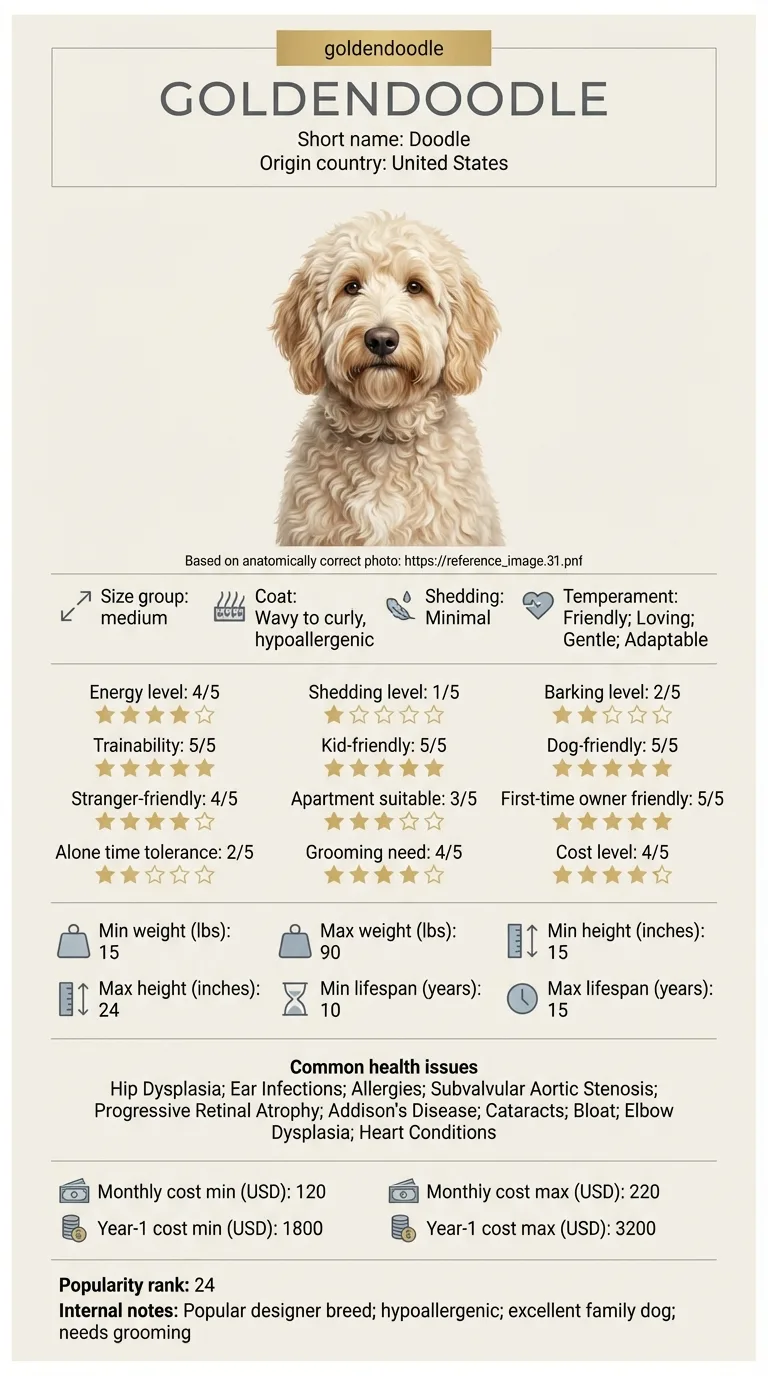
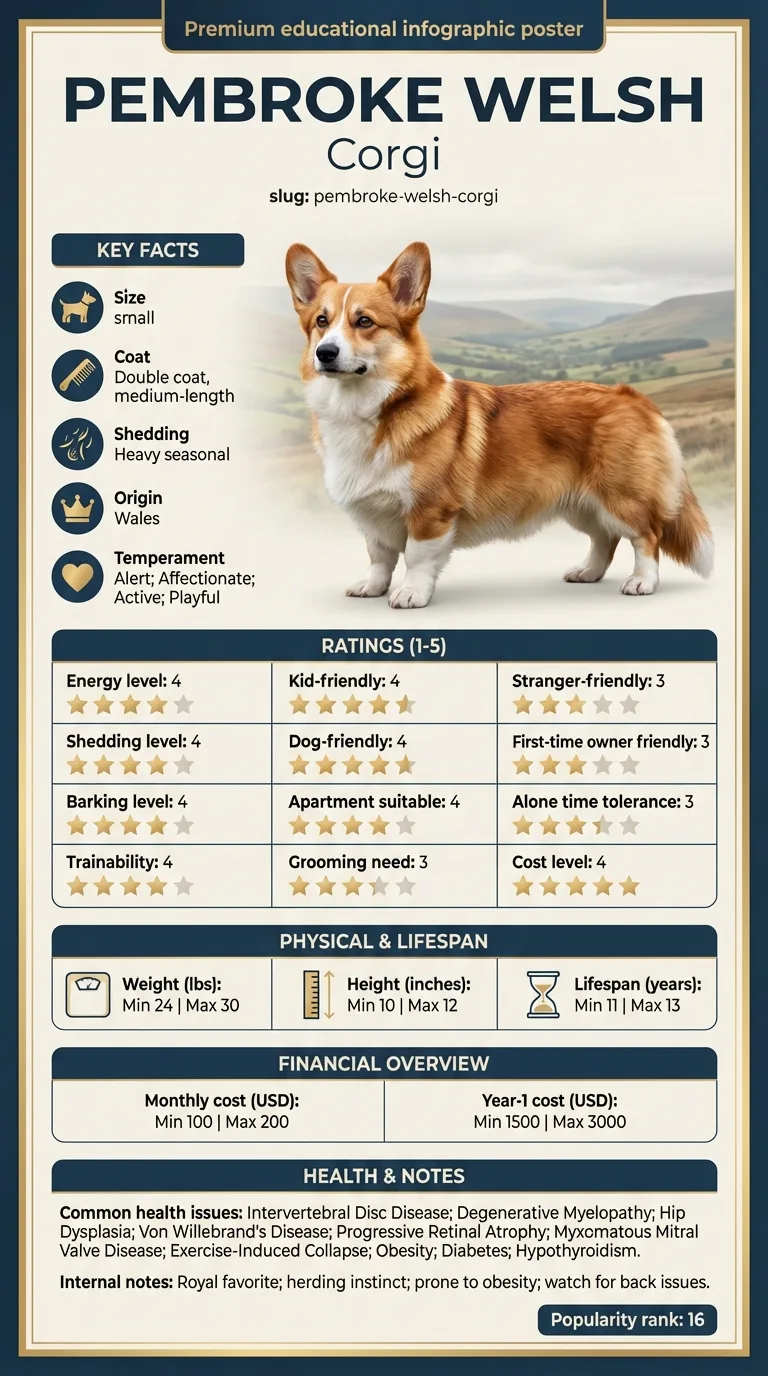
This is for someone already down to Goldendoodle and Pembroke Welsh Corgi and deciding between them. For this pair the decision usually turns on shedding and good for first-time owners, so those are covered first and in most detail. Anyone choosing from a flat has a clear answer here: Pembroke Welsh Corgi rates 4/5 against 3/5. The focus throughout is on daily consequences rather than breed background.
Between Goldendoodle and Pembroke Welsh Corgi, shedding is what separates them, and Pembroke Welsh Corgi is the lower-effort dog of the two to keep.
Choose Goldendoodle if this is your first dog, shedding is a problem in your house and there are young children at home.
Choose Pembroke Welsh Corgi if you are in a flat or a smaller home, you do not want a standing grooming appointment and the dog will be alone during the working day.
| Feature | goldendoodle | pembroke welsh corgi | Winner |
|---|---|---|---|
| Size class | medium | small | Equal |
| Weight | 15–90 lbs | 24–30 lbs | Equal |
| Height | 15–24 in | 10–12 in | Equal |
| Lifespan | 10–15 years | 11–13 years | goldendoodle |
| Exercise need | High (4/5) | High (4/5) | Equal |
| Grooming need | High (4/5) | Moderate (3/5) | pembroke welsh corgi |
| Shedding | Very low (1/5) | High (4/5) | goldendoodle |
| Energy level | High (4/5) | High (4/5) | Equal |
| Barking | Low (2/5) | High (4/5) | goldendoodle |
| Apartment suitability | Moderate (3/5) | High (4/5) | pembroke welsh corgi |
| Good for first-time owners | Very high (5/5) | Moderate (3/5) | goldendoodle |
| Tolerates being alone | Low (2/5) | Moderate (3/5) | pembroke welsh corgi |
| Trainability | Very high (5/5) | High (4/5) | goldendoodle |
| Good with kids | Very high (5/5) | High (4/5) | goldendoodle |
| Good with other dogs | Very high (5/5) | High (4/5) | goldendoodle |
| Friendly to strangers | High (4/5) | Moderate (3/5) | goldendoodle |
| Cost level | High (4/5) | High (4/5) | Equal |
| Coat | Wavy to curly, hypoallergenic | Double coat, medium-length | Equal |
| Origin | United States | Wales | Equal |
| Typical monthly cost | $120–$220 | $100–$200 | Equal |
| Typical first-year cost | $1,800–$3,200 | $1,500–$3,000 | Equal |
Corgis are deceptive: 24 to 30 pounds packed into a body just 10 to 12 inches off the ground, on short legs and a long back. Goldendoodles run the opposite way 15 to 90 pounds and 15 to 24 inches, taller and proportioned normally. The corgi's elongated spine is worth remembering, since it ties directly to the breed's biggest health risk.
Don't let the corgi's stubby legs fool you its exercise need is rated high (4/5), same as the Goldendoodle's. Both breeds carry high energy ratings too. The difference is how that energy gets used: a corgi was bred to herd cattle and wants a job or a task, while a Goldendoodle is happier with open-ended fetch and swimming. A bored Corgi without that outlet tends to find its own job, usually one you did not assign it.
This is where the two really diverge. The Goldendoodle sheds very little (1/5) but demands high grooming effort (4/5) to keep its curly coat from matting. The Corgi is nearly the reverse moderate grooming (3/5) but high shedding (4/5), thanks to a double coat that blows out seasonally and leaves hair on everything you own. A weekly deshedding session helps the Corgi more than daily brushing would.
The Corgi barks more (4/5 versus 2/5) it's a herding breed bred to vocalize at livestock, and that instinct doesn't disappear indoors. Even so, it rates higher for apartment suitability (4/5 versus 3/5) than the Goldendoodle, and tolerates alone time slightly better (3/5 versus 2/5). Neither breed handles long stretches of solitude well, though. If your building has strict noise rules, weigh that bark rating carefully before committing to a Corgi.
Both breeds train well, but the Goldendoodle rates higher across the board very high trainability (5/5) versus the Corgi's high (4/5), and very high first-time-owner suitability (5/5) against the Corgi's moderate (3/5). Corgis are smart but opinionated, closer to a working dog's mindset, and a new owner can find that independence harder to manage. Both breeds are intelligent, but intelligence and ease of handling are not the same thing, and the Corgi asks more of the person holding the leash.
The Goldendoodle outscores the Corgi with kids (5/5 versus 4/5), other dogs (5/5 versus 4/5), and strangers (4/5 versus 3/5) a consistent pattern across every social category. Corgis are still rated good in all three areas, just not quite as good, and their herding instinct can show up as nipping at heels during play, worth watching with small children. Early socialization narrows that gap considerably for either breed.
The Corgi's long back is the through-line in its health list: intervertebral disc disease and degenerative myelopathy both relate directly to that build, alongside hip dysplasia and exercise-induced collapse. The Goldendoodle's list runs longer overall and includes bloat and heart conditions tied to its larger size. Hip dysplasia and progressive retinal atrophy show up on both. Lifespan favors the Goldendoodle slightly here, 10 to 15 years against the Corgi's 11 to 13.
Costs land close together: $120 to $220 a month and $1,800 to $3,200 in year one for the Goldendoodle, $100 to $200 a month and $1,500 to $3,000 for the Corgi. Both are rated high (4/5) on overall cost level a tie, unusual in this comparison, and a reminder that neither breed is a budget option. Budget accordingly whichever breed you land on.
Goldendoodle weighs 15–90 lbs and lives 10–15 years; Pembroke Welsh Corgi weighs 24–30 lbs and lives 11–13 years. The two diverge most on shedding, good for first-time owners and barking. They are level on cost level, energy level and exercise need, so those cannot decide it. The table below marks a winner only where one breed is genuinely easier for a typical owner; size and origin are facts rather than merits and stay level. Ratings come from one source applied to both breeds, so they are meaningful against each other rather than as absolute scores.

By height, yes 10 to 12 inches tall. By weight, less so: 24 to 30 pounds is heavier than it looks, packed into that long, low frame. A Goldendoodle can range anywhere from a similar weight up to 90 pounds.
The Corgi, by a wide margin high shedding (4/5) against the Goldendoodle's very low (1/5). Corgis carry a double coat that blows out with the seasons; expect fur on the couch, the car, and your clothes.
It's rated moderate (3/5) for first-time owners, noticeably behind the Goldendoodle's very high (5/5). Corgis are smart and trainable (4/5) but carry real herding instincts and a strong-willed streak that reward experience.
The Corgi rates higher (4/5 versus 3/5), despite barking more. If noise isn't a concern for your neighbors, the Corgi's smaller footprint works; if it is, the quieter Goldendoodle (2/5 barking) may be the safer pick.
They're close. The Goldendoodle runs $120 to $220 monthly and $1,800 to $3,200 in year one; the Corgi runs $100 to $200 monthly and $1,500 to $3,000. Both carry the same high overall cost rating.
Hip dysplasia and progressive retinal atrophy appear on both lists. Otherwise the Corgi's risks center on its long spine intervertebral disc disease and degenerative myelopathy while the Goldendoodle's lean toward bloat and heart conditions.
Its long spine and short legs define the breed, and that same build is behind two of its listed health risks intervertebral disc disease and degenerative myelopathy. Keeping a Corgi lean and limiting jumps off furniture is a common way owners manage that risk.
The Goldendoodle scores higher across trainability, kid-friendliness, and sociability; pick the Corgi if you want lower grooming effort and don't mind more shedding and barking.
Close: $120 to $220 for the Goldendoodle versus $100 to $200 for the Corgi both land in the same high overall cost bracket.
Both need a lot high exercise (4/5) for both breeds though the Corgi does best with structured, job-like activity rather than free play.
The Goldendoodle runs 10 to 15 years, the Corgi 11 to 13 close enough that individual health and care matter more than the averages.
Secure checkout on Stripe. We never see your card.
7-day money-back guarantee. Instant access.
Health information here is general and is not veterinary advice. If your dog shows pain, sudden behaviour change, or worsening symptoms, consult a licensed veterinarian.
Some links on this site are affiliate links. We may earn a commission at no extra cost to you, and we only suggest products we believe are helpful for dog owners.
We research and check what we publish, but we do not warrant that any figure, date, price, or statement is accurate, complete, or current, and we accept no liability for any loss, cost, injury, or other harm arising from the use of this site. Use it as one reference among several. You remain responsible for your own decisions and for your dog's care - confirm anything that matters with a licensed veterinarian or another qualified professional before you act on it. Full disclaimer.
Match your lifestyle to the right dog.
Take quizNot sure which breed is right for you? Take our 2-minute quiz to find out.
Take the quiz