Behavior
Which should most people pick?
The GSP if you want a dog that gets along with other dogs and trains easily; the JRT if size and cost matter more than sociability.

Quick answer
Which should most people pick?
The GSP if you want a dog that gets along with other dogs and trains easily; the JRT if size and cost matter more than sociability.
German Shorthaired Pointer or Jack Russell Terrier? On paper they differ most on barking, and on the scales German Shorthaired Pointer is the heavier at 45–70 lbs. Here is how the two compare on everything that shapes an ordinary week.
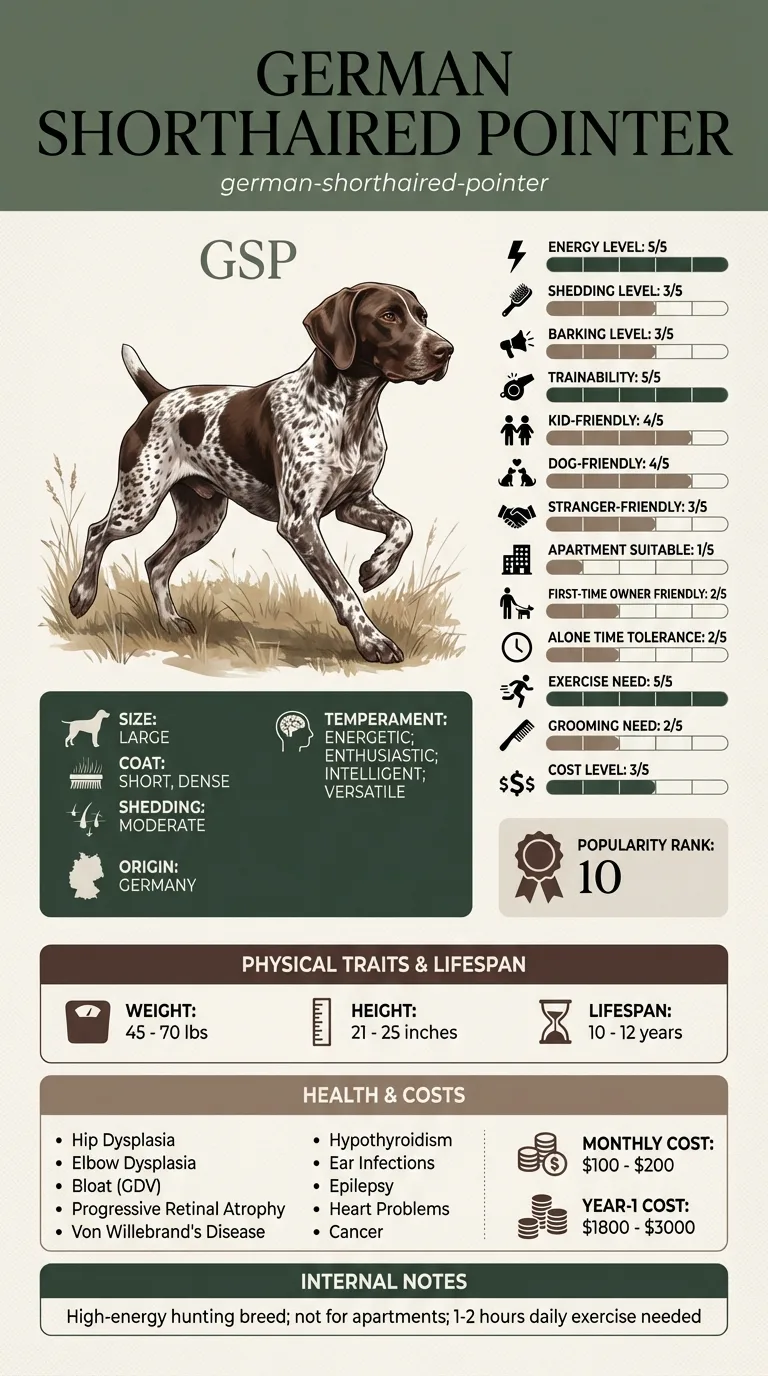
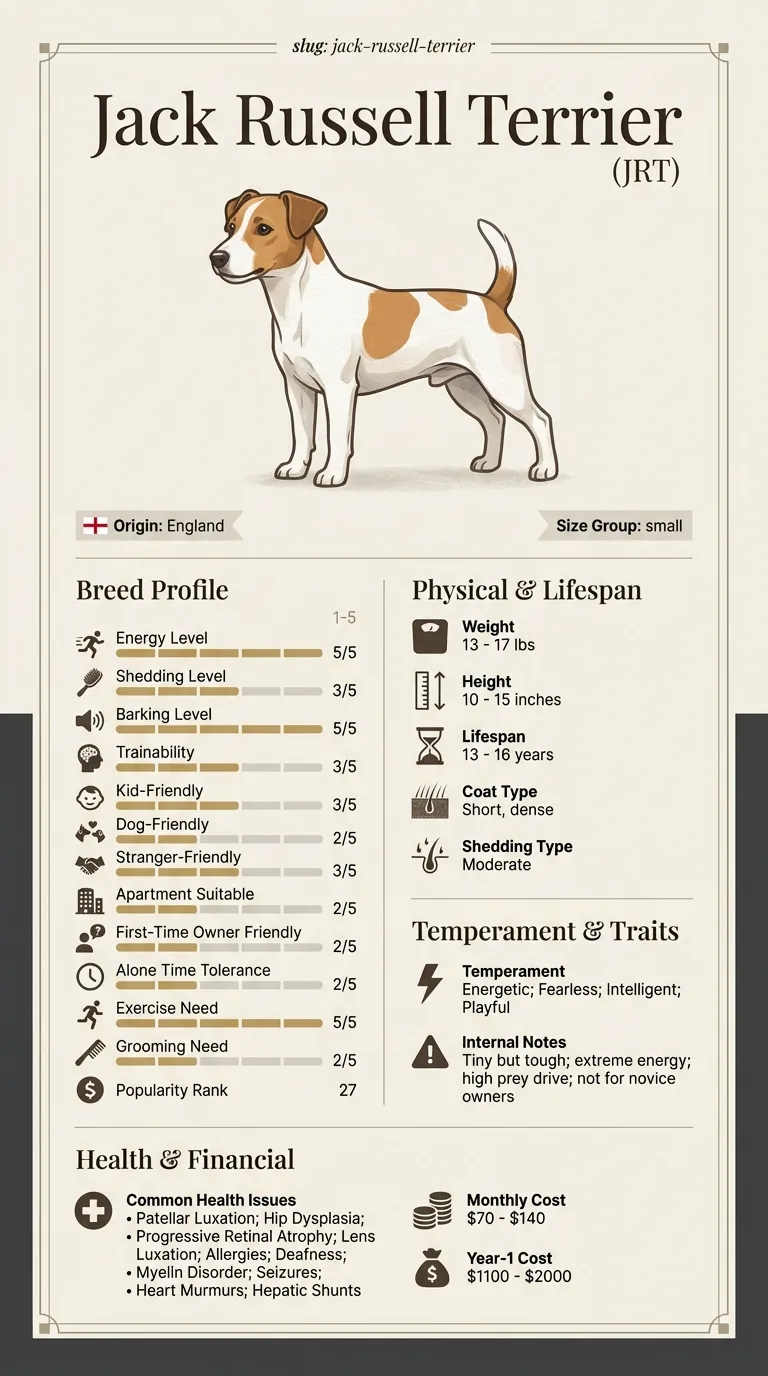
This is for someone already down to German Shorthaired Pointer and Jack Russell Terrier and deciding between them. For this pair the decision usually turns on barking and trainability, so those are covered first and in most detail. Anyone choosing from a flat has a clear answer here: Jack Russell Terrier rates 2/5 against 1/5. The focus throughout is on daily consequences rather than breed background.
Between German Shorthaired Pointer and Jack Russell Terrier, barking is what separates them, and Jack Russell Terrier is the lower-effort dog of the two to keep.
Choose German Shorthaired Pointer if there are young children at home, you already have another dog and you want a dog that picks up training quickly.
Choose Jack Russell Terrier if a smaller dog suits your car, your home or your back.
| Feature | german shorthaired pointer | jack russell terrier | Winner |
|---|---|---|---|
| Size class | large | small | Equal |
| Weight | 45–70 lbs | 13–17 lbs | Equal |
| Height | 21–25 in | 10–15 in | Equal |
| Lifespan | 10–12 years | 13–16 years | jack russell terrier |
| Exercise need | Very high (5/5) | Very high (5/5) | Equal |
| Grooming need | Low (2/5) | Low (2/5) | Equal |
| Shedding | Moderate (3/5) | Moderate (3/5) | Equal |
| Energy level | Very high (5/5) | Very high (5/5) | Equal |
| Barking | Moderate (3/5) | Very high (5/5) | german shorthaired pointer |
| Apartment suitability | Very low (1/5) | Low (2/5) | jack russell terrier |
| Good for first-time owners | Low (2/5) | Low (2/5) | Equal |
| Tolerates being alone | Low (2/5) | Low (2/5) | Equal |
| Trainability | Very high (5/5) | Moderate (3/5) | german shorthaired pointer |
| Good with kids | High (4/5) | Moderate (3/5) | german shorthaired pointer |
| Good with other dogs | High (4/5) | Low (2/5) | german shorthaired pointer |
| Friendly to strangers | Moderate (3/5) | Moderate (3/5) | Equal |
| Cost level | Moderate (3/5) | Low (2/5) | jack russell terrier |
| Coat | Short, dense | Short, dense | Equal |
| Origin | Germany | England | Equal |
| Typical monthly cost | $100–$200 | $70–$140 | Equal |
| Typical first-year cost | $1,800–$3,000 | $1,100–$2,000 | Equal |
Both breeds are compact and muscular for their size, but the numbers aren't close: GSP at 45-70 lbs and 21-25 inches, Jack Russell at 13-17 lbs and 10-15 inches. The JRT packs a lot of dog into a small frame — don't mistake its size for fragility, it's a working terrier bred to go to ground after quarry.
This is a rare pairing where both breeds max out identically at very high (5/5) energy and exercise need. Neither is a good match for a sedentary household. The difference is in style: the GSP wants distance and purpose, while the JRT's energy is more explosive and unpredictable — expect digging, jumping, and chasing anything that moves.
Grooming and shedding are ties across the board — both low (2/5) on grooming, both moderate (3/5) on shedding. Short coats on both dogs mean neither needs a groomer, though the JRT's wiry-textured variants can benefit from occasional hand-stripping if you're showing the dog. Weekly brushing and routine nail trims cover both breeds' actual maintenance needs the rest of the year.
Neither dog suits an apartment well, but the JRT is marginally better (low, 2/5, versus the GSP's very low, 1/5). Barking is where the JRT stands out — very high (5/5) against the GSP's moderate (3/5) — terriers were bred to be vocal, and it shows, especially at doorbells and passing dogs. Both breeds tolerate being alone equally poorly (low, 2/5), so plan for a dog walker on long workdays either way.
The GSP is clearly the more trainable dog — very high (5/5) versus the JRT's moderate (3/5) — thanks to a working heritage built around following handler direction. Both are rated equally low (2/5) for first-time owners, though, for different reasons: the GSP for its physical intensity, the JRT for its stubborn, independent streak that can test a new owner's patience in obedience classes.
The GSP wins clearly here: high (4/5) with kids versus the JRT's moderate (3/5), and high (4/5) with other dogs versus the JRT's low (2/5). Jack Russells have a real reputation for scrappiness with other dogs, and this data backs it up — worth knowing if you already have a multi-dog household or plan regular trips to the dog park.
The JRT outlives the GSP, typically 13-16 years against 10-12, a solid extra stretch for a smaller dog. Both share hip dysplasia and progressive retinal atrophy risk. The GSP's list adds bloat, Von Willebrand's Disease, and heart problems, while the JRT carries lens luxation and hepatic shunts, different genetic baggage despite the shared PRA and hip risk between the two.
The Jack Russell is the budget option: $70-140 monthly versus the GSP's $100-200, and $1,100-2,000 in the first year versus $1,800-3,000. A smaller dog eats less and needs smaller medication doses, and that gap holds up across the whole first year of ownership, from food and flea prevention through routine vet visits, insurance premiums, and even boarding rates.
German Shorthaired Pointer weighs 45–70 lbs and lives 10–12 years; Jack Russell Terrier weighs 13–17 lbs and lives 13–16 years. The two diverge most on barking, trainability and good with other dogs. They are level on tolerates being alone, energy level and exercise need, so those cannot decide it. The table below marks a winner only where one breed is genuinely easier for a typical owner; size and origin are facts rather than merits and stay level. Ratings come from one source applied to both breeds, so they are meaningful against each other rather than as absolute scores.

They're tied — both rate very high (5/5) on exercise need. Neither breed fits a low-activity lifestyle.
The Jack Russell, rated very high (5/5) versus the GSP's moderate (3/5). Terriers are bred to be vocal, and it's a real consideration for close neighbors.
The GSP, clearly — high (4/5) versus the JRT's low (2/5). Jack Russells can be scrappy with other dogs, especially same-sex pairs.
Neither scores well, both at low (2/5). The GSP's intensity and the JRT's independent streak both present a learning curve.
The Jack Russell — $70-140 a month versus $100-200 for the GSP, and roughly $700 less in the first year.
Some — hip dysplasia and progressive retinal atrophy appear on both lists. Beyond that their risk profiles diverge quite a bit.
The Jack Russell, typically 13-16 years versus the GSP's 10-12 — a solidly longer runway for a smaller dog.
The GSP if you want a dog that gets along with other dogs and trains easily; the JRT if size and cost matter more than sociability.
$100-200 for the GSP versus $70-140 for the Jack Russell.
Both need very high (5/5) exercise — this pairing offers no easy option on activity level.
The Jack Russell Terrier, at 13-16 years versus the GSP's 10-12.
Secure checkout on Stripe. We never see your card.
7-day money-back guarantee. Instant access.
Health information here is general and is not veterinary advice. If your dog shows pain, sudden behaviour change, or worsening symptoms, consult a licensed veterinarian.
Some links on this site are affiliate links. We may earn a commission at no extra cost to you, and we only suggest products we believe are helpful for dog owners.
We research and check what we publish, but we do not warrant that any figure, date, price, or statement is accurate, complete, or current, and we accept no liability for any loss, cost, injury, or other harm arising from the use of this site. Use it as one reference among several. You remain responsible for your own decisions and for your dog's care - confirm anything that matters with a licensed veterinarian or another qualified professional before you act on it. Full disclaimer.
Match your lifestyle to the right dog.
Take quizNot sure which breed is right for you? Take our 2-minute quiz to find out.
Take the quiz