Living
Which breed is bigger?
The German Shorthaired Pointer, at 45-70 lbs and 21-25 inches, versus the Schnauzer's 26-50 lbs and 17-20 inches.

Quick answer
Which breed is bigger?
The German Shorthaired Pointer, at 45-70 lbs and 21-25 inches, versus the Schnauzer's 26-50 lbs and 17-20 inches.
German Shorthaired Pointer or Schnauzer (Standard)? On paper they differ most on apartment suitability, and on the scales German Shorthaired Pointer is the heavier at 45–70 lbs. Here is how the two compare on everything that shapes an ordinary week.
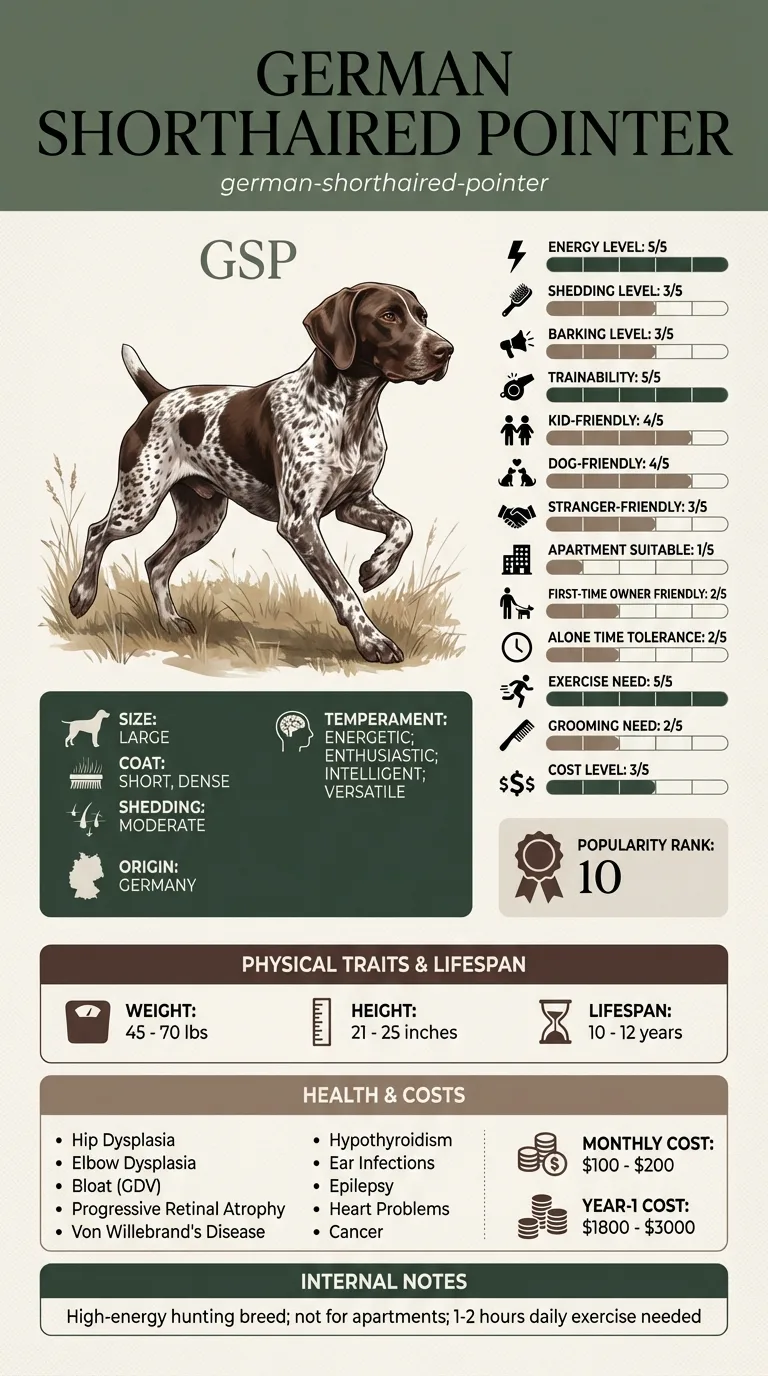
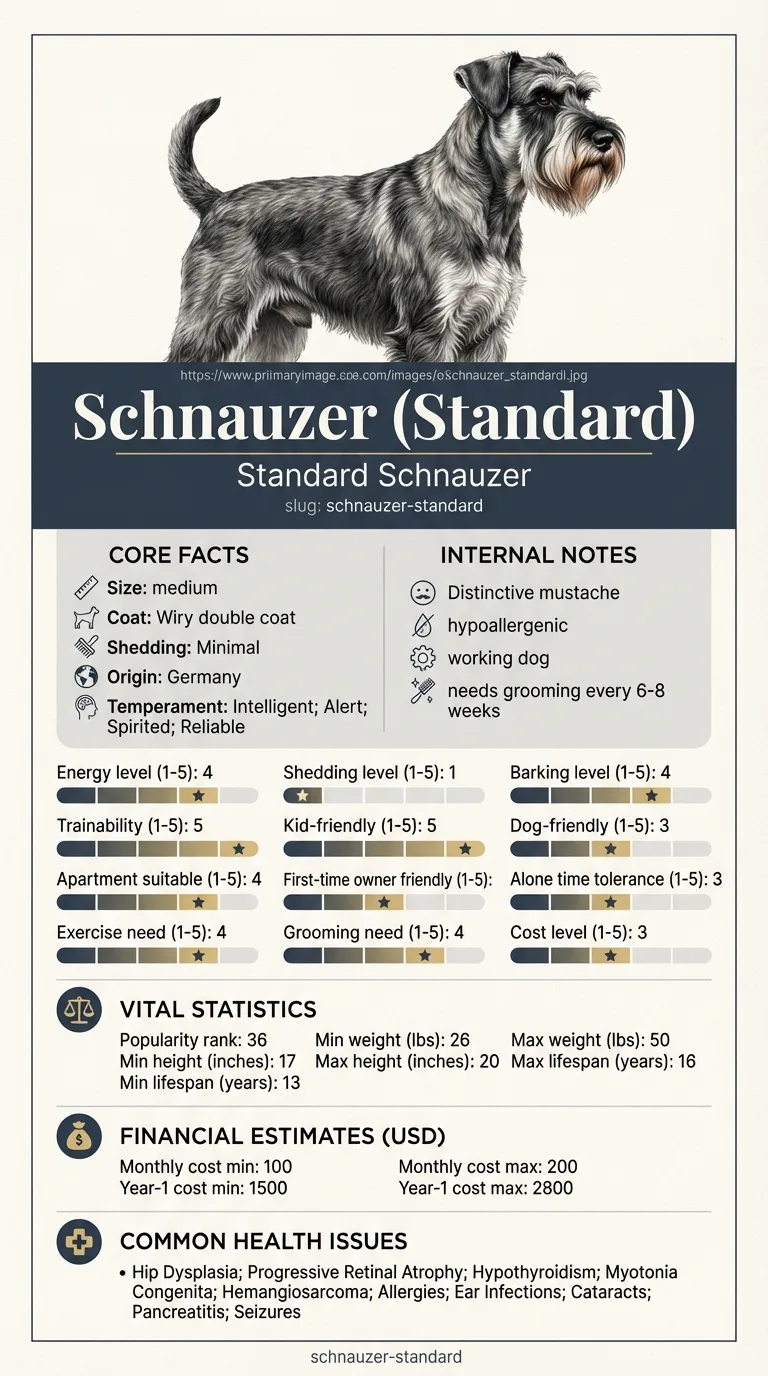
This is for someone already down to German Shorthaired Pointer and Schnauzer (Standard) and deciding between them. For this pair the decision usually turns on apartment suitability and grooming need, so those are covered first and in most detail. Anyone choosing from a flat has a clear answer here: Schnauzer (Standard) rates 4/5 against 1/5. Breed history is left out; what follows is what you will actually live with.
Between German Shorthaired Pointer and Schnauzer (Standard), apartment suitability is what separates them, and Schnauzer (Standard) is the lower-effort dog of the two to keep.
Choose German Shorthaired Pointer if you do not want a standing grooming appointment, you already have another dog and you want a dog that can keep up with an active routine.
Choose Schnauzer (Standard) if you are in a flat or a smaller home, this is your first dog and shedding is a problem in your house.
| Feature | german shorthaired pointer | schnauzer standard | Winner |
|---|---|---|---|
| Size class | large | medium | Equal |
| Weight | 45–70 lbs | 26–50 lbs | Equal |
| Height | 21–25 in | 17–20 in | Equal |
| Lifespan | 10–12 years | 13–16 years | schnauzer standard |
| Exercise need | Very high (5/5) | High (4/5) | schnauzer standard |
| Grooming need | Low (2/5) | High (4/5) | german shorthaired pointer |
| Shedding | Moderate (3/5) | Very low (1/5) | schnauzer standard |
| Energy level | Very high (5/5) | High (4/5) | Equal |
| Barking | Moderate (3/5) | High (4/5) | german shorthaired pointer |
| Apartment suitability | Very low (1/5) | High (4/5) | schnauzer standard |
| Good for first-time owners | Low (2/5) | Moderate (3/5) | schnauzer standard |
| Tolerates being alone | Low (2/5) | Moderate (3/5) | schnauzer standard |
| Trainability | Very high (5/5) | Very high (5/5) | Equal |
| Good with kids | High (4/5) | Very high (5/5) | schnauzer standard |
| Good with other dogs | High (4/5) | Moderate (3/5) | german shorthaired pointer |
| Friendly to strangers | Moderate (3/5) | Moderate (3/5) | Equal |
| Cost level | Moderate (3/5) | Moderate (3/5) | Equal |
| Coat | Short, dense | Wiry double coat | Equal |
| Origin | Germany | Germany | Equal |
| Typical monthly cost | $100–$200 | $100–$200 | Equal |
| Typical first-year cost | $1,800–$3,000 | $1,500–$2,800 | Equal |
Forty-five to seventy pounds of German Shorthaired Pointer stands noticeably taller than a Standard Schnauzer's 26 to 50 pounds — a four-to-five-inch difference at the shoulder (21-25 in versus 17-20 in) that shows up the moment they're side by side in a vet's waiting room. The GSP's frame is built for covering ground: lean, long-legged, athletic. The Schnauzer carries a squarer, more compact silhouette under that wiry double coat, closer to a working terrier scaled up. Neither breed is small, but only one of them was bred to run all day in open country, and it shows in how each moves.
Skip a day of exercise with the Schnauzer and you'll get a mildly annoyed dog underfoot; skip it with the GSP and you'll likely get chewed baseboards. Both breeds score high on the exercise scale — the GSP tops out at very high (5/5) while the Schnauzer sits one notch below at high (4/5) — but that single point of difference is bigger in practice than it looks on paper, since the Pointer was purpose-bred to hunt for hours across fields. The Schnauzer's energy is real too, closer to a terrier's restless alertness than a sprinter's stamina, so it settles indoors after a brisk outing in a way the GSP rarely does.
Reverse the exercise scores and you've basically got the grooming picture: the GSP's short, dense coat needs almost nothing — a low 2/5 grooming demand and moderate 3/5 shedding that a weekly brush handles. The Schnauzer flips that, landing at a high 4/5 for grooming because that wiry double coat needs regular hand-stripping or clipping to hold its texture, plus the beard and leg furnishings need combing to avoid mats. The payoff is shedding that drops to a very low 1/5 — Schnauzers are often chosen specifically because they don't leave hair on the couch, a trade the GSP's owners don't get to make.
One point on a five-point scale separates 'don't try this in a condo' from 'it can work.' Apartment suitability tells the real story here: the GSP scores a rock-bottom 1/5, while the Schnauzer scores 4/5 — the widest gap on the whole comparison chart. That's not really about size, since the Schnauzer at 26-50 lbs is still a substantial dog; it's about what each was built to do with pent-up energy in a small space. Barking cuts the other way, though — the Schnauzer's 4/5 barking tendency, true to its alert temperament, can be a bigger neighbor problem than the GSP's more moderate 3/5. Long stretches alone suit neither breed well, but the Schnauzer's moderate 3/5 tolerance edges out the GSP's low 2/5.
Both breeds land at the top of the trainability scale — 5/5 for the GSP, 5/5 for the Schnauzer — which sounds like a tie until you account for what the first-time-owner scores say underneath it. The GSP rates a low 2/5 for first-time owners; the Schnauzer does slightly better at 3/5. Neither is a beginner's dog by the numbers, but the reasons differ: the GSP's enthusiastic, versatile drive means training sessions compete with a dog that wants to be doing something physical, while the Schnauzer's spirited, alert nature means training competes with independent-minded stubbornness more than raw energy.
Kids first: the Schnauzer edges the GSP here, rating very high (5/5) against the GSP's still-solid high (4/5). Flip to other dogs and the GSP takes it, 4/5 versus the Schnauzer's 3/5 — a byproduct of the GSP's pack-hunting background versus the Schnauzer's more territorial guarding instincts. Strangers land as a dead heat at moderate 3/5 for both. Families weighing this pair against real household chaos — toddlers, a resident cat, weekend guests — should read those numbers as: the Schnauzer is the steadier presence with children, the GSP the more sociable one at the dog park.
Thirteen to sixteen years is what a Standard Schnauzer typically gets; a GSP averages ten to twelve. That three-to-four-year gap is the single largest difference in this whole comparison. Both breeds share hip dysplasia, progressive retinal atrophy, hypothyroidism and ear infections on their common-issue lists, but the GSP's list adds bloat (GDV), von Willebrand's disease, epilepsy, heart problems and cancer — a longer and arguably heavier roster. The Schnauzer's distinctive risks run toward myotonia congenita and hemangiosarcoma, plus cataracts, pancreatitis and seizures. Neither list is minor, but the Schnauzer's added years make its overall health profile the stronger one on paper.
$100 to $200 a month — that figure is identical for both breeds, and so is the moderate 3/5 cost rating each carries. Where they diverge is the first year: a GSP puppy typically runs $1,800 to $3,000 once initial vetting, gear built for an athletic large dog, and training are factored in, while the Schnauzer lands somewhat lower at $1,500 to $2,800. Ongoing grooming bills tilt back toward the GSP being cheaper long-term, since regular professional hand-stripping or clipping for the Schnauzer's coat adds a recurring cost the GSP's wash-and-go coat never does.
German Shorthaired Pointer weighs 45–70 lbs and lives 10–12 years; Schnauzer (Standard) weighs 26–50 lbs and lives 13–16 years. The two diverge most on apartment suitability, grooming need and shedding. They are level on cost level, friendly to strangers and trainability, so those cannot decide it. The comparison marks an easier option only where one exists. Facts like weight and country of origin are not scored. Both dogs are rated from the same dataset, which is what makes the numbers comparable with each other even though any individual dog sits somewhere inside its breed's range.

Neither is ideal, but the numbers aren't close: the Schnauzer rates 4/5 for apartment suitability against the GSP's 1/5. The GSP's very high exercise and energy needs make it a poor match for compact living, while the Schnauzer's more moderate exercise needs (still a high 4/5) make apartment life workable with committed daily walks.
The Schnauzer, clearly — it rates a very low 1/5 for shedding versus the GSP's moderate 3/5. That's the tradeoff for the Schnauzer's much higher grooming workload (4/5 versus 2/5), since keeping that wiry coat shedding-free requires regular hand-stripping.
Yes. Standard Schnauzers typically live 13-16 years, compared to 10-12 years for German Shorthaired Pointers — a difference of three to four years that's worth weighing for anyone thinking long-term.
The Schnauzer, rated 4/5 for barking versus the GSP's 3/5. Its alert temperament trait shows up as a readiness to sound off at anything unfamiliar, which matters more in close-quarters housing than it does on a rural property.
Both score on the low side — 2/5 for the GSP, 3/5 for the Schnauzer — so neither is a top pick for a first dog. The Schnauzer is the somewhat easier of the two, mainly because its exercise needs are one notch lower and it tolerates being left alone slightly better.
The Schnauzer rates very high (5/5) with kids, edging out the GSP's still-good high (4/5). Both are considered good family dogs, but the Schnauzer's rating is the strongest of the two on this specific measure.
The GSP's list includes bloat (GDV), von Willebrand's disease, epilepsy, heart problems and cancer, while the Schnauzer's distinctive risks are myotonia congenita and hemangiosarcoma alongside pancreatitis and seizures. Both share hip dysplasia, PRA, hypothyroidism and ear infections as common concerns.
The German Shorthaired Pointer, at 45-70 lbs and 21-25 inches, versus the Schnauzer's 26-50 lbs and 17-20 inches.
The German Shorthaired Pointer, whose short coat rates a low 2/5 for grooming versus the Schnauzer's high 4/5.
The German Shorthaired Pointer, rated very high (5/5) versus the Schnauzer's high (4/5).
The German Shorthaired Pointer, at $1,800-$3,000 versus the Schnauzer's $1,500-$2,800.
Secure checkout on Stripe. We never see your card.
7-day money-back guarantee. Instant access.
Health information here is general and is not veterinary advice. If your dog shows pain, sudden behaviour change, or worsening symptoms, consult a licensed veterinarian.
Some links on this site are affiliate links. We may earn a commission at no extra cost to you, and we only suggest products we believe are helpful for dog owners.
We research and check what we publish, but we do not warrant that any figure, date, price, or statement is accurate, complete, or current, and we accept no liability for any loss, cost, injury, or other harm arising from the use of this site. Use it as one reference among several. You remain responsible for your own decisions and for your dog's care - confirm anything that matters with a licensed veterinarian or another qualified professional before you act on it. Full disclaimer.
Match your lifestyle to the right dog.
Take quizNot sure which breed is right for you? Take our 2-minute quiz to find out.
Take the quiz