Health
How much should a Chihuahua weigh?
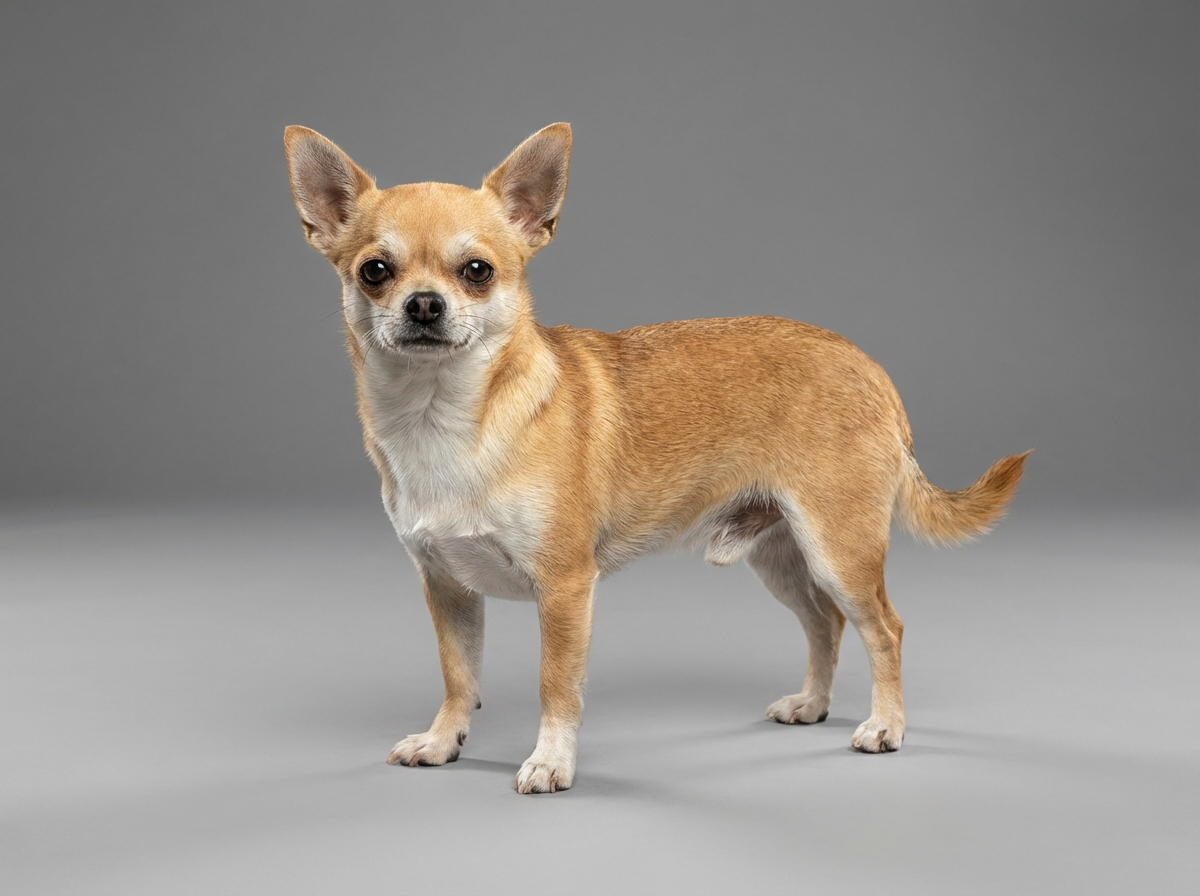
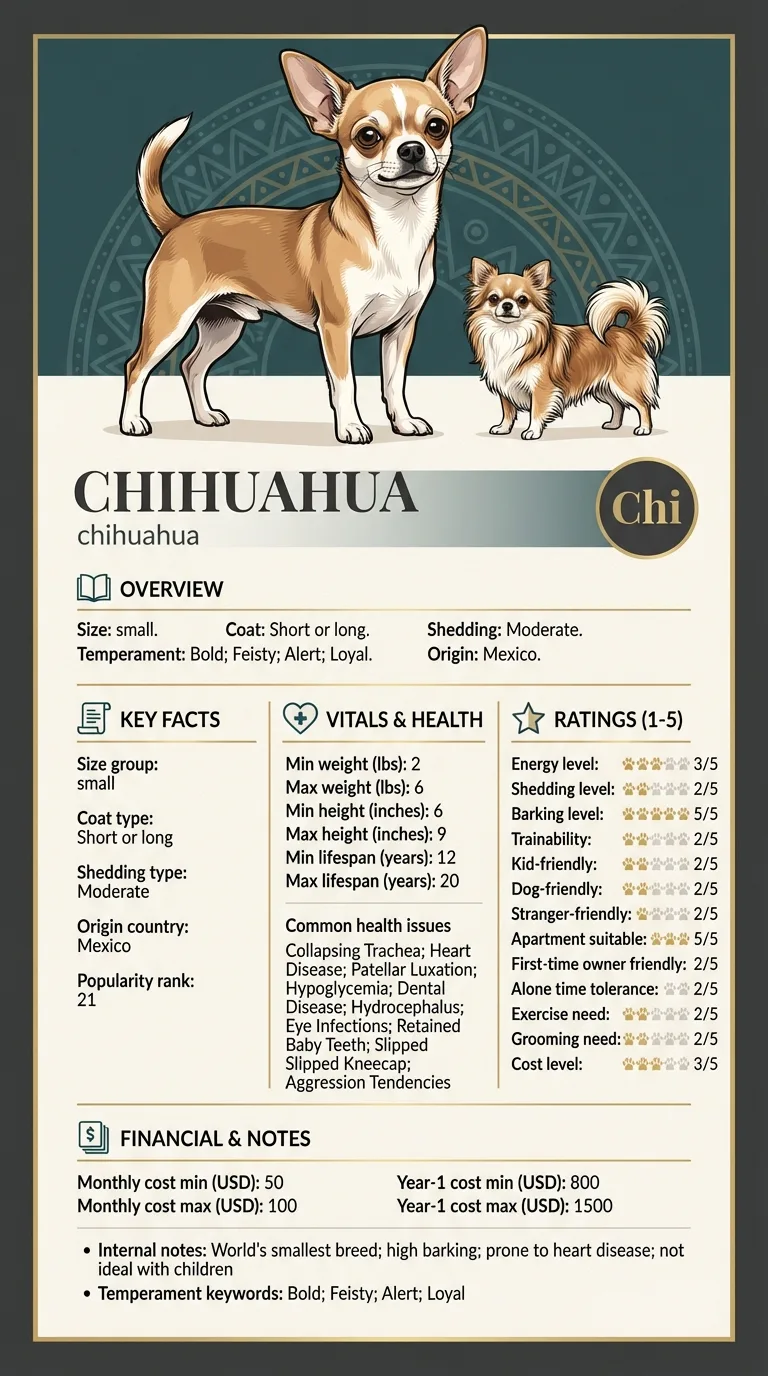
Between 2 and 6 pounds depending on frame. What matters more than the number is body condition: ribs easily felt, a visible waist and an abdominal tuck.

Quick answer
How much should a Chihuahua weigh?
Between 2 and 6 pounds depending on frame. What matters more than the number is body condition: ribs easily felt, a visible waist and an abdominal tuck.
Nobody sets out to overfeed a Chihuahua. They set out to give her a piece of cheese, which for a four-pound dog is closer to a meal than a treat.
Owners who have been told at a checkup that she needs to lose weight and cannot see it, and multi-person households where everyone is giving small amounts and nobody is counting.
This guide is not medical advice. If your dog shows pain, sudden behavior change, or worsening symptoms, consult a licensed veterinarian.
Some links may be affiliate links. We may earn a commission at no extra cost to you. We only suggest products we believe are helpful for dog owners.
We research and check what we publish, but we do not warrant that any figure, date, price, or statement is accurate, complete, or current, and we accept no liability for any loss, cost, injury, or other harm arising from the use of this site. Use it as one reference among several. You remain responsible for your own decisions and for your dog's care - confirm anything that matters with a licensed veterinarian or another qualified professional before you act on it. Full disclaimer.
Obesity in Chihuahuas is a problem of scale. With a healthy range of only 2 to 6 pounds and a correspondingly tiny calorie budget, ordinary treats and scraps represent enormous proportional overfeeding. The resulting weight accelerates several conditions the breed is already documented as prone to, and the gains that cause it are usually invisible until a vet points them out.
Excess weight is one of the most frequently identified problems in small-dog practice and it is chronically under-recognised by owners, particularly in long-coated dogs where the coat hides the outline. Because the breed's healthy weight range is so narrow, a Chihuahua can be substantially overweight while still looking like a small dog to everyone who sees her.
The mechanism is arithmetic rather than metabolism. A 2 to 6 pound body standing 6 to 9 inches tall requires very few calories, so the ratio between a normal treat and a full day's intake is unlike anything in a larger breed. The breed's exercise need is rated only two out of five, which limits how much can be burned off through activity. Beyond that, the consequences fall on documented Chihuahua weaknesses: patellar luxation, heart disease and collapsing trachea are all made worse by additional load.
Household coordination is the dominant factor. A small dog with an appealing face in a house of several people receives food from many directions, and each contributor honestly believes they are giving almost nothing. Sharing a home with a larger dog provides a second food source at floor level. Cold weather, which keeps a Chihuahua indoors and under blankets, reduces activity without reducing feeding. And because the breed is often carried rather than walked, the modest exercise she should be getting quietly disappears.
Book a routine appointment before starting any weight loss plan, so a target weight and a safe rate of loss can be set for her specific frame, and so underlying causes can be excluded. Arrange a prompt appointment if she has gained weight despite unchanged feeding, if her appetite has suddenly and markedly increased, if she is drinking and urinating more, or if she has developed a pot-bellied appearance or coat changes alongside the weight, since hormonal conditions can drive all of these. Seek same-day care for breathing difficulty at rest, a persistent honking cough, collapse, or refusal to use a limb, all of which can be provoked or worsened by excess weight in this breed and need assessment rather than a diet plan.
See all Chihuahua health problems, which breeds are prone to obesity, or the full Chihuahua breed guide for temperament, exercise needs and ownership costs.
Expect months, not weeks. A safe rate of loss means a dog needing to shed a pound is on a plan for three to five months. Progress at this scale is invisible without a scale, so weekly weighing is what keeps people going through a period where nothing appears to be happening. Improvements in movement, breathing comfort and energy usually become noticeable partway through rather than at the end, often once she is a third to halfway to target.
Success is a dog whose ribs you can feel with a light hand, who has a waist you can see from above, and whose weight sits stable on the same scale month after month. Practically, it also looks like a household that has changed its habits permanently, because the failure mode is not losing the weight but regaining it once everyone relaxes. A Chihuahua at a correct body condition moves better, breathes more easily and asks less of a knee and a heart that will both have to last into her late teens.
Calorie requirements scale with body size, so a four-pound dog needs a small fraction of what a forty-pound dog needs. Her whole daily allowance is a modest handful of food. Against that budget, ordinary human generosity becomes catastrophic arithmetic.
A single small dog biscuit can represent a meaningful percentage of her day. A cube of cheddar the size of a fingernail is more. A quarter of a slice of ham, a corner of toast, a couple of pieces of kibble from a larger dog's bowl. Each individual item is trivially small in human terms and none of them feels like feeding the dog. Together they routinely double her intake.
The household structure makes this worse. If four people each give her one small thing a day, believing themselves to be the only one, she has received four supplementary meals. Because each person has honestly given almost nothing, no one can identify the cause when the vet says she has gained.
The consequences land on systems this breed already has documented weaknesses in. Patellar luxation is a Chihuahua problem, and weight increases the force through a poorly tracking knee. Heart disease is a Chihuahua problem, and extra mass means extra work every minute. Collapsing trachea is a Chihuahua problem, and a fatter neck and chest make breathing harder. Obesity does not create new diseases here so much as accelerate the ones the breed already carries.

Weight loss in a tiny dog is a measurement problem and a coordination problem, not a willpower problem.
If you think your Chi has obesity, the plan is three steps: write down what you have seen and when it started, book a veterinary appointment rather than waiting for the next flare, and take video of the behaviour or symptom before you go — the thing you are worried about rarely happens in the consulting room. Screening in the parents covers collapsing trachea, heart disease, patellar luxation.
What the vet visit should produce is a diagnosis and a written plan, not just reassurance: what is being ruled out, what the monitoring interval is, and which signs mean you come back sooner. Ask what the treatment costs across a year rather than per visit, because that is the number that decides whether you are managing this condition or reacting to it.
Between appointments, keep a short log — dates, what you saw, what changed. It is the single most useful thing an owner brings to a follow-up, and for obesity it is often what separates a clear pattern from a guess.
Lupe weighed seven pounds and eleven ounces at eight years old, which her owner Denise had assumed was simply Lupe's size. Her vet disagreed, felt for ribs, could not find them easily, and set a target of five pounds four ounces over five months. Denise's first attempt failed. She reduced meals, everyone agreed, and Lupe lost nothing in six weeks. The breakthrough was a plastic tub on the kitchen counter with the day's forty-two grams in it, including treats. Within a week it was obvious what had been happening: her father-in-law, who visited daily, had been giving Lupe a quarter of his biscuit every afternoon, which Denise had never seen because it happened while she was at work. Lupe reached five pounds seven at month six. Her skipping gait, which had been getting more frequent, went back to occasional. Denise's assessment was that the diet had never been the hard part; identifying the invisible extra meal was.
Key takeaway: In a household with more than one person, a Chihuahua's weight problem is usually a measurement problem. Put the whole day's food in one visible container and the missing calories identify themselves.
Use your hands rather than your eyes, especially with a long coat. Ribs should be easy to feel with light pressure, like the back of your knuckles rather than your palm. Looking down from above there should be a visible narrowing behind the ribs, and from the side the belly should tuck up rather than run straight. If you have to press to find ribs, she is carrying too much.
Slowly and under veterinary guidance. Rapid weight loss in dogs carries real risks, and in a two to six pound dog the margins are tight enough that this is not a project to improvise. A structured plan from your vet, with weigh-ins, will typically aim at a modest percentage of body weight per week over several months.
The breed range is 2 to 6 pounds, and individuals do sit at different points in it legitimately. What is not legitimate is a dog whose ribs cannot be felt. Frame size determines where in the range she belongs; body condition determines whether she is at her own right weight, and those are different questions.
Begging is a learned behaviour maintained by intermittent success, and it correlates poorly with actual need. It is also very effective, because a bold, vocal breed is good at it and people find a small dog begging charming. If food-seeking has genuinely and suddenly increased, that is worth mentioning to your vet, since some medical conditions increase appetite.
Not on its own. This breed's exercise need is rated two out of five, so there is limited room to burn substantially more, and a dog with joint or airway problems may not tolerate much increase. Weight loss in small dogs is driven overwhelmingly by intake. Exercise maintains muscle and joint health, which matters enormously, but it is not the lever that moves the scale.
Weight itself is entirely reversible. Some of its consequences are not. Cartilage worn from a knee that has been carrying extra load for years does not regenerate, and a heart that has enlarged does not return to its former size. That asymmetry is the argument for acting on a small gain now rather than a large one later.
Between 2 and 6 pounds depending on frame. What matters more than the number is body condition: ribs easily felt, a visible waist and an abdominal tuck.
Half a pound on a four-pound dog is over ten percent of her body weight, loading knees, discs and heart in a breed already predisposed to problems in all three.
By weight in grams on a kitchen scale, not by cups. Portion all food including treats into one container each morning.
No. On a budget this small, treats must be taken out of the daily ration. Using her own kibble for training is the simplest way to do it.
A one-page prep sheet for this condition: the signs, the questions to ask, what to get priced. Unlocks here.
You get: Vet visit prep sheet
No spam. One-click unsubscribe. See our privacy policy.
Preview page 1 before you decide.