Living
What is the difference between an apple head and a deer head Chihuahua?
Apple heads have a domed skull, short muzzle and a sharp stop; deer heads have a flatter skull and a longer sloping muzzle. Same breed, different type.

Quick answer
What is the difference between an apple head and a deer head Chihuahua?
Apple heads have a domed skull, short muzzle and a sharp stop; deer heads have a flatter skull and a longer sloping muzzle. Same breed, different type.
A Chihuahua carries the same forty-two adult teeth as a German Shepherd, in a jaw a fraction of the length. Something has to give, and what gives is the alignment of the teeth and the depth of the eye sockets.
Owners choosing between apple-headed and deer-headed puppies, owners who have been told their dog's teeth are crowded or its eyes are prominent, and anyone trying to understand why this breed's health problems cluster so heavily around the face.
This guide is not medical advice. If your dog shows pain, sudden behavior change, or worsening symptoms, consult a licensed veterinarian.
Some links may be affiliate links. We may earn a commission at no extra cost to you. We only suggest products we believe are helpful for dog owners.
We research and check what we publish, but we do not warrant that any figure, date, price, or statement is accurate, complete, or current, and we accept no liability for any loss, cost, injury, or other harm arising from the use of this site. Use it as one reference among several. You remain responsible for your own decisions and for your dog's care - confirm anything that matters with a licensed veterinarian or another qualified professional before you act on it. Full disclaimer.
The Chihuahua's shortened muzzle and domed skull, most pronounced in the apple-headed type, are moderate rather than extreme, and they do not produce the airway obstruction associated with truly flat-faced breeds. What they do produce is a jaw too short for a full set of adult teeth, leading to crowding, retained baby teeth and early periodontal disease, and eye sockets too shallow to protect a prominent eye. Both consequences are on the breed's documented health list.
Universal in the sense that every Chihuahua has this skull to some degree, and consequential in the majority. Dental disease, retained baby teeth and eye infections all appear explicitly on the breed's documented health list, and each traces back to face shape. Severity varies with type: a moderate deer-headed dog has measurably more room in its jaw and deeper orbits than an extreme apple-headed one.
This is a conformational problem, meaning it is built in rather than acquired. Selection for the rounded apple skull with a sharply angled short muzzle shortened the maxilla and mandible without changing the number of teeth, so forty-two adult teeth occupy bone designed for fewer. They rotate and overlap, creating crevices that trap debris and plaque, and they leave insufficient room for erupting adult teeth to displace their deciduous predecessors, which is why retained baby teeth appear on the breed list. The same skull shortening reduces orbital depth, so the eye protrudes and its surface is more exposed. The domed cranium is also associated with the molera and, in a small proportion, with the hydrocephalus documented in the breed.
Conformation is fixed but outcome is not, and the environment decides how much damage the anatomy causes. A household that never brushes teeth allows crowding to become periodontal disease within a few years; one that brushes daily and books regular professional cleaning can keep a crowded mouth functional for well over a decade. Play with substantially larger dogs, dense undergrowth on walks, and rough handling by children all put a poorly protected eye at risk. Delaying removal of retained deciduous teeth allows a second row of plaque traps to establish before the dog is a year old.
Go the same day for a squinting eye, a suddenly cloudy or blue-looking eye, an eye held shut, obvious pain around the face, or any eye that appears to be bulging further than usual, since an eye displaced from a shallow socket is a genuine emergency and the window for saving vision is short. Book promptly for a double row of teeth in a dog older than about six months, for bad breath, for reluctance to chew on one side, or for any visible tartar or receding gum. Ask specifically about a dental assessment at every annual visit rather than waiting to be offered one.
See all Chihuahua health problems, which breeds are prone to brachycephalic features, or the full Chihuahua breed guide for temperament, exercise needs and ownership costs.
Nothing about the skull changes over time. Crowding is present from the moment the adult teeth arrive at four to seven months, and eye prominence is there for life. What changes is the disease burden: with daily brushing from puppyhood and regular professional care, a crowded mouth can remain healthy into the teens, while a neglected one typically shows significant periodontal disease by three to five and tooth loss well before ten. The trajectory is set early and is difficult to reverse later.
Success is a Chihuahua whose anatomy has not become its pathology: a crowded but clean mouth with all its teeth at ten, eyes that are prominent but clear and uninjured, and an owner who books dental assessments proactively rather than after the breath becomes unbearable. It is not a dog with a normal-shaped skull, because that is not on offer. The realistic goal is managing a conformation you cannot change.
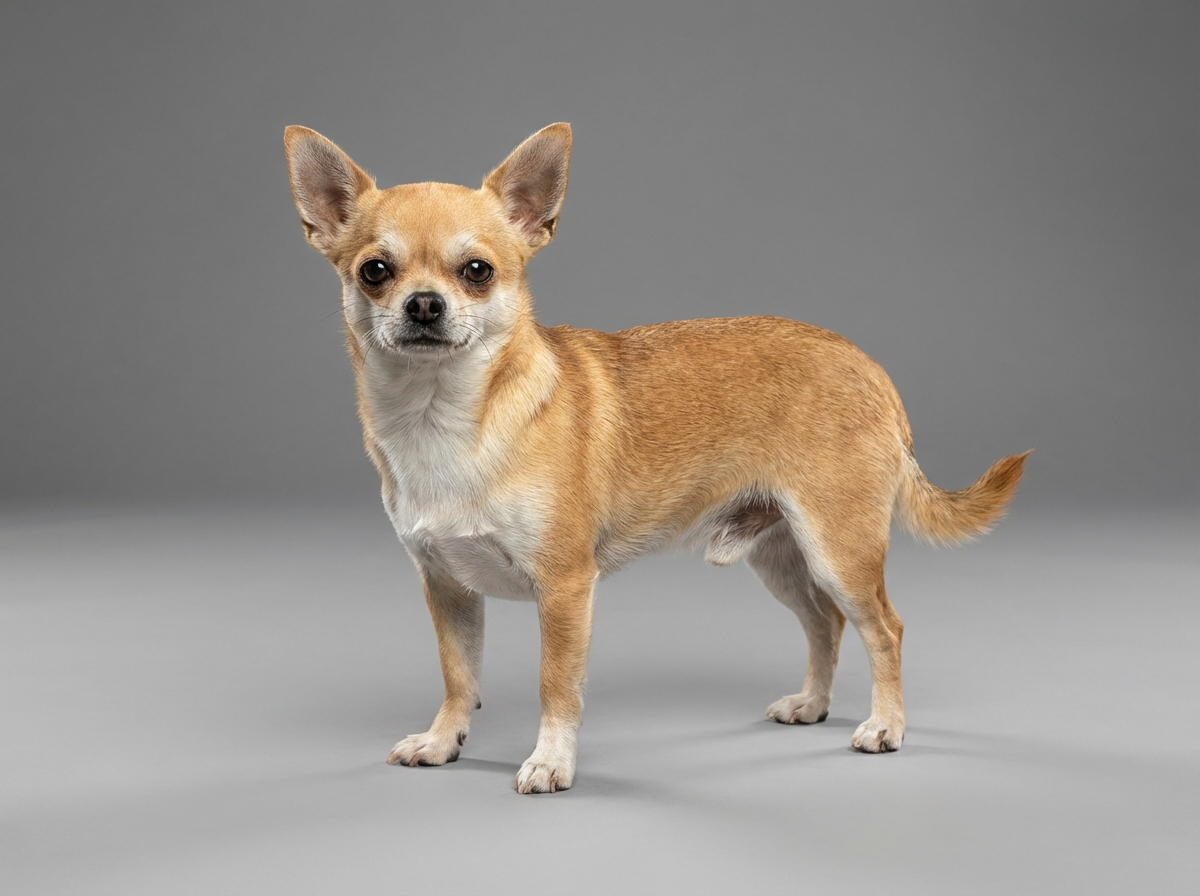
Neither term is a separate breed and both describe the same dog. The apple-headed Chihuahua has a domed, rounded skull with the muzzle meeting it at roughly ninety degrees, a shorter nose and larger, more forward-set eyes. The deer-headed type has a flatter skull, a longer sloping muzzle and a more gradual transition between forehead and nose.
The apple head is the type described in breed standards, and it is also the type more strongly associated with two of this breed's characteristic features. The first is the molera, the incompletely closed opening at the top of the skull, which follows from the domed shape. The second is the shortened jaw.
That shortened jaw is where the real cost lands. Dogs have forty-two adult teeth regardless of size, and shortening the length of bone available to hold them means the teeth rotate, overlap and sit too closely together. Crowded teeth trap food between them, and trapped food is the beginning of the periodontal disease listed among this breed's common health problems. It also explains why baby teeth are so often retained: there is not enough room for the adult tooth to push its predecessor out cleanly, so both stay.
The second cost is orbital. A shortened face means shallower eye sockets, and shallower sockets mean an eye that sits more prominently and is protected by less bone.

If you want to know what a Chihuahua's head shape means for its life, these are the honest downstream consequences rather than the ones borrowed from bulldog literature.
If you think your Chi has brachycephalic features, the plan is three steps: write down what you have seen and when it started, book a veterinary appointment rather than waiting for the next flare, and take video of the behaviour or symptom before you go — the thing you are worried about rarely happens in the consulting room. Screening in the parents covers collapsing trachea, heart disease, patellar luxation.
What the vet visit should produce is a diagnosis and a written plan, not just reassurance: what is being ruled out, what the monitoring interval is, and which signs mean you come back sooner. Ask what the treatment costs across a year rather than per visit, because that is the number that decides whether you are managing this condition or reacting to it.
Between appointments, keep a short log — dates, what you saw, what changed. It is the single most useful thing an owner brings to a follow-up, and for brachycephalic features it is often what separates a clear pattern from a guess.
Corina in Seville kept two Chihuahua sisters from the same litter. Almendra had a pronounced apple head with a very short muzzle; Ceniza was noticeably deer-headed with a longer nose. Same parents, same food, same house, same brushing routine started at nine weeks. Almendra needed both retained upper canines removed at seven months. Ceniza had none. By age six Almendra had had two professional cleanings with a single extraction of a badly rotated premolar; Ceniza had had one cleaning and no extractions. Almendra also scratched a cornea at four, chasing through a hedge, and needed two weeks of treatment. Ceniza came through the same hedge unharmed. Corina is clear that neither dog was neglected, and that Almendra is not unhealthy. The difference is that one skull left less margin than the other, and the bills followed the margin.
Key takeaway: Within a single litter, muzzle length predicted the dental and ocular history better than anything the owner did. Care changes the outcome enormously, but it works with the anatomy it is given.
Neither is a health guarantee, but the longer-muzzled deer-headed type has more jaw length for the same forty-two teeth and deeper eye sockets, which are genuine advantages. The apple head is what breed standards describe, so show-bred dogs trend that way. If you are choosing a pet and health is your priority, a moderate muzzle is worth preferring over an extreme one.
Generally no. Airway syndrome requires the extreme facial compression seen in Pugs and French Bulldogs, and the Chihuahua's muzzle, while short, is not in that category. The breed's documented airway problem is a collapsing windpipe, which is a structure below the throat and unrelated to face shape.
Because forty-two adult teeth are trying to fit into a jaw shortened by selective breeding. Teeth rotate, overlap and sit at odd angles simply because there is no room to line up. Crowding is not cosmetic: the gaps between overlapping teeth trap food and plaque in places a toothbrush struggles to reach, which is why this breed develops periodontal disease so young.
Prominent eyes in shallow sockets are more exposed to injury and dry out faster than deep-set ones. That does not make them abnormal, but it does mean the eyes deserve daily attention and real protection: no rough play with larger dogs, care in undergrowth, and a prompt veterinary visit for any squinting, redness or discharge rather than a wait-and-see approach.
A small, stable molera in a bright, normally behaved Chihuahua is common and generally not a problem, though it does mean that area has no bony protection. What needs assessment is a very large or enlarging gap, a head that looks increasingly domed, eyes that turn outwards and downwards, circling, head pressing or seizures, since hydrocephalus is documented in this breed.
You cannot change the jaw, but you can change the outcome. Daily toothbrushing started early, removal of retained baby teeth as soon as they are identified, and regular professional cleaning under anesthesia are what separate a Chihuahua with a functional mouth at twelve from one that has lost most of its teeth by eight. The crowding is fixed; the disease it causes is not inevitable.
Apple heads have a domed skull, short muzzle and a sharp stop; deer heads have a flatter skull and a longer sloping muzzle. Same breed, different type.
Crowded and rotated teeth, retained baby teeth and shallower eye sockets. It does not cause bulldog-style airway obstruction in this breed.
A shortened face means shallower orbits, so the eye sits further forward with less bone around it and more surface exposed.
Many do, particularly apple-headed ones, and it is often harmless. A very large or enlarging one, or odd behaviour, needs veterinary assessment.
Indirectly. A more crowded mouth means earlier and more frequent dental work under anesthesia, which is this breed's largest recurring health expense.
A one-page prep sheet for this condition: the signs, the questions to ask, what to get priced. Unlocks here.
You get: Vet visit prep sheet
No spam. One-click unsubscribe. See our privacy policy.
Preview page 1 before you decide.