Health
What does a luxating patella look like?
A brief hopping skip during a run, with the back leg held up for a couple of strides, then normal movement resuming as if nothing happened.

Quick answer
What does a luxating patella look like?
A brief hopping skip during a run, with the back leg held up for a couple of strides, then normal movement resuming as if nothing happened.
Most owners meet this condition as a quirk: three normal strides, one skipping hop, then normal again. The quirk is a joint coming apart and going back together.
Owners who have noticed the skip and been told it is mild, and who want to know what they can actually do to keep it that way rather than simply waiting to see whether surgery becomes necessary.
This guide is not medical advice. If your dog shows pain, sudden behavior change, or worsening symptoms, consult a licensed veterinarian.
Some links may be affiliate links. We may earn a commission at no extra cost to you. We only suggest products we believe are helpful for dog owners.
We research and check what we publish, but we do not warrant that any figure, date, price, or statement is accurate, complete, or current, and we accept no liability for any loss, cost, injury, or other harm arising from the use of this site. Use it as one reference among several. You remain responsible for your own decisions and for your dog's care - confirm anything that matters with a licensed veterinarian or another qualified professional before you act on it. Full disclaimer.
A luxating patella is a kneecap that slides out of its groove during movement. It is graded one to four by how easily and how often it displaces, and it is the most frequent orthopaedic finding in Chihuahuas. Low grades are usually managed with environment and weight rather than surgery, and the aim of that management is to prevent the grade from climbing.
This is the breed's signature joint problem and it appears twice in the Chihuahua's documented health issues, as patellar luxation and as slipped kneecap. A large proportion of Chihuahuas have some degree of it, many at a grade so low it never causes a clinical problem. It is common enough that an owner noticing the skip should assume this before considering anything rarer.
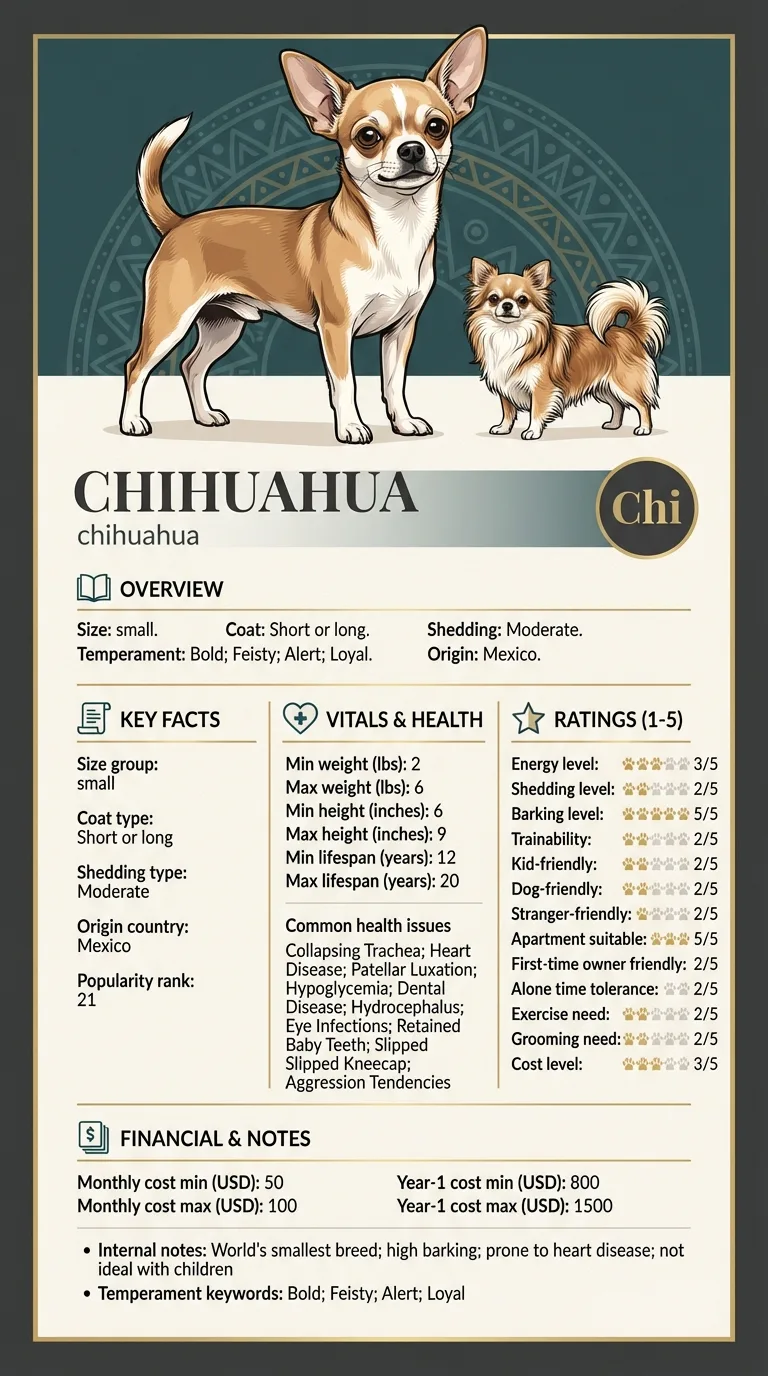
The problem is one of alignment rather than injury. In affected dogs the groove at the end of the thigh bone is too shallow to retain the kneecap, or the point where the tendon attaches to the shin sits slightly off centre, pulling the kneecap sideways every time the muscle contracts. Both are conformational and inherited. Extreme miniaturisation to a 2 to 6 pound body has produced very fine limb bones with correspondingly shallow grooves, and this is the mechanical price of that size.
The household governs how often the knee dislocates and under what load. Hard slippery flooring is the biggest single culprit, because a foot that slides sideways delivers exactly the lateral force that pops the kneecap out. Human-height furniture turns each descent into a substantial impact for a dog nine inches tall. Sedentary periods cost thigh muscle, and thigh muscle is the active restraint holding the kneecap in place. Excess weight multiplies every one of these effects.
Book a routine appointment to have both knees graded if you have noticed a skip, even an occasional one, so you have a documented baseline to compare against in future years. Arrange a prompt appointment, within a few days, if the skipping becomes more frequent, if she starts holding the leg up for longer than a stride or two, if her hind stance has changed to a crouch or a bow, or if she has become reluctant to jump or climb her ramp. Seek same-day care for a leg she will not bear any weight on, obvious pain, crying out, or a knee that stays displaced and does not correct itself, and for any sudden lameness after a fall, since fractures are a genuine risk in bones this fine. All pain relief should be prescribed by your vet.
See all Chihuahua health problems, which breeds are prone to luxating patellas, or the full Chihuahua breed guide for temperament, exercise needs and ownership costs.
Environmental changes take effect immediately in terms of reducing dislocations, though the benefit is measured in years of slowed progression rather than in any visible improvement next week. Weight loss in a small dog should be gradual, so expect three to five months to reach a lean body condition. Grade progression, where it happens, unfolds over years, which is why a fortnightly gait check and an annual veterinary grading are the right monitoring intervals rather than anything more frequent.
Success is a grade that does not climb. A dog who was a grade two at three years old and is still a grade two at twelve, moving comfortably, using her ramps, and never needing surgery, is the ideal outcome and it is a common one. Success does not mean the skip disappears; conformation does not change without surgery. It means the joint is doing less damage per year than it otherwise would.
Grade one means the kneecap sits in place normally and can be pushed out of the groove by a vet, returning by itself immediately. Owners often see nothing at all. Grade two means it slips out during normal movement and goes back on its own, sometimes when the dog straightens or shakes the leg. This is the classic skipping gait, and it is where most Chihuahuas sit.
Grade three means the kneecap spends most of its time out of the groove and can be pushed back, but slips out again. The dog's gait changes more permanently: a crouched hind end, a bow-legged stance, or a persistent reluctance to extend the leg. Grade four means it is out permanently and cannot be replaced manually, and the leg is usually held bent with the dog bearing little weight on it.
The important thing about the grades is that they are not fixed. A knee at grade two can wear the edge of its groove down over years and become a grade three. That progression is not inevitable, and the factors that drive it, load and repeated dislocation, are partly within an owner's control.
Many dogs at grades one and two are not obviously in pain during an episode. This misleads owners into thinking the condition is harmless. What is happening is cartilage abrading against bone each time the kneecap crosses the ridge of the groove, and the arthritis that produces arrives years later.

None of these treat the knee. All of them reduce how often and how hard it dislocates, which is what determines the damage over time.
If you think your Chi has luxating patellas, the plan is three steps: write down what you have seen and when it started, book a veterinary appointment rather than waiting for the next flare, and take video of the behaviour or symptom before you go — the thing you are worried about rarely happens in the consulting room. Screening in the parents covers collapsing trachea, heart disease, patellar luxation.
What the vet visit should produce is a diagnosis and a written plan, not just reassurance: what is being ruled out, what the monitoring interval is, and which signs mean you come back sooner. Ask what the treatment costs across a year rather than per visit, because that is the number that decides whether you are managing this condition or reacting to it.
Between appointments, keep a short log — dates, what you saw, what changed. It is the single most useful thing an owner brings to a follow-up, and for luxating patellas it is often what separates a clear pattern from a guess.
Kiki and Rufo were littermates, both graded two on both knees at eighteen months. Kiki went to a household with carpet throughout, a ramp to the sofa and an owner who weighed her monthly. Rufo went to a flat with polished concrete floors and a habit of leaping from a high bed. At seven, Kiki was still grade two and sound. Rufo had progressed to grade three on the left, was walking with a crouched hind end, and had surgery that year. Neither dog had done anything wrong and neither owner had been careless in any obvious way. The surgeon who operated on Rufo put it simply to his owner: the knees started identically, and the difference was several thousand landings on concrete versus several thousand walks down a ramp onto carpet.
Key takeaway: Conformation sets the starting grade; the household decides how fast it moves. Traction, ramps and a lean body weight are not minor comfort measures, they are the treatment for a low-grade knee.
Often not obviously so at the time, which is why it is so easily dismissed. The dog is not crying out because the dislocation itself is brief. The relevant harm is cumulative cartilage wear, which produces arthritis years later, and by then it is not reversible. A painless skip is still worth acting on.
No. Many grade one and grade two knees are managed conservatively for a dog's whole life with weight control, traction, ramps and muscle maintenance. Surgery becomes the conversation when the grade progresses, when the dog is lame rather than skipping, or when pain is evident. It is a decision driven by function, not by the presence of the diagnosis.
Do not try. In low grades it relocates by itself when the dog straightens the leg, and a dog who is holding a leg up will usually resolve it within seconds by stretching. Manipulating a joint you cannot assess risks worsening it, and a knee that stays out needs a vet the same day rather than a home attempt.
No. Patellar luxation is documented in this breed and has a strong heritable component, so breeding affected dogs perpetuates it. A breeder who has both parents examined by a vet and can show you the findings is doing the one thing that reduces the frequency of this condition over generations.
The evidence is mixed and they do nothing to change the shape of the groove or the alignment of the tendon, which is the actual problem. They are not a substitute for weight control and muscle maintenance, which have far better support. Discuss any supplement with your vet rather than adding several, since dosing a two to six pound dog needs care.
Yes. It is a conformational problem, not a wear-and-tear one, so it can be detectable in puppies and is frequently noted at early vet visits. That early note is also the reason so many patella claims are later declined as pre-existing, so insure before the first examination if you intend to insure at all.
A brief hopping skip during a run, with the back leg held up for a couple of strides, then normal movement resuming as if nothing happened.
Yes. Patellar luxation and slipped kneecap both appear among the breed's documented health issues, and it is the most common cause of hind-leg lameness in Chihuahuas.
Keeping her lean. On a two to six pound frame, weight has more leverage on joint load than anything else you can do at home.
Yes. Install a ramp and block access to furniture she cannot reach safely. Landing impact is the highest-force event in her day.
A one-page prep sheet for this condition: the signs, the questions to ask, what to get priced. Unlocks here.
You get: Vet visit prep sheet
No spam. One-click unsubscribe. See our privacy policy.
Preview page 1 before you decide.