Health
Is heart disease common in Chihuahuas?
It is listed among the breed's documented health problems, and likelihood rises steeply with age in a breed that often reaches its late teens.

Quick answer
Is heart disease common in Chihuahuas?
It is listed among the breed's documented health problems, and likelihood rises steeply with age in a breed that often reaches its late teens.
Most owners are handed a diagnosis and no map. The useful question is not "does my dog have heart disease" but "which chapter are we in, and what does the next one look like?"
Owners of middle-aged and senior Chihuahuas who have a diagnosis in hand and want to plan rather than react. Also anyone who has been told their dog is stable and does not know how long stable typically lasts.
This guide is not medical advice. If your dog shows pain, sudden behavior change, or worsening symptoms, consult a licensed veterinarian.
Some links may be affiliate links. We may earn a commission at no extra cost to you. We only suggest products we believe are helpful for dog owners.
We research and check what we publish, but we do not warrant that any figure, date, price, or statement is accurate, complete, or current, and we accept no liability for any loss, cost, injury, or other harm arising from the use of this site. Use it as one reference among several. You remain responsible for your own decisions and for your dog's care - confirm anything that matters with a licensed veterinarian or another qualified professional before you act on it. Full disclaimer.
Canine heart disease progresses through recognizable phases, and in a Chihuahua those phases are usually spread across a long life rather than compressed into a bad year. The practical consequence is that the same diagnosis can mean twelve quiet months of nothing or the beginning of intensive daily care, depending entirely on where in the arc the dog was caught.
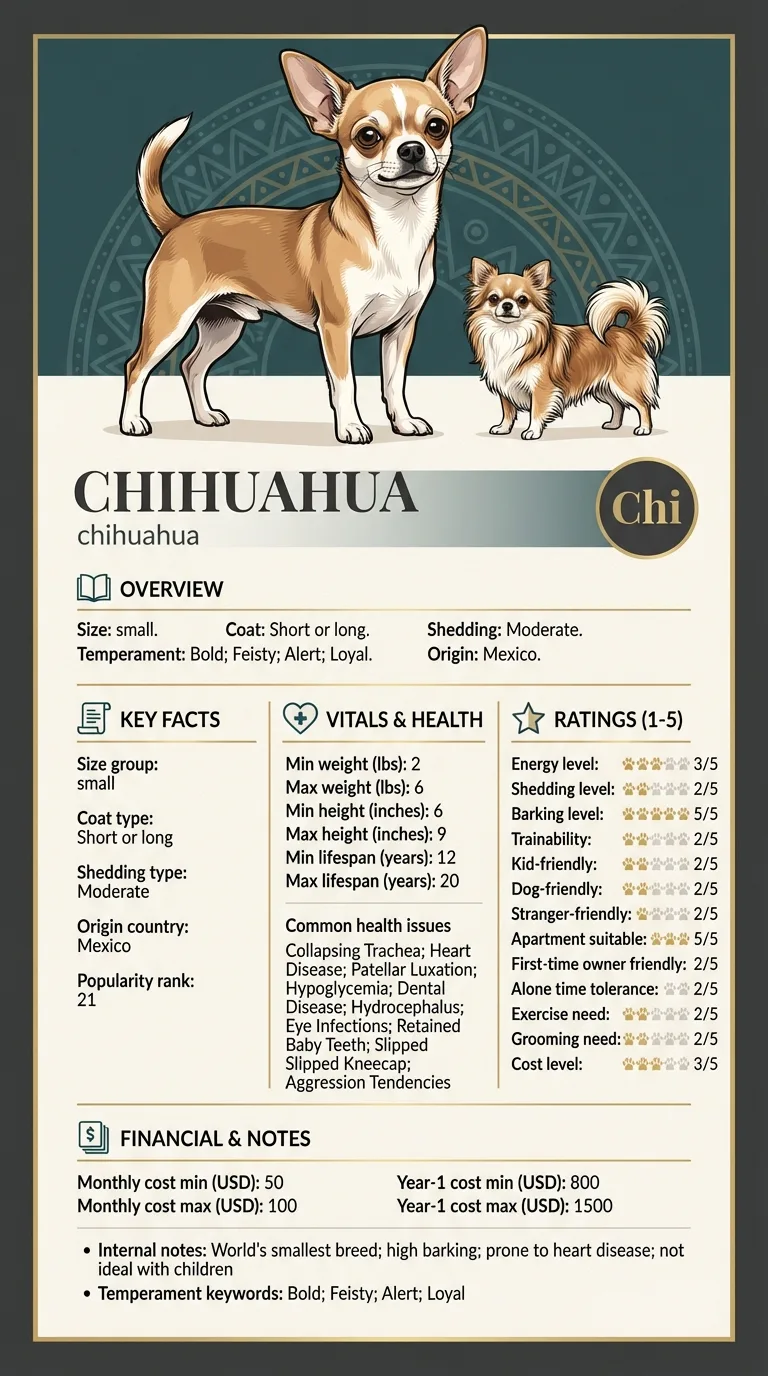
Cardiac disease is one of the more predictable problems of Chihuahua old age. Because the breed's lifespan runs from 12 to 20 years, many dogs simply live long enough to develop it, and a substantial number of Chihuahua owners will manage some phase of it at some point.
Toy breeds are predisposed to slow degeneration of the heart valves, a wear-and-tear process rather than an inflammatory one. The Chihuahua's documented heart disease predisposition sits on top of a very long lifespan, and degenerative processes reward time. A four-pound heart is also small enough that comparatively minor structural change represents a large proportional loss of function.
Nothing an owner does causes valve degeneration, but several things change its speed and its consequences. Weight gain adds continuous workload. Persistent dental infection adds inflammatory burden. Skipped checkups delay detection past the chapter where intervention helps most. Stressful, hot or high-altitude environments make an already compromised heart work harder without changing the underlying disease.
Treat as an emergency, tonight rather than tomorrow: breathing that is fast, laboured or open-mouthed while the dog is resting; a stretched neck and elbows held out from the body to breathe; gums that are pale, grey or blue; collapse or fainting; or a belly that has visibly swelled over days. These indicate the failure chapter and require same-day intervention. Book a non-urgent appointment within a week for a newly developed cough, a walk she now refuses partway through, restlessness at night, or weight loss you did not intend. Do not adjust or skip cardiac medication yourself, including when the dog seems better, because apparent improvement is usually the medication working.
See all Chihuahua health problems, which breeds are prone to heart disease, or the full Chihuahua breed guide for temperament, exercise needs and ownership costs.
Movement between chapters is typically measured in years, not weeks. A dog can sit in the asymptomatic phase for three to five years or longer. Once structural change is documented, the interval to congestive failure varies widely between individuals, which is precisely why rechecks tighten at that point. After failure begins, the timeline shortens and is measured in months, though treated dogs often do better than owners expect.
Success here is time bought and comfort preserved. A well-managed Chihuahua with heart disease eats, sleeps flat, greets people, and does a shorter version of her usual routine. She has no emergency visits for breathing distress, her medication is given on time without a fight, and the chapter changes are caught at a scheduled appointment rather than at two in the morning.
Chapter one is risk without disease. The dog belongs to a breed where heart problems are documented, but nothing abnormal has been found. Nothing needs doing except showing up for annual exams. Owners often skip this chapter entirely and only learn it existed in hindsight.
Chapter two is disease without consequence. Something abnormal is now audible or visible on imaging, but the heart's shape and the dog's daily life are unchanged. This chapter can last years, and in an older Chihuahua it frequently lasts the rest of her life. It is the least dramatic and by far the most common place to be.
Chapter three is disease with structural change. Imaging shows chambers have enlarged in response to the abnormality. The dog still looks well, but the heart has begun to remodel. This is where treatment decisions are usually made, because evidence supports intervening before symptoms appear rather than after.
Chapter four is congestive failure, where fluid backs up because the heart can no longer keep pace. Breathing becomes fast or laboured, coughing may start, and the dog tires. This chapter is treatable and dogs often live meaningfully longer with treatment, but it is not reversible, and the honest framing is management rather than cure.

The medical staging matters less to daily life than the practical shift it triggers. Here is what typically moves.
Tostada was diagnosed at four during a pre-dental workup. Her owner, Marcus, remembers being told she was in the phase where nothing needed doing, and he remembers not quite believing it. Twelve years passed. She was rechecked every six months, kept at three pounds eleven ounces, and had three dental cleanings. Nothing changed. At sixteen, imaging showed her heart had begun to enlarge. Marcus started her on medication that week. Because the shift had been anticipated for over a decade, there was no scramble and no debate about cost; he had been setting money aside since the second recheck. She entered the failure chapter at eighteen and lived another eight months on adjusted medication, still eating, still shouting at the mail carrier. Marcus's summary was that the diagnosis at four was not the bad news he thought it was. It was twelve years of warning.
Key takeaway: An early diagnosis in a long-lived breed is mostly a planning advantage. The chapters are slow, and almost every hard decision arrives with years of notice if you keep the appointments.
There is no single number, because the diagnosis can arrive in any chapter. A dog found in the asymptomatic phase may have many years ahead; a dog first diagnosed during a breathing crisis has a shorter and more uncertain outlook. Ask your vet which chapter she is in, since that question has an answerable version of the same information.
No. Cardiac medications reduce the workload on a failing heart, control fluid, and delay the next chapter. They do not repair the underlying structure. Anyone promising reversal, including supplement marketing, is not describing veterinary reality.
Because the strongest evidence for delaying congestive failure comes from starting during the structural-change phase, before symptoms appear. Waiting for the dog to look sick means waiting past the window where the benefit is largest.
Absolutely not, and this trips up many Chihuahua owners. Collapsing trachea is also documented in the breed and produces a distinctive dry honking cough. The two can coexist. Distinguishing them usually requires imaging rather than listening to the cough.
In the earlier chapters, yes, with her medication schedule written down and given to whoever is caring for her. In the failure chapter, travel gets harder, mainly because access to a clinic that already knows her matters more than usual.
Useful markers are appetite, interest in the people she likes, and comfort breathing at rest. When a dog stops eating, withdraws, and cannot get comfortable enough to sleep flat, those three together are more informative than any single test result. This is a conversation to have with your vet before it becomes urgent.
It is listed among the breed's documented health problems, and likelihood rises steeply with age in a breed that often reaches its late teens.
Only in the later chapters, and on veterinary direction. Early diet changes risk appetite loss, which is a bigger practical problem in a tiny dog.
Expect recurring costs to shift from one annual exam to two or three visits plus periodic imaging, with daily medication added from the structural-change chapter onward.
Not in the early chapters. Later, walks get shorter and slower rather than stopping, and the dog usually signals the right length herself.
A one-page prep sheet for this condition: the signs, the questions to ask, what to get priced. Unlocks here.
You get: Vet visit prep sheet
No spam. One-click unsubscribe. See our privacy policy.
Preview page 1 before you decide.