Health
Do Chihuahuas have brachycephalic airway syndrome?
It is not a documented problem in this breed. Their recognised airway issue is collapsing trachea, which sounds and behaves quite differently.

Quick answer
Do Chihuahuas have brachycephalic airway syndrome?
It is not a documented problem in this breed. Their recognised airway issue is collapsing trachea, which sounds and behaves quite differently.
When a Chihuahua struggles for breath in hot weather, the two explanations worth checking first are a windpipe that flattens under pressure, and the simple fact that this dog's face is seven inches above pavement that is far hotter than the air you are feeling.

Owners whose Chihuahua labours, snorts or coughs on summer walks, owners of the shorter-muzzled apple-headed type who have been told it is a flat-faced breed, and anyone planning summer travel with a dog this small.
This guide is not medical advice. If your dog shows pain, sudden behavior change, or worsening symptoms, consult a licensed veterinarian.
Some links may be affiliate links. We may earn a commission at no extra cost to you. We only suggest products we believe are helpful for dog owners.
We research and check what we publish, but we do not warrant that any figure, date, price, or statement is accurate, complete, or current, and we accept no liability for any loss, cost, injury, or other harm arising from the use of this site. Use it as one reference among several. You remain responsible for your own decisions and for your dog's care - confirm anything that matters with a licensed veterinarian or another qualified professional before you act on it. Full disclaimer.
Brachycephalic obstructive airway syndrome is a condition of extremely flat-faced breeds and is not documented in Chihuahuas. When a Chihuahua struggles to breathe in warm weather, the realistic explanations are a collapsing trachea, which is on the breed's health list, or straightforward heat stress in a dog whose face travels inches above hot ground and whose body mass gives it almost no thermal buffer. Both are serious, both are manageable, and neither is treated like bulldog airway disease.
Airway syndrome of the flat-faced type is essentially not a Chihuahua problem. Collapsing trachea, by contrast, sits on the breed's documented list and is one of the conditions most associated with toy dogs in general, typically becoming apparent in middle age. Heat intolerance affects every Chihuahua to some degree simply as a consequence of size, though this breed is generally more troubled by cold than by heat.
The Chihuahua's relevant anatomy is the windpipe rather than the face. Collapsing trachea appears explicitly on the breed's health list and reflects a weakening of the cartilage rings that hold the airway open, so the tube flattens when air moves through it quickly. Body size then compounds every temperature problem: at two to six pounds and six to nine inches the dog has a small heat store, a fast metabolism and a head in the hottest layer of air near the ground. The breed's top-of-scale barking drive means frequent bouts of rapid, forceful breathing during arousal. Coat type changes little either way, since both the smooth and long varieties trap or absorb heat rather than shedding it.
Timing and surface do most of the work. Midday walks on asphalt in summer put a Chihuahua's face and feet into conditions that would be obviously unacceptable at human head height. Humid weather blunts the cooling effect of panting. Cars parked in sun become lethal for a dog this size in minutes. Indoors, warm rooms combined with a doorbell that triggers a barking fit produce exactly the airflow pattern that collapses a soft trachea, and a neck collar used for lead walking adds direct mechanical pressure to the same structure.
Go to an emergency clinic immediately for breathing distress that does not settle within a minute or two of rest and cooling, for blue, grey or brick-red gums, for collapse, or for any suspicion of heatstroke, which in a dog this small can become irreversible quickly. Cool with tepid water on the belly and armpits and move air over the dog on the way, but do not delay the journey to do it. Book a routine appointment for a dry honking cough during excitement or exertion, for noisy breathing that is new, or for reduced tolerance of walks the dog used to manage easily.
See all Chihuahua health problems, which breeds are prone to brachycephalic airway syndrome boas, or the full Chihuahua breed guide for temperament, exercise needs and ownership costs.
Heat-related breathing problems improve immediately once the environment changes, and owners who move to early-morning summer walks usually see the difference on day one. Collapsing trachea is a structural condition that does not reverse; management with harness use, weight control, arousal reduction and, where prescribed, medication typically reduces cough frequency over two to six weeks and then holds. Expect a slow progression over years, with good and bad seasons, rather than either a cure or a steady decline.
Success is a Chihuahua that can do its normal short walks year-round because the walks have been rescheduled around the weather, that coughs occasionally rather than daily, and that has never had a breathing crisis requiring an emergency visit. It is not a dog with a silent, normal windpipe, because if the trachea is soft it stays soft. The measure is episode frequency and exercise tolerance, both of which respond well to management.
Collapsing trachea is documented among the Chihuahua's common health problems, and it is the airway diagnosis most affected dogs in this breed actually receive. The windpipe is held open by C-shaped rings of cartilage with a soft membrane bridging the gap. In predisposed toy dogs that cartilage softens, the rings flatten, and the tube narrows from a circle into a slot.
The effect is dynamic rather than fixed, which is the key to recognising it. A dog with a floppy trachea breathes normally at rest and runs into trouble when airflow speeds up: during excitement, during a barking fit, when pulling against a neck collar, and in heat when the dog is panting hard. The classic sound is a dry, repetitive honk, often compared to a goose.
Heat compounds this in a specific way. Panting is fast, shallow, high-velocity airflow, and high-velocity airflow through a floppy tube is exactly what makes it collapse. So the hot-weather breathing crisis in a Chihuahua is often not the heat overwhelming the dog directly; it is the panting response to heat overwhelming a compromised windpipe, which reduces cooling, which increases panting, which narrows the airway further.
That loop is why a hot, coughing, distressed Chihuahua needs to be cooled and calmed immediately rather than encouraged to keep walking to the car.

A Chihuahua experiences a summer afternoon differently from the person holding the lead, and the difference is not small.
Lupita is a nine-year-old, 6-pound Chihuahua in Austin whose owner Devon had been walking her at two in the afternoon because that was when he got home. By July she was honking within a block and lying down on the pavement. Devon assumed it was her flat face, having read about airway syndrome. Her vet pointed out that Lupita's muzzle was not remotely flat, felt her trachea, produced the honk on gentle palpation and confirmed a collapsing windpipe on radiographs. Three changes were made. Walks moved to seven in the morning and after nine at night. Her collar was replaced with a harness. And she lost half a pound over four months, from 6 pounds to 5.5, which on a dog her size was a meaningful proportion. Devon also stuck frosted film on the bottom half of the front window because Lupita's worst coughing fits followed the postman. She still honks when she is excited. She has not had to lie down on a pavement since.
Key takeaway: The diagnosis on the internet was the wrong structure entirely. Once the windpipe was named as the problem, the fixes were free or nearly free, and the biggest one was simply not walking a seven-inch-tall dog across hot asphalt in the afternoon.
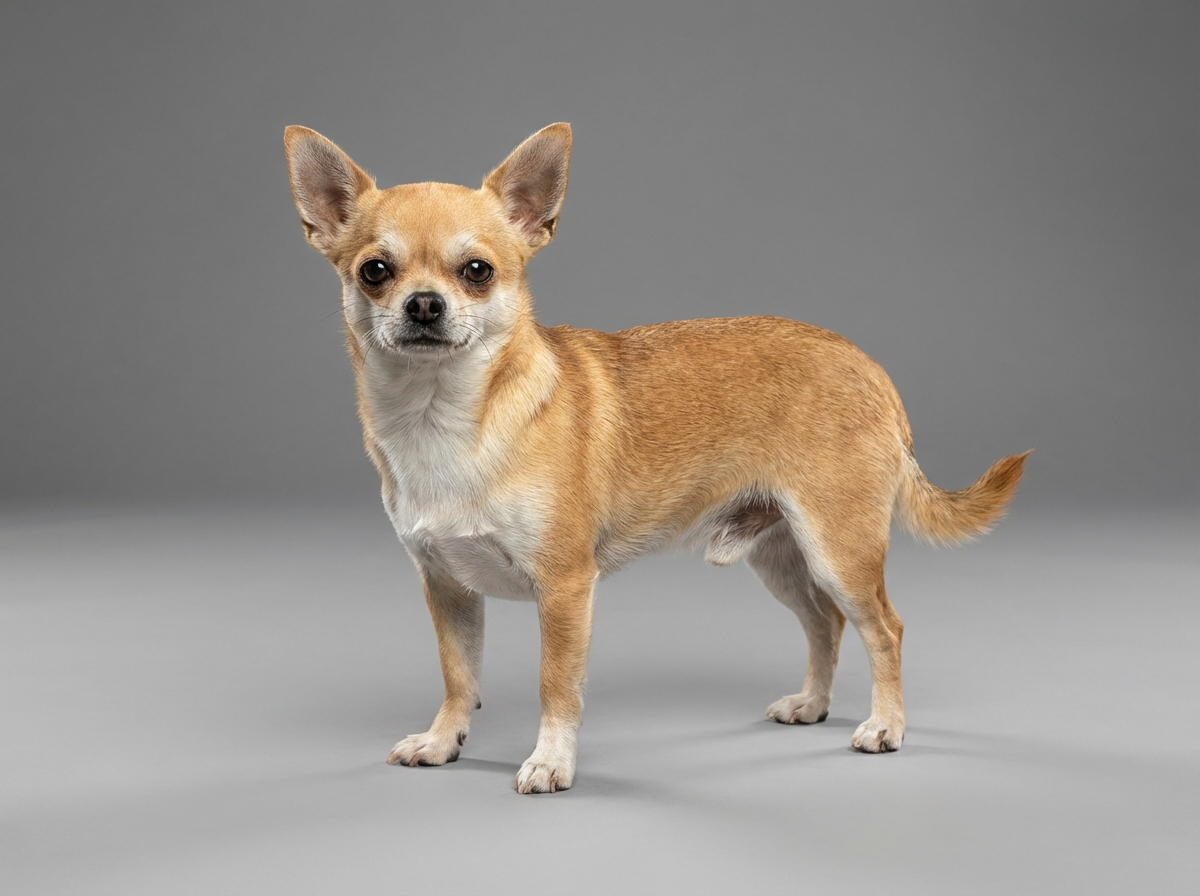
Not in the meaningful sense. The apple-headed Chihuahua has a shorter muzzle than a deer-headed one, but neither approaches the extreme facial compression of a Pug, a French Bulldog or a Boston Terrier, and airway syndrome is not on this breed's documented health list. Collapsing trachea is, and that is a different structure with a different mechanism and different management.
A dry, repetitive honk that arrives with excitement, exertion, heat or a pull on the collar is the classic sound of a flattening windpipe. It typically stops as soon as the dog calms down, and it is worth a veterinary assessment because the management, particularly harness use and weight control, genuinely reduces episodes.
Rather than a fixed number, use the pavement test: press the back of your hand to the surface for seven seconds, and if you cannot hold it there, the dog should not walk on it. Beyond that, prefer early morning and late evening in summer, keep sessions short, and remember that this breed's modest exercise needs are easily met indoors on a bad day.
Frantic panting that does not slow when the dog stops moving, a bright red or unusually dark tongue and gums, thick ropy drool, unsteadiness, vomiting, or a dog that suddenly lies down and will not get up. Heatstroke is a life-threatening emergency and a two-to-six-pound body has very little thermal buffer, so this is a drive-now situation.
The airway surgeries associated with flat-faced breeds, widening the nostrils and shortening an overlong soft palate, are aimed at anatomy Chihuahuas mostly do not have. Tracheal collapse has its own surgical options, including stents, but they are reserved for severe cases that have failed medical management. Most affected Chihuahuas are managed rather than operated on.
Ask your vet about specific products, but the principles are straightforward: cool water on the belly, groin and armpits where the skin is thin, plus moving air, works better than ice, which constricts surface blood vessels and slows heat loss. Do not immerse a small dog in very cold water. The most reliable tool is avoiding the heat in the first place.
It is not a documented problem in this breed. Their recognised airway issue is collapsing trachea, which sounds and behaves quite differently.
Panting is high-speed airflow, and high-speed airflow collapses a floppy windpipe. Heat and a soft trachea feed each other in a loop.
Hold the back of your hand against it for seven seconds. If you cannot, neither can paws seven inches below your knee.
Panting that does not settle at rest, dark red gums, ropy drool, wobbliness or collapse. It is an emergency in a two-to-six-pound dog.
Considerably. It removes collar pressure from a narrow windpipe during the lunging this vocal breed does many times a day.
A one-page prep sheet for this condition: the signs, the questions to ask, what to get priced. Unlocks here.
You get: Vet visit prep sheet
No spam. One-click unsubscribe. See our privacy policy.
Preview page 1 before you decide.