Behavior
What's the difference between separation anxiety and normal barking?
Separation anxiety happens specifically when left alone and involves distress like panting or escape attempts, not general alert barking that happens regardless.

Quick answer
What's the difference between separation anxiety and normal barking?
Separation anxiety happens specifically when left alone and involves distress like panting or escape attempts, not general alert barking that happens regardless.
A dog barking at the mail carrier is being vigilant. A dog panting, drooling and clawing at the door twenty minutes after you leave is in genuine distress, and those two things need completely different responses.
Owners of a dog who has attached almost exclusively to one household member, and anyone who adopted an older rescue Chihuahua with an unknown history of previous separations or abandonment.
This guide is not medical advice. If your dog shows pain, sudden behavior change, or worsening symptoms, consult a licensed veterinarian.
Some links may be affiliate links. We may earn a commission at no extra cost to you. We only suggest products we believe are helpful for dog owners.
We research and check what we publish, but we do not warrant that any figure, date, price, or statement is accurate, complete, or current, and we accept no liability for any loss, cost, injury, or other harm arising from the use of this site. Use it as one reference among several. You remain responsible for your own decisions and for your dog's care - confirm anything that matters with a licensed veterinarian or another qualified professional before you act on it. Full disclaimer.
Separation anxiety is genuine distress specifically tied to being left alone, distinct from general alert barking or under-stimulation. This breed's documented low tolerance for being alone, combined with a tendency toward intense attachment to one particular person, makes it more prone than many breeds to this specific pattern, which typically shows up within minutes of departure and can include panting, drooling, pacing and attempts to escape.
Separation-related distress is one of the more frequently reported behavioral concerns among owners of this breed, consistent with its documented low tolerance for being left alone and its tendency toward intense single-person attachment.
Low tolerance for being alone is a documented trait in this breed, and its bold, loyal temperament often translates into strong attachment concentrated on one household member rather than distributed evenly. Lower trainability scores mean building comfortable independence typically requires more structured, patient repetition than it might in a more naturally adaptable breed.
Constant carrying and close physical proximity from puppyhood can reduce a dog's practiced experience of being safely, calmly apart from its person. A sudden change in routine, such as a previously home-based owner returning to regular time away, removes an established pattern the dog had adapted to. Dramatic, high-emotion departures and reunions reinforce the idea that a person leaving is a significant event worth being upset about.
A trainer or veterinary behaviorist experienced in separation-related distress is worth involving for anything beyond mild, improving cases, since a structured desensitization plan is more effective and safer than ad hoc departures, and progress that stalls after a few weeks of a consistent plan is a signal that professional guidance would help.
Mention suspected separation anxiety to your vet, particularly if it involves self-injury attempts, complete appetite loss while alone, or has developed suddenly, since ruling out or addressing a medical contribution and discussing whether medication alongside training is appropriate can both matter for more severe cases.
See all Chihuahua health problems, which breeds are prone to separation anxiety, or the full Chihuahua breed guide for temperament, exercise needs and ownership costs.
Mild cases often show noticeable improvement within two to four weeks of consistent, gradual departure practice. More established or severe cases, particularly in dogs with a history of abandonment, can take several months of structured work, sometimes alongside professional support, to reach a stable, manageable pattern.
Success is a dog who settles within a few minutes of departure and remains calm for the duration of a normal absence, not necessarily a dog who never reacts at all to being left. For some dogs, particularly those with a difficult history, success may mean manageable mild signs rather than complete resolution.
Separation anxiety is a specific pattern: distress that appears specifically and consistently around being separated from an attachment figure, not general vocal alertness that happens whether the owner is present or not. A dog with separation anxiety typically shows signs within minutes of being left, often escalating rather than settling over the following twenty to thirty minutes: continuous panting, drooling, pacing, vocalizing that is more distressed than alert in tone, and sometimes attempts to escape through a door or window that can cause real injury.
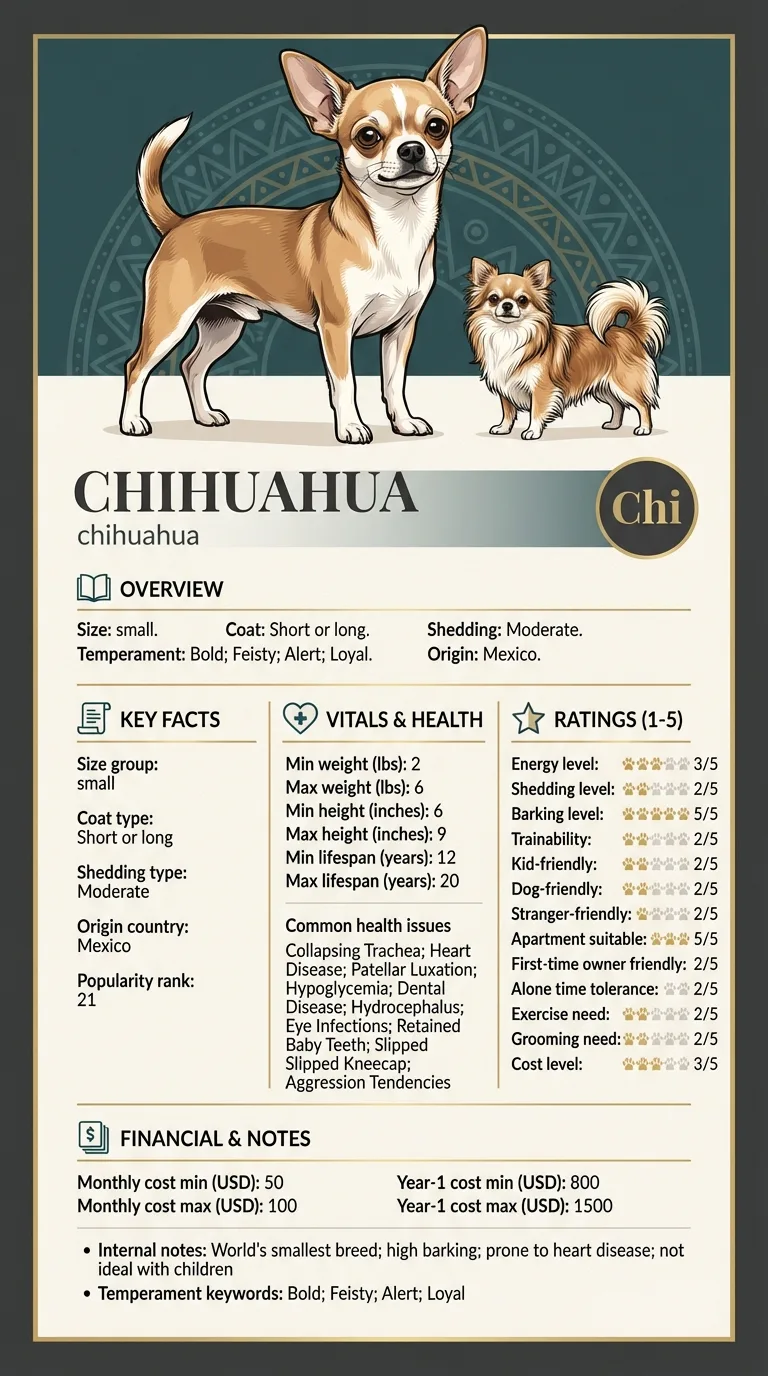
This breed's documented low tolerance for being alone, combined with a tendency to bond intensely with one person, sets up a specific risk pattern: a dog who is calm and confident whenever that person is present in the house, even in another room, but who falls apart the moment that person actually leaves the building. This is different from a dog who is simply bored or under-stimulated, and it is also different from ordinary territorial barking at passersby, both of which are addressed with different strategies than true separation distress.
Because many Chihuahuas are carried frequently rather than walked independently from an early age, physical proximity to a person can become deeply reinforced as the normal state of things, which makes genuine independence, being physically apart with confidence, something that sometimes needs to be actively taught rather than assumed to develop naturally.

One or two of these occasionally is not necessarily anxiety. A consistent pattern across departures is.
Cielo, adopted at four years old with an unknown history of at least two previous homes, was calm and confident whenever her owner Marta was anywhere in the house, even behind a closed bathroom door. The moment Marta actually left the building, Cielo would begin drooling and pacing within about three minutes, escalating to scratching at the front door hard enough to draw a little blood from her paw within twenty minutes. Marta's first instinct had been to sneak out quietly to avoid upsetting Cielo, which a trainer explained was likely making things worse by removing any predictability from departures. The actual plan started almost absurdly small: picking up keys and putting them back down, opening the door for two seconds and closing it again, dozens of times a day, with no departure at all, just neutral repetition of the cues that used to predict distress. Over about ten weeks, departures built gradually from those two-second door openings to genuine absences of first minutes, then hours. Cielo still shows mild pacing in the first minute or two after Marta leaves, which her vet and trainer both consider an acceptable, stable outcome rather than a problem still being solved.
Key takeaway: For a dog with a hard history, the goal was never a dog who does not notice you left. It was a dog whose distress lasts a minute instead of an hour, and that shift came from making departures boring and predictable, not from avoiding them.
Excessive barking in this breed often happens regardless of whether the owner is home, triggered by sounds or passersby, and reflects general alertness. Separation anxiety is specifically tied to being left alone, tends to begin within minutes of departure, and usually involves distress signs like panting, drooling or escape attempts rather than alert vocalizing alone.
Many dogs improve substantially with a structured desensitization plan that gradually builds tolerance for being alone. Some dogs, particularly those with a history of abandonment or multiple homes, may always need more careful management around departures than an average dog, even after significant improvement.
It sometimes helps, but not reliably, since separation anxiety in this breed is often tied to a specific person rather than to being physically alone. A dog anxious about one particular person leaving may remain anxious even with company present, if that specific attachment is what is actually driving the distress.
It depends on the dog. A crate can provide a secure den-like space for some dogs once properly introduced, but forcing a distressed dog into a crate without preparation can increase panic and risk of self-injury. Crate training, if used, should be built up gradually and never as a first response to an active anxiety problem.
Generally no. Calm, low-key departures and arrivals help prevent the contrast between an exciting reunion and a quiet, empty house from becoming part of what makes departures feel significant and distressing.
If distress includes self-injury attempts, complete refusal to eat while alone, or no improvement after several weeks of a consistent desensitization plan, involving a veterinary behaviorist alongside a trainer is worth considering, since some cases benefit from a combined behavioral and medical approach.
The early signs are set out in the sections above, and they are the reason to book a veterinary appointment rather than wait. Separation Anxiety in Chis is diagnosed by a vet, not from a symptom list, and the sooner it is on record the more options remain open.
Separation anxiety happens specifically when left alone and involves distress like panting or escape attempts, not general alert barking that happens regardless.
This breed's tolerance for being alone rates low, and it tends to form especially strong attachment to one particular person.
Not reliably, since the anxiety is often about a specific person leaving rather than about being physically alone.
Begin with very short departures of a few seconds to a minute, gradually increasing duration only as the dog stays calm at each step.
Behaviour changes often start with pain. The prep sheet for this page covers what to rule out, and what to ask.
You get: Vet visit prep sheet
No spam. One-click unsubscribe. See our privacy policy.
Preview page 1 before you decide.