Health
What are the signs of pancreatitis in a dog?
Repeated vomiting, refusing food, abdominal pain often shown as a stretched bowing posture, restlessness and lethargy. Seek same-day veterinary care.

Quick answer
What are the signs of pancreatitis in a dog?
Repeated vomiting, refusing food, abdominal pain often shown as a stretched bowing posture, restlessness and lethargy. Seek same-day veterinary care.
There is a reason emergency clinics get busier the day after a holiday dinner. A single fatty scrap can start this, and in a four-pound dog a scrap is a meal.
Owners whose dog has suddenly stopped eating and is vomiting, and owners whose Chihuahua has already had one episode and needs to understand what a low-fat life actually looks like.
This guide is not medical advice. If your dog shows pain, sudden behavior change, or worsening symptoms, consult a licensed veterinarian.
Some links may be affiliate links. We may earn a commission at no extra cost to you. We only suggest products we believe are helpful for dog owners.
We research and check what we publish, but we do not warrant that any figure, date, price, or statement is accurate, complete, or current, and we accept no liability for any loss, cost, injury, or other harm arising from the use of this site. Use it as one reference among several. You remain responsible for your own decisions and for your dog's care - confirm anything that matters with a licensed veterinarian or another qualified professional before you act on it. Full disclaimer.
Pancreatitis is inflammation of the pancreas caused by digestive enzymes activating within the organ instead of in the intestine. It produces vomiting, abdominal pain and refusal of food, and it ranges from mild and self-limiting to severe and life-threatening. In a very small dog, fluid loss and low blood sugar make even a moderate episode a same-day veterinary matter.
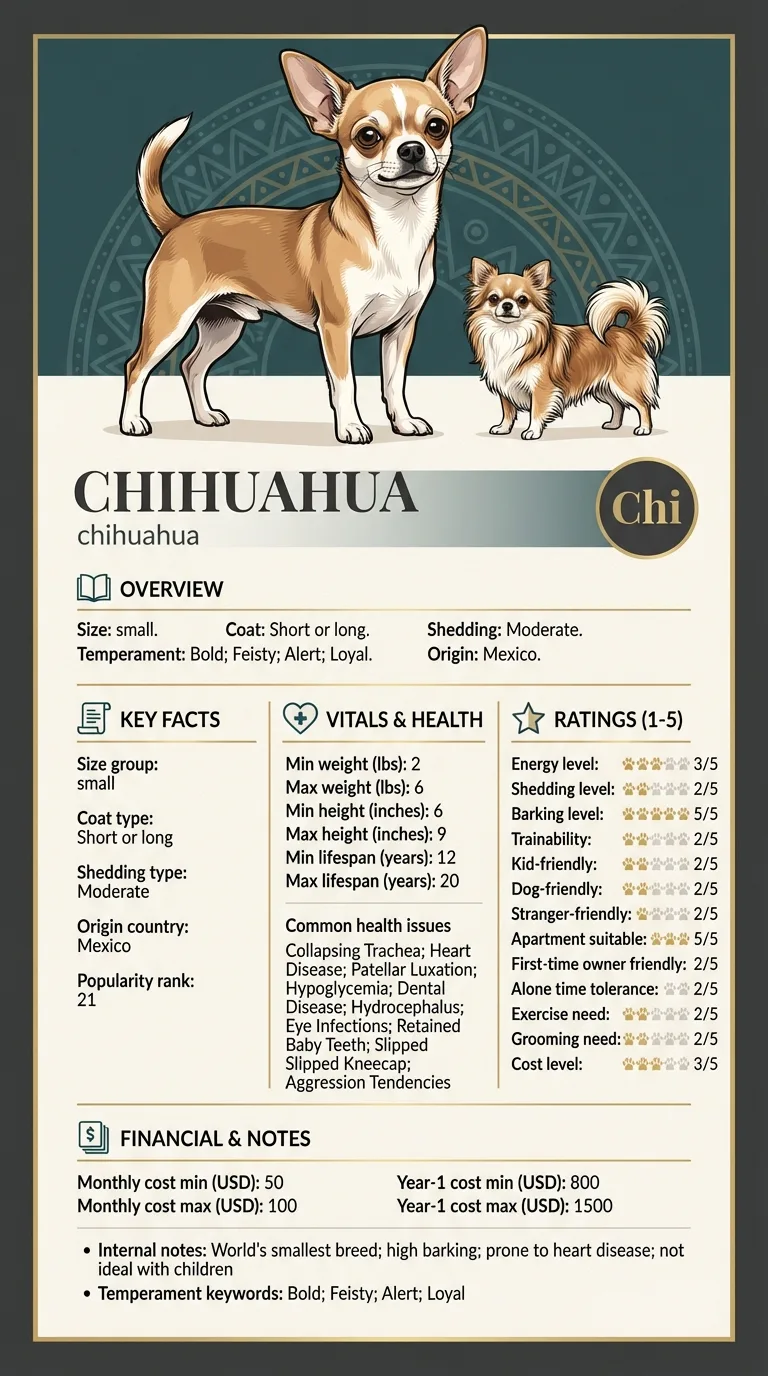
Pancreatitis is a regular presentation in small-animal emergency practice and is more strongly linked to some small breeds than others. It is not among the ten health issues documented for the Chihuahua. Its importance for this breed lies less in frequency than in severity, because a 2 to 6 pound dog has far less physiological margin for the dehydration and fasting an episode brings.
The mechanism is not breed-specific: something prompts premature activation of digestive enzymes and the pancreas begins to damage itself. What the Chihuahua contributes is scale on both sides of the equation. On the input side, a piece of fatty food that is trivial for a large dog constitutes a substantial fat load for an animal weighing four pounds. On the output side, the documented tendency to low blood sugar and the tiny total fluid volume mean the consequences of vomiting and anorexia arrive faster and hit harder.
This is one of the most environmentally driven conditions in the list. Household food practices largely determine risk: whether anyone feeds from a plate, whether bins are secure, whether counters are cleared, whether visitors are briefed. Holiday periods concentrate all of these risks at once, with rich food, distracted people and guests who do not know the rules. Sharing a home with a larger dog on a different diet provides another access route to food she should not have.
Seek veterinary care the same day for repeated vomiting, complete refusal of food, a hunched or stretched bowing posture that she holds and will not break, obvious abdominal pain, or a marked drop in energy. Go immediately, including out of hours, if she is collapsed, weak, trembling, cold, or unresponsive, if vomiting is persistent and she cannot keep water down, or if the gums are pale or grey, because dehydration and low blood sugar are dangerous at this body weight and can develop within hours. Do not attempt to manage this by fasting her at home, do not give human medications of any kind, and do not delay because she seems only mildly unwell, since severity is not predictable at the outset.
See all Chihuahua health problems, which breeds are prone to pancreatitis, or the full Chihuahua breed guide for temperament, exercise needs and ownership costs.
A mild episode typically improves over two to four days with supportive care, often including a short hospital stay for fluids and pain control in a small dog. Moderate cases run several days to a week. Severe cases require intensive care and a longer, less certain course. Appetite is usually the last thing to return, and a dog who is bright but still picky at day four is following a normal pattern. Diet changes are introduced during recovery and are generally intended to continue indefinitely.
Success in the short term is a dog eating, drinking and comfortable again within a week. Success in the long term is measured by absence: no second episode. That outcome is produced almost entirely at home, by a household that has genuinely changed how food moves around it. A Chihuahua who never again gets a piece of anything from a plate is a Chihuahua whose pancreatitis risk has been cut about as far as an owner can cut it.
The posture is the most useful sign. A dog with abdominal pain frequently adopts a stretched position with her chest and forelegs on the floor and her hindquarters raised, as though stuck mid-bow. It looks like a play invitation, which is why it is missed, but the dog holding it is not playing and will not respond to an invitation of her own.
Alongside that, expect repeated vomiting, complete refusal of food, sometimes diarrhoea, and a dog who is restless and cannot settle in any position. Some dogs are clearly painful when their belly is touched. Many are simply flat, quiet and withdrawn, which in a normally bold, opinionated breed is itself a significant change.
What makes this urgent in a Chihuahua specifically is fluid. A dog who is vomiting repeatedly and refusing to drink is losing fluid she cannot spare, and a two to six pound body has very little reserve. Dehydration that a large dog would tolerate for a day can destabilise a tiny one within hours. The breed's documented tendency to low blood sugar adds a second risk, since a small dog who has not eaten for a day and is vomiting can drop dangerously.
Severity varies enormously. Some episodes are mild and resolve with a few days of supportive care. Others become severe, with widespread inflammation, clotting problems and organ involvement, and those can be fatal. Nobody can tell which is which on the first evening, which is why this is a same-day veterinary problem rather than a wait-and-see one.

Once a dog has had pancreatitis she is more likely to have it again, and prevention is almost entirely about controlling what reaches her.
If you think your Chi has pancreatitis, the plan is three steps: write down what you have seen and when it started, book a veterinary appointment rather than waiting for the next flare, and take video of the behaviour or symptom before you go — the thing you are worried about rarely happens in the consulting room. Screening in the parents covers collapsing trachea, heart disease, patellar luxation.
What the vet visit should produce is a diagnosis and a written plan, not just reassurance: what is being ruled out, what the monitoring interval is, and which signs mean you come back sooner. Ask what the treatment costs across a year rather than per visit, because that is the number that decides whether you are managing this condition or reacting to it.
Between appointments, keep a short log — dates, what you saw, what changed. It is the single most useful thing an owner brings to a follow-up, and for pancreatitis it is often what separates a clear pattern from a guess.
Pequeña was five pounds and had been fine her whole life. On Christmas Day a well-meaning uncle gave her a piece of pork crackling under the table, which nobody saw. By the following afternoon she was vomiting, would not eat, and was standing in the middle of the room with her chest on the carpet and her back end in the air, which her owner Marek initially thought was an invitation to play. When she held the position for several minutes and did not respond to him at all, he took her to the emergency clinic. She was dehydrated, painful, and admitted for three days on fluids. She recovered fully. What changed afterwards was social rather than medical. Marek now tells every guest, on arrival and before food appears, that the dog gets nothing. He describes it as slightly awkward for four seconds and considerably less awkward than a Boxing Day in an emergency waiting room.
Key takeaway: The bowing posture is not play. And in a four-pound dog, prevention is a conversation you have with your guests before dinner, not a rule you enforce afterwards.
A high-fat meal is the classic trigger, which is why episodes cluster around holidays and barbecues. Other associations include obesity, certain medications, some hormonal conditions, and elevated blood fats. In a meaningful proportion of cases no specific trigger is ever identified, which is frustrating but does not change the treatment.
By combining the clinical picture with blood testing, including a test relatively specific to pancreatic inflammation, and usually abdominal ultrasound. No single test is perfect, so vets weigh them together. Imaging also helps exclude the other causes of a painful vomiting dog, which is part of why it is worth doing rather than treating on suspicion alone.
Many dogs recover completely from a single mild to moderate episode and go on to live normally on a controlled diet. Repeated or severe episodes can leave lasting damage, either to the enzyme-producing tissue or to the insulin-producing cells, which is why preventing the next episode matters so much more than treating the last one.
No. Prolonged fasting is no longer standard practice, and in a very small dog it risks dangerously low blood sugar. What she needs is veterinary assessment, fluid support and pain control, not a home fast. Withholding food while waiting a few hours for an appointment is reasonable; managing an episode by fasting is not.
Pancreatitis is not among the ten documented health issues for this breed, and it is more strongly associated with certain other small breeds. What is Chihuahua-specific is the consequence: fluid loss and low blood sugar are more dangerous at 2 to 6 pounds, so an episode that a larger dog might weather becomes serious faster.
In most cases yes, at least in the sense that a return to fatty food risks a repeat. Your vet may relax the strictness over time depending on how the dog does, but the household habits, no plate scraps and secure bins, should be treated as permanent regardless of what the prescription diet plan becomes.
Repeated vomiting, refusing food, abdominal pain often shown as a stretched bowing posture, restlessness and lethargy. Seek same-day veterinary care.
A two to six pound body has minimal fluid reserve, and this breed is documented as prone to low blood sugar, so vomiting and not eating destabilise her faster.
A high-fat meal, which is why cases spike after holidays. Obesity, some medications and certain hormonal conditions also contribute.
A consistent low-fat diet, no food from plates by anyone including visitors, secure bins, and keeping her lean.
A one-page prep sheet for this condition: the signs, the questions to ask, what to get priced. Unlocks here.
You get: Vet visit prep sheet
No spam. One-click unsubscribe. See our privacy policy.
Preview page 1 before you decide.