Health
Is ARVC a Chihuahua problem?
No. It is chiefly a Boxer disease. Chihuahua heart trouble is dominated by valve disease, and Chihuahua fainting is most often airway-driven or a blood sugar crash.

Quick answer
Is ARVC a Chihuahua problem?
No. It is chiefly a Boxer disease. Chihuahua heart trouble is dominated by valve disease, and Chihuahua fainting is most often airway-driven or a blood sugar crash.
If your Chihuahua has collapsed and someone has said the word cardiomyopathy, the odds strongly favour something else entirely - and knowing which something else is what gets the dog treated.
Owners whose Chihuahua has fainted, dropped mid-bark or gone briefly limp, and who have found ARVC while searching and want to know whether it applies. It is also for owners handed a Holter monitor recommendation who want to understand what it is actually looking for.
This guide is not medical advice. If your dog shows pain, sudden behavior change, or worsening symptoms, consult a licensed veterinarian.
Some links may be affiliate links. We may earn a commission at no extra cost to you. We only suggest products we believe are helpful for dog owners.
We research and check what we publish, but we do not warrant that any figure, date, price, or statement is accurate, complete, or current, and we accept no liability for any loss, cost, injury, or other harm arising from the use of this site. Use it as one reference among several. You remain responsible for your own decisions and for your dog's care - confirm anything that matters with a licensed veterinarian or another qualified professional before you act on it. Full disclaimer.
ARVC is a disease in which right ventricular muscle is replaced by fat and fibrous tissue, leaving an electrically unstable heart that can throw dangerous ventricular rhythms and cause fainting or sudden death. It is a Boxer disease. In a Chihuahua, the same presenting complaint - collapse, fainting, a dog that drops and gets straight back up - almost always traces to a different cause, and the practical value of this page is helping you find that cause rather than chase a diagnosis the breed does not carry.
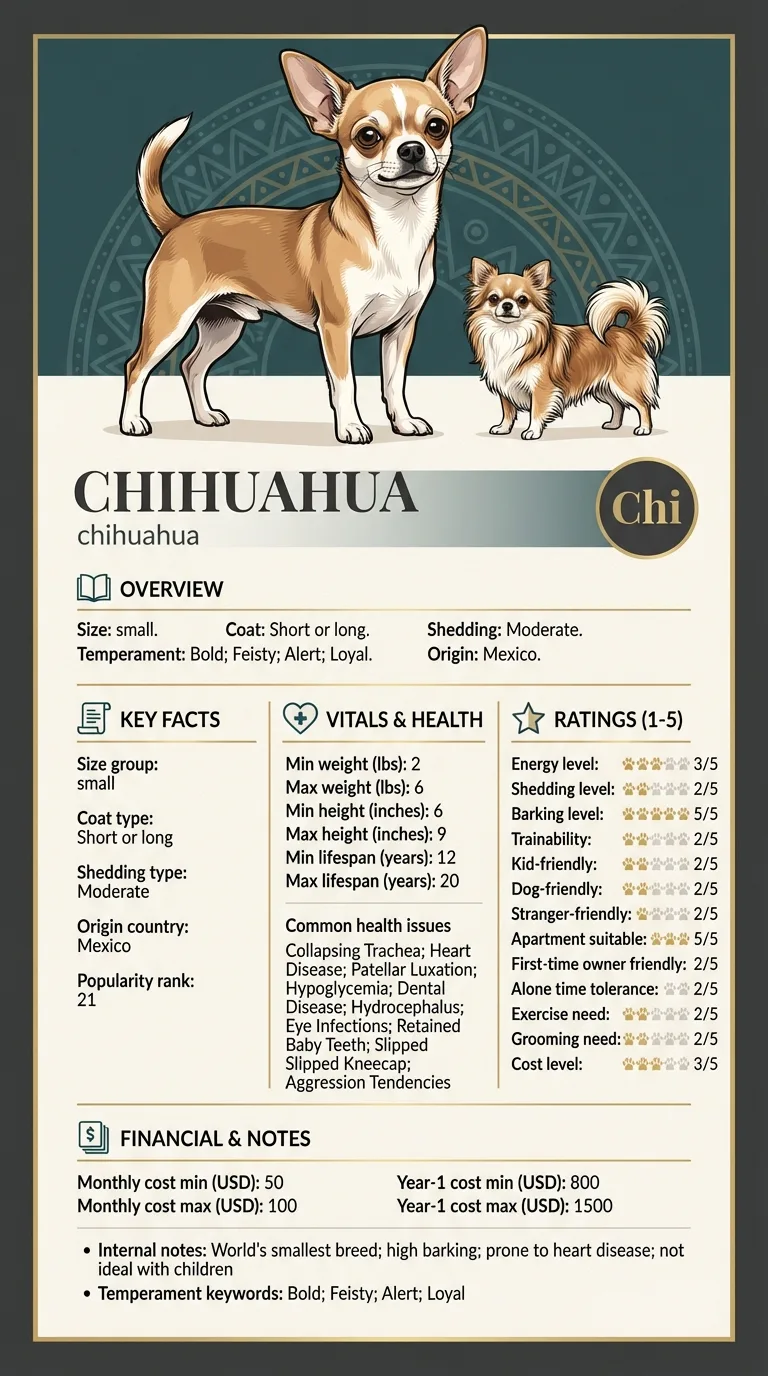
ARVC itself is rare outside a handful of breeds and should not be assumed in a Chihuahua. Fainting, by contrast, is a reasonably common complaint in this breed, and it is worth knowing that the breed's own documented health list includes heart disease, collapsing trachea and hypoglycemia - three conditions that each produce a collapse an owner might describe identically.
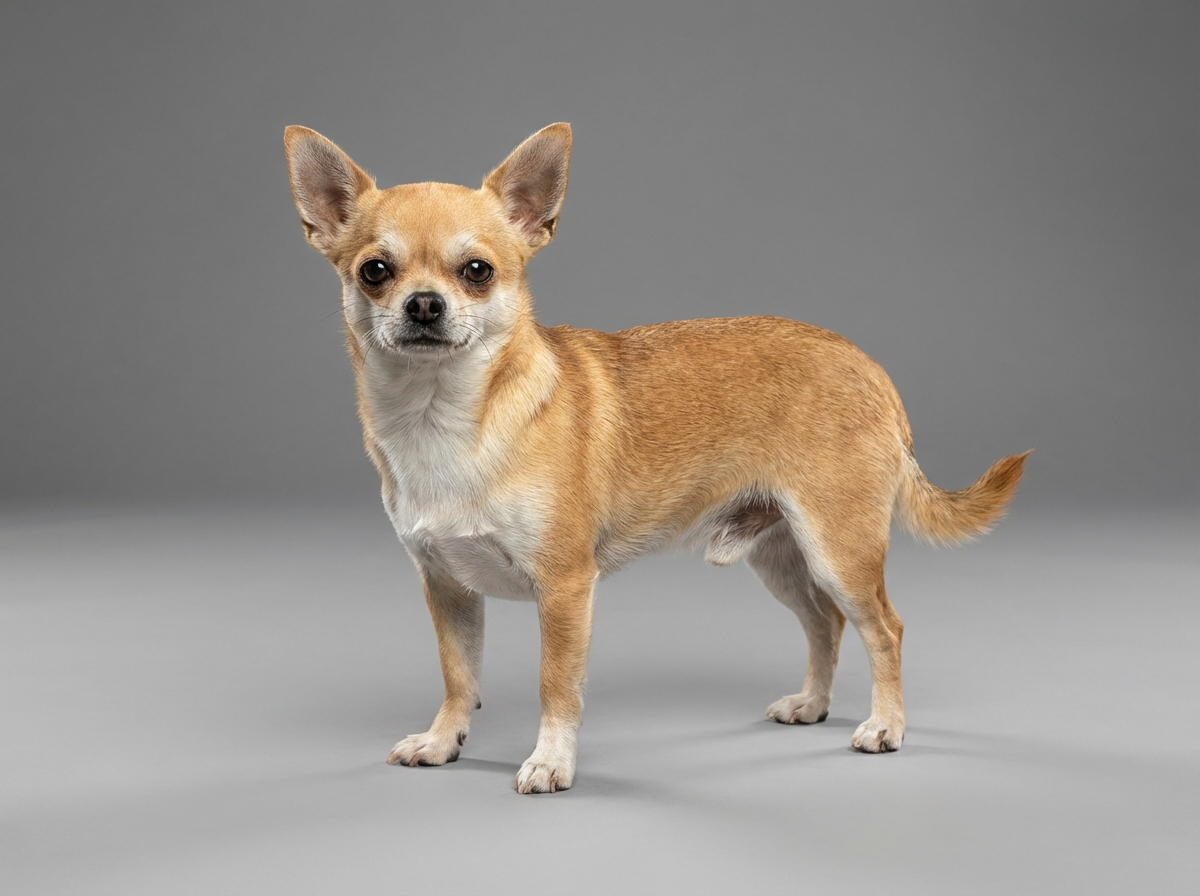
The Chihuahua is not built to develop ARVC, but it is built for several other routes to the same dramatic moment. Heart disease appears explicitly among the breed's documented problems, and in toy dogs that overwhelmingly means degeneration of the mitral valve, which in its late stages does generate arrhythmias. The breed's narrow, collapse-prone trachea gives it a purely mechanical way of fainting during a coughing fit. Hypoglycemia, again on the breed list, reflects a small liver with a small glycogen store in a 2-to-6-pound body. And the apple-shaped skull, sometimes with an open fontanelle, occasionally comes with hydrocephalus, which produces neurological episodes.
Almost everything that sets off a Chihuahua collapse is situational. A neck collar rather than a harness compresses a narrow trachea during a lunge, and this is a bold, alert breed with a barking level at the top of the scale, so lunging at the window is a daily event. Excitement at the door, hot humid weather, an over-long gap between meals in a tiny dog, and cigarette smoke or aerosol sprays that irritate the airway all raise the odds of an episode without any of them being the underlying disease.
Go to an emergency clinic immediately for a collapse the dog does not fully recover from within a minute, for repeated collapses in one day, for blue or grey gums, or for laboured breathing after an episode. Book within a day or two for a single brief faint with full recovery, and bring the video. Also book if you notice a resting breathing rate that has climbed steadily over several evenings, a new cough, or reduced tolerance for the short walks this low-exercise breed normally handles easily.
See all Chihuahua health problems, which breeds are prone to arrhythmogenic right ventricular cardiomyopathy arvc, or the full Chihuahua breed guide for temperament, exercise needs and ownership costs.
Getting to a diagnosis usually takes two to six weeks, because it is a sequence: examination and radiographs, then an echocardiogram, then rhythm monitoring if needed. Cough syncope from a collapsing trachea improves within days once collar pressure and arousal are addressed, though the airway itself does not reverse. Valve disease progresses across years and is staged and managed rather than cured. Genuine arrhythmia management is a matter of ongoing monitoring rather than a fixed course.
Success is having the right name for the episodes and a plan matched to it. For most Chihuahuas that means recognising an airway problem and dropping episode frequency sharply through harness use and lower arousal. For the smaller number with real cardiac disease, it means a staged plan, a home breathing-rate log that catches deterioration early, and a clear written line about what constitutes an emergency.
Fainting - syncope - means the brain briefly ran out of blood flow. In a Chihuahua the list of reasons is short and mostly does not involve a primary muscle disease of the right ventricle.
The most common one is cough syncope from a collapsing trachea. This breed's windpipe is narrow and prone to flattening, a coughing fit spikes pressure inside the chest, blood return to the heart stalls for a few seconds and the dog goes down. The giveaway is that the cough comes first, usually a dry honking sound, and the dog is upright and normal within seconds of stopping.
Second is heart disease, which is genuinely common in this breed, but usually as a leaking mitral valve rather than a diseased ventricular wall. An advanced leak can produce arrhythmias and syncope, but there will be a murmur, and often a cough and a rising resting breathing rate too.
Third is low blood sugar, another documented Chihuahua problem. That episode looks different: wobbling, glassy-eyed disorientation and weakness building over minutes rather than an abrupt drop and instant recovery.
Fourth, in dogs with the breed's open fontanelle, hydrocephalus can cause neurological episodes that owners describe as collapse but which are closer to seizures.

Episodes almost never happen in the consulting room, and an owner's verbal description of ten confusing seconds is the weakest evidence in cardiology. A phone video is worth more than a paragraph.
Chato is a 5-pound Chihuahua in Portland who collapsed three times in a fortnight, always in the hallway. His owner Rhea had read about cardiomyopathy and arrived at the clinic expecting the worst. She also, on her vet nurse's advice, arrived with a video. The video settled it in under a minute. The doorbell went, Chato sprinted to the door barking, broke into a dry honking cough for about eight seconds, then folded onto his side and was back on his feet four seconds later, tail up, still barking. Coughing came first. His heart sounded clean. Radiographs confirmed a narrowed windpipe. Rhea moved him to a harness, put an opaque film on the lower half of the front window and worked with a trainer on a station away from the door. Chato coughs on excited days, but has not collapsed in eight months.
Key takeaway: The order of events was the whole diagnosis. Cough first meant airway, not muscle, and one short video saved a frightened owner from chasing a disease her breed does not get.
It is not a recognised problem in the breed. ARVC is described chiefly in Boxers, where a specific genetic variant has been identified, and reported in some Bulldogs. Chihuahuas are documented as prone to heart disease, but the pattern is overwhelmingly valve disease rather than an arrhythmogenic disease of the right ventricular wall.
If a coughing fit came first, cough syncope from a collapsing trachea leads the list, and this breed is prone to that. If there is a known murmur, advanced valve disease with an arrhythmia is the next candidate. A wobbly, glassy episode building over minutes in a young or very small Chihuahua points instead at low blood sugar.
It records every heartbeat for twenty-four hours or more while the dog goes about a normal day, which is how intermittent arrhythmias get caught. A brief in-clinic tracing samples only a few seconds and can easily be normal in a dog that is having dangerous rhythms twice an hour at home.
Yes, though it takes some ingenuity. The recorder is fitted in a small vest or wrap and is bulky relative to a 4-pound dog, so some Chihuahuas need a day to accept it. Practices used to toy breeds have small harnesses; it is worth asking whether the clinic fits them routinely.
Not for a Chihuahua. The variant tested is a breed-specific finding validated in Boxers, and a result in an unrelated toy breed does not carry meaningful information. Spend the money on the tests that answer your actual question, which are usually chest radiographs, an echocardiogram and rhythm monitoring.
Sudden cardiac death is possible with serious arrhythmias in any breed, which is exactly why repeated collapse deserves a proper workup rather than reassurance. That said, most Chihuahua fainting turns out to be airway-driven or metabolic, and those are far more manageable. The way to know is investigation, not assumption in either direction.
The early signs are set out in the sections above, and they are the reason to book a veterinary appointment rather than wait. Arrhythmogenic Right Ventricular Cardiomyopathy (ARVC) in Chis is diagnosed by a vet, not from a symptom list, and the sooner it is on record the more options remain open.
No. It is chiefly a Boxer disease. Chihuahua heart trouble is dominated by valve disease, and Chihuahua fainting is most often airway-driven or a blood sugar crash.
Film it if you can, note whether coughing came first, and time how long recovery takes. Then call your vet the same day.
Syncope is abrupt, brief and followed by immediate normality. A seizure usually involves paddling or chewing movements and leaves the dog confused for minutes afterwards.
Most healthy dogs sit under about thirty breaths a minute while asleep. A steady climb over several evenings is a genuine early warning worth reporting.
Expect a tiered bill: radiographs first, then an echocardiogram with a specialist, then rhythm monitoring if the picture is still unclear. Ask which step answers your question soonest.
A one-page prep sheet for this condition: the signs, the questions to ask, what to get priced. Unlocks here.
You get: Vet visit prep sheet
No spam. One-click unsubscribe. See our privacy policy.
Preview page 1 before you decide.