Behavior
Needs more exercise?
Doberman Pinscher, rated very high versus the Chihuahua's low.

Quick answer
Needs more exercise?
Doberman Pinscher, rated very high versus the Chihuahua's low.
Chihuahua or Doberman Pinscher? On paper they differ most on exercise need, and on the scales Doberman Pinscher is the heavier at 60–100 lbs. Here is how the two compare on everything that shapes an ordinary week.
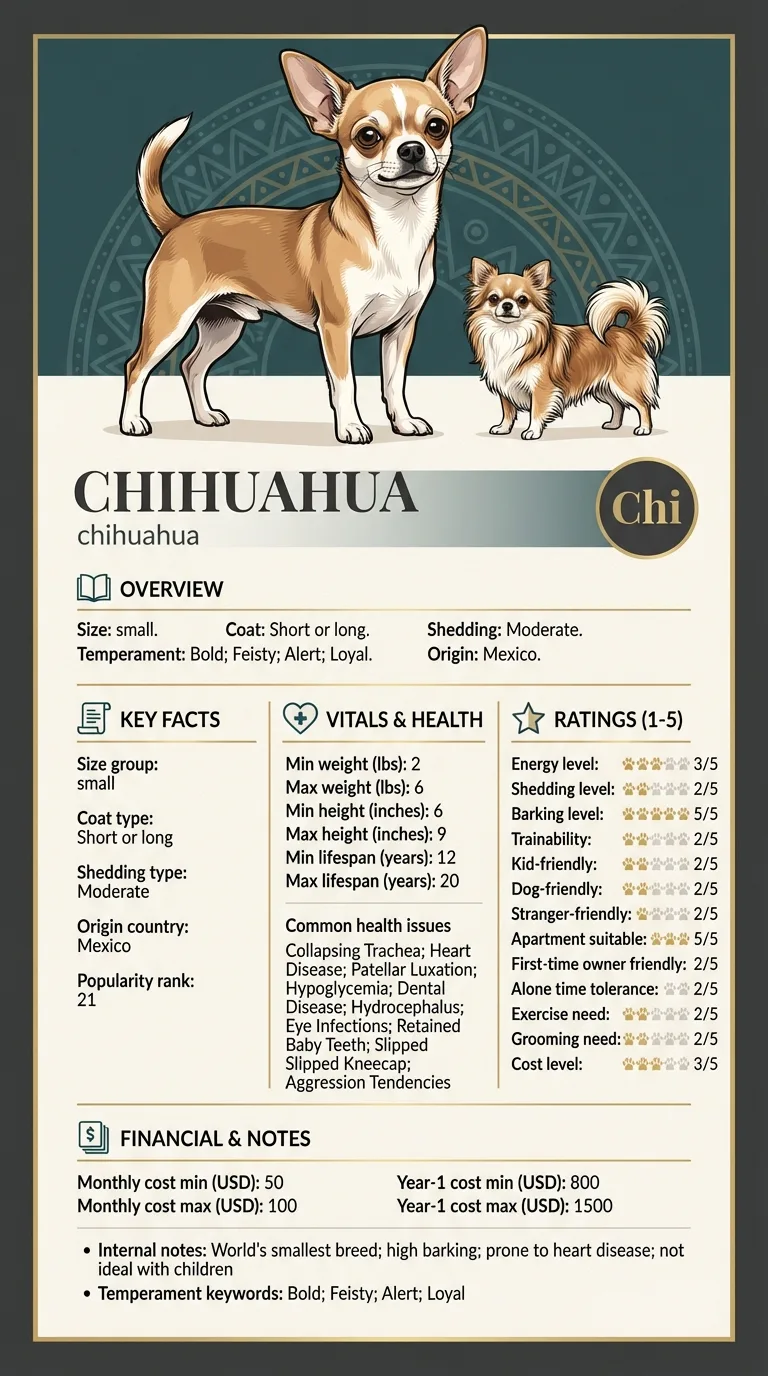
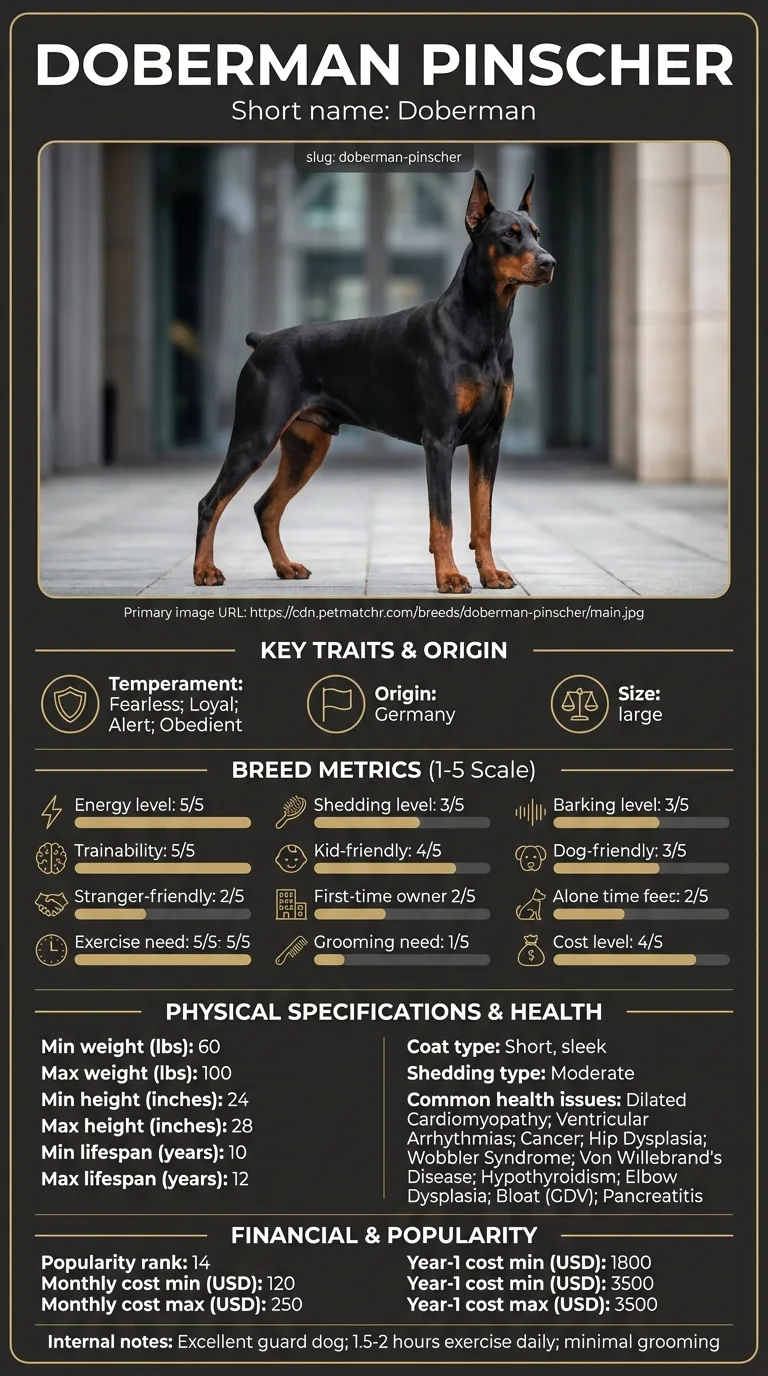
This is for someone already down to Chihuahua and Doberman Pinscher and deciding between them. For this pair the decision usually turns on exercise need and apartment suitability, so those are covered first and in most detail. Anyone choosing from a flat has a clear answer here: Chihuahua rates 5/5 against 2/5. It is written for the decision rather than the breed history.
Between Chihuahua and Doberman Pinscher, exercise need is what separates them, and Chihuahua is the lower-effort dog of the two to keep.
Choose Chihuahua if you are in a flat or a smaller home, shedding is a problem in your house and your walking routine is modest.
Choose Doberman Pinscher if you do not want a standing grooming appointment, there are young children at home and you already have another dog.
| Feature | chihuahua | doberman pinscher | Winner |
|---|---|---|---|
| Size class | small | large | Equal |
| Weight | 2–6 lbs | 60–100 lbs | Equal |
| Height | 6–9 in | 24–28 in | Equal |
| Lifespan | 12–20 years | 10–12 years | chihuahua |
| Exercise need | Low (2/5) | Very high (5/5) | chihuahua |
| Grooming need | Low (2/5) | Very low (1/5) | doberman pinscher |
| Shedding | Low (2/5) | Moderate (3/5) | chihuahua |
| Energy level | Moderate (3/5) | Very high (5/5) | Equal |
| Barking | Very high (5/5) | Moderate (3/5) | doberman pinscher |
| Apartment suitability | Very high (5/5) | Low (2/5) | chihuahua |
| Good for first-time owners | Low (2/5) | Low (2/5) | Equal |
| Tolerates being alone | Low (2/5) | Low (2/5) | Equal |
| Trainability | Low (2/5) | Very high (5/5) | doberman pinscher |
| Good with kids | Low (2/5) | High (4/5) | doberman pinscher |
| Good with other dogs | Low (2/5) | Moderate (3/5) | doberman pinscher |
| Friendly to strangers | Low (2/5) | Low (2/5) | Equal |
| Cost level | Moderate (3/5) | High (4/5) | chihuahua |
| Coat | Short or long | Short, sleek | Equal |
| Origin | Mexico | Germany | Equal |
| Typical monthly cost | $50–$100 | $120–$250 | Equal |
| Typical first-year cost | $800–$1,500 | $1,800–$3,500 | Equal |
Set a Chihuahua next to a Doberman Pinscher and you're looking at opposite ends of the size spectrum: 2-6 lbs and 6-9 inches versus 60-100 lbs and 24-28 inches, a weight ratio that can exceed 30 to 1. The Doberman's sleek, muscular, short-coated build was engineered for speed and protection work, while the Chihuahua's tiny frame was bred purely for companionship. Both breeds share a short-coat option in common, oddly enough -- the Chihuahua can have a short coat and the Doberman's is short and sleek by default -- but that's about where the physical similarities end entirely.
The gap here is enormous: the Doberman rates very high (5/5) for exercise need against the Chihuahua's low (2/5), though both land at similarly high energy levels on paper -- the Doberman very high (5/5), the Chihuahua's own energy closer to moderate (3/5) in practice. A Doberman bred for sustained work and protection duty needs serious daily exercise -- running, structured training, real mental engagement -- or that energy redirects into unwanted behavior. The Chihuahua's low exercise threshold means a short walk and some play genuinely covers its needs, a difference that alone should steer most sedentary households toward the smaller breed.
Grooming actually favors the Doberman: a very low (1/5) grooming need against the Chihuahua's low (2/5), since its short, sleek coat needs almost no brushing. Shedding runs the other way, though -- moderate (3/5) for the Doberman versus low (2/5) for the Chihuahua -- so the larger dog leaves more hair around the house despite requiring less active grooming time. This is a useful reminder that grooming effort and shedding volume aren't the same measurement: a coat can be easy to maintain and still shed noticeably, which is exactly the Doberman's profile here.
Apartment suitability clearly favors the Chihuahua, very high (5/5) versus the Doberman's low (2/5), driven mainly by the Doberman's size and very high exercise needs rather than noise -- barking is actually higher for the Chihuahua (very high, 5/5) than the Doberman (moderate, 3/5). Both breeds tie at low (2/5) for tolerating being left alone, so neither suits an owner gone for long workdays without a plan. A Doberman confined to a small apartment without its daily exercise met is a much bigger behavioral risk than a Chihuahua in the same situation, given the sheer size of the unmet energy.
Trainability strongly favors the Doberman, rated very high (5/5) against the Chihuahua's low (2/5) -- Dobermans were purpose-bred for obedience and protection work and are famously quick learners. Yet both breeds tie at low (2/5) for first-time-owner suitability, for very different reasons: the Chihuahua because of its boldness and reactivity, the Doberman because its size, drive, and protective instincts demand a confident, experienced handler even though the dog itself learns fast. A first-time owner shouldn't assume high trainability equals an easy dog -- the Doberman needs structured, consistent leadership from day one.
The Doberman rates ahead with kids, high (4/5) against the Chihuahua's low (2/5), and moderately ahead with other dogs, moderate (3/5) versus low (2/5), but both tie at low (2/5) for friendliness to strangers -- the Doberman's watchful, protective nature and the Chihuahua's guarded temperament converge on the same outcome for different reasons. Despite popular stereotypes, the fearless, loyal, obedient Doberman is generally the more family-compatible of the two on paper, though its size and protective instincts still call for early socialization and supervision, just like the smaller but equally guarded Chihuahua.
The Chihuahua's lifespan advantage is dramatic -- 12-20 years versus the Doberman's 10-12 -- and the Doberman's ten-item health list includes some of the most serious conditions in this dataset: dilated cardiomyopathy and ventricular arrhythmias are leading causes of sudden death in the breed, alongside cancer, wobbler syndrome, and bloat (GDV). The Chihuahua's own list is real but generally less acute -- collapsing trachea, patellar luxation, and dental disease are manageable chronic issues rather than sudden emergencies. Anyone choosing a Doberman should budget for cardiac screening as a routine, not optional, part of ownership.
The Doberman costs noticeably more: a high (4/5) cost rating against the Chihuahua's moderate (3/5), with monthly costs of $120-250 versus $50-100 and first-year costs of $1,800-3,500 versus $800-1,500 -- more than double the Chihuahua's expense in year one. Food volume for a 60-100 lb dog alone accounts for much of that gap, and the cardiac screening implied by its health risks adds further ongoing cost. The Chihuahua remains one of the more affordable breeds in this comparison set by a wide margin.
Chihuahua weighs 2–6 lbs and lives 12–20 years; Doberman Pinscher weighs 60–100 lbs and lives 10–12 years. The two diverge most on exercise need, apartment suitability and trainability and 3 other rated axes. They are level on tolerates being alone, good for first-time owners and friendly to strangers, so those cannot decide it. In the table, a "winner" means easier for an ordinary household — not better. Size, coat and origin are recorded without a verdict. Because both breeds are scored the same way, the gaps are reliable even where the absolute numbers are rough.

Yes, rated high (4/5) with kids, notably above the Chihuahua's low (2/5) rating -- the fearless, loyal, obedient temperament tends to be family-friendly with proper socialization.
The Doberman by far, rated very high (5/5) versus the Chihuahua's low (2/5) -- it needs serious daily activity to stay balanced.
Yes -- dilated cardiomyopathy and ventricular arrhythmias are both listed as common issues and are leading causes of concern in the breed, making cardiac screening important.
The Doberman, rated very high (5/5) for trainability against the Chihuahua's low (2/5), though it still needs an experienced, confident handler.
The Chihuahua, typically 12-20 years, nearly double the Doberman's 10-12 year average.
Not really -- it rates low (2/5) for apartment suitability against the Chihuahua's very high (5/5), mainly due to its size and exercise needs.
The Chihuahua, rated very high (5/5) versus the Doberman's moderate (3/5).
Doberman Pinscher, rated very high versus the Chihuahua's low.
Doberman Pinscher, rated very high versus the Chihuahua's low.
Chihuahua, typically 12-20 years.
Chihuahua, roughly half the Doberman's monthly cost.
Secure checkout on Stripe. We never see your card.
7-day money-back guarantee. Instant access.

Health information here is general and is not veterinary advice. If your dog shows pain, sudden behaviour change, or worsening symptoms, consult a licensed veterinarian.
Some links on this site are affiliate links. We may earn a commission at no extra cost to you, and we only suggest products we believe are helpful for dog owners.
We research and check what we publish, but we do not warrant that any figure, date, price, or statement is accurate, complete, or current, and we accept no liability for any loss, cost, injury, or other harm arising from the use of this site. Use it as one reference among several. You remain responsible for your own decisions and for your dog's care - confirm anything that matters with a licensed veterinarian or another qualified professional before you act on it. Full disclaimer.
Match your lifestyle to the right dog.
Take quizNot sure which breed is right for you? Take our 2-minute quiz to find out.
Take the quiz