Health
Is hip dysplasia common in Chihuahuas?
It occurs but is not the breed's typical hind-leg problem. Patellar luxation is listed among the breed's documented health issues and explains most limping.

Quick answer
Is hip dysplasia common in Chihuahuas?
It occurs but is not the breed's typical hind-leg problem. Patellar luxation is listed among the breed's documented health issues and explains most limping.
If your Chihuahua is limping on a back leg, hip dysplasia is on the list. It is rarely at the top of it, and getting the order right changes the treatment completely.
Owners who have noticed an intermittent hind-leg limp, a skip in the gait, or reluctance to jump, and who searched the symptoms and landed on hip dysplasia. Also owners who have already been given the diagnosis and want to understand what it means at this size.
This guide is not medical advice. If your dog shows pain, sudden behavior change, or worsening symptoms, consult a licensed veterinarian.
Some links may be affiliate links. We may earn a commission at no extra cost to you. We only suggest products we believe are helpful for dog owners.
We research and check what we publish, but we do not warrant that any figure, date, price, or statement is accurate, complete, or current, and we accept no liability for any loss, cost, injury, or other harm arising from the use of this site. Use it as one reference among several. You remain responsible for your own decisions and for your dog's care - confirm anything that matters with a licensed veterinarian or another qualified professional before you act on it. Full disclaimer.
Hip dysplasia is a loose, poorly shaped hip joint that wears into arthritis over time. In Chihuahuas it is a real but comparatively uncommon cause of hind-limb trouble, sitting behind patellar luxation and, in young dogs, Legg-Calve-Perthes disease. Most of the practical value on this topic comes from getting the diagnosis right before committing to a management plan.
Hip dysplasia is far less prevalent in toy breeds than in large working breeds, and it is not among the ten documented health issues listed for Chihuahuas. It does happen, and it is diagnosed in small dogs often enough that owners should know it exists, but a Chihuahua with a hind-leg limp is statistically far more likely to have a kneecap problem.
Hip laxity is inherited, and it exists across body sizes. What differs in a Chihuahua is the consequence rather than the cause: a poorly fitting joint carrying two to six pounds accumulates damage far more slowly than the same joint carrying eighty. That is why toy dogs with radiographically dysplastic hips are frequently discovered incidentally and may never become clinically lame at all. The breed's actual documented joint problem is patellar luxation, a separate mechanism entirely.
Body condition is the dominant factor an owner controls. On a frame designed for four pounds, every additional ounce is a large proportional increase in joint load. Hard, slippery flooring encourages scrabbling and awkward loading. Repeated jumping down from sofas and beds delivers impacts that are proportionally enormous for a dog nine inches tall. Long periods of inactivity punctuated by bursts of hard play are worse for an unstable joint than a steady, moderate daily routine.
Book a prompt appointment, within days rather than weeks, for a limp that has lasted more than a few days, a limp in a puppy or young dog under a year, visible muscle wasting on one thigh, or any dog who cries out or snaps when her hindquarters are touched. Progressive lameness in a young toy-breed dog needs imaging quickly because Legg-Calve-Perthes worsens with time. Seek same-day care for a leg that is suddenly non-weight-bearing, a limb held at an abnormal angle, or lameness following a fall or a jump, since fractures are a real risk in a dog with bones this fine. Ongoing pain management should always be directed by your vet.
See all Chihuahua health problems, which breeds are prone to hip dysplasia, or the full Chihuahua breed guide for temperament, exercise needs and ownership costs.
Diagnosis is usually quick once imaging happens, often within a single sedated visit. Management effects take longer. Weight loss on a small dog should be slow and deliberate, so expect three to five months to reach a target body condition, with comfort improving progressively across that period rather than at the end. Ramps and flooring changes show benefits within a couple of weeks. Arthritis itself continues to progress, so the plan is reviewed annually rather than set once.
Success is a dog who moves comfortably at the pace she chooses and does not deteriorate visibly year to year. Realistically that means she still trots on walks, gets on the sofa by her own route, rises without hesitation after a nap, and needs no more pain support at twelve than she did at ten. It does not mean a normal hip on a radiograph, and chasing that is the fastest way to spend money without improving her life.
Patellar luxation is the most common by a wide margin in this breed, and it is one of the ten documented health issues for Chihuahuas. The kneecap slips sideways out of its groove. The classic sign is a skip: the dog runs, holds one back leg up for two or three strides, then puts it down and carries on as if nothing happened. It is intermittent, painless in the moment for many dogs, and often first noticed as a quirk rather than a problem.
Legg-Calve-Perthes disease is a toy-breed condition where the blood supply to the head of the femur fails and the bone begins to collapse. It appears in young dogs, typically between four and eleven months, and unlike the patellar skip it gets steadily worse rather than coming and going. The limp becomes persistent, the muscle on that thigh visibly wastes, and the dog resents having the hip moved.
Hip dysplasia itself produces a wider-based, swaying hind gait, difficulty rising after rest, and reluctance to jump up. It usually worsens gradually over years rather than appearing in a young dog, and both sides are commonly affected, which can make the dog look stiff rather than lame.
A radiograph separates all three, and this is one situation where imaging is genuinely worth the money early, because the three conditions have completely different treatments and completely different urgency.

Small size changes the calculus considerably compared with a large-breed patient, mostly in your favour.
Pinto, five pounds, had been limping on and off since he was three. His owner Marta had been told by a friend that it was hip dysplasia and had spent two years buying joint supplements and restricting his walks, which slowly cost him hind-limb muscle. At seven, a new vet watched the video Marta had taken of him running in a park. The vet stopped it and pointed to a two-stride skip. That is a kneecap, she said, not a hip. Radiographs confirmed patellar luxation on both sides, with entirely normal hips. The treatment changed completely. Pinto went back to daily short walks to rebuild the thigh muscle he had lost, got a ramp, and was assessed for surgery on the worse side. Marta's frustration was less about the wasted money than about the two years of restricted exercise, which had made the actual problem worse.
Key takeaway: In this breed, do not treat a hind-leg limp on a guess. The three likely causes are distinguishable on radiographs and pull management in opposite directions, and restricting exercise for the wrong diagnosis does real harm.
Yes, though it is far from their signature orthopaedic problem. Patellar luxation is what appears in the breed's documented health issues, and it is what most hind-leg lameness in Chihuahuas turns out to be. Hip dysplasia occurs but should be confirmed on radiographs rather than assumed from the symptom.
Signs can appear in young adults but more often creep in through middle age as arthritis develops in a joint that has been loose all along. A limp appearing in a four to eleven month old Chihuahua is more suggestive of Legg-Calve-Perthes disease and should be imaged promptly, because that condition progresses and the window for the best outcome is finite.
No. The joint shape does not change back. What can change is how much pain and disability it produces, and in a very small dog the ceiling on that is genuinely high. Many small dogs with dysplastic hips live comfortably for years with weight control, muscle maintenance and veterinary pain management.
Some procedures are, and small size is actually an advantage for certain approaches because the forces the joint must resist afterwards are so much lower. This is a specialist conversation. What is not realistic is deciding for or against surgery before radiographs have confirmed which joint is the problem.
Joint supplements are widely used and the evidence for them is mixed. They are not a substitute for weight control, which has a far larger and better-established effect. Discuss any supplement with your vet rather than layering several products, since dosing anything for a two to six pound dog needs care.
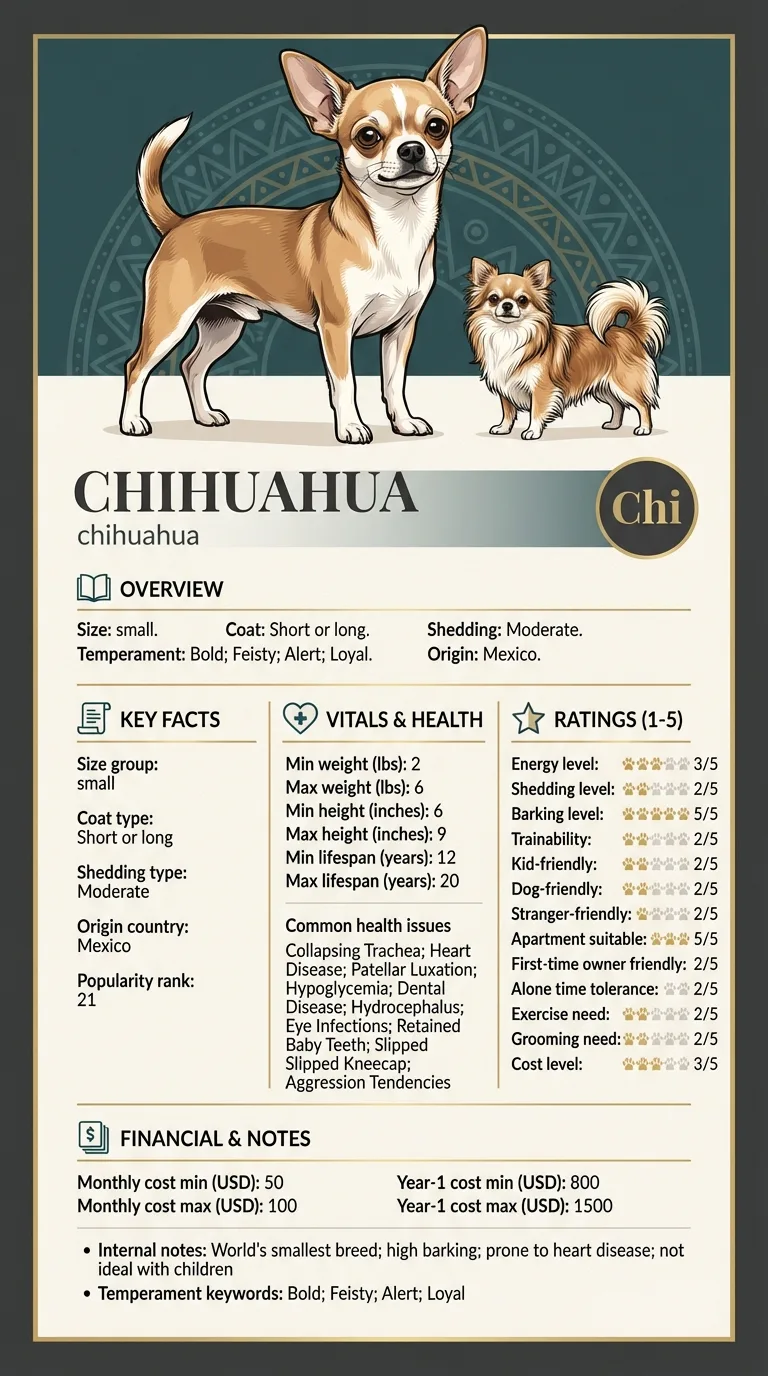
No. Immobility causes muscle loss, and muscle is what holds an unstable joint together. The change is in intensity, not existence: shorter, flatter, more frequent walks on soft ground, and no leaping. This breed's exercise need is rated two out of five, so a gentler regime still meets her requirements comfortably.
It occurs but is not the breed's typical hind-leg problem. Patellar luxation is listed among the breed's documented health issues and explains most limping.
A hands-on orthopaedic exam plus radiographs, usually under sedation so the joint can be assessed without the dog tensing against it.
Keeping her lean, keeping her moving gently every day, adding ramps to remove jumps, and following a vet-directed pain plan.
Not usually. It affects comfort and mobility rather than lifespan, and small body weight makes it far more manageable than in a large breed.
A one-page prep sheet for this condition: the signs, the questions to ask, what to get priced. Unlocks here.
You get: Vet visit prep sheet
No spam. One-click unsubscribe. See our privacy policy.
Preview page 1 before you decide.