Health
Is a straining Chihuahua an emergency?
If she is straining and producing little or no urine, yes, especially in a male dog. Treat it as a suspected obstruction and go to a clinic immediately.

Quick answer
Is a straining Chihuahua an emergency?
If she is straining and producing little or no urine, yes, especially in a male dog. Treat it as a suspected obstruction and go to a clinic immediately.
A stone in the bladder is a problem. A stone lodged in the urethra of a four-pound male dog is a medical emergency measured in hours.
Owners whose dog has been straining, passing small amounts, or leaving pink-tinged urine, and owners of a dog with confirmed stones deciding between surgery, dissolution and prevention.
This guide is not medical advice. If your dog shows pain, sudden behavior change, or worsening symptoms, consult a licensed veterinarian.
Some links may be affiliate links. We may earn a commission at no extra cost to you. We only suggest products we believe are helpful for dog owners.
We research and check what we publish, but we do not warrant that any figure, date, price, or statement is accurate, complete, or current, and we accept no liability for any loss, cost, injury, or other harm arising from the use of this site. Use it as one reference among several. You remain responsible for your own decisions and for your dog's care - confirm anything that matters with a licensed veterinarian or another qualified professional before you act on it. Full disclaimer.
Urinary stones form when dissolved minerals crystallise and aggregate within the urinary tract. They cause irritation, bleeding and recurrent infection, and in male dogs they can obstruct the urethra completely. Because a Chihuahua's urethra is proportionally tiny, obstruction is the dominant risk and the reason urinary signs in this breed warrant a fast response.
Urinary stones are a regular presentation in small-breed practice and small dogs are over-represented compared with large ones. Urolithiasis is not among this breed's ten documented health issues, so a Chihuahua is not unusually likely to form a stone. What is unusual is the severity of the consequence when a male Chihuahua does, which is why the topic deserves attention out of proportion to its frequency.
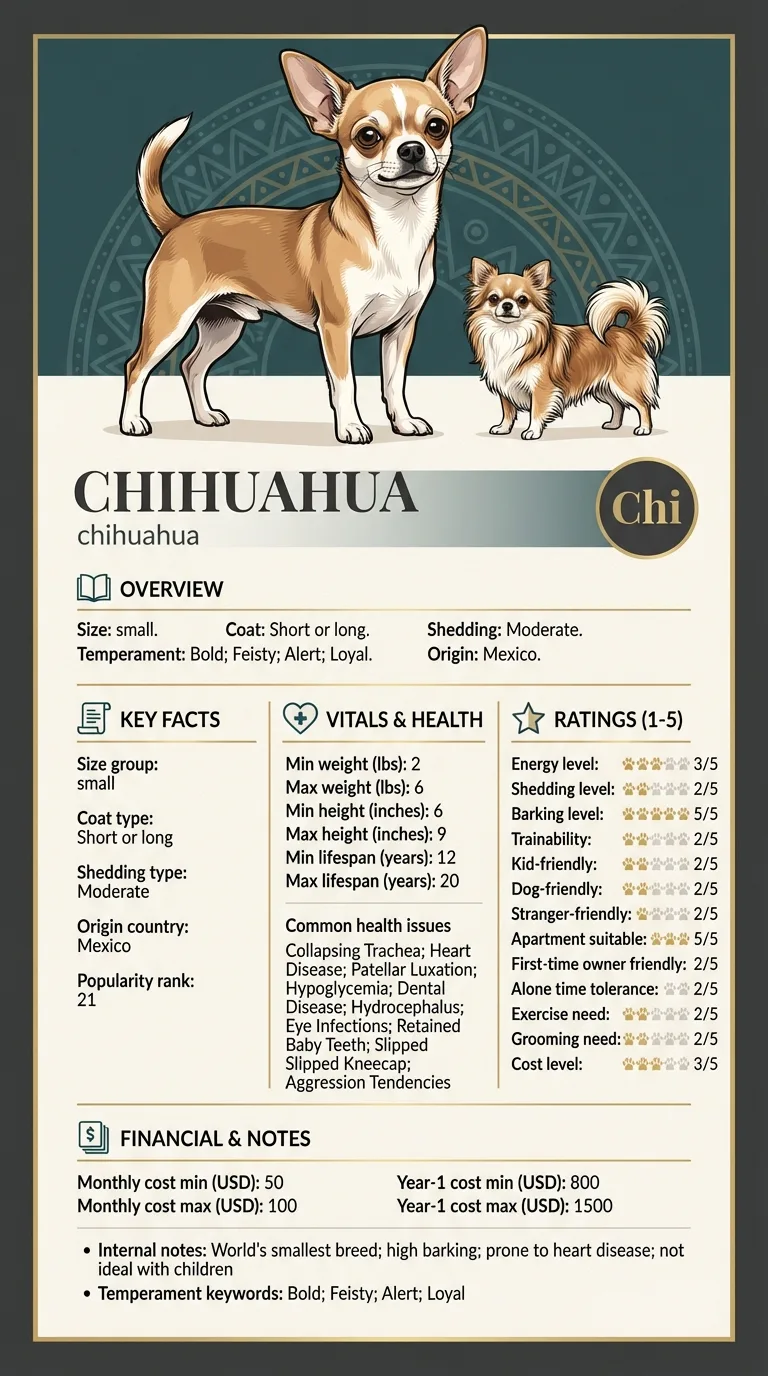
The mechanism of stone formation is chemical rather than breed-specific: urine that is too concentrated, or whose pH and mineral content favour crystallisation, produces crystals that grow. What the Chihuahua contributes is plumbing. At 2 to 6 pounds and 6 to 9 inches tall, every part of the urinary tract is scaled down, and a male dog's urethra becomes narrow enough that a stone measuring a couple of millimetres can occlude it entirely. Small dogs also produce small total volumes of urine, so concentration effects are amplified.
Water intake is the environmental variable that matters most, and it is heavily shaped by what the dog is fed and how accessible her water is. A dry-food diet with a single bowl in one room produces more concentrated urine than wet food with water available throughout the house. Long stretches without a chance to go outside, common in apartment households with a dog who is not paper-trained, mean urine sits in the bladder for longer, which favours crystal growth. Repeated urinary infections, sometimes secondary to other conditions, alter urine chemistry directly.
Go to a veterinary clinic immediately, at any hour, if she is straining to urinate and producing little or nothing, if she cries out while trying, if her abdomen feels tense and she resents it being touched, or if she has become lethargic, vomiting or collapsed alongside urinary straining. In a male dog these signs indicate possible complete obstruction, which becomes life-threatening within a day and requires urgent relief of the blockage. Do not wait for a routine appointment and do not attempt any home remedy. Book a prompt but non-emergency appointment for blood-tinged urine with a normal stream, increased frequency, accidents in a house-trained dog, or excessive licking at the genitals, all of which warrant a urine test and often imaging.
See all Chihuahua health problems, which breeds are prone to kidney stones, or the full Chihuahua breed guide for temperament, exercise needs and ownership costs.
An obstruction is relieved within hours of arrival at a clinic, followed by one to several days of hospitalisation to correct the blood chemistry disturbances it caused. Dissolution of a suitable stone type by prescription diet typically takes several weeks to a few months, with imaging to confirm progress. Surgical removal is followed by a recovery of one to two weeks. Prevention is permanent, and recurrence checks by imaging or urine testing usually continue at intervals for the rest of the dog's life.
Success is a dog who urinates normally, whose urine stays dilute, and who never has a second episode. Concretely, that means the stone type is known, the diet is matched to it, water intake has genuinely increased rather than merely being intended to, and follow-up imaging at agreed intervals keeps finding nothing. For a male Chihuahua who has already obstructed once, success is measured mostly by that second event never happening.
The urethra of a male dog is long, narrow, and passes through a bony structure inside the penis where it cannot expand. That anatomy makes it a natural filter for anything travelling down from the bladder. In a Chihuahua weighing two to six pounds, that channel is very narrow indeed, so a stone far too small to cause trouble in a large dog can wedge in it completely.
Once urine cannot escape, the consequences build fast. Pressure backs up through the bladder to the kidneys, waste products that should be leaving the body accumulate in the blood, and potassium rises to levels that interfere with the heart's rhythm. A completely obstructed dog can deteriorate within a day and can die. There is no version of this where waiting to see how she goes overnight is reasonable.
Female dogs have a shorter, wider urethra and obstruct far less often, which is genuinely reassuring but not a guarantee. A female with stones can still develop recurrent infection, bladder inflammation and bleeding.
The presentation is easy to misread. A dog straining repeatedly and producing a few drops looks, to most owners, like constipation or a urinary infection. In a male small dog, straining without producing a normal stream should be treated as a suspected obstruction until a vet has proved otherwise.

Stones are analysed in a laboratory after removal, and that result drives the whole prevention plan.
Teo was six, male, and five pounds. On a Saturday his owner Marisol noticed him squatting repeatedly in the garden with nothing happening, and assumed constipation. She waited until the evening, then until the following morning, becoming steadily more worried as he stopped eating and began pacing. By the time she reached an emergency clinic on Sunday afternoon he had been obstructed for over twenty-four hours. His potassium was dangerously high and his heart rhythm was abnormal. He was stabilised, unblocked, and hospitalised for three days. He survived, which the vet described honestly as not a foregone conclusion. The stone was analysed, his diet was changed accordingly, and he moved to wet food with bowls in three rooms. Four years later he has had no recurrence. Marisol's regret is the twenty hours, and her advice to every small-dog owner she meets is that a male dog straining without producing urine is never constipation until a vet has said so.
Key takeaway: Repeated squatting with nothing produced is the presentation that gets misread most often and costs the most time. In a male Chihuahua, treat it as an obstruction and go the same hour.
Straining to urinate, going frequently but producing very little, blood-tinged or cloudy urine, licking at the genitals more than usual, accidents in a house-trained dog, and pain or restlessness. In a male dog, straining with almost nothing coming out is the sign that demands immediate attention.
Very small crystals and grit sometimes pass without incident. Actual stones usually do not, and attempting to wait one out in a male Chihuahua risks the exact outcome you are trying to avoid. Once a stone has been imaged, the decision between dissolution and removal belongs with your vet rather than with time.
Yes, and it is the single most useful preventive measure across almost all stone types. More water means more dilute urine, which means minerals are less likely to come out of solution. Feeding wet food rather than dry is one of the most effective ways to increase total water intake in a dog who will not simply drink more.
Urolithiasis is not listed among the ten health issues documented for this breed. Small breeds as a group are over-represented in urinary stone cases, and the consequence of a stone is worse in a tiny dog because of urethral diameter. So the risk of forming one is not remarkable; the risk once one forms is.
Not always. Dissolvable stone types can sometimes be resolved with a prescription diet over weeks, and some stones can be removed by less invasive techniques than open surgery. An obstructed dog, however, needs the obstruction relieved urgently regardless of what the long-term plan turns out to be.
For some stone types diet is highly effective; for others it helps but does not eliminate recurrence, and periodic imaging is recommended to catch new stones while they are still small. This is another reason the laboratory analysis is not an optional extra. Without it, prevention is guesswork.
The early signs are set out in the sections above, and they are the reason to book a veterinary appointment rather than wait. Kidney Stones in Chis is diagnosed by a vet, not from a symptom list, and the sooner it is on record the more options remain open.
If she is straining and producing little or no urine, yes, especially in a male dog. Treat it as a suspected obstruction and go to a clinic immediately.
Their urethra is long, narrow and passes through a bone that cannot expand, so a small stone can block it completely.
Increase water intake, usually by feeding wet food, and follow the specific prescription diet indicated by the laboratory analysis of the stone.
No. Certain compositions dissolve with a prescription diet over several weeks; others must be removed. The analysis result decides.
A one-page prep sheet for this condition: the signs, the questions to ask, what to get priced. Unlocks here.
You get: Vet visit prep sheet
No spam. One-click unsubscribe. See our privacy policy.
Preview page 1 before you decide.