Health
What is the first sign of retinal degeneration?
Reluctance to go out in the dark, or hesitation on unlit stairs, while daytime navigation looks entirely normal.

Quick answer
What is the first sign of retinal degeneration?
Reluctance to go out in the dark, or hesitation on unlit stairs, while daytime navigation looks entirely normal.
Dogs navigate familiar homes from memory. A Bichon can be substantially blind in your living room and you would not know, because it has not needed to see that room for years.
Owners who have noticed hesitation in the dark or bumping into things on holiday, and owners who have just been given the diagnosis and want to know how much time they have and what to change.
This guide is not medical advice. If your dog shows pain, sudden behavior change, or worsening symptoms, consult a licensed veterinarian.
Some links may be affiliate links. We may earn a commission at no extra cost to you. We only suggest products we believe are helpful for dog owners.
We research and check what we publish, but we do not warrant that any figure, date, price, or statement is accurate, complete, or current, and we accept no liability for any loss, cost, injury, or other harm arising from the use of this site. Use it as one reference among several. You remain responsible for your own decisions and for your dog's care - confirm anything that matters with a licensed veterinarian or another qualified professional before you act on it. Full disclaimer.
Progressive retinal atrophy is a painless, untreatable, gradual loss of vision caused by degeneration of the retina's light-sensitive cells. Night vision goes first and daylight vision last. Because it is slow and painless, and because dogs navigate familiar spaces from memory, owners frequently do not recognise it until the dog is taken somewhere new. Management is entirely about the environment and the dog's confidence.
Inherited retinal degeneration is documented across a substantial number of breeds, with several different genetic forms. The Bichon Frise's documented eye concern is cataracts rather than retinal disease. Vision loss in a Bichon is more likely to trace to the lens than to the retina, though the two can coexist and one can conceal the other.
Retinal degenerations are inherited conditions where they occur, arising from variants that became concentrated within closed breeding populations. No such variant is established as a Bichon Frise concern, and the breed's documented ocular problem is lens opacity. Where the breed's traits do become relevant is in detection: a dog with a lifespan of 14 to 15 years spends a long time in a familiar house, which is exactly the situation in which failing sight goes unnoticed.
Nothing in the household causes retinal degeneration, but the household determines how disabling it feels. A home with a stable layout, consistent lighting on routes to the door, and a predictable routine allows a dog with limited sight to function almost normally. Frequent rearrangement, obstacles left in walkways, unfenced steps and stairs, and visitors who approach silently all convert a manageable impairment into a source of anxiety.
Book an examination for hesitation in the dark, bumping into things in dim light, unusual clumsiness in unfamiliar places, or pupils that seem persistently wide. Seek same-day attention if vision loss appears suddenly rather than gradually, if one eye is affected while the other is not, or if there is any squinting, redness or apparent pain, since a painful eye losing sight is a different and far more urgent category of problem. Ask specifically whether the retina has been assessed before agreeing to any cataract surgery.
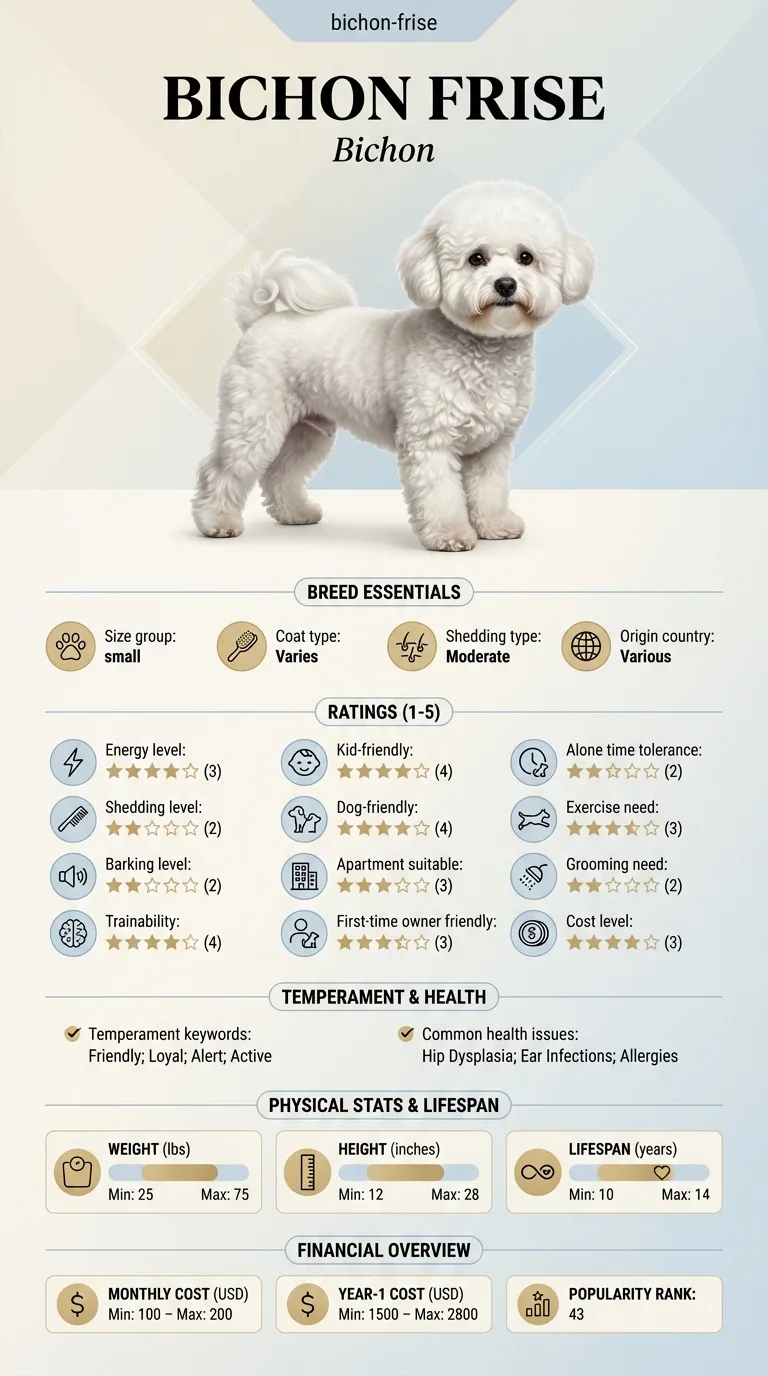
See all Bichon Frise health problems, which breeds are prone to progressive retinal atrophy pra, or the full Bichon Frise breed guide for temperament, exercise needs and ownership costs.
Vision typically declines over a period of months to a few years. Most dogs adapt to each stage within a week or two of it becoming apparent. Environmental changes take an afternoon; teaching verbal cues takes a few weeks of short sessions.
A dog that moves confidently around the house, finds its bowls without hesitation, still enjoys walks on familiar routes, and is not startled by ordinary household contact. Success is not preserved vision, which is not achievable, but preserved confidence, which is.
The progression follows a consistent pattern, and recognising which stage you are watching helps you prepare for the next.
The good news, and it is genuine rather than consoling, is that dogs cope with blindness far better than people expect. Sight is not their dominant sense, and a dog that loses it gradually adapts as it goes rather than facing a sudden change.
The most important rule is to stop moving furniture. A blind dog navigates a map it has memorised, and rearranging the living room erases that map overnight. If something must move, walk the dog around the new layout on a lead several times.
Build in scent and texture cues. A different rug at the top of the stairs, a scented marker near the water bowl, and a distinct doormat by the back door all give the dog information it can use. Keep food and water in fixed locations.
Teach verbal cues before you need them: a word for step up, step down, and stop. A dog that learns these while it can still see will use them confidently later.
Outdoors, use a harness rather than a collar so you can guide gently without pulling the neck, and keep to familiar routes. Approach and speak before touching, so the dog is never startled awake by a hand.

Fergus was eleven and, as far as his owners were concerned, entirely fine. He trotted around the house, found his bed, and never bumped into anything. A week in a rented cottage changed that. Fergus walked into a coffee table twice on the first evening, would not go out into the unlit garden at all, and stayed pressed against someone's leg the entire stay. An ophthalmology examination found significant retinal degeneration. His owners' home had been unchanged for eight years, and he had been navigating it entirely from memory for some time. They put down textured mats, taught him a step cue, and stopped moving the furniture.
Key takeaway: A familiar house is a terrible place to test a dog's sight. If you want to know whether your dog can see, take it somewhere it has never been, in poor light.
The breed's documented eye concern is cataracts, which sits on its list of common health issues. Progressive retinal atrophy is best recognised in a number of other breeds. It is worth being aware of because it produces vision loss that owners initially mistake for behavioural change, and because it can hide behind a cataract.
By examination of the retina by a vet or veterinary ophthalmologist, sometimes supported by electroretinography, which measures the retina's electrical response to light. Breed-specific genetic tests exist where a causative variant has been identified in that breed.
No. The retina degenerates without inflammation or pressure change, so the dog is comfortable throughout. That is a meaningful difference from conditions like glaucoma, where an eye that is losing sight is also acutely painful and needs urgent treatment.
There is no established treatment that halts or reverses the degeneration. Management is about adapting the environment and maintaining the dog's confidence. Some affected dogs also develop cataracts as a secondary change, and it is important that cataract surgery is not performed on an eye whose retina no longer works.
Usually over months to a few years depending on the form. That gradual pace is genuinely helpful: it gives the dog time to build its mental map and gives you time to make changes before they become urgent.
Yes, and this is worth saying plainly. Dogs that lose sight gradually typically continue to eat, play, walk and enjoy company much as before. What they need is a predictable environment, a bit of extra verbal communication, and an owner who does not treat them as fragile.
Reluctance to go out in the dark, or hesitation on unlit stairs, while daytime navigation looks entirely normal.
Not to an owner, until late. Some dogs show unusually wide pupils or a greater eyeshine reflection in dim light.
Very little ongoing. The expense is in the diagnostic work-up rather than in any treatment, since none exists.
Gate them initially, then teach a step cue. Most dogs regain confidence on familiar stairs within weeks.
Speak first, then touch. Startling a sleeping blind dog is the main cause of defensiveness developing.
A one-page prep sheet for this condition: the signs, the questions to ask, what to get priced. Unlocks here.
You get: Vet visit prep sheet
No spam. One-click unsubscribe. See our privacy policy.
Preview page 1 before you decide.
