Behavior
Which needs more exercise, Bichon Frise or Brittany?
The Brittany, rated High (4/5) versus the Bichon's Low (2/5).

Quick answer
Which needs more exercise, Bichon Frise or Brittany?
The Brittany, rated High (4/5) versus the Bichon's Low (2/5).
Bichon Frise or Brittany Spaniel? On paper they differ most on grooming need, and on the scales Brittany Spaniel is the heavier at 30–40 lbs. Here is how the two compare on everything that shapes an ordinary week.
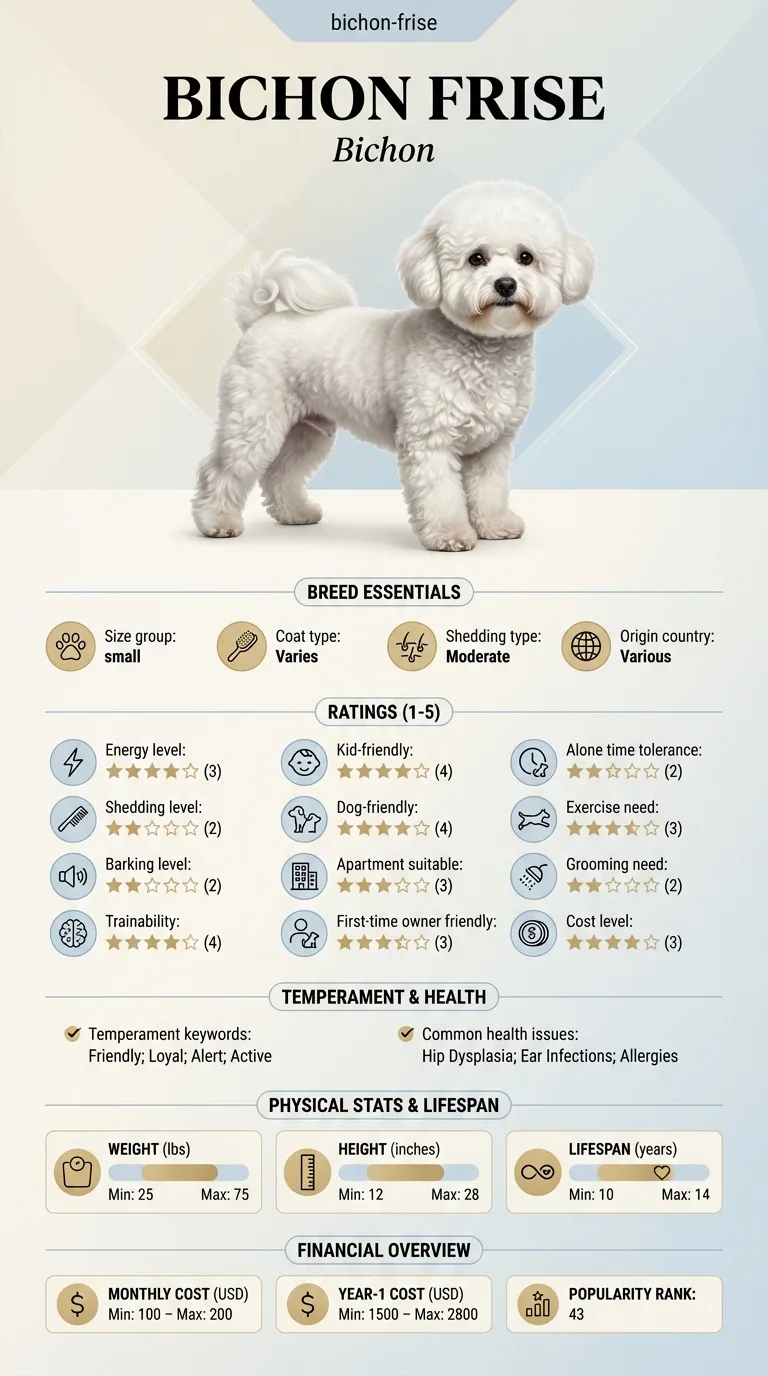
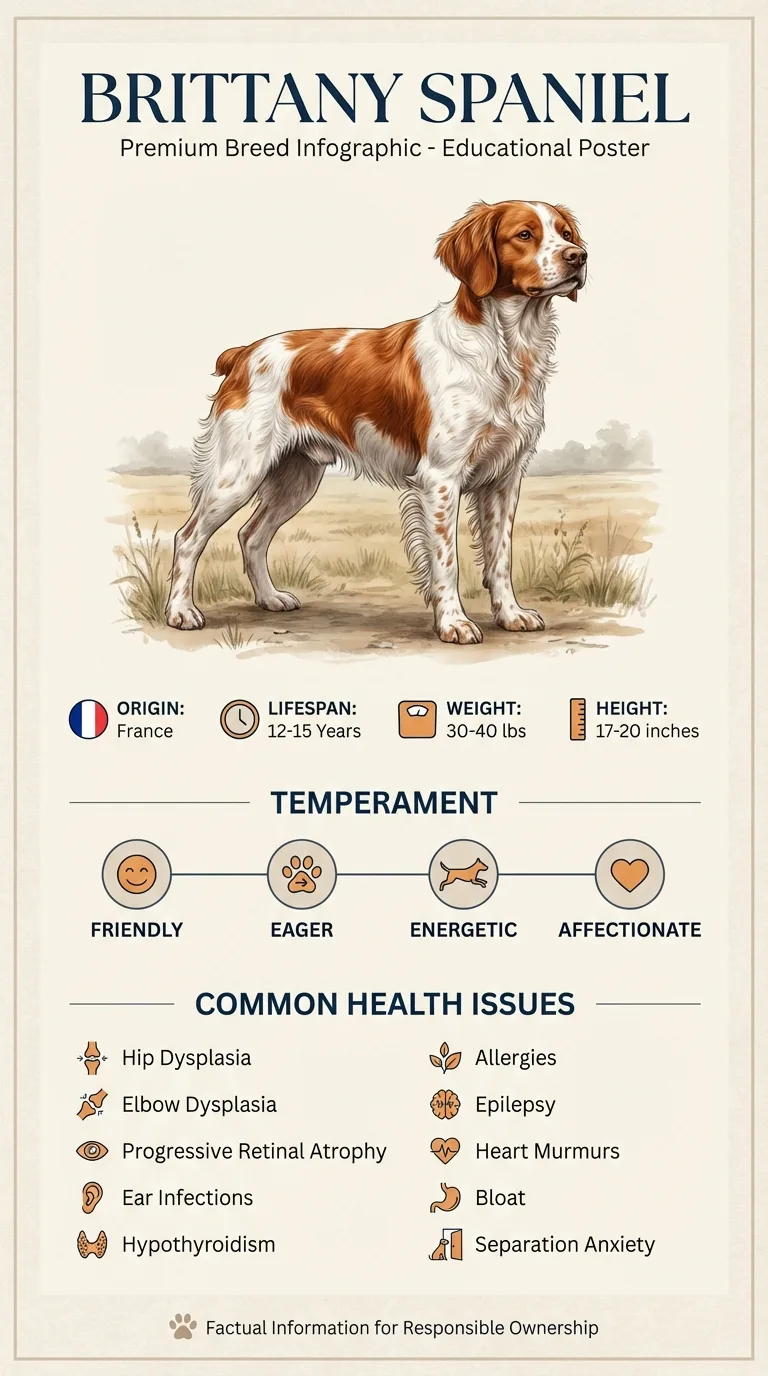
This is for someone already down to Bichon Frise and Brittany Spaniel and deciding between them. For this pair the decision usually turns on grooming need and exercise need, so those are covered first and in most detail. Anyone choosing from a flat has a clear answer here: Bichon Frise rates 5/5 against 3/5. There is no origin story here — only what changes about your week.
Between Bichon Frise and Brittany Spaniel, grooming need is what separates them, and Bichon Frise is the lower-effort dog of the two to keep.
Choose Bichon Frise if you are in a flat or a smaller home, shedding is a problem in your house and your walking routine is modest.
Choose Brittany Spaniel if you do not want a standing grooming appointment, there are young children at home and you already have another dog.
| Feature | bichon frise | brittany | Winner |
|---|---|---|---|
| Size class | small | medium | Equal |
| Weight | 12–18 lbs | 30–40 lbs | Equal |
| Height | 9–12 in | 17–20 in | Equal |
| Lifespan | 14–15 years | 12–15 years | bichon frise |
| Exercise need | Low (2/5) | High (4/5) | bichon frise |
| Grooming need | Very high (5/5) | Low (2/5) | brittany |
| Shedding | Very low (1/5) | Moderate (3/5) | bichon frise |
| Energy level | Moderate (3/5) | High (4/5) | Equal |
| Barking | Moderate (3/5) | Low (2/5) | brittany |
| Apartment suitability | Very high (5/5) | Moderate (3/5) | bichon frise |
| Good for first-time owners | High (4/5) | High (4/5) | Equal |
| Tolerates being alone | Low (2/5) | Low (2/5) | Equal |
| Trainability | Moderate (3/5) | Very high (5/5) | brittany |
| Good with kids | High (4/5) | Very high (5/5) | brittany |
| Good with other dogs | High (4/5) | Very high (5/5) | brittany |
| Friendly to strangers | High (4/5) | High (4/5) | Equal |
| Cost level | Moderate (3/5) | Moderate (3/5) | Equal |
| Coat | Curly, dense double coat | Medium, wavy coat | Equal |
| Origin | Various | France | Equal |
| Typical monthly cost | $80–$150 | $90–$180 | Equal |
| Typical first-year cost | $1,100–$2,300 | $1,300–$2,500 | Equal |
Weight tells most of the story here: the Bichon Frise's 12-18 lbs sits well below the Brittany Spaniel's 30-40 lbs, and height follows suit at 9-12 inches versus 17-20 inches. Both breeds are marked as tied on size class, but the Brittany is a genuine sporting dog built for covering ground in the field, while the Bichon's compact frame was bred purely for companionship. The Brittany's medium, wavy coat and leaner, more athletic build reflect its history as a pointing breed, a build the rounder, fluffier Bichon doesn't share at all.
The Brittany's High (4/5) exercise need and High (4/5) energy level put real distance between it and the Bichon's Low (2/5) exercise need and Moderate (3/5) energy. Bred as a versatile hunting companion, the Brittany's Eager, Energetic temperament wants sustained outdoor activity, running, retrieving, or long hikes, well beyond what satisfies the Playful, Curious Bichon. A Brittany kept without adequate outlets can become anxious or overly vocal in its frustration, while the lower-drive Bichon adapts more readily to a quieter daily rhythm.
The Bichon Frise's curly, dense double coat requires Very high (5/5) grooming attention, compared to the Brittany's medium, wavy coat at Low (2/5), a considerable time difference in brushing and professional trims. Shedding favors the Brittany less clearly, it still sheds Moderate (3/5) against the Bichon's Very low (1/5), since the Bichon's coat traps loose hair rather than releasing it. Owners who want minimal at-home coat care but don't mind some shedding around the house will find the Brittany considerably easier to maintain.
Apartment suitability favors the Bichon Frise, Very high (5/5) versus the Brittany's Moderate (3/5), the Brittany can adapt to smaller spaces better than higher-drive sporting breeds, but its exercise needs mean apartment life only works with a serious daily commitment to outdoor activity. Barking favors the Brittany, Low (2/5) against the Bichon's Moderate (3/5). Both breeds tolerate being alone poorly, tied at Low (2/5), and the Brittany's health list even flags Separation Anxiety by name, underscoring that neither breed suits an owner gone long hours.
The Brittany rates Very high (5/5) on trainability, outpacing the Bichon's Moderate (3/5), which tracks with its background as a hunting companion bred for close cooperation with handlers. Both breeds tie at High (4/5) for first-time-owner suitability, though the Brittany's higher exercise and mental-stimulation needs mean a first-time owner needs to be an active one. The Bichon's Cheerful, Affectionate nature makes it forgiving of training missteps, while the Brittany's Friendly, Eager disposition responds fast to structured lessons but needs that structure paired with real physical outlets.
The Brittany edges out the Bichon on both kids (Very high 5/5 vs. High 4/5) and other dogs (Very high 5/5 vs. High 4/5), reflecting its history as a sociable, cooperative sporting breed that was never bred for territorial guarding. Friendliness to strangers ties at High (4/5) for both. Families with an active household, kids who want a running and fetching partner, other resident dogs who'll join in play, may find the Brittany's Friendly, Affectionate energy an even better match than the equally sociable but lower-energy Bichon.
The Bichon Frise's 14-15 year lifespan edges out the Brittany's 12-15 years, and the health lists diverge in both length and type. The Bichon's five conditions (Skin Allergies, Patellar Luxation, Bladder Stones, Cataracts, Dental Disease) are notably fewer than the Brittany's ten, which includes Hip Dysplasia, Elbow Dysplasia, Progressive Retinal Atrophy, Epilepsy, Heart Murmurs, Bloat, and Separation Anxiety. That last entry is worth flagging specifically, Separation Anxiety appearing on a health list underscores how much the Brittany's emotional wellbeing depends on consistent companionship and adequate exercise.
Costs sit close but not identical: the Brittany runs $90-180 monthly against the Bichon's $80-150, and $1,300-2,500 in year one versus $1,100-2,300, with both rated Moderate (3/5) overall. The gap is modest, but where the money goes differs, the Bichon's budget skews toward grooming appointments given its Very high grooming need, while the Brittany's skews toward food volume (a 30-40 lb dog eats considerably more than a 12-18 lb one) and potentially training classes or field time to satisfy its Very high trainability and High exercise drive.
Bichon Frise weighs 12–18 lbs and lives 14–15 years; Brittany Spaniel weighs 30–40 lbs and lives 12–15 years. The two diverge most on grooming need, exercise need and apartment suitability and 2 other rated axes. They are level on tolerates being alone, cost level and good for first-time owners, so those cannot decide it. Where the table declares a winner it means less work for the owner, nothing more; descriptive rows are left as ties on purpose. The value here is in the differences between the two columns; treat any single score as approximate.

It can work, rated Moderate (3/5) for apartment suitability, but its High (4/5) exercise need means it needs a genuine daily exercise commitment regardless of space, the Bichon Frise, at Very high (5/5) apartment suitability, is the easier fit for compact living.
The Brittany, rated Moderate (3/5) for shedding versus the Bichon Frise's Very low (1/5), though the Brittany's Low (2/5) grooming need still makes at-home coat care simpler overall.
It's specifically listed on the Brittany's health profile in this comparison, alongside a Low (2/5) rating for tolerating being alone, matching the Bichon Frise, which also rates Low (2/5) on that measure.
The Brittany, rated Very high (5/5) on trainability versus the Bichon Frise's Moderate (3/5), reflecting its background as a cooperative hunting companion.
The Brittany, rated Very high (5/5), edges out the Bichon Frise's already strong High (4/5).
The Bichon Frise, typically 14-15 years, versus the Brittany's 12-15 years.
Both tie at High (4/5) for first-time-owner suitability, but the Brittany's higher exercise needs mean it suits an active first-time owner more than a sedentary one.
The Brittany, rated High (4/5) versus the Bichon's Low (2/5).
The Bichon Frise, at Very low (1/5) shedding.
The Brittany, rated Very high (5/5) on trainability.
The Bichon Frise, rated Very high (5/5) versus the Brittany's Moderate (3/5).
Secure checkout on Stripe. We never see your card.
7-day money-back guarantee. Instant access.
Health information here is general and is not veterinary advice. If your dog shows pain, sudden behaviour change, or worsening symptoms, consult a licensed veterinarian.
Some links on this site are affiliate links. We may earn a commission at no extra cost to you, and we only suggest products we believe are helpful for dog owners.
We research and check what we publish, but we do not warrant that any figure, date, price, or statement is accurate, complete, or current, and we accept no liability for any loss, cost, injury, or other harm arising from the use of this site. Use it as one reference among several. You remain responsible for your own decisions and for your dog's care - confirm anything that matters with a licensed veterinarian or another qualified professional before you act on it. Full disclaimer.
Match your lifestyle to the right dog.
Take quizNot sure which breed is right for you? Take our 2-minute quiz to find out.
Take the quiz