Living
Which is better with kids, Bichon Frise or Cavalier?
The Cavalier, rated Very high (5/5), just ahead of the Bichon's High (4/5).

Quick answer
Which is better with kids, Bichon Frise or Cavalier?
The Cavalier, rated Very high (5/5), just ahead of the Bichon's High (4/5).
Bichon Frise or Cavalier King Charles Spaniel? On paper they differ most on grooming need, and on the scales Cavalier King Charles Spaniel is the heavier at 13–18 lbs. Here is how the two compare on everything that shapes an ordinary week.
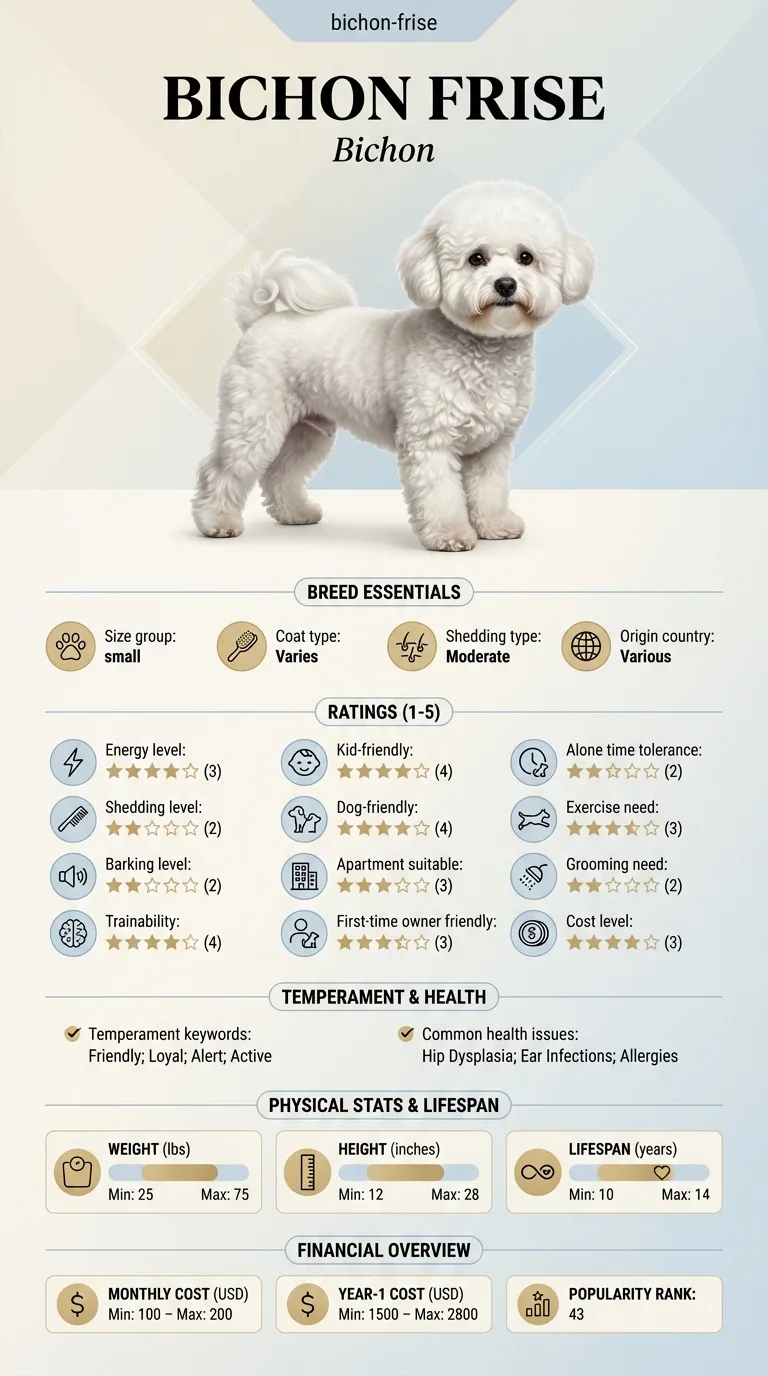
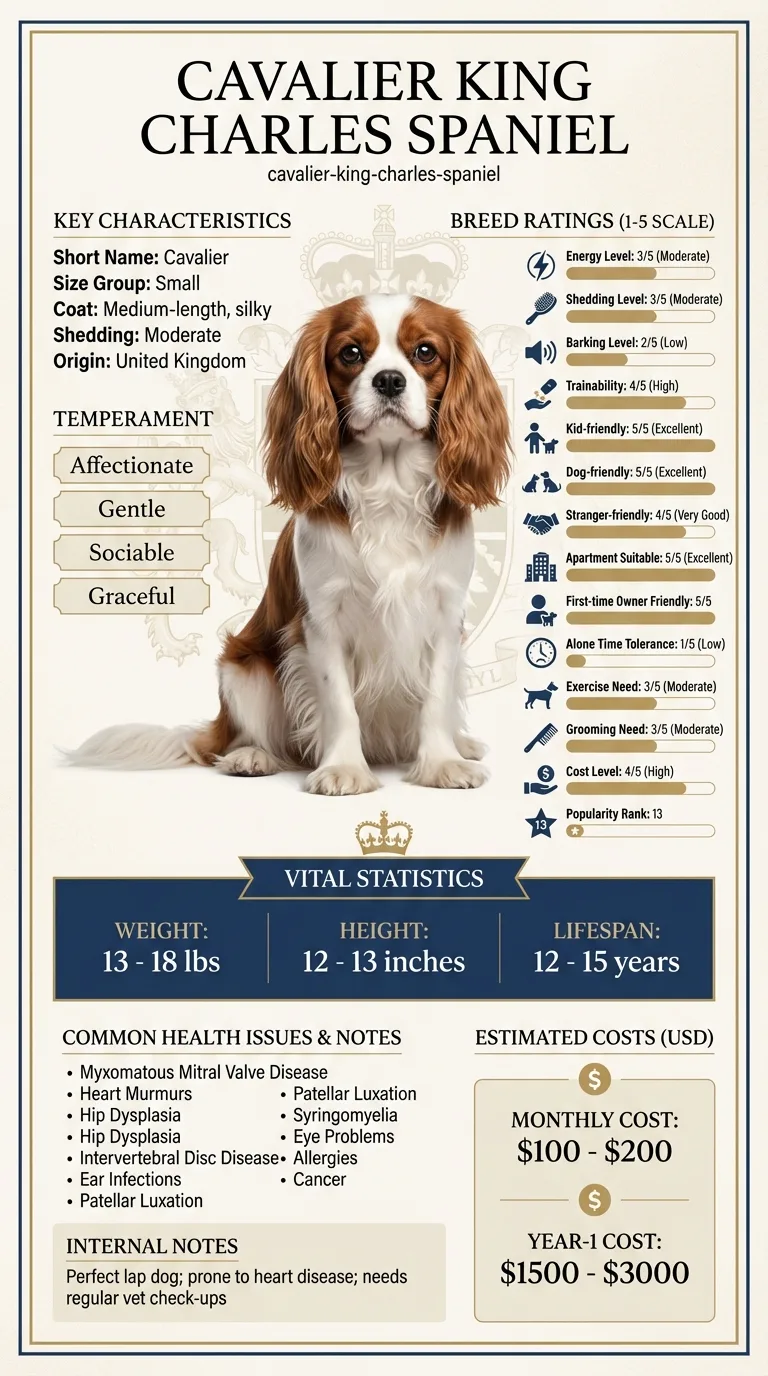
This is for someone already down to Bichon Frise and Cavalier King Charles Spaniel and deciding between them. For this pair the decision usually turns on grooming need and shedding, so those are covered first and in most detail. Both rate 5/5 for flats, so housing does not settle this one. There is no origin story here — only what changes about your week.
Between Bichon Frise and Cavalier King Charles Spaniel, grooming need is what separates them, and Cavalier King Charles Spaniel is the lower-effort dog of the two to keep.
Choose Bichon Frise if shedding is a problem in your house, your walking routine is modest and a smaller dog suits your car, your home or your back.
Choose Cavalier King Charles Spaniel if this is your first dog, you do not want a standing grooming appointment and there are young children at home.
| Feature | bichon frise | cavalier king charles spaniel | Winner |
|---|---|---|---|
| Size class | small | small | Equal |
| Weight | 12–18 lbs | 13–18 lbs | Equal |
| Height | 9–12 in | 12–13 in | Equal |
| Lifespan | 14–15 years | 12–15 years | bichon frise |
| Exercise need | Low (2/5) | Moderate (3/5) | bichon frise |
| Grooming need | Very high (5/5) | Moderate (3/5) | cavalier king charles spaniel |
| Shedding | Very low (1/5) | Moderate (3/5) | bichon frise |
| Energy level | Moderate (3/5) | Moderate (3/5) | Equal |
| Barking | Moderate (3/5) | Low (2/5) | cavalier king charles spaniel |
| Apartment suitability | Very high (5/5) | Very high (5/5) | Equal |
| Good for first-time owners | High (4/5) | Very high (5/5) | cavalier king charles spaniel |
| Tolerates being alone | Low (2/5) | Very low (1/5) | bichon frise |
| Trainability | Moderate (3/5) | High (4/5) | cavalier king charles spaniel |
| Good with kids | High (4/5) | Very high (5/5) | cavalier king charles spaniel |
| Good with other dogs | High (4/5) | Very high (5/5) | cavalier king charles spaniel |
| Friendly to strangers | High (4/5) | High (4/5) | Equal |
| Cost level | Moderate (3/5) | High (4/5) | bichon frise |
| Coat | Curly, dense double coat | Medium-length, silky | Equal |
| Origin | Various | United Kingdom | Equal |
| Typical monthly cost | $80–$150 | $100–$200 | Equal |
| Typical first-year cost | $1,100–$2,300 | $1,500–$3,000 | Equal |
These two are close in scale: the Bichon Frise runs 12-18 lbs and 9-12 inches, while the Cavalier King Charles Spaniel is only slightly heavier and taller at 13-18 lbs and 12-13 inches. Both tie on the small size class, and neither will overwhelm a household. The visual difference owes more to coat and shape than raw dimensions, the Bichon's curly, dense double coat gives it a rounder, fluffier silhouette, while the Cavalier's medium-length, silky coat and characteristic long ears give it a softer, more classically spaniel look despite the near-identical weight range.
Exercise need slightly favors the Bichon at Low (2/5) against the Cavalier's Moderate (3/5), though energy level ties at Moderate (3/5) for both. Neither breed is demanding physically, the Cavalier's Affectionate, Gentle temperament suits leisurely walks and lap time as much as the Bichon's Playful, Cheerful nature does. The small gap in exercise need means Cavalier owners should plan slightly more consistent daily activity than Bichon owners, but neither breed requires the kind of vigorous outlet that sporting or working breeds do.
The Bichon Frise's Very high (5/5) grooming need is considerably steeper than the Cavalier's Moderate (3/5), the Bichon's curly coat needs regular professional trims to avoid matting, while the Cavalier's silky coat mainly needs brushing to prevent tangles, especially around the ears and feathering. Shedding still favors the Bichon at Very low (1/5) against the Cavalier's Moderate (3/5), so the tradeoff runs in opposite directions: less grooming labor for the Cavalier, less loose hair for the Bichon.
Both breeds tie at Very high (5/5) for apartment suitability, making either a strong choice for compact living. Barking favors the Cavalier, Low (2/5) versus the Bichon's Moderate (3/5). The bigger difference shows up in solitude tolerance: the Cavalier rates Very low (1/5) for tolerating being alone, even lower than the Bichon's already-low 2/5, Cavaliers are known for intense attachment to their people and can struggle badly with separation, a trait worth weighing heavily for anyone with a demanding work schedule.
The Cavalier edges ahead on both first-time-owner suitability (Very high 5/5 vs. High 4/5) and trainability (High 4/5 vs. Moderate 3/5), making it the marginally easier breed for a new owner to train from scratch. Both breeds share a fundamentally cooperative, people-pleasing disposition, the Bichon's Cheerful, Affectionate nature and the Cavalier's Affectionate, Gentle, Sociable temperament both respond well to positive reinforcement. Neither presents real training difficulty, but the Cavalier's slightly higher scores suggest a marginally smoother learning curve for a first-time owner.
The Cavalier rates Very high (5/5) with both kids and other dogs, ahead of the Bichon's High (4/5) in both categories, and both tie at High (4/5) for friendliness to strangers. The Cavalier's Sociable, Graceful temperament was bred specifically for companionship in busy Georgian-era households, and that history shows in its consistently top-tier social scores across the board. Families wanting a dog that's equally comfortable with toddlers, resident pets, and a steady stream of visitors may find the Cavalier a slightly stronger all-around social fit than even the already-friendly Bichon.
Lifespan slightly favors the Bichon Frise at 14-15 years against the Cavalier's 12-15 years, but the real story is in the health lists. The Cavalier's ten conditions are dominated by cardiac and neurological risk, Myxomatous Mitral Valve Disease and Heart Murmurs top the list, alongside Syringomyelia, a serious neurological condition well-documented in the breed, plus Intervertebral Disc Disease and Patellar Luxation. The Bichon's five-item list (Skin Allergies, Patellar Luxation, Bladder Stones, Cataracts, Dental Disease) is notably shorter and lacks the cardiac severity that defines Cavalier health screening.
The Cavalier costs more across the board: High (4/5) cost level against the Bichon's Moderate (3/5), with monthly costs of $100-200 versus $80-150 and first-year costs of $1,500-3,000 versus $1,100-2,300. Much of that premium likely reflects the Cavalier's cardiac health monitoring, Myxomatous Mitral Valve Disease screening is a standard, ongoing expense for the breed, on top of typical grooming and food costs. The Bichon's higher grooming need partially closes the gap but doesn't erase the Cavalier's higher overall cost profile.
Bichon Frise weighs 12–18 lbs and lives 14–15 years; Cavalier King Charles Spaniel weighs 13–18 lbs and lives 12–15 years. The two diverge most on grooming need and shedding. They are level on apartment suitability, energy level and friendly to strangers, so those cannot decide it. Where the table declares a winner it means less work for the owner, nothing more; descriptive rows are left as ties on purpose. The value here is in the differences between the two columns; treat any single score as approximate.

Myxomatous Mitral Valve Disease, a heart condition that appears at the top of its health list along with Heart Murmurs, cardiac screening is a standard part of responsible Cavalier ownership.
Neither does well, but the Bichon Frise, rated Low (2/5), edges out the Cavalier's Very low (1/5), Cavaliers are known for particularly intense attachment to their owners.
The Cavalier King Charles Spaniel, rated Moderate (3/5) versus the Bichon Frise's Very high (5/5).
Yes, rated Very high (5/5) for both, even ahead of the Bichon Frise's already strong High (4/5) ratings.
The Bichon Frise, typically 14-15 years, versus the Cavalier's 12-15 years.
The Bichon Frise, with a lower typical first-year cost of $1,100-2,300 versus the Cavalier's $1,500-3,000.
The Cavalier King Charles Spaniel, rated High (4/5) versus the Bichon Frise's Moderate (3/5).
The Cavalier, rated Very high (5/5), just ahead of the Bichon's High (4/5).
The Bichon Frise, at Very low (1/5) versus the Cavalier's Moderate (3/5).
The Bichon Frise, at $1,100-2,300 typical first-year cost versus the Cavalier's $1,500-3,000.
The Cavalier, rated Very low (1/5) for tolerating being alone.
Secure checkout on Stripe. We never see your card.
7-day money-back guarantee. Instant access.
Health information here is general and is not veterinary advice. If your dog shows pain, sudden behaviour change, or worsening symptoms, consult a licensed veterinarian.
Some links on this site are affiliate links. We may earn a commission at no extra cost to you, and we only suggest products we believe are helpful for dog owners.
We research and check what we publish, but we do not warrant that any figure, date, price, or statement is accurate, complete, or current, and we accept no liability for any loss, cost, injury, or other harm arising from the use of this site. Use it as one reference among several. You remain responsible for your own decisions and for your dog's care - confirm anything that matters with a licensed veterinarian or another qualified professional before you act on it. Full disclaimer.
Match your lifestyle to the right dog.
Take quizNot sure which breed is right for you? Take our 2-minute quiz to find out.
Take the quiz