Behavior
Bichon Frise or Yorkshire Terrier for a quiet home?
Bichon Frise, since it barks less (moderate 3/5 versus the Yorkie's high 4/5).

Quick answer
Bichon Frise or Yorkshire Terrier for a quiet home?
Bichon Frise, since it barks less (moderate 3/5 versus the Yorkie's high 4/5).
Bichon Frise or Yorkshire Terrier? On paper they differ most on friendly to strangers, and on the scales Bichon Frise is the heavier at 12–18 lbs. Here is how the two compare on everything that shapes an ordinary week.
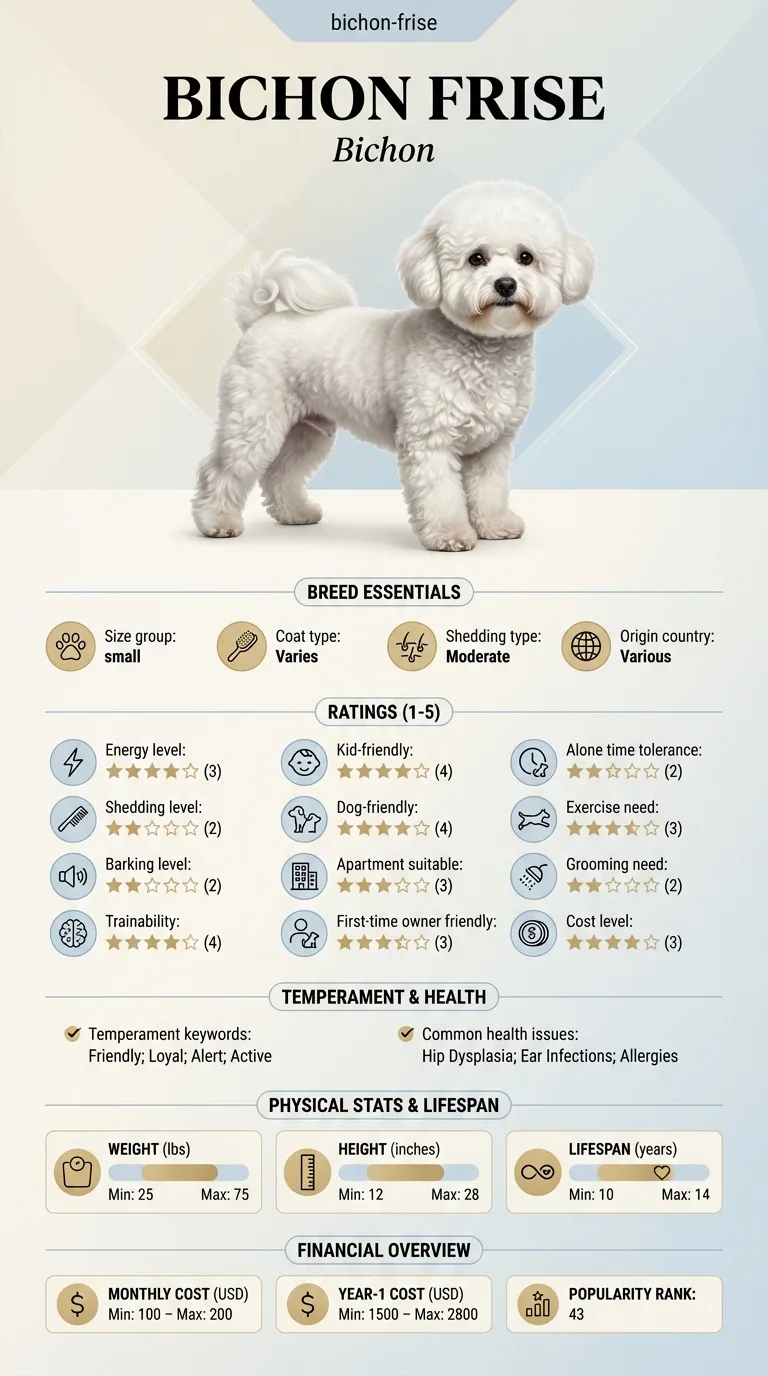
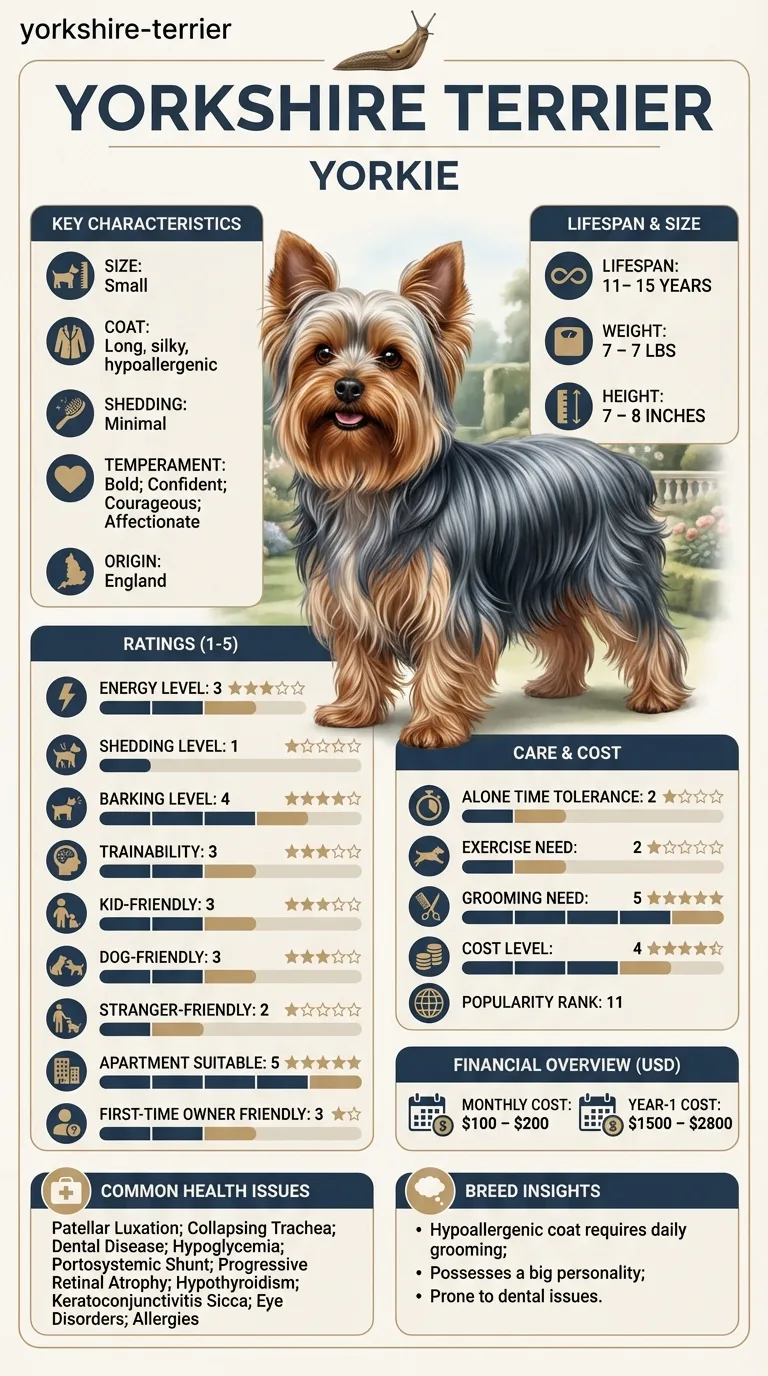
This is for someone already down to Bichon Frise and Yorkshire Terrier and deciding between them. For this pair the decision usually turns on friendly to strangers, so those are covered first and in most detail. Both rate 5/5 for flats, so housing does not settle this one. It is written for the decision rather than the breed history.
Between Bichon Frise and Yorkshire Terrier, friendly to strangers is what separates them, and Bichon Frise is the lower-effort dog of the two to keep.
Choose Bichon Frise if this is your first dog, there are young children at home and you already have another dog.
Choose Yorkshire Terrier if a smaller dog suits your car, your home or your back and you want a dog that is more watchful with visitors.
| Feature | bichon frise | yorkshire terrier | Winner |
|---|---|---|---|
| Size class | small | small | Equal |
| Weight | 12–18 lbs | 4–7 lbs | Equal |
| Height | 9–12 in | 7–8 in | Equal |
| Lifespan | 14–15 years | 11–15 years | bichon frise |
| Exercise need | Low (2/5) | Low (2/5) | Equal |
| Grooming need | Very high (5/5) | Very high (5/5) | Equal |
| Shedding | Very low (1/5) | Very low (1/5) | Equal |
| Energy level | Moderate (3/5) | Moderate (3/5) | Equal |
| Barking | Moderate (3/5) | High (4/5) | bichon frise |
| Apartment suitability | Very high (5/5) | Very high (5/5) | Equal |
| Good for first-time owners | High (4/5) | Moderate (3/5) | bichon frise |
| Tolerates being alone | Low (2/5) | Low (2/5) | Equal |
| Trainability | Moderate (3/5) | Moderate (3/5) | Equal |
| Good with kids | High (4/5) | Moderate (3/5) | bichon frise |
| Good with other dogs | High (4/5) | Moderate (3/5) | bichon frise |
| Friendly to strangers | High (4/5) | Low (2/5) | bichon frise |
| Cost level | Moderate (3/5) | High (4/5) | bichon frise |
| Coat | Curly, dense double coat | Long, silky, hypoallergenic | Equal |
| Origin | Various | England | Equal |
| Typical monthly cost | $80–$150 | $100–$190 | Equal |
| Typical first-year cost | $1,100–$2,300 | $1,400–$2,900 | Equal |
Both breeds share the small size class, but the numbers inside it differ sharply: a Bichon Frise weighs 12-18 lbs and stands 9-12 inches, while a Yorkshire Terrier weighs only 4-7 lbs and stands just 7-8 inches, making the Yorkie roughly a third the Bichon's weight. The Bichon's curly dense double coat gives it a rounder, puffier look, while the Yorkie's long, silky, hypoallergenic coat hangs straight and sleek. Despite the size difference, both are true toy-to-small companion breeds built for laps and short walks rather than serious athletic work.
Exercise need ties at low (2/5), and energy level ties at moderate (3/5), meaning these two breeds are unusually well matched on activity level compared with most pairings on this site. Neither needs more than a couple of short walks and some indoor play to stay satisfied, and both are equally suited to a lower-key daily routine. The real differences between them show up elsewhere, particularly in barking and sociability, rather than in how much physical exertion each dog demands from its owner.
Grooming and shedding both tie exactly: very high (5/5) grooming need for each, and very low (1/5) shedding for each. The Bichon's curly coat and the Yorkie's long, silky coat both mat readily without regular brushing and professional trims every four to six weeks, and both are popular choices for allergy-sensitive households precisely because they shed so little. Anyone choosing based on coat maintenance alone will find no advantage either way; the decision has to rest on other factors like temperament and cost.
Apartment suitability ties at very high (5/5) for both breeds, and tolerating being alone ties at low (2/5) for both, so living-space fit is nearly identical. Barking is the one clear split: the Yorkshire Terrier rates high (4/5) against the Bichon's moderate (3/5), reflecting the Yorkie's bold, confident, courageous temperament that often includes vocal alertness to noises and visitors. In a thin-walled apartment building, that difference in barking tendency may matter more than any other single trait on this comparison.
Trainability ties at moderate (3/5) for both breeds, but first-time-owner suitability favors the Bichon, high (4/5) against the Yorkie's moderate (3/5). The temperament lists hint at why: the Yorkshire Terrier is bold, confident and courageous, personality traits that can tip into willfulness without consistent handling, while the Bichon's playful, cheerful, curious nature is generally easier for a novice to manage day to day. Both are trainable with patience, but the Bichon offers a slightly gentler learning curve for someone new to dog ownership.
The Bichon pulls ahead across all three social measures here: high (4/5) with kids against the Yorkie's moderate (3/5), high (4/5) with other dogs against the Yorkie's moderate (3/5), and high (4/5) friendly to strangers against the Yorkie's low (2/5). The Yorkshire Terrier's small size and bold, terrier-bred temperament make it better suited to calmer households with older children and fewer unfamiliar faces, while the Bichon's more universally sociable nature fits busier, more varied households with greater ease.
The Bichon's 14-15 year lifespan edges out the Yorkie's 11-15 year range, though both can live well into their teens with good care. Health profiles differ meaningfully in length and content: the Bichon's five-item list covers skin allergies, patellar luxation, bladder stones, cataracts and dental disease, while the Yorkie's ten-item list adds collapsing trachea, hypoglycemia and portosystemic shunt on top of shared concerns like patellar luxation and dental disease. That broader Yorkie list reflects the added fragility that comes with an extremely small 4-7 lb frame.
The Yorkshire Terrier runs slightly more expensive overall, rated high (4/5) cost level against the Bichon's moderate (3/5), and monthly costs of $100-190 versus $80-150 reflect that, though first-year costs land close at $1,400-2,900 for the Yorkie against $1,100-2,300 for the Bichon. Both breeds share the burden of a very high 5/5 grooming rating, so professional coat care is a recurring line item for either dog; the Yorkie's slightly higher overall cost likely also reflects veterinary attention tied to its longer list of small-breed-specific health conditions.
Bichon Frise weighs 12–18 lbs and lives 14–15 years; Yorkshire Terrier weighs 4–7 lbs and lives 11–15 years. The two diverge most on friendly to strangers. They are level on tolerates being alone, apartment suitability and energy level, so those cannot decide it. In the table, a "winner" means easier for an ordinary household — not better. Size, coat and origin are recorded without a verdict. Because both breeds are scored the same way, the gaps are reliable even where the absolute numbers are rough.

Neither has an edge; both are rated very low (1/5) for shedding, making them equally popular choices for allergy-sensitive homes.
Yes, it rates very high (5/5) for apartment suitability, tied with the Bichon Frise, though it does bark more, rated high (4/5) versus the Bichon's moderate (3/5).
The Bichon Frise, rated high (4/5) friendly to strangers against the Yorkshire Terrier's low (2/5).
Neither needs much; both tie at low (2/5) exercise need and moderate (3/5) energy level.
The Yorkshire Terrier's health list runs to ten items, including collapsing trachea, hypoglycemia and portosystemic shunt, versus the Bichon's five more manageable concerns.
Slightly less so; the Bichon rates high (4/5) good with kids against the Yorkie's moderate (3/5), reflecting its more universally sociable temperament.
The Yorkshire Terrier, rated high (4/5) cost level versus the Bichon's moderate (3/5), with a higher typical monthly cost of $100-190.
Bichon Frise, since it barks less (moderate 3/5 versus the Yorkie's high 4/5).
The Yorkshire Terrier, described as bold, confident and courageous.
The Bichon Frise, rated 4/5 for first-time owners versus the Yorkie's 3/5.
Neither; both tie at a very high 5/5 grooming need.
Secure checkout on Stripe. We never see your card.
7-day money-back guarantee. Instant access.
Health information here is general and is not veterinary advice. If your dog shows pain, sudden behaviour change, or worsening symptoms, consult a licensed veterinarian.
Some links on this site are affiliate links. We may earn a commission at no extra cost to you, and we only suggest products we believe are helpful for dog owners.
We research and check what we publish, but we do not warrant that any figure, date, price, or statement is accurate, complete, or current, and we accept no liability for any loss, cost, injury, or other harm arising from the use of this site. Use it as one reference among several. You remain responsible for your own decisions and for your dog's care - confirm anything that matters with a licensed veterinarian or another qualified professional before you act on it. Full disclaimer.
Match your lifestyle to the right dog.
Take quizNot sure which breed is right for you? Take our 2-minute quiz to find out.
Take the quiz