Behavior
Bichon Frise or Weimaraner for low grooming effort?
Weimaraner, rated 1/5 grooming need versus the Bichon's 5/5.

Quick answer
Bichon Frise or Weimaraner for low grooming effort?
Weimaraner, rated 1/5 grooming need versus the Bichon's 5/5.
Bichon Frise or Weimaraner? On paper they differ most on grooming need, and on the scales Weimaraner is the heavier at 55–90 lbs. Here is how the two compare on everything that shapes an ordinary week.
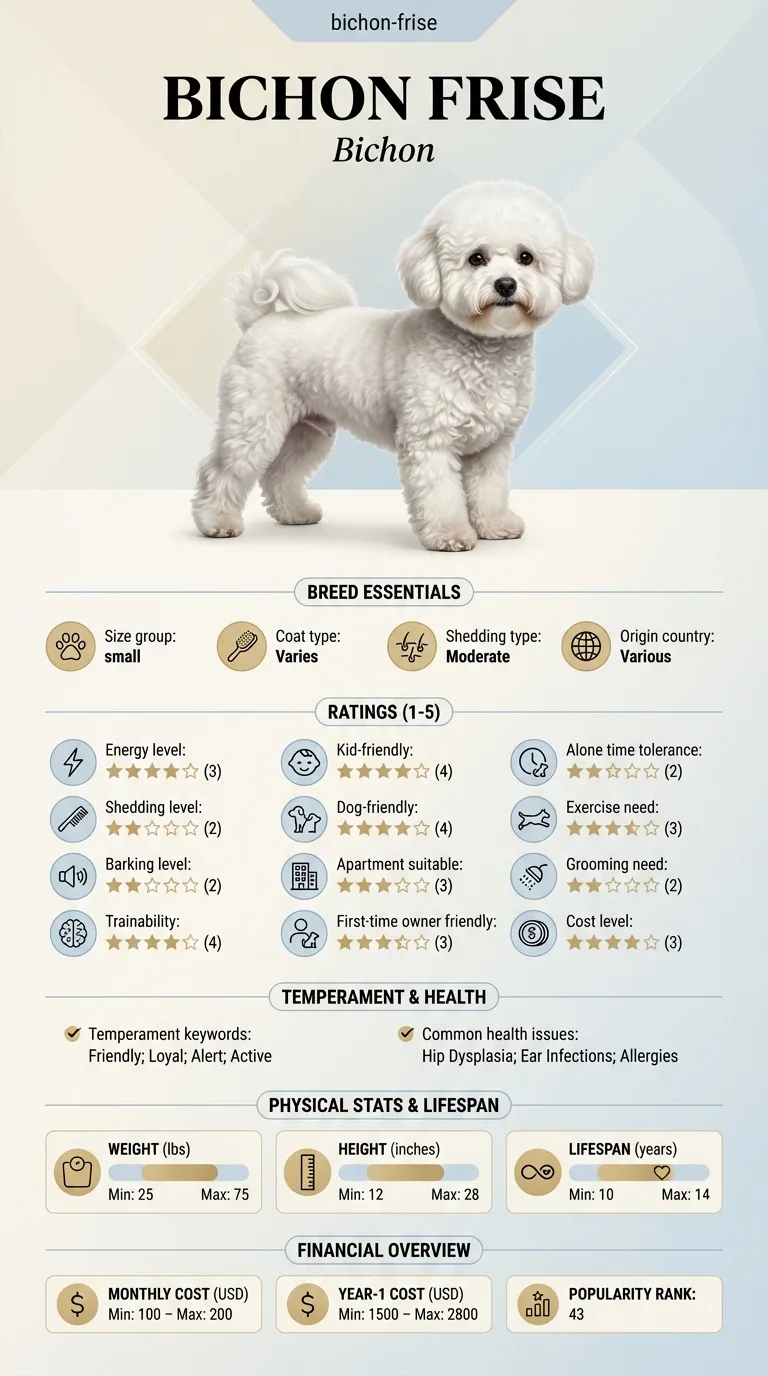
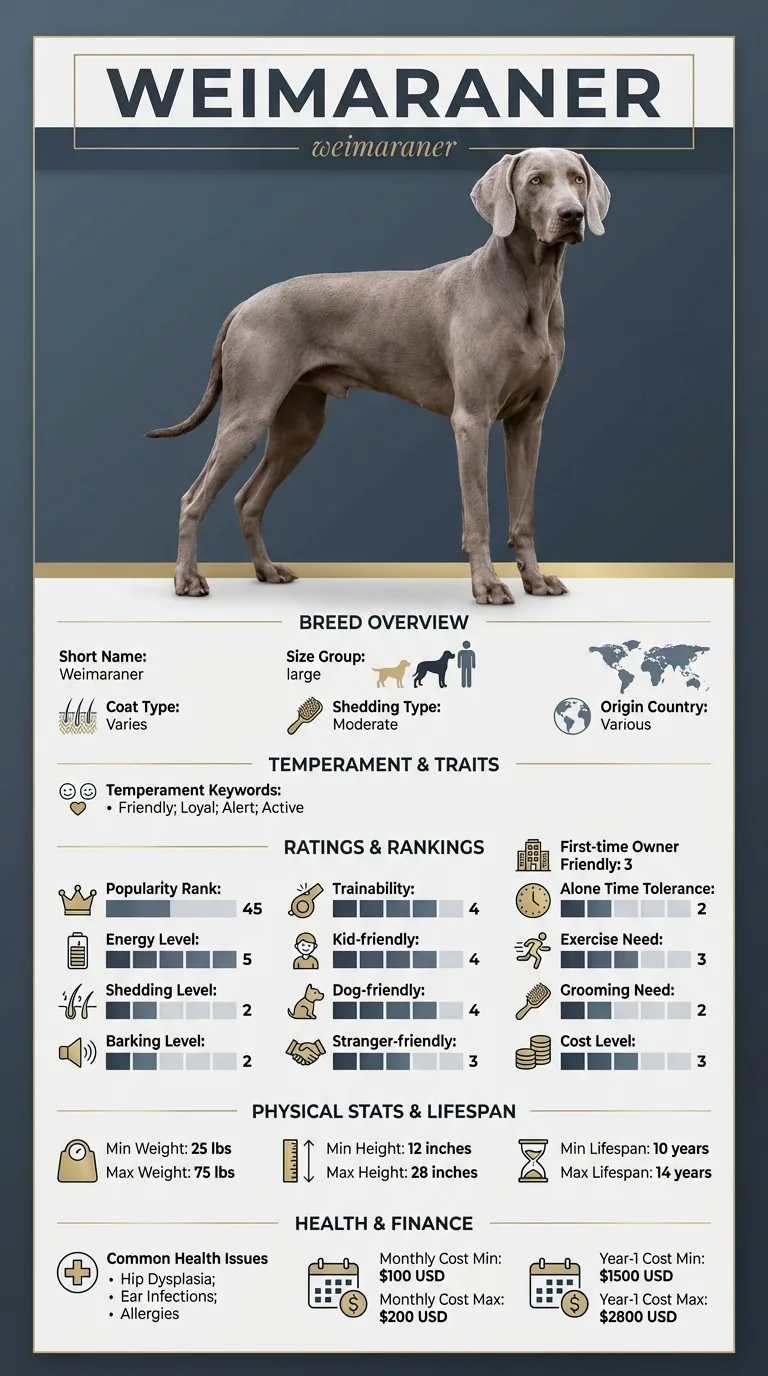
This is for someone already down to Bichon Frise and Weimaraner and deciding between them. For this pair the decision usually turns on grooming need and apartment suitability, so those are covered first and in most detail. Anyone choosing from a flat has a clear answer here: Bichon Frise rates 5/5 against 1/5. The focus throughout is on daily consequences rather than breed background.
Between Bichon Frise and Weimaraner, grooming need is what separates them, and Bichon Frise is the lower-effort dog of the two to keep.
Choose Bichon Frise if you are in a flat or a smaller home, this is your first dog and shedding is a problem in your house.
Choose Weimaraner if you do not want a standing grooming appointment, you want a dog that picks up training quickly and you want a dog that can keep up with an active routine.
| Feature | bichon frise | weimaraner | Winner |
|---|---|---|---|
| Size class | small | large | Equal |
| Weight | 12–18 lbs | 55–90 lbs | Equal |
| Height | 9–12 in | 23–27 in | Equal |
| Lifespan | 14–15 years | 10–13 years | bichon frise |
| Exercise need | Low (2/5) | Very high (5/5) | bichon frise |
| Grooming need | Very high (5/5) | Very low (1/5) | weimaraner |
| Shedding | Very low (1/5) | Low (2/5) | bichon frise |
| Energy level | Moderate (3/5) | Very high (5/5) | Equal |
| Barking | Moderate (3/5) | Moderate (3/5) | Equal |
| Apartment suitability | Very high (5/5) | Very low (1/5) | bichon frise |
| Good for first-time owners | High (4/5) | Low (2/5) | bichon frise |
| Tolerates being alone | Low (2/5) | Very low (1/5) | bichon frise |
| Trainability | Moderate (3/5) | High (4/5) | weimaraner |
| Good with kids | High (4/5) | High (4/5) | Equal |
| Good with other dogs | High (4/5) | Moderate (3/5) | bichon frise |
| Friendly to strangers | High (4/5) | Moderate (3/5) | bichon frise |
| Cost level | Moderate (3/5) | Moderate (3/5) | Equal |
| Coat | Curly, dense double coat | Short and sleek | Equal |
| Origin | Various | Various | Equal |
| Typical monthly cost | $80–$150 | $110–$240 | Equal |
| Typical first-year cost | $1,100–$2,300 | $1,700–$3,200 | Equal |
Put a 12-18 lb Bichon Frise next to a 55-90 lb Weimaraner and the difference is almost comic: the Weimaraner can outweigh the Bichon five to one and stands 23-27 inches tall against the Bichon's 9-12. The Weimaraner's short, sleek gray coat covers a large, athletic hunting frame built for stamina in open country, while the Bichon's rounded, curly-coated silhouette is purely a companion shape. This is one of the largest size mismatches in any comparison on this site, and it drives nearly every other difference between the two breeds, from exercise need to living space.
Both breeds carry a 3/5 barking rating, but exercise need is where they diverge sharply: the Bichon sits at low (2/5) while the Weimaraner is rated very high (5/5), with an energy level to match at 5/5 versus the Bichon's moderate 3/5. Weimaraners were bred to hunt large game over full days in the field, and that drive doesn't switch off indoors; without vigorous daily outlets this breed becomes anxious and destructive. A Bichon's exercise needs are satisfied by a couple of short walks and some living-room play, a fraction of what the Weimaraner requires.
The grooming gap runs the opposite direction from size. The Bichon's curly dense double coat earns a very high 5/5 grooming rating, needing regular brushing and professional trims to avoid matting, while its shedding stays very low at 1/5. The Weimaraner needs almost none of that upkeep, rated very low (1/5) for grooming thanks to its short, sleek coat, but it sheds slightly more, at low (2/5). A household that wants to skip the grooming salon entirely will find the Weimaraner far more convenient, hair on the furniture notwithstanding.
Apartment suitability reads very high (5/5) for the Bichon and very low (1/5) for the Weimaraner, a direct consequence of that 5/5 exercise need and large frame needing room to move. Both breeds struggle with alone time, the Bichon rated low (2/5) and the Weimaraner even lower at very low (1/5); the Weimaraner's health list even names separation anxiety outright as a known issue. Anyone working long hours away from home should think twice about either breed, but especially the Weimaraner, which was bred to be constantly at a handler's side in the field.
The Weimaraner edges the Bichon on trainability, high (4/5) versus moderate (3/5), fitting its temperament tags of alert and devoted, though headstrong signals a dog that needs a confident, consistent handler rather than a passive one. First-time-owner suitability tells the more practical story: the Bichon rates high (4/5) while the Weimaraner rates low (2/5), because raw trainability doesn't offset the daily exercise and structure a headstrong large hunting breed demands. A novice who wants an easy-going pet rather than a working partner should lean Bichon.
Both breeds are rated high, 4/5, with kids, a tie, but the Bichon pulls ahead with other dogs, high (4/5) against the Weimaraner's moderate (3/5), and with strangers, high (4/5) versus the Weimaraner's moderate (3/5). The Weimaraner's devoted, alert temperament makes it a watchful, protective presence that may be more reserved with unfamiliar dogs and people, whereas the Bichon's playful, cheerful nature is built for easy socializing. A household that entertains often or has other pets in the mix may find the Bichon the lower-friction choice.
The Bichon's 14-15 year lifespan is noticeably longer than the Weimaraner's 10-13 years, a gap common between small and large breeds. The health lists reflect different risk profiles too: the Bichon deals with skin allergies, patellar luxation, bladder stones, cataracts and dental disease, none typically life-threatening, while the Weimaraner's list includes bloat (GDV) and hip dysplasia, both serious large-breed concerns, plus hypertrophic osteodystrophy and von Willebrand disease. Owners of a large, deep-chested Weimaraner in particular should learn the warning signs of bloat, a fast-moving emergency that this breed is specifically prone to.
Monthly costs run $80-150 for the Bichon against a noticeably higher $110-240 for the Weimaraner, and first-year costs follow suit at $1,100-2,300 versus $1,700-3,200. Both land in the moderate cost tier, but the Weimaraner's larger body means more food, larger-dose medications, and bigger gear, while the Bichon's spending concentrates on grooming appointments for that high-maintenance coat. Anyone budgeting for a Weimaraner should also factor in potential costs tied to bloat surgery or joint issues later in life, expenses less common on the Bichon's simpler health profile.
Bichon Frise weighs 12–18 lbs and lives 14–15 years; Weimaraner weighs 55–90 lbs and lives 10–13 years. The two diverge most on grooming need, apartment suitability and exercise need and 2 other rated axes. They are level on barking, cost level and good with kids, so those cannot decide it. The table below marks a winner only where one breed is genuinely easier for a typical owner; size and origin are facts rather than merits and stay level. Ratings come from one source applied to both breeds, so they are meaningful against each other rather than as absolute scores.

Generally yes. The Weimaraner rates very low (1/5) for apartment suitability due to its very high exercise need and large size, while the Bichon Frise rates very high (5/5).
The Weimaraner sheds slightly more, low (2/5) versus the Bichon's very low (1/5), though the Bichon requires far more grooming overall to prevent matting.
Yes, it's listed directly among the Weimaraner's health concerns, and the breed also rates very low (1/5) on tolerating being alone, lower even than the Bichon's low (2/5).
The Bichon Frise, rated high (4/5) for first-time owners against the Weimaraner's low (2/5).
Yes, bloat (GDV) is a significant risk for the deep-chested Weimaraner and is not on the Bichon's list, which instead centers on allergies, dental disease and bladder stones.
The Weimaraner, at $110-240 per month versus the Bichon's $80-150, reflecting its larger size and food needs.
The Bichon Frise, rated high (4/5) friendly to strangers versus the Weimaraner's moderate (3/5).
Weimaraner, rated 1/5 grooming need versus the Bichon's 5/5.
The Weimaraner, given its very high 5/5 exercise need and very low apartment suitability.
The Weimaraner, described as headstrong, versus the more easygoing, cheerful Bichon.
The Bichon Frise, at 14-15 years versus the Weimaraner's 10-13 years.
Secure checkout on Stripe. We never see your card.
7-day money-back guarantee. Instant access.
Health information here is general and is not veterinary advice. If your dog shows pain, sudden behaviour change, or worsening symptoms, consult a licensed veterinarian.
Some links on this site are affiliate links. We may earn a commission at no extra cost to you, and we only suggest products we believe are helpful for dog owners.
We research and check what we publish, but we do not warrant that any figure, date, price, or statement is accurate, complete, or current, and we accept no liability for any loss, cost, injury, or other harm arising from the use of this site. Use it as one reference among several. You remain responsible for your own decisions and for your dog's care - confirm anything that matters with a licensed veterinarian or another qualified professional before you act on it. Full disclaimer.
Match your lifestyle to the right dog.
Take quizNot sure which breed is right for you? Take our 2-minute quiz to find out.
Take the quiz