Health
What's the very first thing to do if I suspect bloat?
Call an emergency vet immediately and head there — do not wait to see if symptoms pass.

Quick answer
What's the very first thing to do if I suspect bloat?
Call an emergency vet immediately and head there — do not wait to see if symptoms pass.
A dog that seems restless and uncomfortable at 7pm can be in critical condition by 9pm. Knowing the timeline and what happens at the ER can be the difference in getting there in time.
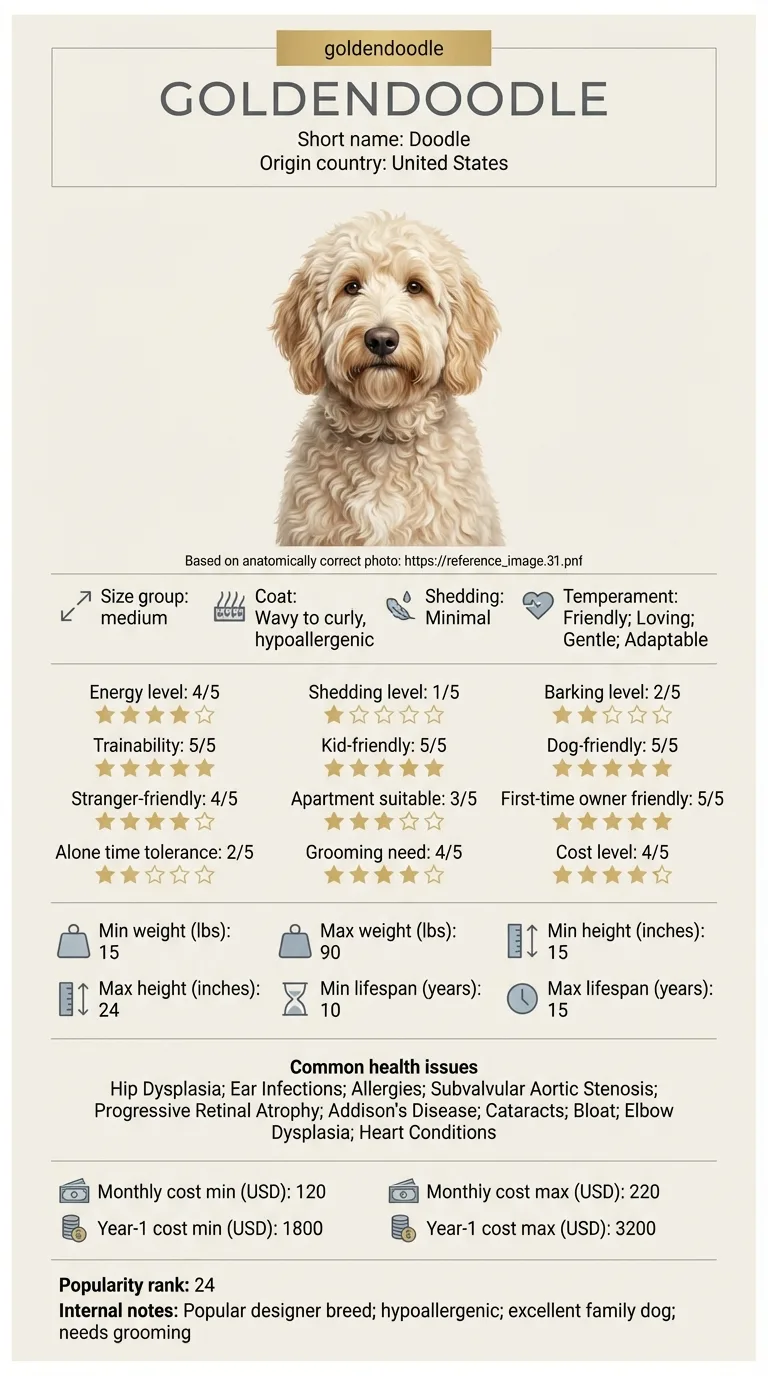
Any Goldendoodle owner can face this, but it's especially relevant for owners of larger, deeper-bodied individuals within this breed's size range, and anyone whose dog eats quickly or is active soon after a large meal.
This guide is not medical advice. If your dog shows pain, sudden behavior change, or worsening symptoms, consult a licensed veterinarian.
Some links may be affiliate links. We may earn a commission at no extra cost to you. We only suggest products we believe are helpful for dog owners.
We research and check what we publish, but we do not warrant that any figure, date, price, or statement is accurate, complete, or current, and we accept no liability for any loss, cost, injury, or other harm arising from the use of this site. Use it as one reference among several. You remain responsible for your own decisions and for your dog's care - confirm anything that matters with a licensed veterinarian or another qualified professional before you act on it. Full disclaimer.
Check this first
GDV often starts subtly: a dog paces, seems uncomfortable, tries repeatedly to vomit but brings up nothing, and its abdomen looks swollen or feels tight. This early stage can look like ordinary discomfort, but it can progress to visible distress, pale gums, rapid breathing, and collapse within one to two hours if the stomach has twisted.
This is always a same-minute emergency — call the vet while you're already heading to the car, not after watching for a while. There is no safe waiting period with suspected bloat.
At the emergency vet, the first step is usually an X-ray to confirm whether the stomach is simply distended with gas or has rotated (volvulus). If it's rotated, the dog needs emergency surgery. Vets may first decompress the stomach — passing a tube, or in some cases inserting a needle through the skin — to relieve pressure and stabilize the dog for anesthesia, then proceed to surgery to untwist the stomach and tack it in place to reduce future risk.
Time-to-surgery is the single biggest factor in survival. A dog that reaches surgery within the first couple of hours of the stomach twisting has a meaningfully better outlook than one where treatment is delayed, because prolonged twisting cuts off blood supply to stomach tissue and can affect the spleen as well.
If any of these apply, call your vet or an emergency clinic now. The rest of this page is for the cases that are not an emergency.
GDV, or bloat, is a medical emergency in which the stomach fills with gas and can rotate on itself, cutting off blood flow. This page focuses purely on recognizing it as it happens and knowing what to do minute by minute — not the underlying anatomy or the cost of treatment.
GDV is not documented as a defining risk for this breed specifically the way it is for classic deep-chested breeds, but it can occur in any dog and needs to be recognized quickly regardless of breed.
This page is not the place for the anatomical explanation of why bloat happens in this breed — see the dedicated mechanism page for that. What matters here is that any Goldendoodle, regardless of body type, can develop GDV, and the emergency response is identical.
Large or fast meals, heavy activity shortly after eating, and stressful mealtime environments are commonly discussed situational factors that can precede an episode, though bloat can also occur without any of these being obviously present.
Call immediately — not after monitoring — if you see a swollen or tight abdomen, repeated unproductive retching, restlessness or pacing, or any sign of weakness or pale gums. This is always a same-minute emergency, never a wait-and-see situation.
GDV is won or lost on speed. These are the delays that matter most when minutes count.
See all Goldendoodle health problems, which breeds are prone to gastric dilatation volvulus gdvbloat, or the full Goldendoodle breed guide for temperament, exercise needs and ownership costs.
Once GDV is confirmed as a twist, surgery typically happens the same day, on an emergency basis. Recovery from surgery generally involves several days of hospitalization and weeks of restricted activity afterward.
Success is measured in minutes, not months: recognizing the signs immediately, getting to a capable emergency vet without delay, and getting the dog into surgery as fast as possible if the stomach has twisted. That response is what most improves the odds.
Paul Hendricks noticed his Goldendoodle Duke pacing restlessly around 7pm in their Peoria, IL home, trying repeatedly to vomit without bringing anything up. Duke's belly felt tight and swollen. Paul didn't wait to see if it would pass — he called the nearest emergency animal hospital while already walking Duke to the car. By the time they arrived less than 30 minutes later, Duke was breathing rapidly. An X-ray confirmed the stomach had rotated, and he was taken into surgery within the hour. Paul later learned that the swift call, rather than any decision he made at home, was what mattered most.
Key takeaway: Duke's outcome came down to Paul treating the first signs as an emergency immediately rather than waiting to see if they'd pass — a decision made in the first few minutes, not the first few hours.
A dog can go from restless and uncomfortable to critical within one to two hours if the stomach has twisted. This is why suspected bloat always means calling the vet immediately, not monitoring at home.
Pacing, an anxious or restless demeanor, a visibly swollen or tight abdomen, and repeated unproductive retching — trying to vomit but bringing nothing up — are the earliest signs most owners notice.
The vet will typically take an X-ray right away to determine whether the stomach is simply distended with gas or has rotated. That result decides whether the dog needs immediate surgery.
If the stomach has actually twisted, surgery is generally necessary to correct it and restore blood flow to affected tissue. Without it, the outcome is very poor.
No — there's no safe home treatment for suspected GDV. The only appropriate action is getting to an emergency vet immediately, ideally calling ahead so they can prepare.
Yes. A clinic equipped for immediate X-ray and emergency abdominal surgery is worth choosing over a slightly closer clinic that would need to refer you elsewhere and lose time.
A twisted stomach cuts off its own blood supply and can affect the spleen. The longer that goes on, the more tissue damage occurs, which is why survival odds drop with every hour of delay.
Call an emergency vet immediately and head there — do not wait to see if symptoms pass.
As little as one to two hours once the stomach has actually twisted, which is why speed matters more than anything else.
An abdominal X-ray is the standard first step to tell gas distension apart from an actual twist.
No — this doesn't relieve a twisted stomach and only wastes time you need for getting to the vet.
Fast eating and activity soon after a large meal are commonly discussed risk factors, so slower feeding and rest after meals are reasonable precautions.
A one-page prep sheet for this condition: the signs, the questions to ask, what to get priced. Unlocks here.
You get: Vet visit prep sheet
No spam. One-click unsubscribe. See our privacy policy.
Preview page 1 before you decide.