Health
What is grade two patellar luxation?
The kneecap slips out during normal movement and stays out until the leg straightens, producing the classic intermittent skip.

Quick answer
What is grade two patellar luxation?
The kneecap slips out during normal movement and stays out until the leg straightens, producing the classic intermittent skip.
A grade two dog can limp constantly and a grade three dog can barely limp at all. The number describes the joint, not the dog's experience of it, and both matter for the decision ahead.
Owners weighing a surgical recommendation, and those trying to reconcile a grade they were given with how their dog actually seems. Also puppy buyers trying to interpret a breeder's patella certificates.
This guide is not medical advice. If your dog shows pain, sudden behavior change, or worsening symptoms, consult a licensed veterinarian.
Some links may be affiliate links. We may earn a commission at no extra cost to you. We only suggest products we believe are helpful for dog owners.
We research and check what we publish, but we do not warrant that any figure, date, price, or statement is accurate, complete, or current, and we accept no liability for any loss, cost, injury, or other harm arising from the use of this site. Use it as one reference among several. You remain responsible for your own decisions and for your dog's care - confirm anything that matters with a licensed veterinarian or another qualified professional before you act on it. Full disclaimer.
Patellar luxation is a documented Bichon Frise condition in which the kneecap fails to stay in its groove. This page addresses the clinical framework: what the grades describe, what surgery corrects, and how the decision between operating and managing is actually made. The grade is one input into that decision, and it is neither the only one nor the most important.
Patellar luxation is among the most frequently diagnosed orthopaedic problems in small breeds and is specifically listed among the Bichon Frise's common health issues. The distribution is skewed heavily toward the lower grades, and a substantial proportion of affected dogs are identified incidentally during routine examination rather than because of lameness.
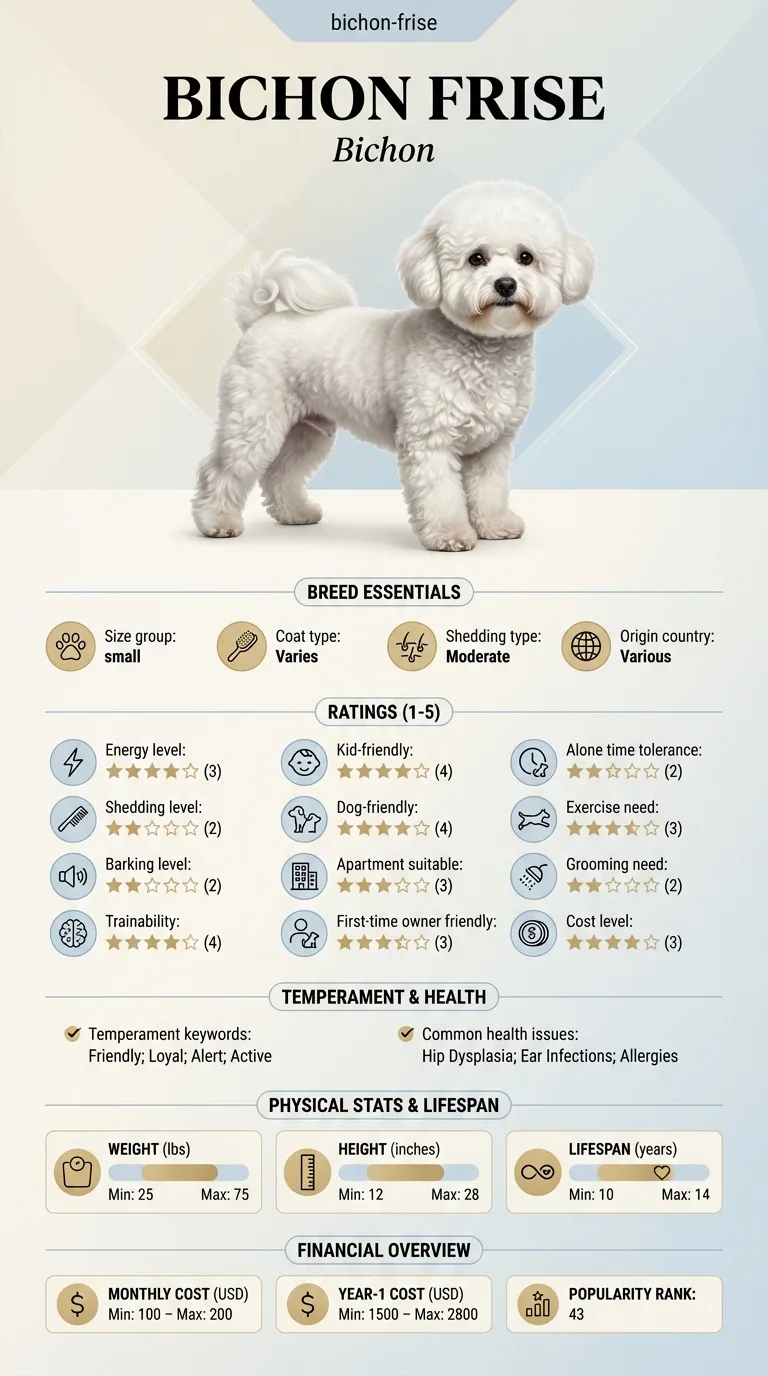
The underlying fault is skeletal geometry rather than injury. In affected dogs the trochlear groove at the end of the femur is too shallow to retain the kneecap, and the line of pull from the quadriceps sits off-centre because of how the femur and tibia are aligned. Small breeds with short limbs, including the Bichon at nine to twelve inches tall, are structurally over-represented. Because the fault is developmental, it is present long before any dog limps, which is why examination detects it earlier than owners do.
The environment does not create the anatomical fault but governs how fast the joint deteriorates. Every dislocation abrades the ridges that are supposed to retain the kneecap, so anything that increases dislocation frequency accelerates progression: hard slippery flooring, repeated jumping from furniture, high-speed turning games and carried weight. Managing those is why two dogs with the same starting grade can have very different joints five years later.
Seek same-day attention if your Bichon suddenly will not put a hind leg down at all, screams when the leg is handled, or has a leg locked in an abnormal position, since a permanently dislocated kneecap or a torn cruciate ligament needs prompt assessment. Book within a week for lameness that has become constant rather than intermittent, stiffness that persists after rest, visible muscle loss on one side, or any reluctance to use stairs the dog previously managed. After surgery, contact the practice immediately about a wound that is swollen, discharging or opening.
See all Bichon Frise health problems, which breeds are prone to patellar luxation, or the full Bichon Frise breed guide for temperament, exercise needs and ownership costs.
Surgery is a day procedure in most cases. Confinement runs roughly four to six weeks, controlled rehabilitation another two to three months, and full return to normal activity around three to four months post-operatively. Arthritis that existed before surgery persists afterwards, and management for that continues indefinitely.
A kneecap that stays in its groove on examination, a dog walking evenly with balanced muscle on both thighs, and no return of the skip. In dogs managed without surgery, success is a grade that has not changed across several annual examinations.
The grading is a physical examination finding. It is worth knowing what your vet's fingers were actually testing.
Surgical repair is not one operation but a combination chosen to address whichever part of the anatomy is at fault in that particular dog. Understanding the components makes the surgeon's plan far less opaque.
One component deepens the groove at the end of the femur so the kneecap has somewhere to sit. Another moves the bony attachment point on the shin bone, shifting the direction the quadriceps pulls in. A third tightens or releases the soft tissue on either side of the joint to rebalance it. Higher grades usually require more of these together, and grade four sometimes involves correcting rotation of the bones themselves.
The threshold for operating is generally clinical rather than numerical. A grade two dog that is lame frequently, losing muscle, or showing pain between episodes is a stronger candidate than a grade three dog that trots around comfortably. Age matters too, since a young dog with a high grade faces a long life of joint damage if nothing is done.
The honest caveat is that surgery is not a guarantee. Re-luxation happens in a minority of cases, arthritis that has already developed does not go away, and the outcome depends substantially on whether the rehabilitation is actually completed.

If you think your Bichon has patellar luxation, the plan is three steps: write down what you have seen and when it started, book a veterinary appointment rather than waiting for the next flare, and take video of the behaviour or symptom before you go — the thing you are worried about rarely happens in the consulting room. Screening in the parents covers skin allergies, patellar luxation, bladder stones.
What the vet visit should produce is a diagnosis and a written plan, not just reassurance: what is being ruled out, what the monitoring interval is, and which signs mean you come back sooner. Ask what the treatment costs across a year rather than per visit, because that is the number that decides whether you are managing this condition or reacting to it.
Between appointments, keep a short log — dates, what you saw, what changed. It is the single most useful thing an owner brings to a follow-up, and for patellar luxation it is often what separates a clear pattern from a guess.
Otto's grade three luxation was found at four during a check-up for something else entirely. His owner Simone was startled, because Otto had never limped in his life. The surgeon they were referred to examined him, watched him move, measured his thigh muscle on both sides and found it even. His recommendation was to wait: Otto had no pain, no muscle loss and a stable gait, and operating on a comfortable dog risked complications for no clear gain. Otto was re-examined every six months. At seven the grade was unchanged and he was still comfortable. At nine he began to stiffen, lost muscle on the left, and had that knee operated on. The recovery was straightforward.
Key takeaway: A high grade in a comfortable dog is not an automatic operation. What changes the decision is pain, lameness and muscle loss, which is why re-examination on a schedule matters more than the number itself.
Yes. It appears explicitly on the breed's documented health concerns, alongside skin allergies, bladder stones, cataracts and dental disease. It is one of the conditions where breed-specific caution is genuinely warranted rather than borrowed from another breed's profile.
There is no automatic grade threshold. Most surgeons weigh the grade against how lame the dog is, whether it is painful between episodes, how much muscle has been lost, and how old the dog is. Grade one is rarely operated on; grade four almost always warrants at least a specialist opinion.
Yes. Repeated dislocation wears down the ridges of the groove, making it shallower and allowing the kneecap out more easily. That is why a stable grade at annual checks is meaningful information and why a rising grade prompts a different conversation.
Surgeons differ. Doing one at a time means the dog always has a better leg to stand on during recovery, which suits a small dog well. Doing both together means one anaesthetic and one recovery period. Discuss the trade-off rather than assuming either is standard.
Expect several weeks of confinement with controlled lead-only toileting, followed by a graduated return to exercise over two to three months. Rehabilitation exercises are prescribed and genuinely matter; the outcome of this operation is more dependent on aftercare than most owners are told.
Ask any Bichon breeder for documented veterinary patella examinations on both parents, ideally repeated as adults. It is a simple, inexpensive examination and a breeder who does not do it is not screening for this breed's most likely orthopaedic problem.
The kneecap slips out during normal movement and stays out until the leg straightens, producing the classic intermittent skip.
No. Grade reflects joint laxity on examination. Some higher-grade dogs are surprisingly comfortable and some lower-grade dogs are not.
Typically in the low thousands per knee including imaging, anaesthesia and follow-up, with regional variation and referral fees on top.
Yes, for several weeks. Set it up in a busy room so restriction does not also mean separation for a people-oriented breed.
Veterinary patella examination certificates on both parents, ideally repeated in adulthood rather than done once as puppies.
A one-page prep sheet for this condition: the signs, the questions to ask, what to get priced. Unlocks here.
You get: Vet visit prep sheet
No spam. One-click unsubscribe. See our privacy policy.
Preview page 1 before you decide.