Living
Bichon Frise or Maltese for kids?
Bichon Frise, rated high (4/5) with kids versus the Maltese's moderate (3/5).

Quick answer
Bichon Frise or Maltese for kids?
Bichon Frise, rated high (4/5) with kids versus the Maltese's moderate (3/5).
Bichon Frise or Maltese? On paper they differ most on grooming need, and on the scales Bichon Frise is the heavier at 12–18 lbs. Here is how the two compare on everything that shapes an ordinary week.
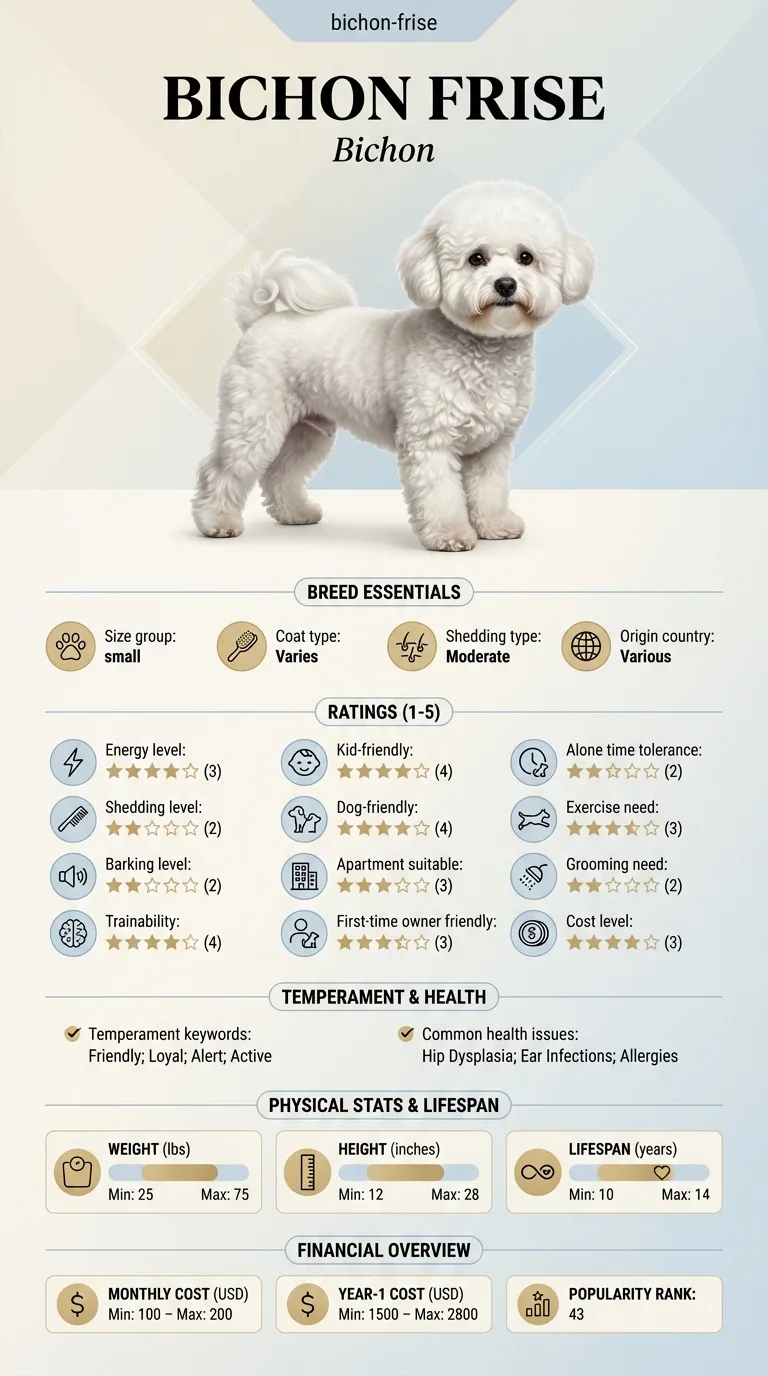
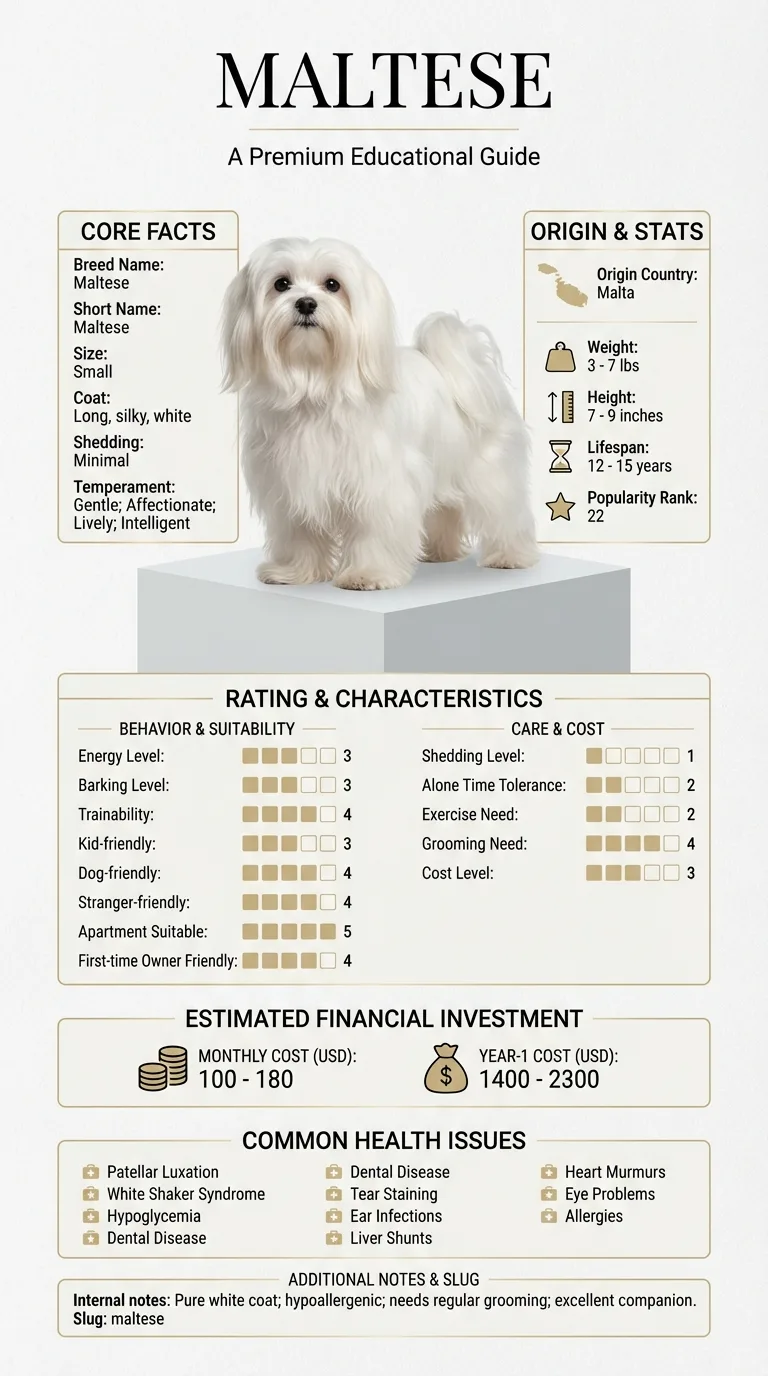
This is for someone already down to Bichon Frise and Maltese and deciding between them. Because the two are so evenly matched, the page works through every axis rather than leading with one. Both rate 5/5 for flats, so housing does not settle this one. There is no origin story here — only what changes about your week.
Between Bichon Frise and Maltese, size is the honest dividing line, and Maltese is the lower-effort dog of the two to keep.
Choose Bichon Frise if there are young children at home.
Choose Maltese if you do not want a standing grooming appointment, you want a dog that picks up training quickly and a smaller dog suits your car, your home or your back.
| Feature | bichon frise | maltese | Winner |
|---|---|---|---|
| Size class | small | small | Equal |
| Weight | 12–18 lbs | 3–7 lbs | Equal |
| Height | 9–12 in | 7–9 in | Equal |
| Lifespan | 14–15 years | 12–15 years | bichon frise |
| Exercise need | Low (2/5) | Low (2/5) | Equal |
| Grooming need | Very high (5/5) | High (4/5) | maltese |
| Shedding | Very low (1/5) | Very low (1/5) | Equal |
| Energy level | Moderate (3/5) | Moderate (3/5) | Equal |
| Barking | Moderate (3/5) | Moderate (3/5) | Equal |
| Apartment suitability | Very high (5/5) | Very high (5/5) | Equal |
| Good for first-time owners | High (4/5) | High (4/5) | Equal |
| Tolerates being alone | Low (2/5) | Low (2/5) | Equal |
| Trainability | Moderate (3/5) | High (4/5) | maltese |
| Good with kids | High (4/5) | Moderate (3/5) | bichon frise |
| Good with other dogs | High (4/5) | High (4/5) | Equal |
| Friendly to strangers | High (4/5) | High (4/5) | Equal |
| Cost level | Moderate (3/5) | Moderate (3/5) | Equal |
| Coat | Curly, dense double coat | Long, silky, white | Equal |
| Origin | Various | Malta | Equal |
| Typical monthly cost | $80–$150 | $100–$180 | Equal |
| Typical first-year cost | $1,100–$2,300 | $1,400–$2,300 | Equal |
The Maltese is the smaller of these two small breeds by a wide margin, just 3-7 lbs against the Bichon Frise's 12-18 lbs, with height also trailing at 7-9 inches versus 9-12 inches. A full-grown Maltese can weigh less than half of even a small Bichon, closer in scale to a large cat than to most dogs. Both are classified in the same small size class, but the practical experience of handling, carrying, and even choosing accessories differs meaningfully between a dog that might weigh 5 lbs and one that might weigh three times that.
Exercise need ties at low (2/5) for both breeds, and energy level ties at moderate (3/5) as well; these are two genuinely similar companion breeds when it comes to daily activity requirements, both satisfied with short walks and indoor play rather than demanding runs. Neither breed will push a sedentary owner toward more activity than they're already doing. Given how closely matched these two are on exercise, anyone choosing between them purely on activity level will find essentially no daylight between the Bichon and the Maltese; the decision will need to rest on other factors.
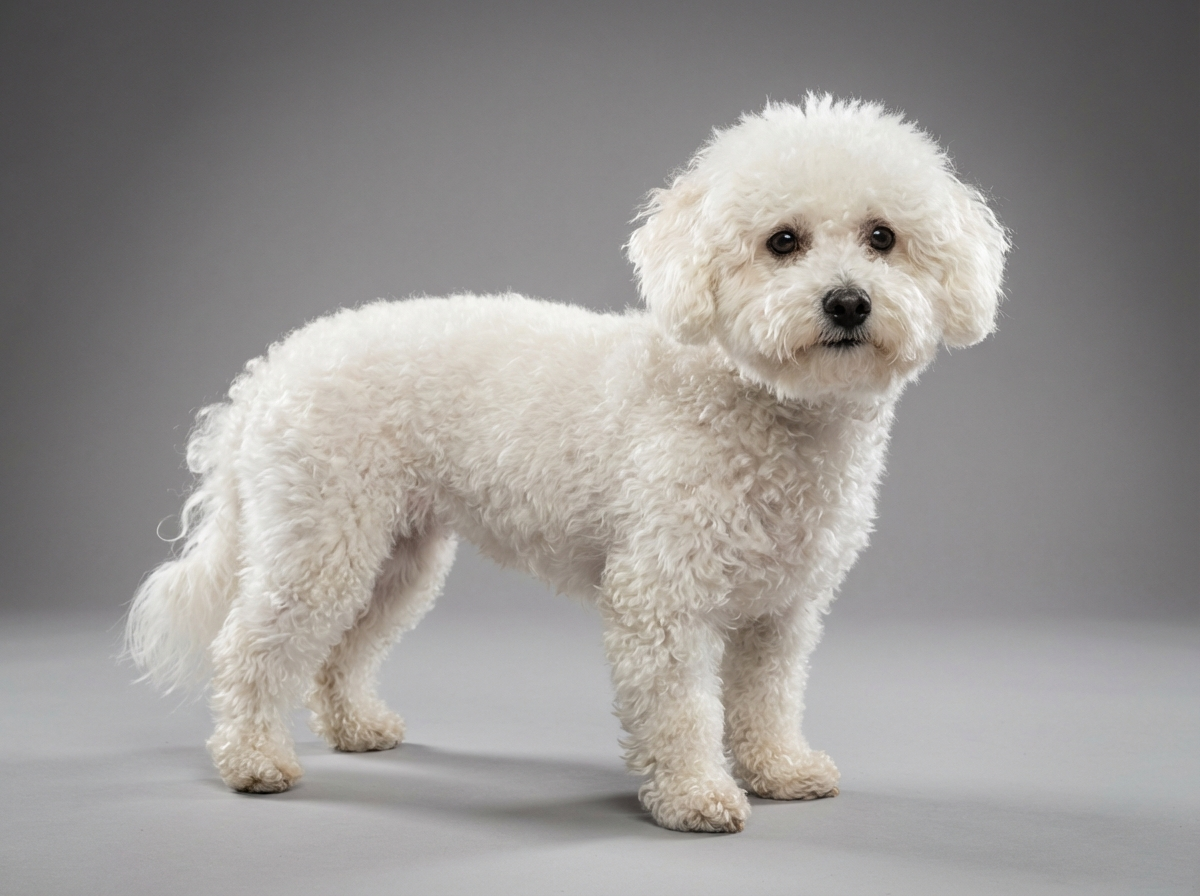
The Bichon Frise demands marginally more grooming, very high (5/5) versus the Maltese's still-substantial high (4/5), both needing frequent brushing to keep their long or curly coats from matting. Shedding actually ties at very low (1/5) for both breeds, making this one of the closer low-shed matchups on this site, a real plus for allergy-conscious households choosing between them. The Maltese's long, silky, white coat and the Bichon's dense curly coat both require real time investment, whether that's daily home brushing or a standing professional grooming appointment every few weeks.
Apartment suitability ties at very high (5/5) for both breeds, and barking also ties at moderate (3/5), two of the more evenly matched categories in this entire comparison. Alone tolerance ties too, both rated low (2/5), meaning neither breed handles long solo stretches particularly well despite their compact size and small space needs. For anyone specifically shopping for a small-space, low-energy companion, these two breeds present an unusually close match across nearly every apartment-relevant category, which shifts the real decision-making weight onto training, health, and household fit instead.
The Maltese edges ahead on trainability, high (4/5) versus the Bichon's moderate (3/5), while both breeds tie at high (4/5) for first-time-owner suitability. Despite its tiny size, the Maltese has a long history as a companion and show breed selectively bred for responsiveness to its owner, which shows up in how readily it takes to structured training. The Bichon remains an easy breed to live with day-to-day even without matching that trainability edge, since its motivation leans more toward affection-seeking than task-completion.
This is where a real gap opens up: the Bichon rates high (4/5) with kids versus the Maltese's moderate (3/5), reflecting the Maltese's smaller, more delicate frame and lower tolerance for the rough handling young children sometimes bring. Both breeds tie at high (4/5) with other dogs and high (4/5) friendliness to strangers. Families with young, boisterous children should weigh the Bichon's sturdier build and higher kid-friendliness rating carefully against the Maltese's more fragile 3-7 lb frame, which is more easily injured by an enthusiastic toddler than the larger Bichon.
The Bichon's 14-15 year lifespan edges out the Maltese's still-long 12-15 years. Health lists differ in character more than length: the Maltese's ten conditions include white shaker syndrome (a tremor disorder distinctive to small white breeds), hypoglycemia, tear staining, and liver shunts, alongside patellar luxation and dental disease. Hypoglycemia is a particular concern given the Maltese's tiny size, since small-bodied dogs can drop blood sugar quickly, especially as puppies. The Bichon's five-condition list is shorter and centers on more manageable issues like skin allergies and bladder stones rather than metabolic emergencies.
Costs run close between these two small breeds: both tie at moderate (3/5) on overall cost level, with monthly spending of $80-150 for the Bichon versus $100-180 for the Maltese, and first-year totals of $1,100-2,300 against $1,400-2,300. The Maltese's slightly higher costs likely reflect its longer, more specialized health-condition list and the veterinary attention some of those conditions, like hypoglycemia monitoring in puppyhood, can require. For budget purposes these two land close enough together that cost alone shouldn't be the deciding factor between them.
Bichon Frise weighs 12–18 lbs and lives 14–15 years; Maltese weighs 3–7 lbs and lives 12–15 years. No rated axis separates them by more than a single point, which makes this one of the closer pairings on the site. They are level on tolerates being alone, apartment suitability and barking, so those cannot decide it. Where the table declares a winner it means less work for the owner, nothing more; descriptive rows are left as ties on purpose. The value here is in the differences between the two columns; treat any single score as approximate.

Substantially; a Maltese typically weighs just 3-7 lbs compared to the Bichon's 12-18 lbs, less than half the size in most cases, though their heights are closer at 7-9 inches versus 9-12 inches.
Less so than a Bichon; it rates moderate (3/5) with kids versus the Bichon's high (4/5), largely because its tiny, delicate 3-7 lb frame is more easily injured by rough handling from young children.
They tie; both the Bichon Frise and the Maltese rate very low (1/5) on shedding, making this one of the closest low-shed matchups on this site.
It's a tremor disorder that appears on the Maltese's health list, more common in small white-coated breeds; it's manageable with veterinary treatment but worth knowing about before bringing a Maltese puppy home.
The Maltese, rated high (4/5) versus the Bichon's moderate (3/5); despite its tiny size, it has a long history as a responsive companion and show breed.
Yes, they're close; first-year costs run $1,100-2,300 for the Bichon and $1,400-2,300 for the Maltese, both tying at moderate (3/5) on overall cost level.
Yes, hypoglycemia appears on its health list, a real concern for such a small-bodied breed, especially in puppyhood, and worth discussing feeding schedules with a vet.
Bichon Frise, rated high (4/5) with kids versus the Maltese's moderate (3/5).
The Maltese, typically 3-7 lbs versus the Bichon's 12-18 lbs.
It's a tie; both rate very low (1/5) on shedding.
The Maltese, rated high (4/5) versus the Bichon's moderate (3/5).
Secure checkout on Stripe. We never see your card.
7-day money-back guarantee. Instant access.
Health information here is general and is not veterinary advice. If your dog shows pain, sudden behaviour change, or worsening symptoms, consult a licensed veterinarian.
Some links on this site are affiliate links. We may earn a commission at no extra cost to you, and we only suggest products we believe are helpful for dog owners.
We research and check what we publish, but we do not warrant that any figure, date, price, or statement is accurate, complete, or current, and we accept no liability for any loss, cost, injury, or other harm arising from the use of this site. Use it as one reference among several. You remain responsible for your own decisions and for your dog's care - confirm anything that matters with a licensed veterinarian or another qualified professional before you act on it. Full disclaimer.
Match your lifestyle to the right dog.
Take quizNot sure which breed is right for you? Take our 2-minute quiz to find out.
Take the quiz