Living
Which is better for apartments?
The Bichon Frise, thanks to its smaller size and Very high (5/5) apartment suitability rating.

Quick answer
Which is better for apartments?
The Bichon Frise, thanks to its smaller size and Very high (5/5) apartment suitability rating.
Bichon Frise or Chow Chow? On paper they differ most on shedding, and on the scales Chow Chow is the heavier at 45–70 lbs. Here is how the two compare on everything that shapes an ordinary week.
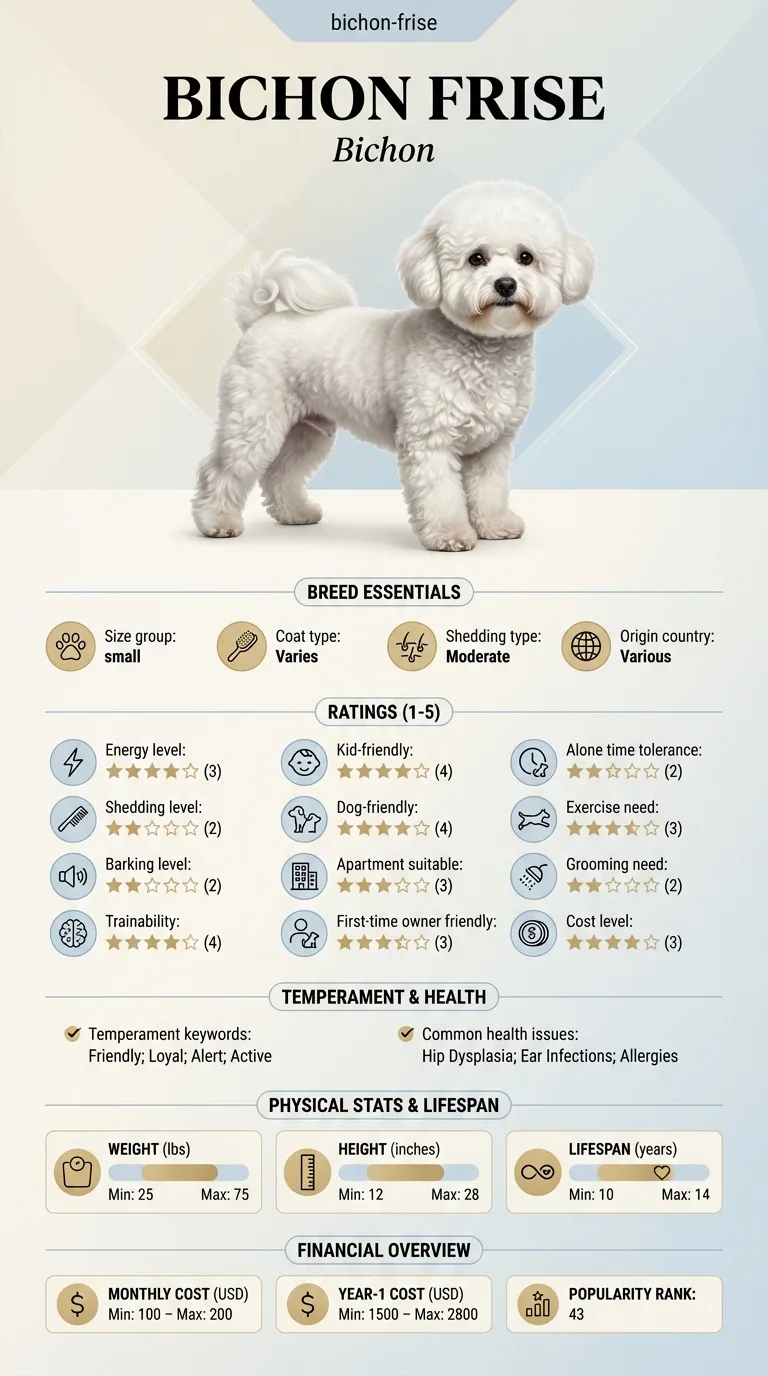
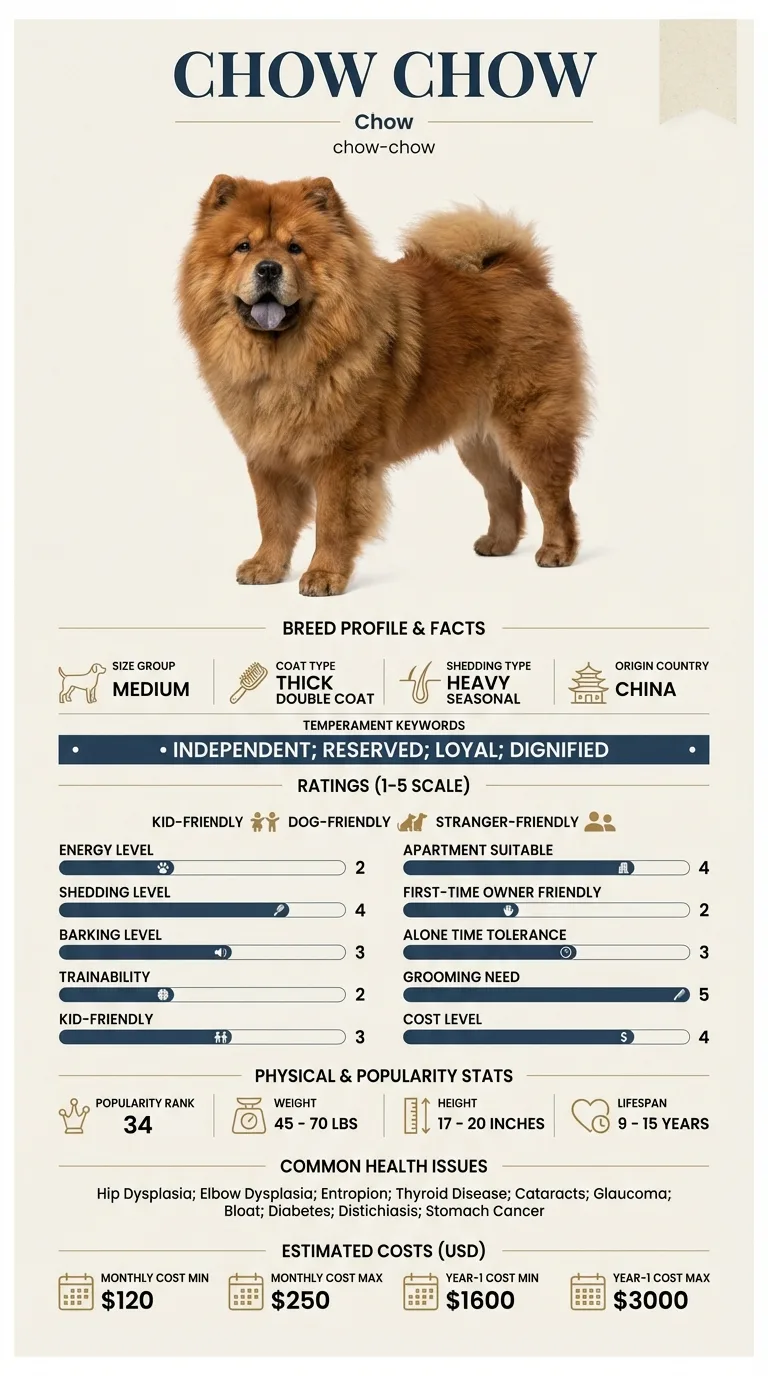
This is for someone already down to Bichon Frise and Chow Chow and deciding between them. For this pair the decision usually turns on shedding and good for first-time owners, so those are covered first and in most detail. Anyone choosing from a flat has a clear answer here: Bichon Frise rates 5/5 against 4/5. There is no origin story here — only what changes about your week.
Between Bichon Frise and Chow Chow, shedding is what separates them, and Bichon Frise is the lower-effort dog of the two to keep.
Choose Bichon Frise if you are in a flat or a smaller home, this is your first dog and shedding is a problem in your house.
Choose Chow Chow if the dog will be alone during the working day and you want a dog that is more watchful with visitors.
| Feature | bichon frise | chow chow | Winner |
|---|---|---|---|
| Size class | small | medium | Equal |
| Weight | 12–18 lbs | 45–70 lbs | Equal |
| Height | 9–12 in | 17–20 in | Equal |
| Lifespan | 14–15 years | 9–15 years | bichon frise |
| Exercise need | Low (2/5) | Low (2/5) | Equal |
| Grooming need | Very high (5/5) | Very high (5/5) | Equal |
| Shedding | Very low (1/5) | High (4/5) | bichon frise |
| Energy level | Moderate (3/5) | Low (2/5) | Equal |
| Barking | Moderate (3/5) | Moderate (3/5) | Equal |
| Apartment suitability | Very high (5/5) | High (4/5) | bichon frise |
| Good for first-time owners | High (4/5) | Low (2/5) | bichon frise |
| Tolerates being alone | Low (2/5) | Moderate (3/5) | chow chow |
| Trainability | Moderate (3/5) | Low (2/5) | bichon frise |
| Good with kids | High (4/5) | Moderate (3/5) | bichon frise |
| Good with other dogs | High (4/5) | Low (2/5) | bichon frise |
| Friendly to strangers | High (4/5) | Low (2/5) | bichon frise |
| Cost level | Moderate (3/5) | High (4/5) | bichon frise |
| Coat | Curly, dense double coat | Thick double coat | Equal |
| Origin | Various | China | Equal |
| Typical monthly cost | $80–$150 | $120–$250 | Equal |
| Typical first-year cost | $1,100–$2,300 | $1,600–$3,000 | Equal |
A Bichon Frise tops out around 12–18 lbs and stands 9–12 inches at the shoulder, while a Chow Chow is built on an entirely different scale at 45–70 lbs and 17–20 inches. That's a gap of roughly three to five times the body weight, and it shows up in everything from how much floor space the dog needs to how a leash pull feels on a walk. The Bichon's compact frame carries its fluffy coat without much bulk underneath, whereas the Chow's stocky, lion-maned silhouette is dense muscle and bone. Anyone choosing between the two is really choosing between a lap-sized companion and a medium dog with real physical presence.
Both breeds land on the low end for exercise need — 2/5 for the Bichon Frise and 2/5 for the Chow Chow — which is unusual, since most comparisons this size-mismatched split sharply on activity level. The Bichon actually scores slightly higher on energy (moderate, 3/5) than the Chow (low, 2/5), so day to day the Bichon is more likely to bounce around the living room between walks while the Chow settles into a calmer, more deliberate pace. Neither breed needs hours of daily running; a couple of short-to-moderate walks plus some yard time satisfies both. The Chow's independent streak also means it may simply opt out of vigorous play on its own terms, regardless of what's offered.
Grooming need is identical on paper — both breeds score a demanding 5/5 for Very high — but the coats behind that number are almost opposites. The Bichon Frise's curly, dense double coat sheds Very low (1/5), which is why it's popular with allergy-conscious households, though that same coat mats without regular brushing and professional trims. The Chow Chow's thick double coat sheds High (4/5), so despite needing similarly intensive brushing to control matting and undercoat buildup, it will leave noticeably more hair around the house, especially during seasonal blowouts. In short: comparable grooming labor, but the Bichon rewards it with a nearly hairless home while the Chow does not.
Apartment suitability favors the Bichon Frise (Very high, 5/5) over the Chow Chow (High, 4/5), and the size difference alone explains most of that gap — a 15-pound dog simply fits smaller spaces more comfortably than a 45–70 lb one. Barking is tied at Moderate (3/5) for both, so neither is a guaranteed quiet neighbor, but the Bichon's low tolerance for being alone (2/5) versus the Chow's moderate tolerance (3/5) flips the practical calculus for anyone gone long hours: the Bichon is more prone to separation-related vocalizing or anxiety, while the reserved, independent Chow is comparatively more content entertaining itself in a quiet apartment during the workday.
First-time owners score High (4/5) suitability with the Bichon Frise but only Low (2/5) with the Chow Chow, and trainability tells the same story — Moderate (3/5) for the Bichon against Low (2/5) for the Chow. The Bichon's cheerful, affectionate, playful temperament makes it eager to work with a handler, while the Chow's independent, dignified, reserved nature means it questions commands rather than following them automatically. This isn't a case of one breed being smarter; it's a case of motivation. A Chow Chow owner needs patience, consistency, and a willingness to earn cooperation rather than assume it, which is exactly why this breed is steered toward experienced handlers.
On paper the Bichon Frise wins every social category here: High (4/5) with kids versus Moderate (3/5) for the Chow, High (4/5) with other dogs versus Low (2/5), and High (4/5) friendliness to strangers versus Low (2/5). Those numbers line up with the temperament lists — Bichon keywords are playful, curious, cheerful, and affectionate, while Chow keywords are independent, reserved, loyal, and dignified. A Chow Chow's loyalty tends to concentrate on its own family rather than extending warmly to visitors or unfamiliar dogs, so households that host frequently, run a dog park routine, or have young children underfoot will generally find the Bichon the easier day-to-day fit.
The Bichon Frise's 14–15 year lifespan comfortably outpaces the Chow Chow's 9–15 year range, and the health lists explain part of why. Bichon concerns — skin allergies, patellar luxation, bladder stones, cataracts, and dental disease — are mostly manageable, non-life-threatening issues. The Chow Chow's list runs longer and heavier: hip and elbow dysplasia, entropion, thyroid disease, cataracts, glaucoma, bloat, diabetes, distichiasis, and stomach cancer. Bloat and stomach cancer in particular are conditions owners need to actively watch for, since both can turn serious quickly. Anyone drawn to the Chow's dignified look should budget for more veterinary vigilance across the dog's life than a Bichon typically requires.
Cost level rates Moderate (3/5) for the Bichon Frise against High (4/5) for the Chow Chow, and the ranges bear that out: $80–$150 monthly and $1,100–$2,300 in year one for the Bichon versus $120–$250 monthly and $1,600–$3,000 for the Chow. Some of that gap is simple math — a 45–70 lb dog eats more than a 15 lb one — but the Chow's longer health list also means a realistic budget should include room for orthopedic or endocrine issues down the line. The Bichon's grooming bills stay comparably high given its coat, so the overall gap isn't as dramatic as the size difference alone would suggest.
Bichon Frise weighs 12–18 lbs and lives 14–15 years; Chow Chow weighs 45–70 lbs and lives 9–15 years. The two diverge most on shedding, good for first-time owners and good with other dogs and 1 other rated axes. They are level on barking, exercise need and grooming need, so those cannot decide it. Where the table declares a winner it means less work for the owner, nothing more; descriptive rows are left as ties on purpose. The value here is in the differences between the two columns; treat any single score as approximate.

Yes — the Chow Chow scores Low (2/5) on trainability against the Bichon's Moderate (3/5), reflecting its independent, dignified temperament versus the Bichon's more eager, affectionate nature. Chow owners generally need more patience and consistency to get reliable obedience.
The Bichon Frise sheds Very low (1/5) thanks to its curly coat, while the Chow Chow sheds High (4/5) despite needing the same Very high (5/5) grooming commitment. Expect noticeably more loose hair around the house with a Chow.
Neither is ideal, but the Chow Chow tolerates being alone Moderately (3/5) better than the Bichon Frise, which scores Low (2/5) and is more prone to separation anxiety. Crate training and enrichment help both.
Only moderately with kids (3/5) and poorly with other dogs (2/5), compared with the Bichon Frise's High (4/5) ratings in both categories. A Chow's reserved, independent temperament means less patience for boisterous play than a Bichon typically shows.
The Bichon Frise's 14–15 year lifespan tends to run longer than the Chow Chow's 9–15 year range, partly reflecting the Chow's longer list of serious health risks like bloat and stomach cancer.
Yes — Chow Chows rate High (4/5) on cost level with a $120–$250 monthly range, compared with the Bichon's Moderate (3/5) and $80–$150 monthly range, driven by larger size and a longer list of health conditions to monitor.
Both score Very high (5/5) for grooming need, but the results differ — the Bichon's coat needs regular trims and produces almost no loose hair, while the Chow's thick double coat sheds heavily despite similar brushing demands.
The Bichon Frise, thanks to its smaller size and Very high (5/5) apartment suitability rating.
Neither — both rate Moderate (3/5) on barking.
The Bichon Frise rates High (4/5) versus the Chow Chow's Low (2/5).
The Bichon Frise, rated High (4/5) for first-time owners versus the Chow Chow's Low (2/5).
Secure checkout on Stripe. We never see your card.
7-day money-back guarantee. Instant access.
Health information here is general and is not veterinary advice. If your dog shows pain, sudden behaviour change, or worsening symptoms, consult a licensed veterinarian.
Some links on this site are affiliate links. We may earn a commission at no extra cost to you, and we only suggest products we believe are helpful for dog owners.
We research and check what we publish, but we do not warrant that any figure, date, price, or statement is accurate, complete, or current, and we accept no liability for any loss, cost, injury, or other harm arising from the use of this site. Use it as one reference among several. You remain responsible for your own decisions and for your dog's care - confirm anything that matters with a licensed veterinarian or another qualified professional before you act on it. Full disclaimer.
Match your lifestyle to the right dog.
Take quizNot sure which breed is right for you? Take our 2-minute quiz to find out.
Take the quiz