Living
Bichon Frise or Border Collie for apartment living?
Bichon Frise, by a wide margin (5/5 vs 1/5 apartment suitability).

Quick answer
Bichon Frise or Border Collie for apartment living?
Bichon Frise, by a wide margin (5/5 vs 1/5 apartment suitability).
Bichon Frise or Border Collie? On paper they differ most on apartment suitability, and on the scales Border Collie is the heavier at 30–55 lbs. Here is how the two compare on everything that shapes an ordinary week.
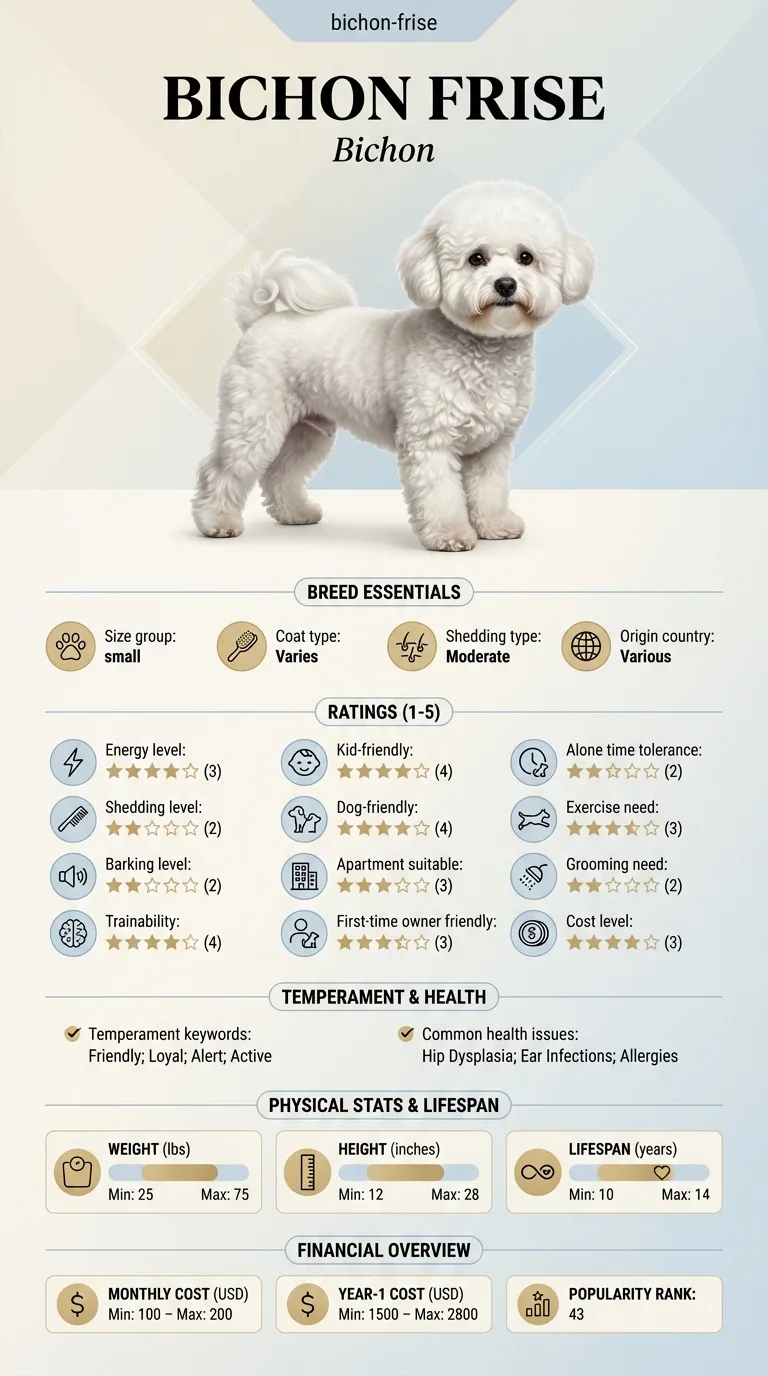
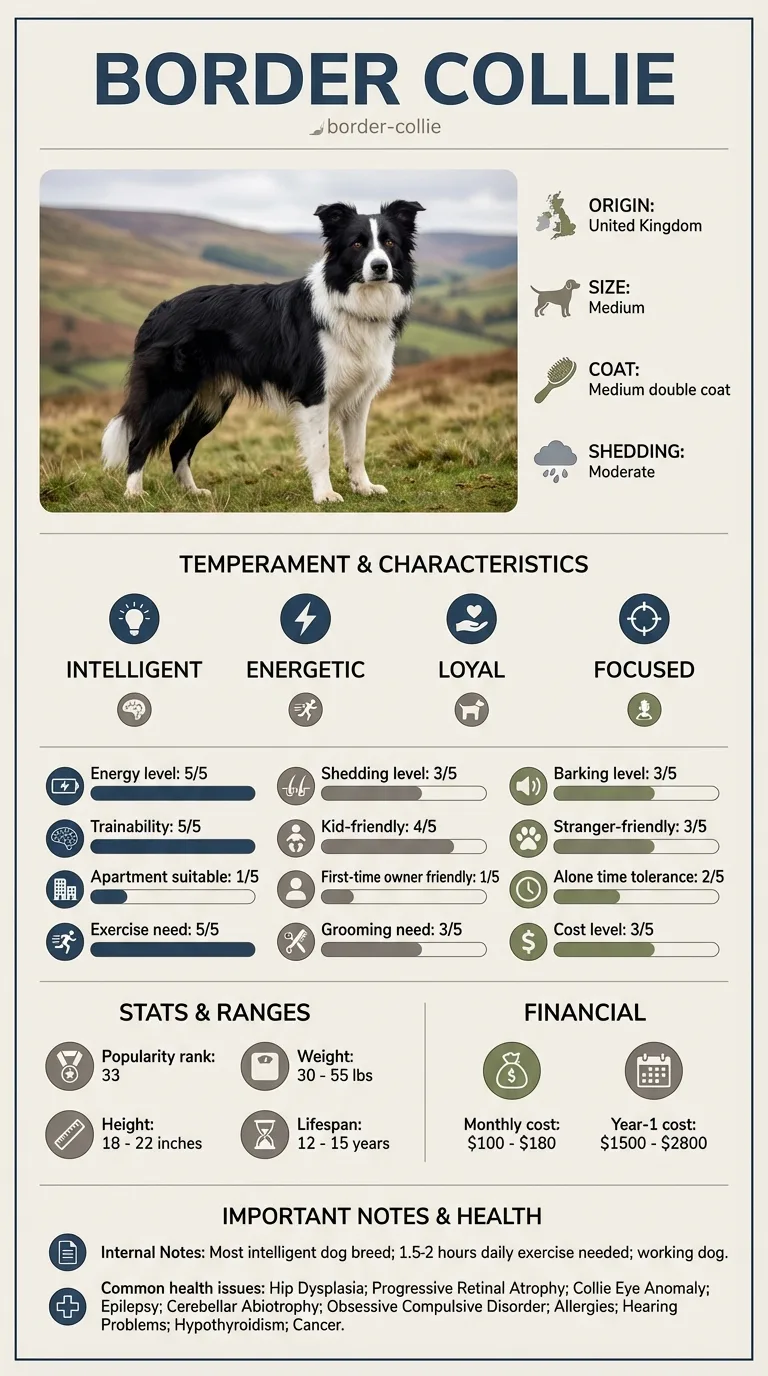
This is for someone already down to Bichon Frise and Border Collie and deciding between them. For this pair the decision usually turns on apartment suitability and exercise need, so those are covered first and in most detail. Anyone choosing from a flat has a clear answer here: Bichon Frise rates 5/5 against 1/5. There is no origin story here — only what changes about your week.
Between Bichon Frise and Border Collie, apartment suitability is what separates them, and Bichon Frise is the lower-effort dog of the two to keep.
Choose Bichon Frise if you are in a flat or a smaller home, this is your first dog and shedding is a problem in your house.
Choose Border Collie if you do not want a standing grooming appointment, you want a dog that picks up training quickly and you want a dog that can keep up with an active routine.
| Feature | bichon frise | border collie | Winner |
|---|---|---|---|
| Size class | small | medium | Equal |
| Weight | 12–18 lbs | 30–55 lbs | Equal |
| Height | 9–12 in | 18–22 in | Equal |
| Lifespan | 14–15 years | 12–15 years | bichon frise |
| Exercise need | Low (2/5) | Very high (5/5) | bichon frise |
| Grooming need | Very high (5/5) | Moderate (3/5) | border collie |
| Shedding | Very low (1/5) | Moderate (3/5) | bichon frise |
| Energy level | Moderate (3/5) | Very high (5/5) | Equal |
| Barking | Moderate (3/5) | Moderate (3/5) | Equal |
| Apartment suitability | Very high (5/5) | Very low (1/5) | bichon frise |
| Good for first-time owners | High (4/5) | Very low (1/5) | bichon frise |
| Tolerates being alone | Low (2/5) | Low (2/5) | Equal |
| Trainability | Moderate (3/5) | Very high (5/5) | border collie |
| Good with kids | High (4/5) | High (4/5) | Equal |
| Good with other dogs | High (4/5) | High (4/5) | Equal |
| Friendly to strangers | High (4/5) | Moderate (3/5) | bichon frise |
| Cost level | Moderate (3/5) | Moderate (3/5) | Equal |
| Coat | Curly, dense double coat | Medium double coat | Equal |
| Origin | Various | United Kingdom | Equal |
| Typical monthly cost | $80–$150 | $100–$180 | Equal |
| Typical first-year cost | $1,100–$2,300 | $1,500–$2,800 | Equal |
The scale difference here is stark: a Bichon Frise tops out around 12-18 lbs and 9-12 inches at the shoulder, while a Border Collie runs 30-55 lbs and stands 18-22 inches, roughly double the height and up to three times the weight. Both are officially tied on size class in our data because 'small' versus 'medium' undersells how differently they move through a house; the Border Collie's rangy, working-dog frame needs room to accelerate and turn, while the compact, cobby Bichon can complete its whole exercise routine in a hallway. Anyone choosing based on physical space alone should weigh the Border Collie's need for open ground heavily.
Exercise need splits sharply: Bichon Frise sits at Low (2/5) against the Border Collie's Very high (5/5), even though energy level itself is scored as a tie at Moderate versus Very high. In practice that means a Border Collie bred to gather and drive livestock wants real work, fetch, agility, herding games, not just a walk, whereas a Bichon's daily needs are met with modest play sessions. A bored Border Collie tends to invent its own jobs, which can mean chewing, digging, or obsessive fence-running; a bored Bichon is more likely to just nap.
Grooming flips the advantage the other way: the Bichon Frise's curly, dense double coat rates Very high (5/5) for grooming need and demands regular professional trims to avoid matting, while the Border Collie's medium double coat sits at Moderate (3/5) and is largely brushed rather than clipped. Shedding tells a similar story, the Bichon is Very low (1/5), close to non-shedding, while the Border Collie sheds Moderate (3/5) with seasonal blowouts. Owners chasing a low-vacuuming home lean Bichon; owners who would rather skip the grooming-salon bill lean Border Collie despite the fur on the couch.
Apartment suitability is one of the widest gaps in this comparison: Bichon Frise scores Very high (5/5) against the Border Collie's Very low (1/5). Barking is tied at Moderate (3/5) for both, so noise complaints are not the deciding factor, space and stimulation are. A Border Collie confined to a small unit without acreage or serious daily outlets is a recipe for anxious, destructive behavior; this is a breed built to cover miles of pasture. Both breeds tolerate being alone poorly, rated Low (2/5) each, so neither is a good fit for owners gone all day regardless of square footage.
Trainability favors the Border Collie decisively, Very high (5/5) versus the Bichon's Moderate (3/5), Border Collies are widely considered among the most trainable dogs alive, and the data backs that with a first-time-owner suitability that runs the opposite direction: High (4/5) for the Bichon against Very low (1/5) for the Border Collie. That combination is the crux of this comparison: the Border Collie learns fast but needs an owner who can channel its Intelligent, Energetic, Focused nature into structured work, while the Cheerful, Affectionate Bichon is more forgiving of a first dog owner's mistakes.
Both breeds are rated High (4/5) for getting along with kids and other dogs, but the details differ. The Bichon's Playful, Curious temperament makes it an easygoing household companion content to shadow whoever is nearby, while the Loyal, Focused Border Collie often channels its herding instinct toward children and pets alike, nipping at heels or circling, unless that drive gets redirected early. Strangers see the bigger split: Bichon Frise rates High (4/5) friendliness to strangers against the Border Collie's Moderate (3/5), reflecting the Border Collie's more reserved, watchful streak around unfamiliar people.
The Bichon Frise's 14-15 year lifespan outpaces the Border Collie's 12-15 years, and the health profiles diverge in scale as much as substance. The Bichon's list stays short, Skin Allergies, Patellar Luxation, Bladder Stones, Cataracts, Dental Disease, while the Border Collie's runs to ten conditions including Hip Dysplasia, Progressive Retinal Atrophy, Collie Eye Anomaly, Epilepsy, Cerebellar Abiotrophy, and Obsessive Compulsive Disorder, plus Cancer. Prospective Border Collie owners should budget for eye and neurological screening given breed-specific conditions like Collie Eye Anomaly and Cerebellar Abiotrophy that do not appear on the Bichon's list at all.
Monthly costs sit close together, $80-150 for the Bichon Frise against $100-180 for the Border Collie, and first-year costs follow the same modest gap, $1,100-2,300 versus $1,500-2,800. Both land at Moderate (3/5) on overall cost level, so raw dollars will not decide this one. The real cost difference is grooming labor and time: a Bichon's coat means recurring salon visits baked into that monthly figure, while a Border Collie's higher exercise and mental-stimulation needs translate into spending on training classes, agility equipment, or dog-walking services rather than clipper time.
Bichon Frise weighs 12–18 lbs and lives 14–15 years; Border Collie weighs 30–55 lbs and lives 12–15 years. The two diverge most on apartment suitability, exercise need and good for first-time owners and 4 other rated axes. They are level on tolerates being alone, barking and cost level, so those cannot decide it. Where the table declares a winner it means less work for the owner, nothing more; descriptive rows are left as ties on purpose. The value here is in the differences between the two columns; treat any single score as approximate.

The Bichon Frise is the clear pick, rating High (4/5) for first-time owners against the Border Collie's Very low (1/5). Border Collies need an owner ready to provide structured daily work for a Very high (5/5) exercise drive, which trips up many new owners.
The Bichon Frise, rated Very low (1/5) for shedding versus the Border Collie's Moderate (3/5). Neither is hypoallergenic, but the Bichon's coat leaves far less hair around the house.
The Bichon Frise can, scoring Very high (5/5) for apartment suitability, but the Border Collie scores Very low (1/5) and genuinely needs space and vigorous daily exercise to stay balanced indoors.
The Bichon Frise, with a typical lifespan of 14-15 years compared to the Border Collie's 12-15 years.
No, Border Collies rate Very high (5/5) on trainability, the highest tier in this comparison, versus Moderate (3/5) for the Bichon. They are easier to teach commands to, just harder to keep satisfied without a job.
Neither does well: both rate Low (2/5) for tolerating being alone, so a full workday alone is a struggle regardless of which breed you pick.
The Border Collie's list is longer and includes more serious hereditary conditions, Progressive Retinal Atrophy, Collie Eye Anomaly, Epilepsy, and Cerebellar Abiotrophy, versus the Bichon's shorter, generally more manageable list.
Bichon Frise, by a wide margin (5/5 vs 1/5 apartment suitability).
The Bichon Frise, rated Low (2/5) versus the Border Collie's Very high (5/5).
The Border Collie, rated Very high (5/5) on trainability.
The Bichon Frise, with a lower typical first-year cost of $1,100-2,300.
Secure checkout on Stripe. We never see your card.
7-day money-back guarantee. Instant access.
Health information here is general and is not veterinary advice. If your dog shows pain, sudden behaviour change, or worsening symptoms, consult a licensed veterinarian.
Some links on this site are affiliate links. We may earn a commission at no extra cost to you, and we only suggest products we believe are helpful for dog owners.
We research and check what we publish, but we do not warrant that any figure, date, price, or statement is accurate, complete, or current, and we accept no liability for any loss, cost, injury, or other harm arising from the use of this site. Use it as one reference among several. You remain responsible for your own decisions and for your dog's care - confirm anything that matters with a licensed veterinarian or another qualified professional before you act on it. Full disclaimer.
Match your lifestyle to the right dog.
Take quizNot sure which breed is right for you? Take our 2-minute quiz to find out.
Take the quiz