Living
Which is smaller?
The Pomeranian, 3–7 lbs versus the Bichon Frise's 12–18 lbs.

Quick answer
Which is smaller?
The Pomeranian, 3–7 lbs versus the Bichon Frise's 12–18 lbs.
Bichon Frise or Pomeranian? On paper they differ most on shedding, and on the scales Bichon Frise is the heavier at 12–18 lbs. Here is how the two compare on everything that shapes an ordinary week.
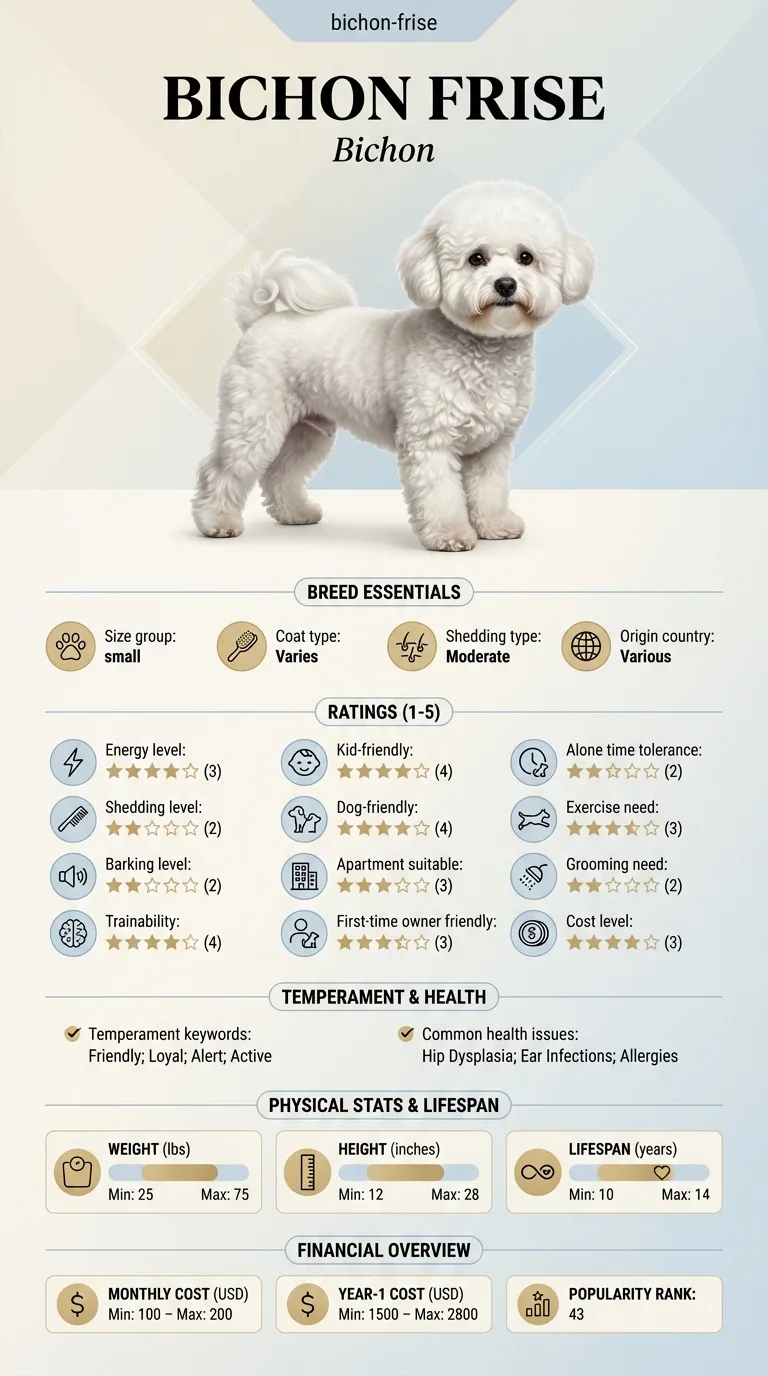
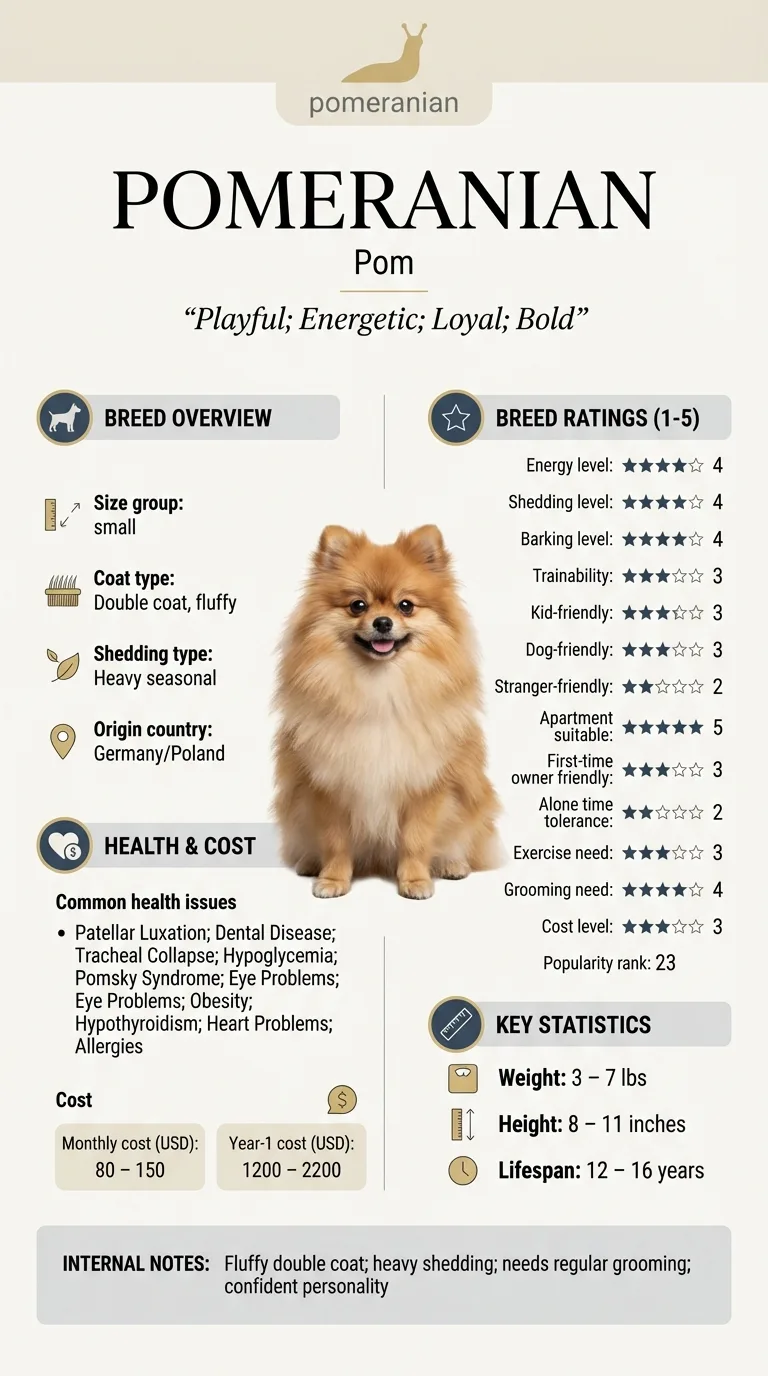
This is for someone already down to Bichon Frise and Pomeranian and deciding between them. For this pair the decision usually turns on shedding and friendly to strangers, so those are covered first and in most detail. Both rate 5/5 for flats, so housing does not settle this one. It is written for the decision rather than the breed history.
Between Bichon Frise and Pomeranian, shedding is what separates them, and Bichon Frise is the lower-effort dog of the two to keep.
Choose Bichon Frise if this is your first dog, shedding is a problem in your house and your walking routine is modest.
Choose Pomeranian if you do not want a standing grooming appointment, a smaller dog suits your car, your home or your back and you want a dog that can keep up with an active routine.
| Feature | bichon frise | pomeranian | Winner |
|---|---|---|---|
| Size class | small | small | Equal |
| Weight | 12–18 lbs | 3–7 lbs | Equal |
| Height | 9–12 in | 8–11 in | Equal |
| Lifespan | 14–15 years | 12–16 years | bichon frise |
| Exercise need | Low (2/5) | Moderate (3/5) | bichon frise |
| Grooming need | Very high (5/5) | High (4/5) | pomeranian |
| Shedding | Very low (1/5) | High (4/5) | bichon frise |
| Energy level | Moderate (3/5) | High (4/5) | Equal |
| Barking | Moderate (3/5) | High (4/5) | bichon frise |
| Apartment suitability | Very high (5/5) | Very high (5/5) | Equal |
| Good for first-time owners | High (4/5) | Moderate (3/5) | bichon frise |
| Tolerates being alone | Low (2/5) | Low (2/5) | Equal |
| Trainability | Moderate (3/5) | Moderate (3/5) | Equal |
| Good with kids | High (4/5) | Moderate (3/5) | bichon frise |
| Good with other dogs | High (4/5) | Moderate (3/5) | bichon frise |
| Friendly to strangers | High (4/5) | Low (2/5) | bichon frise |
| Cost level | Moderate (3/5) | Moderate (3/5) | Equal |
| Coat | Curly, dense double coat | Double coat, fluffy | Equal |
| Origin | Various | Germany/Poland | Equal |
| Typical monthly cost | $80–$150 | $80–$150 | Equal |
| Typical first-year cost | $1,100–$2,300 | $1,200–$2,200 | Equal |
The Pomeranian is dramatically lighter than the Bichon Frise — 3–7 lbs against 12–18 lbs — even though their heights sit close, 8–11 inches versus 9–12. A full-grown Pomeranian can weigh less than a third of a Bichon's lower weight bound, making it one of the true toy breeds on this site while the Bichon sits at the upper edge of small. That weight difference matters practically: a Pomeranian is fragile enough that rough handling by small children or larger dogs is a real injury risk, while the sturdier Bichon tolerates more physical play. Both wear a fluffy double coat that can make their size difference look smaller in photos than it actually is in person.
The Pomeranian outranks the Bichon Frise on both exercise need (Moderate 3/5 vs Low 2/5) and energy level (High 4/5 vs Moderate 3/5), a common trait of toy breeds that pack outsized energy into a tiny frame. Its Playful, Energetic, Bold temperament tags back that up — Pomeranians are known for acting like much bigger dogs, often to their own detriment around larger animals. The Bichon's lower, steadier energy makes it a bit easier to satisfy with shorter play sessions, while a Pomeranian that doesn't get enough stimulation can become a persistent barker, a trait already elevated on its own scorecard.
Grooming need runs close, Very High (5/5) for the Bichon Frise against High (4/5) for the Pomeranian, but shedding is where they diverge sharply: the Bichon sheds Very Low (1/5) thanks to its curly, non-shedding-style coat, while the Pomeranian sheds High (4/5), releasing a surprising amount of undercoat fluff for such a small dog, especially during seasonal blowouts. A Bichon owner deals with matting risk and frequent trims but minimal loose hair; a Pomeranian owner deals with less intensive brushing per session but considerably more fur drifting around the house. Neither breed is a low-maintenance coat, but the maintenance looks different in each case.
Both breeds tie at Very High (5/5) for apartment suitability, so either can work in a compact home. Noise is the clearer differentiator: the Pomeranian rates High (4/5) on barking against the Bichon Frise's Moderate (3/5), and Pomeranians are notorious for sounding off at nearly anything that moves outside a window. Alone-time tolerance ties at Low (2/5) for both, meaning neither breed handles being left solo for long stretches particularly well, and a bored, anxious Pomeranian is especially likely to channel that anxiety into barking given its already-elevated vocal tendencies. Thin-walled apartment buildings should weigh the Pomeranian's noise level carefully before committing.
Trainability ties at Moderate (3/5) for both breeds, so neither has a clear edge in raw obedience learning. The Bichon Frise rates better for first-time owners overall, though, High (4/5) against the Pomeranian's Moderate (3/5) — Pomeranians carry a Bold streak that can tip into stubbornness or small-dog syndrome without consistent early boundaries, whereas the Bichon's Cheerful, Affectionate nature tends to be more immediately forgiving of a beginner's inconsistent handling. A first-time owner set on a Pomeranian should be especially deliberate about socialization and boundary-setting early, since its size makes it easy to under-train by comparison to a larger dog.
The Bichon Frise outranks the Pomeranian across every social category tracked here: kids (High 4/5 vs Moderate 3/5), other dogs (High 4/5 vs Moderate 3/5), and strangers, where the gap widens most sharply — High (4/5) against the Pomeranian's Low (2/5). That last figure is notable: despite its Playful, Loyal temperament tags, the Pomeranian tends to be wary or vocal with unfamiliar people, a trait some owners actually value as watchdog behavior. Families who host frequently or have young, boisterous kids will likely find the sturdier, more universally friendly Bichon the smoother fit, while owners wanting a small dog that's naturally alert to newcomers may prefer the Pomeranian's more guarded disposition.
Lifespan ranges overlap substantially — 14–15 years for the Bichon Frise against 12–16 for the Pomeranian — so a well-cared-for Pomeranian can actually outlive a Bichon at the top end of its range. The Pomeranian's tracked health list is twice as long, though: patellar luxation, dental disease, tracheal collapse, hypoglycemia, pomsky syndrome, eye problems, obesity, hypothyroidism, heart problems, and allergies, several of which (tracheal collapse, hypoglycemia) are especially tied to its tiny size and demand careful attention to harness choice and feeding schedule. The Bichon's shorter list — skin allergies, patellar luxation, bladder stones, cataracts, dental disease — shares patellar luxation and dental disease as common ground between the two toy-adjacent breeds.
Cost levels tie at Moderate (3/5), and the monthly ranges are essentially identical, $80–$150 for both breeds. First-year totals run close too, $1,100–$2,300 for the Bichon Frise against $1,200–$2,200 for the Pomeranian — a negligible difference given the breed size gap. What the raw numbers don't fully capture is the Pomeranian's longer health-issue list, including tracheal collapse and heart problems, which can translate into more frequent vet visits and potential specialist costs over a lifetime even if the baseline budget looks similar on paper. Owners choosing between these two on cost alone should factor in that history of veterinary need rather than the sticker price ranges.
Bichon Frise weighs 12–18 lbs and lives 14–15 years; Pomeranian weighs 3–7 lbs and lives 12–16 years. The two diverge most on shedding and friendly to strangers. They are level on tolerates being alone, apartment suitability and cost level, so those cannot decide it. In the table, a "winner" means easier for an ordinary household — not better. Size, coat and origin are recorded without a verdict. Because both breeds are scored the same way, the gaps are reliable even where the absolute numbers are rough.

Yes, considerably — a Pomeranian weighs 3–7 lbs against the Bichon Frise's 12–18 lbs, though their heights are similar.
The Pomeranian, High (4/5) versus the Bichon Frise's Moderate (3/5).
The Bichon Frise, High (4/5) versus the Pomeranian's Low (2/5).
The Pomeranian, High (4/5) versus the Bichon's Very Low (1/5).
It's rated Moderate (3/5), a step behind the Bichon's High (4/5), partly due to its small, fragile size.
Their ranges overlap — the Bichon Frise runs 14–15 years while the Pomeranian runs 12–16 years.
Yes, ten tracked conditions versus the Bichon's five, including tracheal collapse and heart problems tied to its tiny size.
The Pomeranian, 3–7 lbs versus the Bichon Frise's 12–18 lbs.
The Bichon Frise, Moderate (3/5) versus the Pomeranian's High (4/5).
The Bichon Frise, High (4/5) versus the Pomeranian's Low (2/5).
The Bichon Frise, Very Low (1/5).
Secure checkout on Stripe. We never see your card.
7-day money-back guarantee. Instant access.
Health information here is general and is not veterinary advice. If your dog shows pain, sudden behaviour change, or worsening symptoms, consult a licensed veterinarian.
Some links on this site are affiliate links. We may earn a commission at no extra cost to you, and we only suggest products we believe are helpful for dog owners.
We research and check what we publish, but we do not warrant that any figure, date, price, or statement is accurate, complete, or current, and we accept no liability for any loss, cost, injury, or other harm arising from the use of this site. Use it as one reference among several. You remain responsible for your own decisions and for your dog's care - confirm anything that matters with a licensed veterinarian or another qualified professional before you act on it. Full disclaimer.
Match your lifestyle to the right dog.
Take quizNot sure which breed is right for you? Take our 2-minute quiz to find out.
Take the quiz