Akita or Alaskan Malamute: Two Very Different Big Dogs
Quick answer
Akita vs Alaskan Malamute: which should I choose?
Choose the Akita for a calmer house dog with moderate exercise needs, if you accept a guardian breed rating 1/5 for first-time owners. Choose the Malamute for a sociable family dog, if you can deliver 5/5 exercise and live with year-round heavy shedding.
From across a park these look like variations on the same idea: a big, thick-coated, curl-tailed northern dog. Live with them and they are opposites in the way that matters most. The Malamute greets your visitors like old friends, rating 4/5 with strangers. The Akita rates 2/5 and will decide about each one personally.
This is for someone drawn to the big northern look who has not yet worked out that these two were bred for opposite social jobs. It covers what each weighs, how each behaves with visitors and other dogs, the very different exercise requirements, the shedding that both bring and one brings year-round, and the specific health conditions to raise with a breeder.
Quick verdict
The Malamute is the friendlier and more demanding dog; the Akita is the calmer one in the house and the harder one to own responsibly.
Choose akita if...
Choose the Akita if you want a quiet, dignified, low-drama house dog that needs moderate exercise — 3/5 against the Malamute's 5/5 — and you understand that you are taking on a guardian breed that rates 1/5 for first-time owners and 2/5 with both strangers and other dogs. This is a dog for someone who will socialise deliberately for years, not someone who wants a friendly giant.
Choose alaskan malamute if...
Choose the Alaskan Malamute if you want the sociable one — 5/5 with children, 4/5 with strangers — and you can meet a genuinely high exercise requirement of 5/5 plus year-round heavy shedding at grooming 4/5. It is the more expensive of the two at $150–$300 a month against $110–$240, and the more physically demanding to keep entertained.
Head-to-head comparison
Feature
akita
alaskan malamute
Winner
Weight
70–130 lbs
75–110 lbs
Equal
Height
24–28 in
23–25 in
Equal
Lifespan
10–13 years
10–14 years
alaskan malamute
Coat
Dense double coat
Thick double coat
Equal
Grooming need
Moderate (3/5)
High (4/5)
akita
Shedding
Very high (5/5), seasonal
Very high (5/5), year-round
Equal
Energy level
Moderate (3/5)
High (4/5)
Equal
Exercise need
Moderate (3/5)
Very high (5/5)
akita
Trainability
Moderate (3/5)
Moderate (3/5)
Equal
Barking
Low (2/5)
Moderate (3/5)
akita
Good with kids
Moderate (3/5)
Very high (5/5)
alaskan malamute
Good with other dogs
Low (2/5)
Moderate (3/5)
alaskan malamute
Friendly to strangers
Low (2/5)
High (4/5)
alaskan malamute
Apartment suitability
Low (2/5)
Very low (1/5)
akita
Good for first-time owners
Very low (1/5)
Low (2/5)
alaskan malamute
Tolerates being alone
Moderate (3/5)
Low (2/5)
akita
Typical monthly cost
$110–$240
$150–$300
akita
Typical first-year cost
$1,700–$3,200
$2,000–$4,000
akita
Deep dive
Guardian against team dog
This is the whole comparison and it comes straight from what each breed was for.
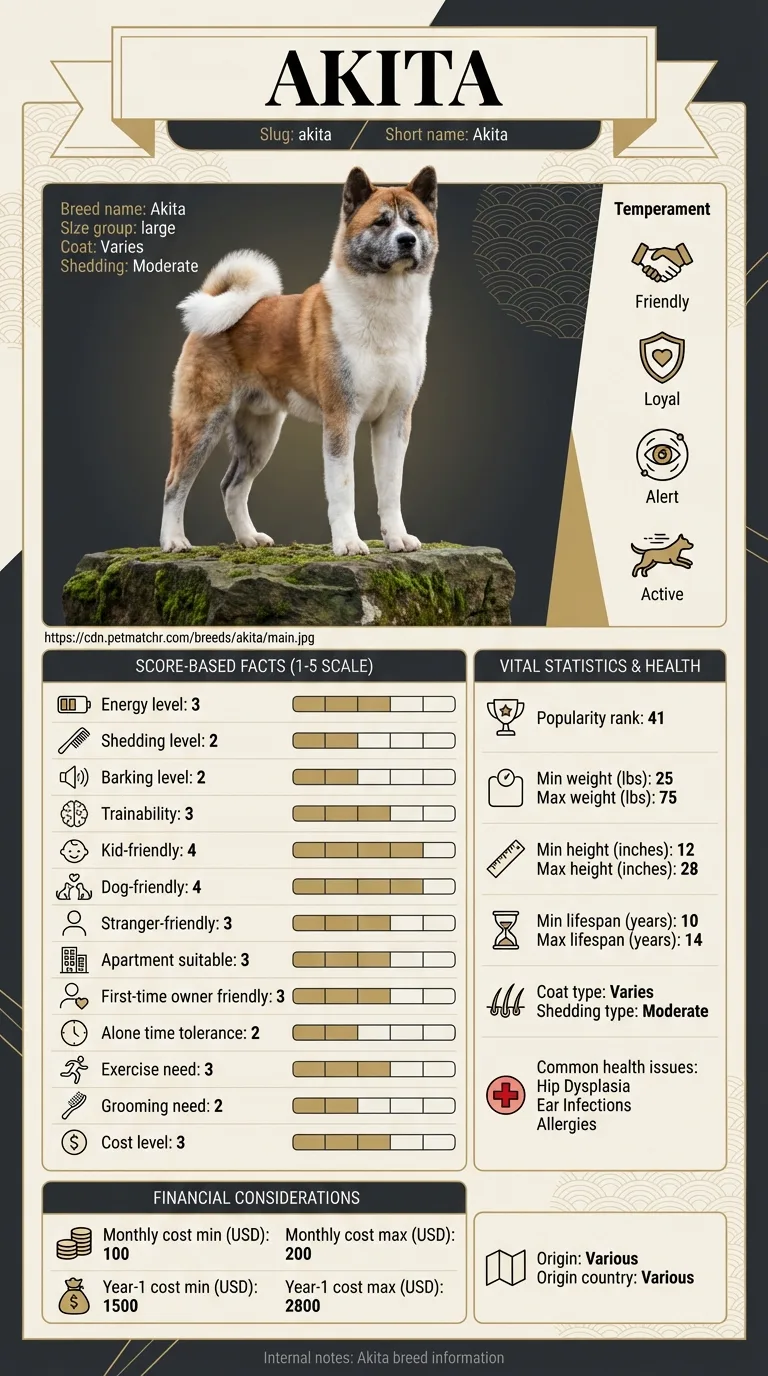
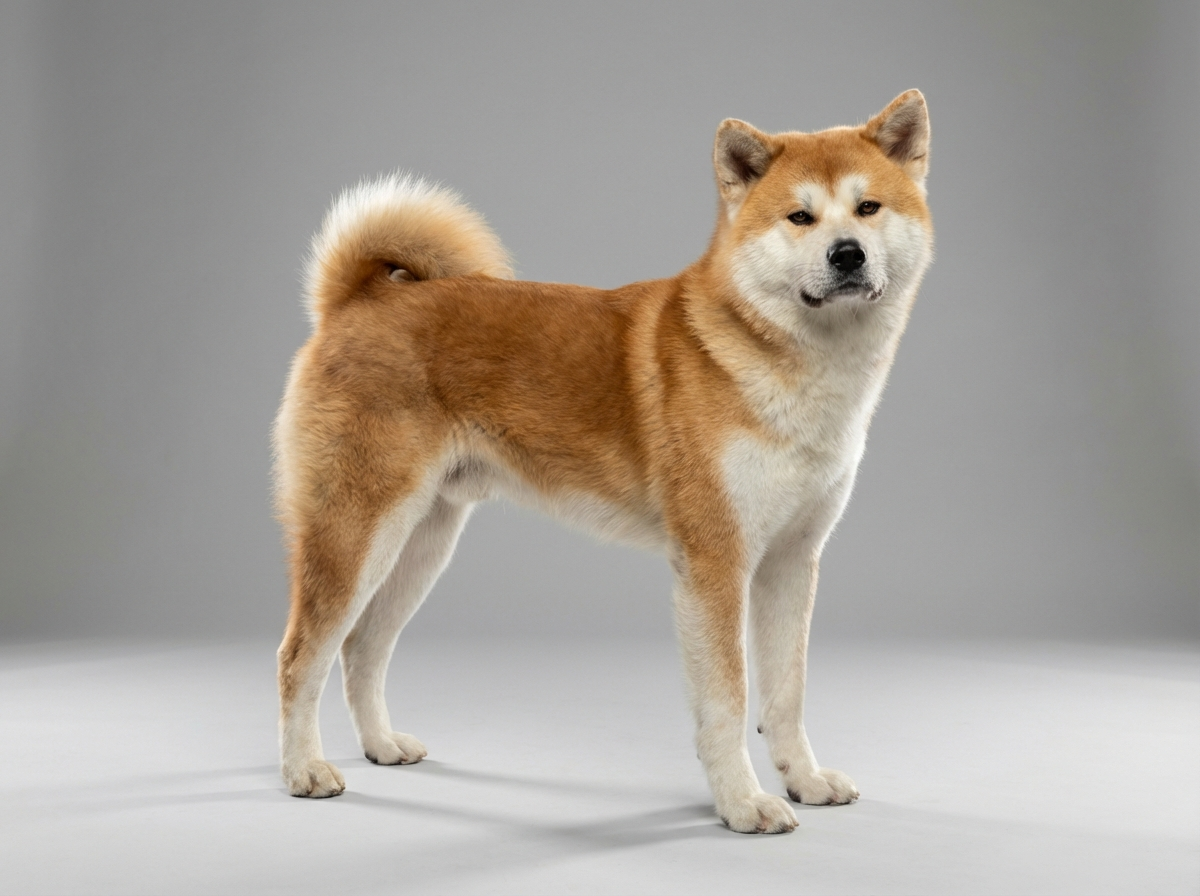
The Akita was developed in northern Japan as a large-game hunter and household guardian. It is described as dignified, loyal and aloof, and every one of those words is doing work. An Akita is not unfriendly so much as uninterested in people outside its household, and it forms opinions rather than greeting reflexively. It rates 2/5 with strangers and 2/5 with other dogs, and same-sex dog intolerance is a well-known trait of the breed rather than a training failure.
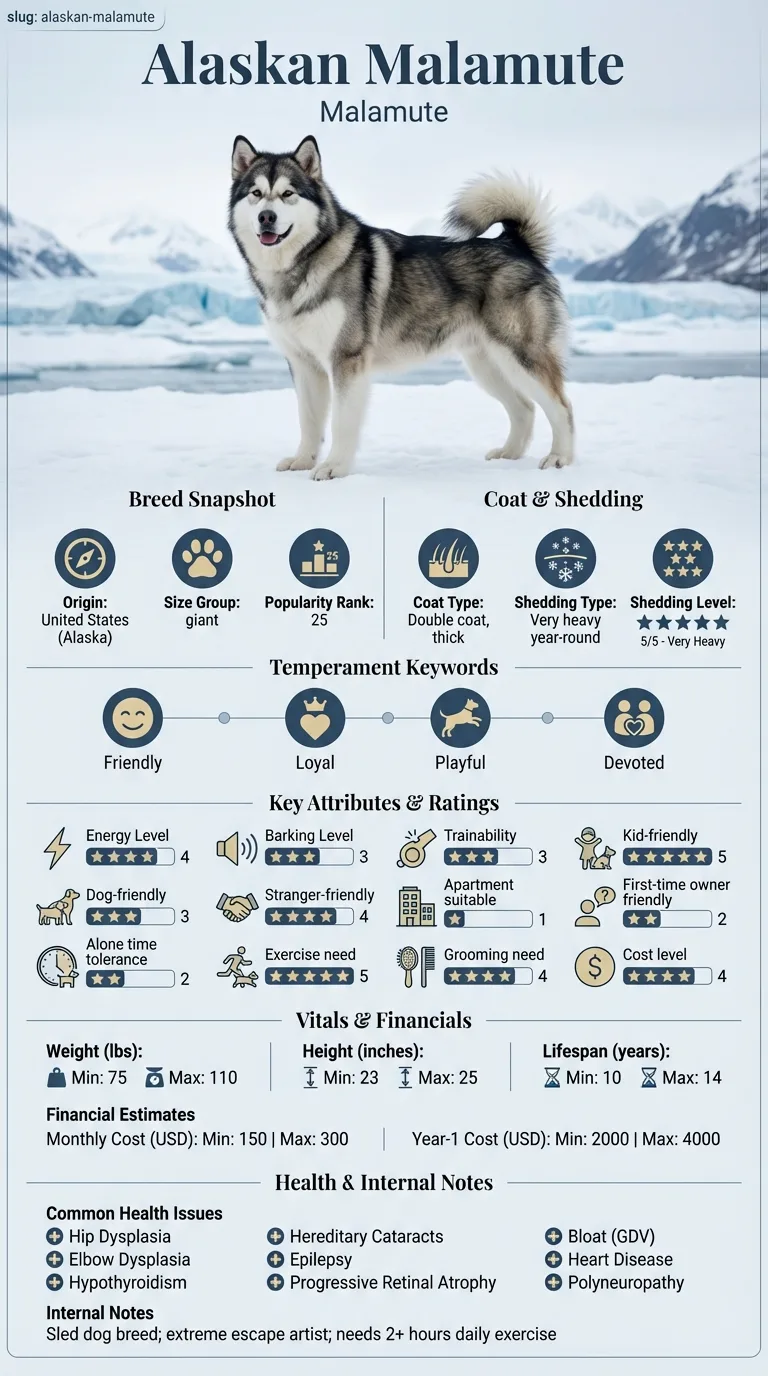
The Malamute worked in a team, in harness, alongside other dogs and around whichever people were in camp. A sled dog that guarded resources or resented handlers was not kept. That history shows in 5/5 with children and 4/5 with strangers. It is not a guard dog at all — it will show a stranger the house.
If your reason for wanting a big northern dog is deterrence, only one of these delivers it, and it delivers it with a management burden attached.
The exercise gap is bigger than the ratings suggest
The Akita rates 3/5 for exercise and the Malamute 5/5, and that two-point gap understates the practical difference.
An Akita is content with a decent daily walk and some mental engagement. It is a dog that lies down heavily in a hallway and stays there. Its energy rating of 3/5 indoors is accurate — this is not a breed that paces.
A Malamute at 5/5 was built to pull heavy loads for hours and it retains the engine. A walk around the block twice a day produces a bored hundred-pound dog with a talent for excavation. Malamutes dig, and they dig with the same commitment they were bred to haul with. Cart-pulling, backpacking, skijoring or long hikes are what actually satisfies the breed.
If your realistic offering is an hour a day of ordinary walking, the Akita will be fine with it and the Malamute will not.
Both shed enormously; one does it all year
Both rate 5/5 for shedding, the top of the scale, and both blow their undercoats twice a year in a way that has to be seen to be believed.
The difference is what happens in between. The Akita's shedding is seasonal — two dramatic moults with comparatively quiet months either side, which is why grooming rates 3/5. The Malamute's thicker coat sheds heavily year-round on top of the seasonal blowouts, and grooming rates 4/5 accordingly. An undercoat rake is not optional for either.
Neither should ever be shaved. The double coat insulates against summer heat as much as winter cold, and clipping it can permanently damage the regrowth. Both also struggle in hot climates, the Malamute slightly more given the thicker coat, and in a hot region both need shade, water and exercise moved to the cool hours.
Both rate 3/5 for trainability, for different reasons
Neither is a biddable breed and both share the same headline number, but they resist in different ways.
The Akita is described as strong-willed and it is genuinely independent — it understands what you want and weighs whether it agrees. Harsh handling of a hundred-pound guardian breed is a bad plan for obvious reasons. What works is early, consistent, positive training and a great deal of deliberate socialisation, started young and continued for years, because the guardian instinct sharpens with maturity rather than fading.
The Malamute is friendly but was bred to make its own decisions on a trail, which produces a dog that will happily ignore a recall in favour of something more interesting. Neither breed should be trusted off-lead in an unfenced space, and both need serious fencing because both dig.
First-time suitability is 1/5 for the Akita and 2/5 for the Malamute. Both numbers are honest, and the Akita's is the lowest on this site alongside the Siberian Husky.
Shared risks, and one condition each
Both carry hip dysplasia, hypothyroidism, progressive retinal atrophy and bloat, and both should come from parents with hip scores and current eye certificates. Bloat in particular is worth knowing the signs of in any deep-chested breed: unproductive retching, a swollen tight abdomen, and distress is an emergency measured in hours.
The Akita carries an unusual burden of autoimmune disease — immune-mediated conditions affecting skin, eyes and blood turn up in the breed more than in most, and Vogt-Koyanagi-Harada-like syndrome, which attacks pigment and can affect vision, is associated with it. Ask a breeder about autoimmune history specifically.
The Malamute carries zinc-responsive dermatosis, where the dog absorbs zinc poorly and develops crusting lesions around the face and feet. It is manageable once diagnosed but is frequently mistaken for an allergy first. Inherited polyneuropathy and chondrodysplasia also appear in the breed, and DNA tests exist for both.
Lifespans are close: 10 to 13 years for the Akita, 10 to 14 for the Malamute.
Cost, housing and being alone
The Malamute is the more expensive of the two at $150–$300 a month against $110–$240, with first-year totals of $2,000–$4,000 against $1,700–$3,200. Some of that is coat maintenance and some is simply that a working-engine dog eats more than a dog that lies in the hall.
On housing, neither belongs in a flat — the Akita rates 2/5 and the Malamute 1/5 — but the Akita is the more plausible of the two in a smaller home, because a quiet dog that barks at 2/5 and needs 3/5 exercise is easier to contain than one that needs to run and howls at 3/5.
On time alone the Akita is the better bet at 3/5 against 2/5. A Malamute left alone and under-exercised will rearrange the garden.
Akita vs Alaskan Malamute: the honest summary
Weight is nearly the same — 70 to 130 pounds against 75 to 110 — and both carry the double coat, the curled tail and the tolerance for cold. Everything else diverges.
The Akita is the calmer dog to live with: exercise 3/5, barking 2/5, and 3/5 for time alone. It is also the harder dog to own well, rating 1/5 for first-time owners, 2/5 with strangers and 2/5 with other dogs. The Malamute is the opposite trade: 5/5 with children, 4/5 with strangers, but 5/5 exercise, 4/5 grooming, 1/5 for apartments, and the higher running cost of the two.
One is a guardian you must manage socially. The other is a friend you must exhaust daily.
Akita or Alaskan Malamute: Two Very Different Big Dogs - Akita vs Alaskan Malamute: the honest summary
Frequently asked questions
Which is friendlier, an Akita or an Alaskan Malamute?
The Malamute, clearly and by design. It rates 5/5 with children and 4/5 with strangers, because sled work selected against dogs that resented people or teammates. The Akita rates 3/5 with children and 2/5 with strangers — it is a guardian breed, aloof rather than aggressive, but it forms opinions about visitors rather than greeting them automatically.
Which needs more exercise?
The Malamute, at 5/5 against the Akita's 3/5, and the gap is larger in practice than the numbers suggest. An Akita is satisfied by a decent daily walk. A Malamute was built to haul heavy loads for hours and needs real work — hiking, carting, skijoring — or it will dig up your garden with the same commitment.
Which sheds more?
Both rate 5/5, the top of the scale, and both blow their undercoats spectacularly twice a year. The difference is between moults: the Akita is largely seasonal, grooming 3/5, while the Malamute's thicker coat sheds heavily year-round, grooming 4/5. Neither should ever be shaved, since the double coat insulates against heat as well as cold.
Is either suitable for a first-time owner?
Neither, and the Akita least of all — it rates 1/5 against the Malamute's 2/5. The Akita is a guardian breed whose protectiveness sharpens with maturity and which rates 2/5 with other dogs, so it needs years of deliberate socialisation. The Malamute is friendlier but needs containment, hard daily exercise and an owner comfortable with an unreliable recall.
Which is better with other dogs?
The Malamute, at 3/5 against the Akita's 2/5, though neither is a reliably dog-social breed. Same-sex intolerance is a recognised trait in the Akita rather than a training failure, and Malamutes can be assertive with other dogs too. If you already own a dog, particularly of the same sex, take this row seriously for both.
Which costs more to keep?
The Malamute, at $150–$300 a month against the Akita's $110–$240, with first-year totals of $2,000–$4,000 against $1,700–$3,200. The gap reflects both the heavier grooming requirement and the greater food intake of a dog with a working engine.
What health conditions should I ask a breeder about?
For both, hip scores, eye certificates and bloat awareness. Specifically for the Akita, ask about autoimmune disease history — the breed carries an unusual burden of immune-mediated conditions. Specifically for the Malamute, ask about zinc-responsive dermatosis, polyneuropathy and chondrodysplasia, the last two of which have DNA tests available.
Choose the Akita for a calmer house dog with moderate exercise needs, if you accept a guardian breed rating 1/5 for first-time owners. Choose the Malamute for a sociable family dog, if you can deliver 5/5 exercise and live with year-round heavy shedding.
Costs
How much does each cost per month?
The Akita runs $110–$240 a month and the Alaskan Malamute $150–$300, with first-year totals of $1,700–$3,200 and $2,000–$4,000.
Behavior
Which is better with children?
The Malamute at 5/5 against the Akita's 3/5. Both are large enough to knock a small child over without meaning to, so supervision is about size for either.
Living
Can either live in an apartment?
Neither is well suited — the Akita rates 2/5 and the Malamute 1/5. The Akita is the more plausible of the two in a smaller home because it is quieter and needs less exercise.
Related DogBreedCompass guides
Akita breed guide – The Akita profile covers the guardian temperament and the socialisation window in more detail.
Alaskan Malamute vs Siberian Husky – The Husky is the third northern breed people weigh here, and it is the lightest and least containable of the three.
Akita vs German Shepherd – Anyone considering the Akita for guarding usually looks at the German Shepherd as the more trainable alternative.
Akita autoimmune diseases – Autoimmune disease is the burden most specific to the Akita and the thing to raise with a breeder first.
Alaskan Malamute bloat – Bloat is the emergency both deep-chested breeds are at risk of, and the signs are worth knowing before you need them.
Health information here is general and is not veterinary advice. If your dog shows pain, sudden behaviour change, or worsening symptoms, consult a licensed veterinarian.
Some links on this site are affiliate links. We may earn a commission at no extra cost to you, and we only suggest products we believe are helpful for dog owners.
We research and check what we publish, but we do not warrant that any figure, date, price, or statement is accurate, complete, or current, and we accept no liability for any loss, cost, injury, or other harm arising from the use of this site. Use it as one reference among several. You remain responsible for your own decisions and for your dog's care - confirm anything that matters with a licensed veterinarian or another qualified professional before you act on it. Full disclaimer.