Living
Akita vs Bulldog: which should I choose?
The Bulldog if you want an exceptionally placid flat dog and can absorb high veterinary costs. The Akita if you have space and experience and want a physically sound dog that asks little of your week.

Quick answer
Akita vs Bulldog: which should I choose?
The Bulldog if you want an exceptionally placid flat dog and can absorb high veterinary costs. The Akita if you have space and experience and want a physically sound dog that asks little of your week.
The Bulldog weighs 40 to 50 pounds and costs $150 to $350 a month. The Akita weighs 70 to 130 pounds and costs $110 to $240. That inversion is the whole story: nowhere else on this site does a medium breed outspend a large one, and the reason is medicine, not food.
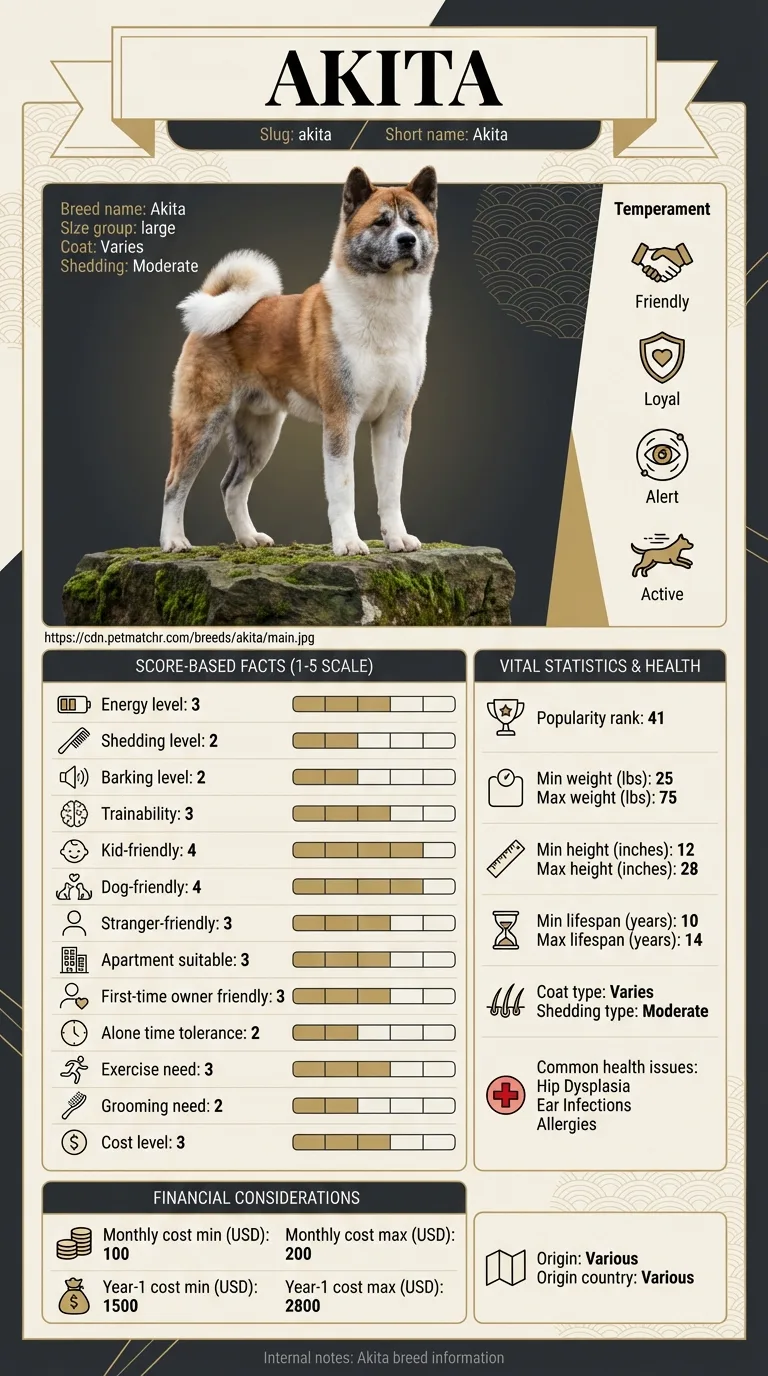
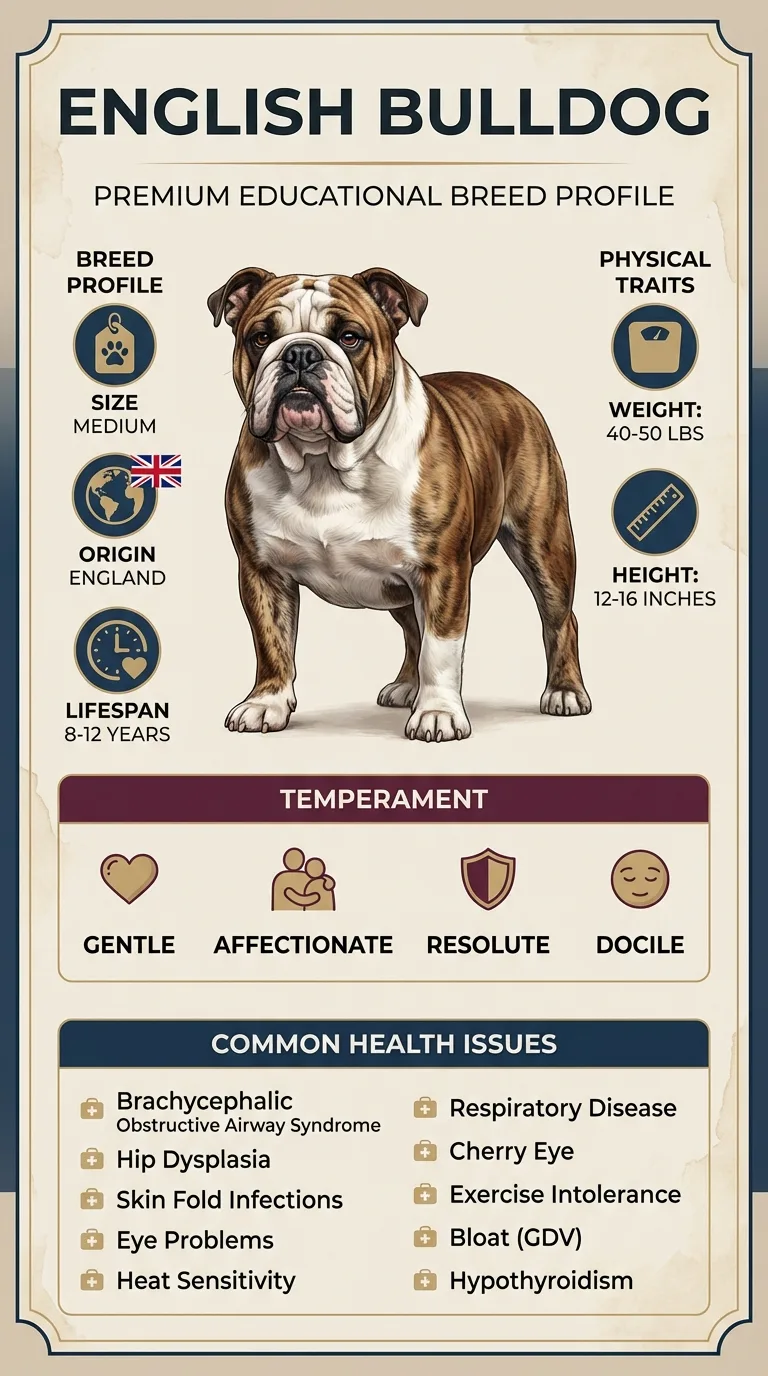
This page is for someone attracted to two very different kinds of presence: an easygoing, comic, deeply affectionate flat dog and a large silent guardian. It covers running costs honestly, breathing and heat limits, exercise, lifespan and what each breed asks of an ordinary week.
The Bulldog is the easier temperament and the harder body; the Akita is the harder temperament and the sounder body, and the budget question points the opposite way to what size suggests.
Choose the Akita if you have space, a fenced garden and experience with a powerful breed, and want a dog that is physically sound. It lives 10 to 13 years against 8 to 12, costs $110–$240 a month against $150–$350, and needs no special heat management. You are accepting 1/5 for first-time owners and 2/5 with other dogs and strangers.
Choose the Bulldog if you want a placid, funny, exceptionally tolerant flat dog and can absorb the veterinary cost. It rates 5/5 for apartments, 5/5 with children, 4/5 with other dogs and strangers, and needs only 2/5 exercise. You are accepting brachycephalic airway disease, skin fold care, real heat danger and the highest medical spend on this site.
| Feature | akita | bulldog | Winner |
|---|---|---|---|
| Weight | 70–130 lbs | 40–50 lbs | Equal |
| Height | 24–28 in | 12–16 in | Equal |
| Lifespan | 10–13 years | 8–12 years | akita |
| Coat | Dense double coat | Short and smooth | Equal |
| Grooming need | Moderate (3/5) | Moderate (3/5) | Equal |
| Shedding | Very high (5/5) | Moderate (3/5) | bulldog |
| Energy level | Moderate (3/5) | Low (2/5) | Equal |
| Exercise need | Moderate (3/5) | Low (2/5) | bulldog |
| Trainability | Moderate (3/5) | Moderate (3/5) | Equal |
| Barking | Low (2/5) | Low (2/5) | Equal |
| Good with kids | Moderate (3/5) | Very high (5/5) | bulldog |
| Good with other dogs | Low (2/5) | High (4/5) | bulldog |
| Friendly to strangers | Low (2/5) | High (4/5) | bulldog |
| Apartment suitability | Low (2/5) | Very high (5/5) | bulldog |
| Good for first-time owners | Very low (1/5) | Moderate (3/5) | bulldog |
| Tolerates being alone | Moderate (3/5) | Moderate (3/5) | Equal |
| Typical monthly cost | $110–$240 | $150–$350 | akita |
| Typical first-year cost | $1,700–$3,200 | $2,500–$5,000 | akita |
$150–$350 a month against $110–$240. $2,500–$5,000 in the first year against $1,700–$3,200. The medium dog is more expensive than the large one at every point in both ranges.
Food is not the explanation — an Akita eats roughly twice what a Bulldog eats. The explanation is that the Bulldog's cost is medical, structural, and recurring rather than occasional.
Skin folds need cleaning and periodically get infected. Ears get infected. Eyes need treatment, and cherry eye often needs surgery. Airway correction — nostrils and soft palate — is common enough to be considered routine in the breed. Many Bulldogs are delivered by caesarean, which shapes what breeders charge before you have even brought one home.
Insurance pricing reflects all of this. Bulldogs are quoted at or near the top of the market, and some policies exclude airway and skin fold conditions as breed-related, which is precisely the cover you would want.
The Akita's veterinary risk is real but episodic: autoimmune disease, thyroid disease, bloat. Expensive when it happens, absent when it does not.
Exercise intolerance appears as its own item on the Bulldog's condition list, and it is worth pausing on how unusual that is. Most breeds' lists are diseases. This one includes a limitation.
The cause is brachycephalic obstructive airway syndrome. A shortened skull with a full complement of soft tissue produces narrowed nostrils, an elongated soft palate, and in many dogs a narrow windpipe. The result is a dog that overheats quickly, tires quickly, and can go from panting to a genuine emergency faster than owners expect.
The practical rules are firm. No exercise in the heat of the day between spring and autumn. A harness, never a collar. Strict weight control, because every extra pound loads an already compromised airway. Air conditioning or fans in summer, and never a car left standing. Most airlines will not carry the breed at all.
The Akita has the opposite constraint and a much milder one: a dense double coat that makes it comfortable in cold that keeps other breeds indoors, and which should never be clipped because it insulates both ways.
The Bulldog rates 5/5 with children, 4/5 with other dogs and 4/5 with strangers. Those are high numbers, and in the Bulldog's case they are not a polite summary — the breed is genuinely placid, slow to take offence, and largely unbothered by household chaos.
It is also stubborn. The 3/5 trainability is accurate in a specific way: a Bulldog is not confused by what you want, it has simply weighed the request against lying down and found in favour of lying down. Short sessions, food, and low expectations about speed all help.
The Akita rates 3/5, 2/5 and 2/5 and is not placid in the slightest. It is calm, which is a different thing. It assesses visitors rather than greeting them, and its intolerance of other dogs — frequently same-sex — commonly appears at social maturity around two years old, in a dog that was fine as a puppy.
Both rate 2/5 for barking, so neither is a nuisance in that respect. The Bulldog is, however, one of the noisiest breeds alive in every other sense: snoring, snorting and wheezing are constant.
The Bulldog's day is short. 2/5 exercise means two gentle walks, timed around temperature, and a great deal of sleeping. It rates 5/5 for apartments and deserves it — a Bulldog in a one-bedroom flat is genuinely content, provided the stairs are manageable, because most Bulldogs should not be jumping down them repeatedly.
The maintenance is daily rather than weekly. Face and tail folds need wiping and drying, because trapped moisture is what turns a fold into an infection. Ears need checking. Teeth need attention, since the jaw shape crowds them.
The Akita's day is longer but simpler: forty-five to sixty minutes of walking at 3/5 exercise, a secure garden, and then a large dog asleep across a doorway. Its maintenance is seasonal — twice a year the dense double coat comes out in clumps at 5/5 shedding and needs an undercoat rake and patience. Between blows there is very little to do.
On tolerating a working day both rate 3/5, which is one of the few genuine ties here.
The Bulldog's list is long and mostly consequential to its build: brachycephalic obstructive airway syndrome, respiratory disease, heat sensitivity, skin fold dermatitis, cherry eye and other eye problems, hip dysplasia, exercise intolerance, hypothyroidism and bloat. Very little of it is bad luck; most of it is anatomy.
That means breeder selection matters more here than in almost any breed. Ask about the parents' breathing under exertion rather than at rest, whether either has had airway surgery, how open the nostrils are, and whether the line whelps naturally. A breeder who treats a wide open nostril as a selling point is telling you something useful.
The Akita's burden is immune and endocrine rather than structural: autoimmune disorders affecting skin, eyes and blood, hypothyroidism, progressive retinal atrophy, hip dysplasia and bloat. Both breeds are deep-chested enough for gastric dilatation-volvulus to be a real risk, and both carry known sensitivities to some anaesthetic protocols — which is a particular concern in a Bulldog, since it may need anaesthesia several times.
Lifespan runs 10 to 13 years against 8 to 12.
The Bulldog weighs 40 to 50 pounds and costs $150 to $350 a month. The Akita weighs up to 130 pounds and costs $110 to $240. That inversion is the whole story: nowhere else on this site does a medium breed outspend a large one, and the reason is medicine rather than food.
The Bulldog is the easier temperament — 5/5 with children, 5/5 for apartments, only 2/5 exercise — and the harder body, carrying brachycephalic airway disease, skin fold care and real heat danger. The Akita is the opposite trade: a sounder, longer-lived body at 10 to 13 years against 8 to 12, paired with a guardian temperament that rates 1/5 for first-time owners and 2/5 with strangers and other dogs.
Choose the Akita for physical soundness and a lower running cost if you have space and experience with a powerful breed. Choose the Bulldog for a placid, exceptionally tolerant flat dog if you can absorb the veterinary bills.

Because the Bulldog's cost is medical and recurring rather than driven by food. It runs $150–$350 a month against the Akita's $110–$240 despite weighing roughly half as much. Skin fold infections, ear and eye treatment, cherry eye surgery and airway correction are all common, and insurance is quoted near the top of the market for the breed.
Very little — 2/5, meaning two gentle walks a day, and they must be timed around temperature. Exercise intolerance is listed as a condition of the breed rather than a preference. Between spring and autumn, walk early and late only. The Akita needs 3/5, around forty-five to sixty minutes, with no particular heat restriction.
The Akita, at 10 to 13 years against the Bulldog's 8 to 12 — unusual, since the Akita is far the heavier breed and size normally shortens lifespan. The Bulldog's figure is driven by respiratory, cardiac and orthopaedic consequences of its build rather than by mass.
The Bulldog at 5/5 against the Akita's 3/5. It is genuinely placid, sturdy, slow to take offence and largely unbothered by noise, which makes it one of the more reliable family breeds. The Akita's rating reflects its size, tolerance for handling and the need to supervise a guardian breed around visiting children.
Fold care. Face and tail folds need wiping and drying every day, because trapped moisture is what turns a fold into an infection. Ears and teeth need regular attention too. The Akita's coat work is seasonal instead — an undercoat rake through the two annual periods when it blows its coat at 5/5 shedding.
Usually not. Most airlines refuse short-faced breeds in the hold entirely, and several restrict them in cabin as well, because the combination of stress, heat and a compromised airway has proved dangerous. If international travel is part of your life, this is a serious practical constraint on the breed.
The Bulldog at 3/5 against the Akita's 1/5, but with a caveat. The Bulldog is easy to live with and difficult to keep healthy; a first-time owner needs to be prepared for veterinary decisions early. The Akita is physically sound and behaviourally demanding, and its judgement about other dogs firms up at around two years old.
The Bulldog if you want an exceptionally placid flat dog and can absorb high veterinary costs. The Akita if you have space and experience and want a physically sound dog that asks little of your week.
The Bulldog runs $150–$350 a month and the Akita $110–$240, with first-year totals of $2,500–$5,000 and $1,700–$3,200. The smaller breed is the more expensive one at every point in the range.
The Bulldog at 5/5 against the Akita's 2/5. It needs only 2/5 exercise, barks at 2/5 and weighs 40 to 50 pounds. Stairs are the one caveat — repeated jumping down them is hard on the breed's frame.
How the parents breathe under exertion, not at rest. Then whether either has had airway surgery, how open the nostrils are, and whether the line whelps naturally rather than by routine caesarean.
Secure checkout on Stripe. We never see your card.
7-day money-back guarantee. Instant access.
Health information here is general and is not veterinary advice. If your dog shows pain, sudden behaviour change, or worsening symptoms, consult a licensed veterinarian.
Some links on this site are affiliate links. We may earn a commission at no extra cost to you, and we only suggest products we believe are helpful for dog owners.
We research and check what we publish, but we do not warrant that any figure, date, price, or statement is accurate, complete, or current, and we accept no liability for any loss, cost, injury, or other harm arising from the use of this site. Use it as one reference among several. You remain responsible for your own decisions and for your dog's care - confirm anything that matters with a licensed veterinarian or another qualified professional before you act on it. Full disclaimer.
Match your lifestyle to the right dog.
Take quizNot sure which breed is right for you? Take our 2-minute quiz to find out.
Take the quiz