Akita or English Cocker: The Working Spaniel or the Guardian
Quick answer
Akita vs English Cocker Spaniel: which should I choose?
The English Cocker if you walk a lot, want a sociable mid-sized dog and will do the grooming and ear care. The Akita if your week is short on time and you want a quiet, self-contained guardian with space to keep it.
The English Cocker is the larger, leggier, more athletic cousin of the Cocker Spaniel most people picture, and the difference matters here: it rates 4/5 for exercise and 4/5 for energy, not 3/5. It is a working gundog first and a companion second, and it does not thrive on two short walks.
This page is for someone weighing a mid-sized sporting dog against a large guardian, and for anyone who needs to know how the English Cocker differs from the American one. It covers exercise, coat and ear maintenance, two inherited diseases with DNA tests, sociability, and cost.
Quick verdict
The English Cocker is a sociable, biddable dog that needs real daily work and real weekly grooming; the Akita needs neither and asks for judgement instead.
Choose akita if...
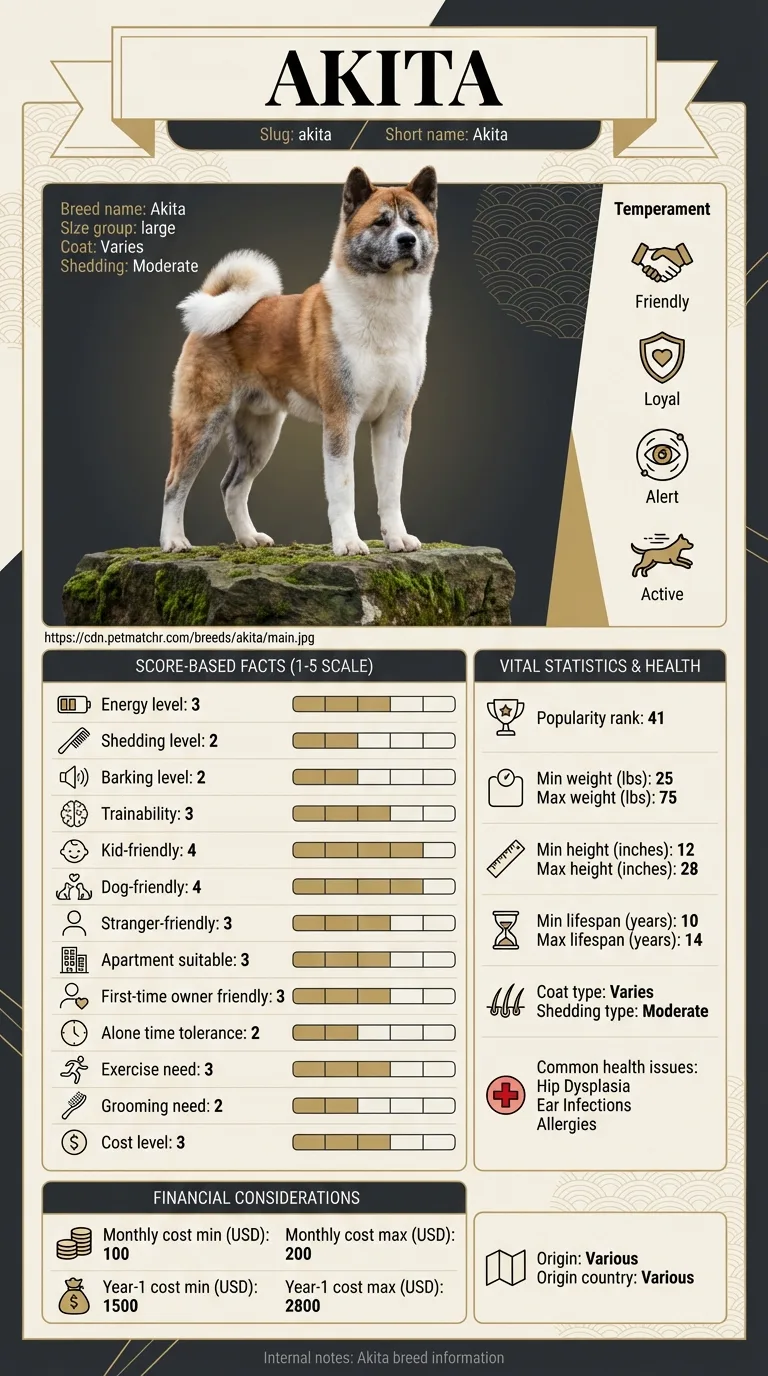
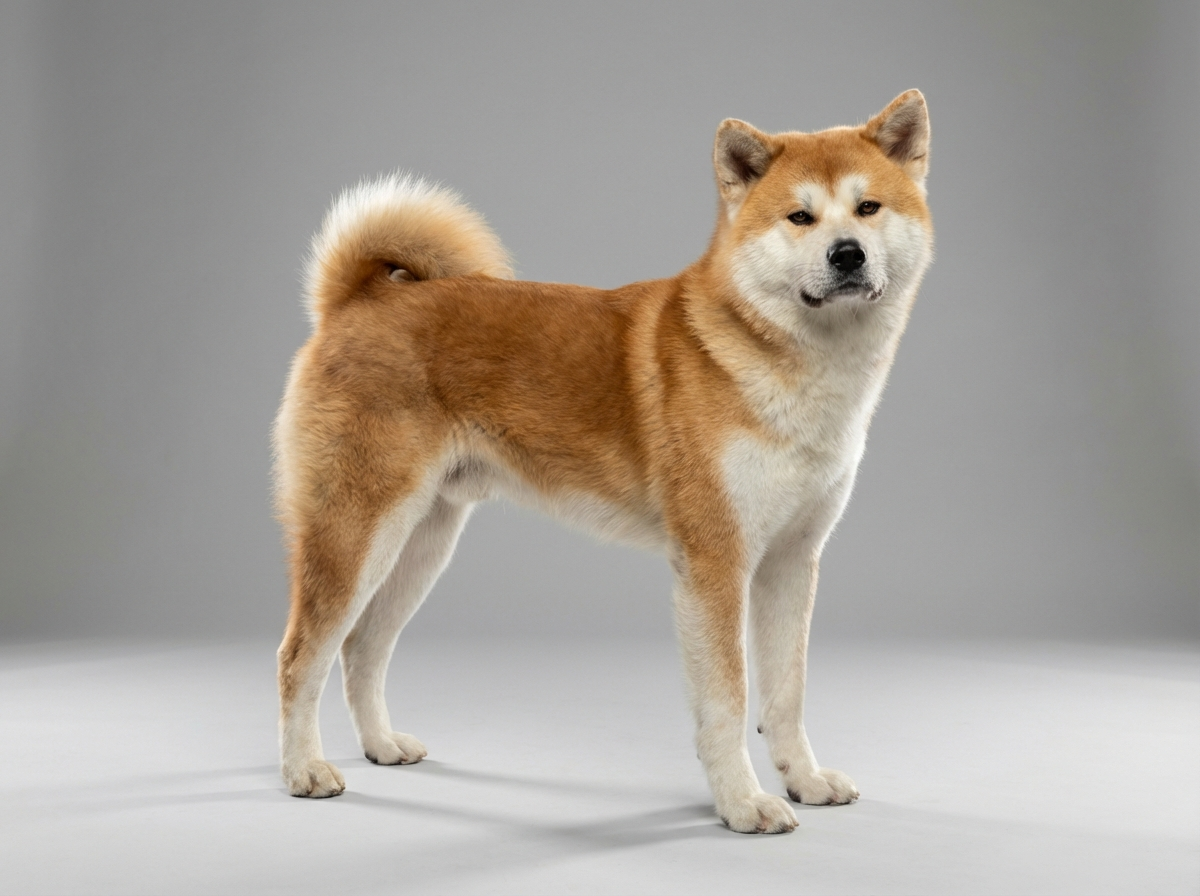
Choose the Akita if your week is short on time. It needs 3/5 exercise against the English Cocker's 4/5, grooms at 3/5 against 4/5, tolerates being alone at 3/5 against 2/5, and barks at 2/5 against 3/5. You are accepting 1/5 for first-time owners, 2/5 with other dogs and strangers, 5/5 shedding and up to 130 pounds.
Choose english cocker spaniel if...
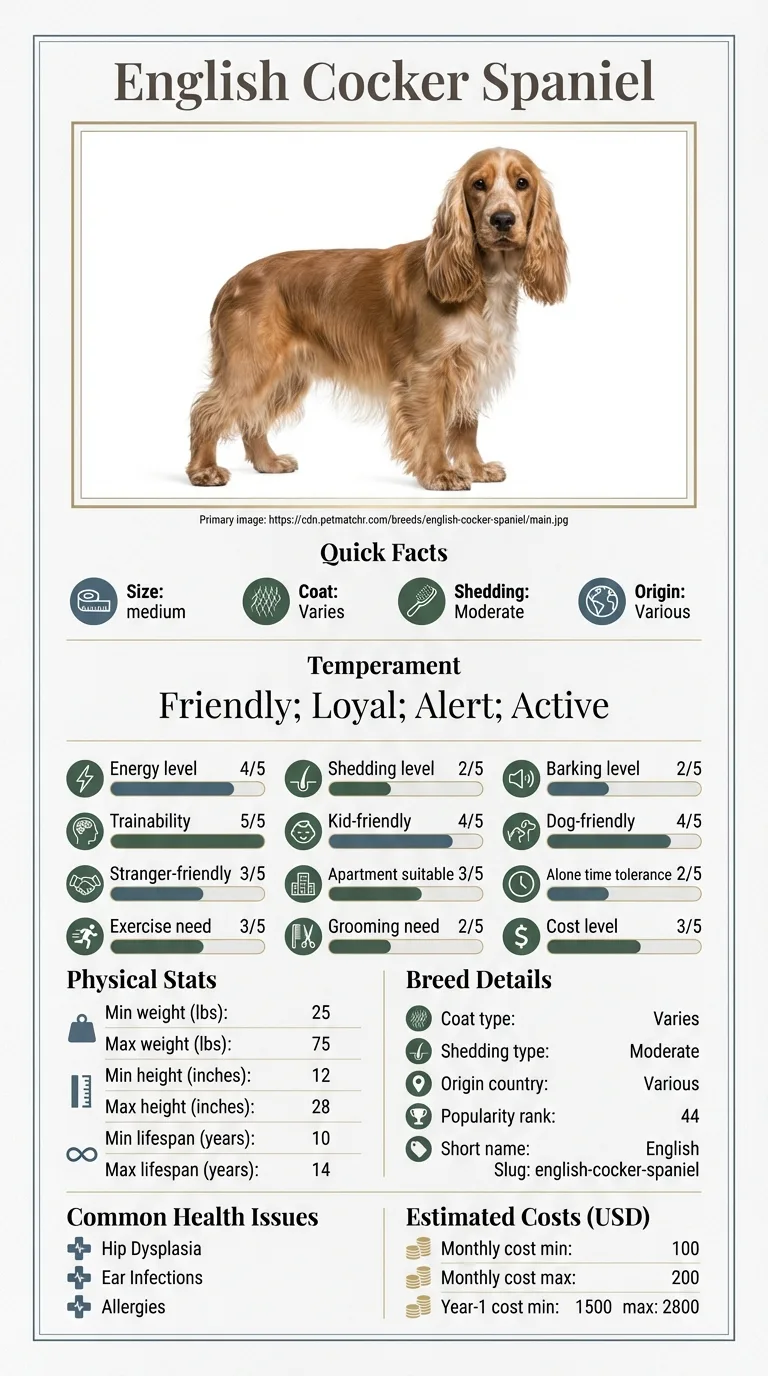
Choose the English Cocker if you walk a lot and want a friendly, capable, mid-sized dog. It rates 5/5 with children, 4/5 with other dogs and strangers, 4/5 for trainability and first-time owners, lives 12 to 14 years and costs $100–$200 a month. You are accepting daily ear care, weekly grooming and a breed that dislikes solitude.
Head-to-head comparison
Feature
akita
english cocker spaniel
Winner
Weight
70–130 lbs
26–34 lbs
Equal
Height
24–28 in
15–17 in
Equal
Lifespan
10–13 years
12–14 years
english cocker spaniel
Coat
Dense double coat
Medium, silky, feathered
Equal
Grooming need
Moderate (3/5)
High (4/5)
akita
Shedding
Very high (5/5)
Moderate (3/5)
english cocker spaniel
Energy level
Moderate (3/5)
High (4/5)
Equal
Exercise need
Moderate (3/5)
High (4/5)
akita
Trainability
Moderate (3/5)
High (4/5)
english cocker spaniel
Barking
Low (2/5)
Moderate (3/5)
akita
Good with kids
Moderate (3/5)
Very high (5/5)
english cocker spaniel
Good with other dogs
Low (2/5)
High (4/5)
english cocker spaniel
Friendly to strangers
Low (2/5)
High (4/5)
english cocker spaniel
Apartment suitability
Low (2/5)
High (4/5)
english cocker spaniel
Good for first-time owners
Very low (1/5)
High (4/5)
english cocker spaniel
Tolerates being alone
Moderate (3/5)
Low (2/5)
akita
Typical monthly cost
$110–$240
$100–$200
english cocker spaniel
Typical first-year cost
$1,700–$3,200
$1,400–$2,900
english cocker spaniel
Deep dive
What 4/5 looks like in a flushing spaniel
An English Cocker wants around ninety minutes a day and it wants to use its nose for a good part of that. Quartering ground, hunting hedgerows, retrieving in cover — the breed's satisfaction comes from searching rather than from distance covered.
This is useful, because it means the requirement is met by scent games, retrieves and varied off-lead ground rather than by running miles. A Cocker that has spent forty minutes hunting a wood is more settled than one that has jogged for an hour beside a bicycle.
The failure mode of an under-worked one is a busy, mouthy, bin-raiding dog that hunts the house instead. It is not destructive out of anxiety so much as out of employment.
Recall needs proofing against live scent specifically. A Cocker that has picked up rabbit is genuinely not listening, and 4/5 trainability does not override that unless it has been trained around it deliberately.
The Akita's 3/5 is forty-five to sixty minutes of walking, on a lead in most environments, with secure fencing at home and a recall treated as conditional.
Feathering, grass seeds and the ear problem
Grooming is 4/5. The feathering on the ears, chest, legs and belly mats where it rubs — behind the ears, in the armpits, around the tail — and brushing has to go through it rather than over it. Two or three sessions a week plus a professional tidy every couple of months is a realistic routine.
A working coat brings a seasonal hazard the show coat does not: grass seeds. They work into the feathering, then into the skin, between the toes and occasionally into an ear canal, and they migrate. Checking feet, ears and armpits after summer walks is a five-minute habit that prevents minor surgery.
Ear infections head the breed's condition list. The long, heavy, feathered ear leaf lies over the canal and traps warmth and moisture, and the cycle of repeated inflammation thickens the canal and makes each episode harder to treat. Check the ears daily, dry them after every swim or wet walk, and keep the hair beneath them trimmed.
The Akita's upright ears are self-ventilating. Its coat work is two intensive shedding periods a year at 5/5 and a weekly brush the rest of the time.
Two inherited diseases with DNA tests
Familial nephropathy is the English Cocker item most worth knowing about. It is an inherited kidney disease that affects young dogs — typically between six months and two years — causing progressive renal failure. There is no treatment, but there is a DNA test, and responsible breeders test so that two carriers are never mated together.
Ask for that result by name. A breeder who knows what familial nephropathy is and can show you the parents' status is demonstrating something more useful than any general assurance about health.
Adult-onset neuropathy is the second, a progressive neurological condition appearing in middle age with an unsteady gait and weakness. It also has a DNA test.
Progressive retinal atrophy and hip dysplasia complete the list, and both are testable — eye certification and hip scores on the parents.
The Akita's burden is autoimmune and endocrine instead: immune-mediated disease of skin, eyes and blood, hypothyroidism, progressive retinal atrophy, hip dysplasia and bloat as a large deep-chested breed. Its most useful pre-purchase questions are hip scores, thyroid panels and eye testing.
Temperament, solitude and money
The English Cocker's 5/5 with children and 4/5 with other dogs and strangers describe a genuinely easy dog to take places. It is busy, cheerful and interested in everything, and it settles when the day's work is done.
The 2/5 for time alone is the caveat. Cockers are closely bonded and long unbroken absences produce vocalising and door-directed destruction. Absence training from the first week, regardless of your current schedule, is the standard prevention.
One thing worth raising with a breeder is temperament in the line. Sudden, out-of-character aggression has been reported historically in the breed, more often in solid-coloured dogs, and while it is uncommon and its causes are debated, a breeder who is willing to discuss the temperament of the parents and grandparents openly is worth more than one who deflects the question.
On money the Cocker runs $100–$200 a month against $110–$240, and $1,400–$2,900 against $1,700–$3,200 in the first year — mostly a weight difference, narrowed in practice by grooming and ear treatment.
Lifespan runs 12 to 14 years against 10 to 13.
Akita vs English Cocker Spaniel: a working dog in a family package
The English Cocker's ratings look like a family dog's until you reach exercise and energy, which are both 4/5. That is a working figure, not a companion one.
It is worth being clear about what separates it from the American Cocker Spaniel, since the two are often treated as one breed. The English dog is taller, longer in the muzzle, less profusely coated and considerably more active: 4/5 exercise against 3/5, and 4/5 grooming against 5/5. It has kept more of the gundog and less of the show coat.
Against the Akita, the social gap is the usual one — 5/5 with children against 3/5, 4/5 with other dogs and strangers against 2/5 and 2/5.
The Akita's advantages are the quiet ones. It barks at 2/5 against 3/5, tolerates a working day at 3/5 against 2/5, and needs an hour of walking rather than ninety minutes of activity.
Akita or English Cocker: The Working Spaniel or the Guardian - Akita vs English Cocker Spaniel: a working dog in a family package
Frequently asked questions
How is an English Cocker different from a Cocker Spaniel?
The English dog is taller, longer in the muzzle, less profusely coated and considerably more active — 4/5 exercise and 4/5 energy against 3/5 and 3/5, and 4/5 grooming against 5/5. It has kept more of the working gundog and less of the show coat, so it needs around ninety minutes a day rather than an hour.
How much exercise does an English Cocker need?
Around ninety minutes a day, and it should include scent work rather than just distance. Quartering ground, hunting hedgerows and retrieving satisfy the breed far better than jogging does. An under-worked Cocker becomes busy, mouthy and inclined to hunt the house instead of a field.
What is familial nephropathy?
An inherited kidney disease affecting young English Cockers, typically between six months and two years, causing progressive renal failure with no treatment available. There is a DNA test, and responsible breeders use it so two carriers are never mated. Ask for the parents' status by name before buying.
Why do Cockers get so many ear infections?
A long, heavy, feathered ear leaf lies flat over the canal and traps warmth and moisture. Each infection thickens the canal lining, which makes the next one likelier and harder to treat. Daily checks, drying after every swim or wet walk, and trimming the hair under the ear are what break the cycle.
Which is better for a first-time owner?
The English Cocker at 4/5 against the Akita's 1/5, provided you can meet the exercise and grooming. It is sociable, biddable at 4/5 trainability, and manageable in size. The Akita is an independent guardian rating 2/5 with other dogs, whose adult opinions arrive at around two years old.
What are grass seeds and why do they matter?
They are barbed seed heads that work into feathering and then into the skin, between the toes, or into an ear canal, and they migrate rather than staying put. In a feathered working coat they are easy to miss. Checking feet, ears and armpits after summer walks prevents most cases needing minor surgery.
Which copes better with a working day?
The Akita at 3/5 against the Cocker's 2/5. Cockers bond closely and long absences produce vocalising and destruction at doors, so absence training should start in the first week whatever your current schedule. The Akita is self-contained and will sleep through an empty afternoon.
Akita vs English Cocker Spaniel: which should I choose?
The English Cocker if you walk a lot, want a sociable mid-sized dog and will do the grooming and ear care. The Akita if your week is short on time and you want a quiet, self-contained guardian with space to keep it.
Costs
How much does each cost per month?
The English Cocker runs $100–$200 a month and the Akita $110–$240, with first-year totals of $1,400–$2,900 and $1,700–$3,200. Add a professional groom every couple of months for the Cocker.
Health
What DNA tests should an English Cocker have?
Familial nephropathy and adult-onset neuropathy, plus progressive retinal atrophy. Hip scores and eye certification on the parents complete the picture. Ask for each by name rather than accepting a general health assurance.
Behavior
Which is quieter?
The Akita at 2/5 against the Cocker's 3/5. Cocker barking rises sharply when the dog is under-exercised or left alone, so the noise level is partly within your control.
Related DogBreedCompass guides
Akita breed guide – The Akita profile covers guardian temperament and the long socialisation window the breed needs.
English Cocker Spaniel guide – The English Cocker profile covers working drive, coat care and inherited disease testing.
Akita vs Cocker Spaniel – The American Cocker is the smaller, more heavily coated version of the same breed.
Akita vs English Springer Spaniel – The Springer is the larger flushing spaniel with higher exercise needs again.
English Cocker ear infections – Chronic ear disease is the condition most Cocker owners will deal with at some point.
Akita autoimmune diseases – Autoimmune disease is the Akita's most distinctive burden and the first question for a breeder.
Health information here is general and is not veterinary advice. If your dog shows pain, sudden behaviour change, or worsening symptoms, consult a licensed veterinarian.
Some links on this site are affiliate links. We may earn a commission at no extra cost to you, and we only suggest products we believe are helpful for dog owners.
We research and check what we publish, but we do not warrant that any figure, date, price, or statement is accurate, complete, or current, and we accept no liability for any loss, cost, injury, or other harm arising from the use of this site. Use it as one reference among several. You remain responsible for your own decisions and for your dog's care - confirm anything that matters with a licensed veterinarian or another qualified professional before you act on it. Full disclaimer.