Health
What eye conditions matter most for Akitas?
Cataracts, progressive retinal atrophy, and glaucoma are the three most clearly documented conditions for this breed.

Quick answer
What eye conditions matter most for Akitas?
Cataracts, progressive retinal atrophy, and glaucoma are the three most clearly documented conditions for this breed.
Eye health in Akitas spans several genuinely distinct conditions, from the lens to the eyelids to the retina, and understanding which ones are actually documented for this breed helps focus an owner's attention where it matters most.
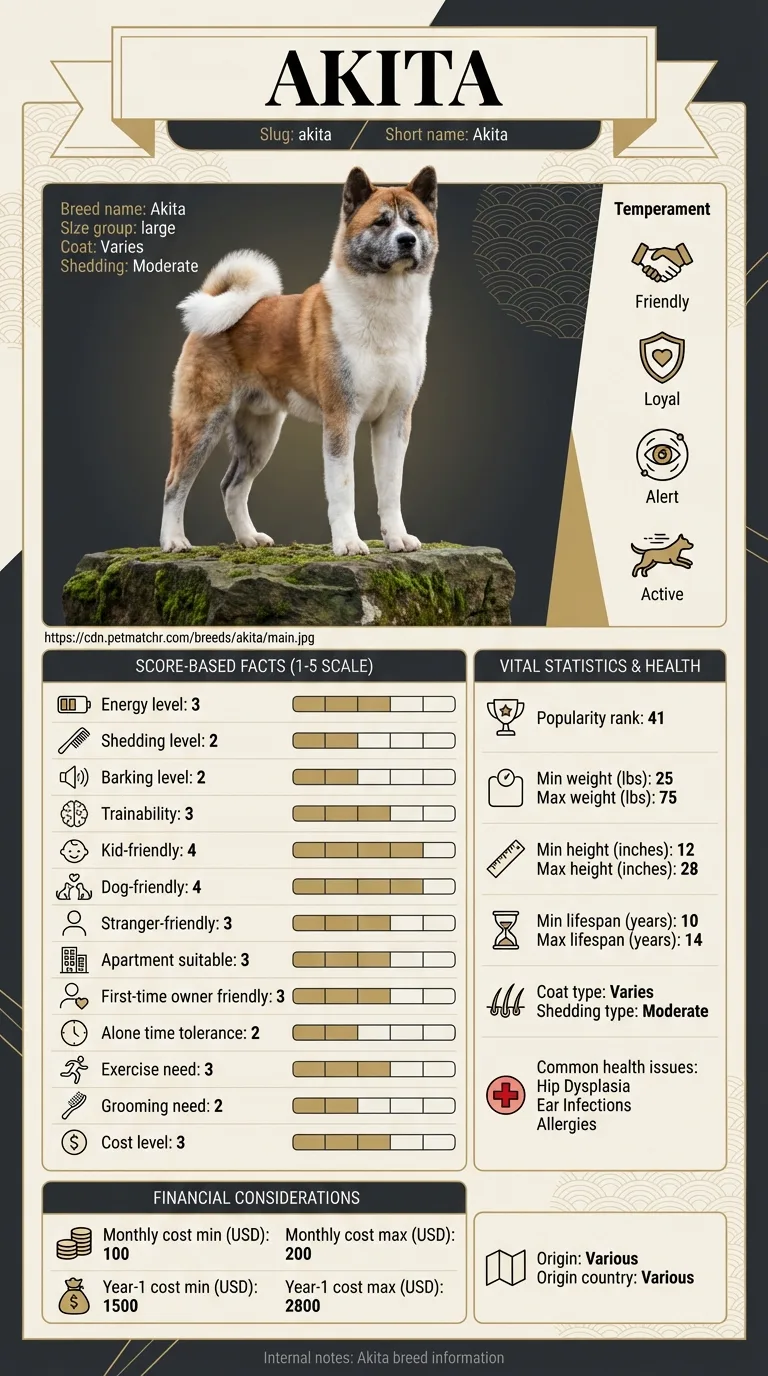
Owners wanting a single, organized reference for Akita eye health, rather than researching each condition separately, are the audience for this overview.
This guide is not medical advice. If your dog shows pain, sudden behavior change, or worsening symptoms, consult a licensed veterinarian.
Some links may be affiliate links. We may earn a commission at no extra cost to you. We only suggest products we believe are helpful for dog owners.
We research and check what we publish, but we do not warrant that any figure, date, price, or statement is accurate, complete, or current, and we accept no liability for any loss, cost, injury, or other harm arising from the use of this site. Use it as one reference among several. You remain responsible for your own decisions and for your dog's care - confirm anything that matters with a licensed veterinarian or another qualified professional before you act on it. Full disclaimer.
Check this first
A sudden, painful, red or bulging eye, significant squinting, excessive tearing, or sudden apparent blindness all warrant same-day emergency veterinary care. These can indicate glaucoma, a corneal ulcer, or acute inflammation, several of which can cause permanent vision loss within hours to days if untreated.
Gradual changes — a slowly developing cloudy lens, progressively worsening night vision, or mild chronic eyelid irritation — are not usually emergencies, but do warrant a scheduled vet visit, ideally with referral to a veterinary ophthalmologist for a full evaluation.
The key distinction across all these conditions is speed and pain: sudden and painful means today; gradual and comfortable means soon, but not necessarily today.
If any of these apply, call your vet or an emergency clinic now. The rest of this page is for the cases that are not an emergency.
Eye health in Akitas spans several distinct conditions: cataracts, progressive retinal atrophy, and glaucoma are the most clearly documented, while eyelid conformation issues like entropion are also relevant given the breed's eye shape. Understanding how these conditions differ, and which structures of the eye they each affect, helps owners know what to actually watch for and when to escalate to a specialist.
Cataracts, PRA, and glaucoma are each individually documented as relevant concerns for this breed, making overall eye health a meaningful part of routine Akita care, particularly from middle age onward.
The Akita's documented eye health profile centers on the lens (cataracts), the retina (progressive retinal atrophy), and intraocular pressure (glaucoma), each a genuinely distinct mechanism. Additionally, this breed's somewhat deep-set eye shape can predispose certain individuals to eyelid conformation issues like entropion, which is a structural rather than degenerative concern.
Underlying metabolic conditions like diabetes can accelerate cataract formation well beyond typical age-related timelines. Chronic irritation from an uncorrected eyelid conformation issue can contribute to corneal damage over time, making early identification and correction relevant to overall long-term eye health.
See a vet the same day for a sudden painful, red, or bulging eye, significant squinting, or sudden apparent blindness. Schedule a routine exam for gradual vision changes, cloudiness, or chronic mild eyelid irritation.
With several possible eye conditions to track, a few habits lead owners astray. Avoid these mistakes.
See all Akita health problems, which breeds are prone to eye disorders, or the full Akita breed guide for temperament, exercise needs and ownership costs.
Each specific eye condition carries its own distinct timeline — cataracts and PRA typically progress over months to years, while entropion correction, when needed, is a single surgical procedure with a few weeks of recovery.
Success is a clear, ongoing picture of your dog's eye health through regular monitoring, with any specific condition identified and managed appropriately before it progresses to a more serious or painful stage.
After noticing his Akita Sato squinting occasionally and rubbing at one eye, Alistair in Raleigh brought him in for what he expected to be a simple checkup. His vet found mild entropion on that side, along with early lens changes suggesting a developing cataract in the other eye. Alistair opted for surgical correction of the entropion, which resolved the squinting and rubbing immediately, and began periodic monitoring of the cataract with his vet. Having a full picture of what was actually going on with each eye, rather than treating one symptom in isolation, gave Alistair a much clearer long-term plan.
Key takeaway: A single eye symptom can have more than one underlying cause — a full exam covering lens, retina, and eyelid conformation gives the clearest overall picture.
Cataracts, progressive retinal atrophy, and glaucoma are the most clearly documented conditions, while eyelid conformation issues like entropion are also relevant given the breed's eye shape.
Entropion is an inward rolling of the eyelid that causes the eyelashes or fur to rub against the cornea, causing chronic irritation and potential damage. It's a recognized issue in breeds with certain eyelid conformations, including some Akitas, and is typically corrected surgically if significant.
An annual eye exam as part of a routine wellness visit is reasonable for most dogs, with more frequent monitoring recommended if any condition, family history, or early finding is already known.
They affect different parts of the eye — PRA affects the retina and cataracts affect the lens — and while both cause vision problems, an ophthalmologic exam distinguishes clearly between the two, which matters since their management differs entirely.
It can be either primary (occurring on its own) or secondary to another condition like an advanced cataract or chronic inflammation; a veterinary ophthalmologist can help determine which type is present.
An initial consultation typically runs $150 to $300, with additional testing (like an electroretinogram for suspected PRA) adding to that depending on what's being evaluated.
For PRA specifically, genetic testing is available and widely recommended for breeding dogs to reduce the risk of passing on the condition to offspring.
Cataracts, progressive retinal atrophy, and glaucoma are the three most clearly documented conditions for this breed.
Yes — some Akitas have a degree of entropion, an inward-rolling eyelid that can cause chronic irritation if unaddressed.
An annual eye exam as part of routine wellness care is a reasonable baseline.
Typically $150 to $300 for an initial evaluation.
Yes, particularly for progressive retinal atrophy, which is useful for breeding decisions.
A one-page prep sheet for this condition: the signs, the questions to ask, what to get priced. Unlocks here.
You get: Vet visit prep sheet
No spam. One-click unsubscribe. See our privacy policy.
Preview page 1 before you decide.