Akita or Dachshund: A Guardian or a Hound With a Fragile Spine
Quick answer
Akita vs Dachshund: which should I choose?
The Dachshund if you live in a flat, someone is usually home, and you will commit to lifelong back protection. The Akita if the house is often empty, you want quiet, and you have the space and experience for a large guardian.
Almost everything you need to decide about a Dachshund follows from one fact: intervertebral disc disease heads its condition list, and roughly a quarter of the breed will experience it. Stairs, sofas, harnesses, weight and even how you pick the dog up are all downstream of that.
This page is for someone weighing a small, characterful, apartment-friendly hound against a large guardian. It covers spinal disease and what managing it actually involves, barking, the Dachshund's very low tolerance for solitude, lifespan, and running costs.
Quick verdict
The Dachshund is cheap, long-lived and suited to a flat, and it comes with a lifelong physical management plan; the Akita is expensive, structurally sound and needs a house.
Choose akita if...
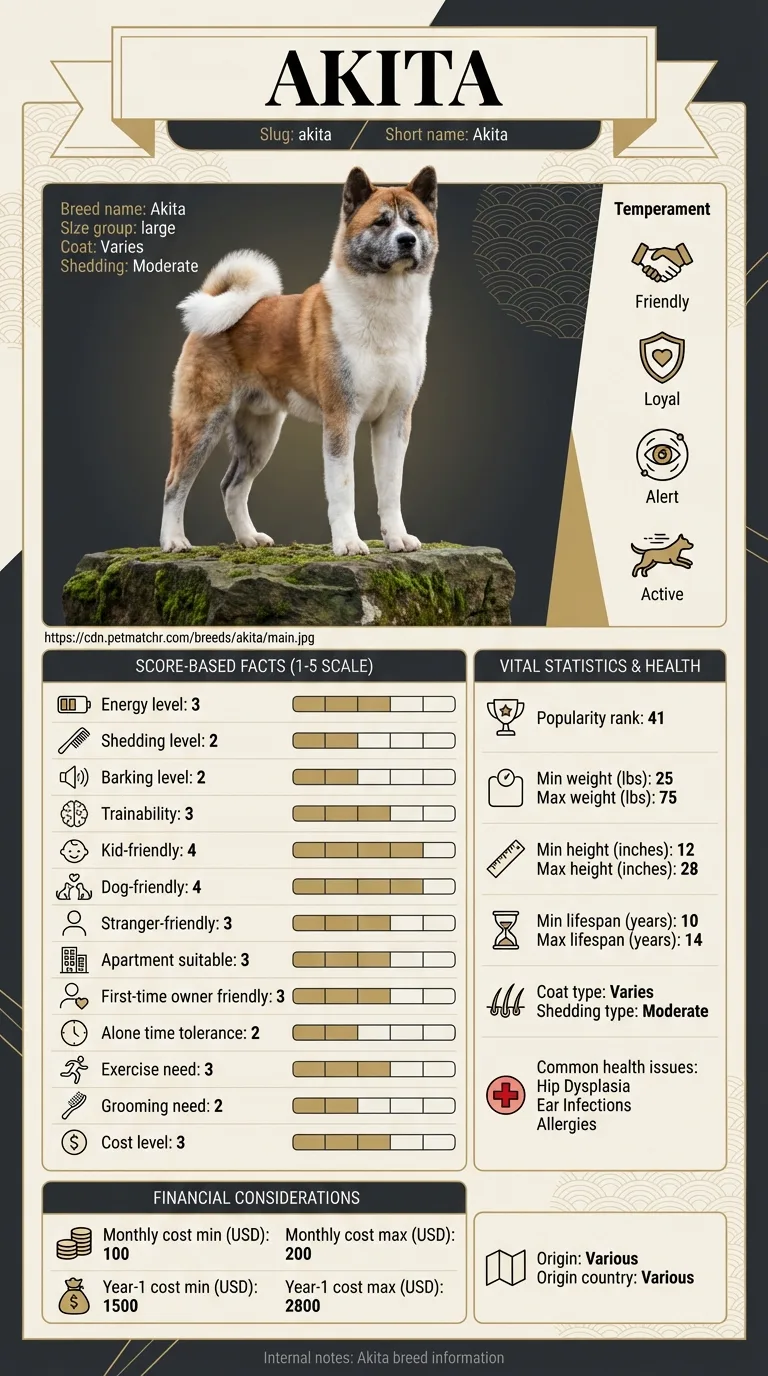
Choose the Akita if the house is often empty and you want a quiet dog. It tolerates being alone at 3/5 against the Dachshund's 1/5 and barks at 2/5 against 4/5, and it has no comparable structural weakness. You are accepting 1/5 for first-time owners, 2/5 with other dogs, 5/5 shedding, $110–$240 a month and a shorter life.
Choose dachshund if...
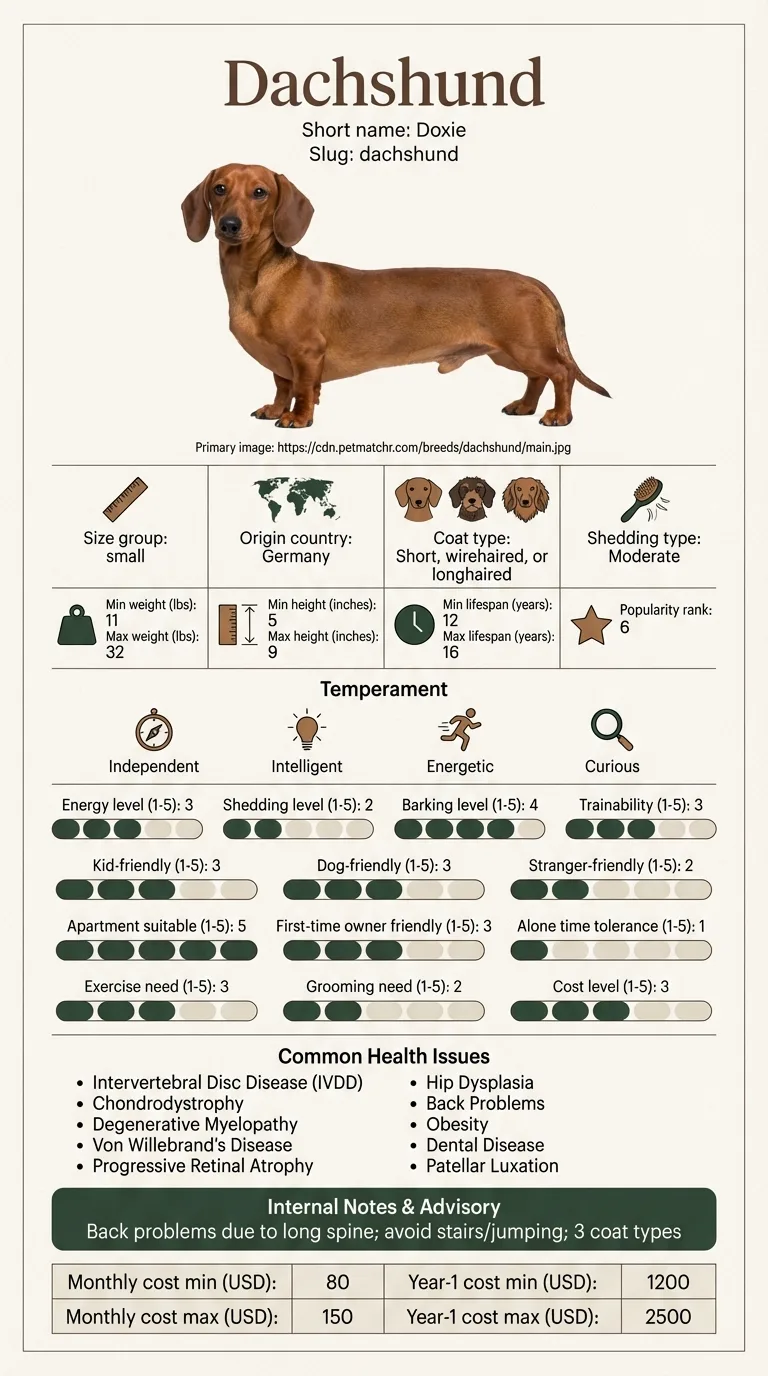
Choose the Dachshund if you live in a flat, want a small characterful dog and someone is usually home. It rates 5/5 for apartments, lives 12 to 16 years and costs $80–$150 a month. You are accepting 4/5 barking, a 1/5 tolerance for solitude, 3/5 trainability with slow house-training, and a lifelong spinal management routine.
Head-to-head comparison
Feature
akita
dachshund
Winner
Weight
70–130 lbs
11–32 lbs
Equal
Height
24–28 in
5–9 in
Equal
Lifespan
10–13 years
12–16 years
dachshund
Coat
Dense double coat
Short, wire or long
Equal
Grooming need
Moderate (3/5)
Low (2/5)
dachshund
Shedding
Very high (5/5)
Low (2/5)
dachshund
Energy level
Moderate (3/5)
Moderate (3/5)
Equal
Exercise need
Moderate (3/5)
Moderate (3/5)
Equal
Trainability
Moderate (3/5)
Moderate (3/5)
Equal
Barking
Low (2/5)
High (4/5)
akita
Good with kids
Moderate (3/5)
Moderate (3/5)
Equal
Good with other dogs
Low (2/5)
Moderate (3/5)
dachshund
Friendly to strangers
Low (2/5)
Low (2/5)
Equal
Apartment suitability
Low (2/5)
Very high (5/5)
dachshund
Good for first-time owners
Very low (1/5)
Moderate (3/5)
dachshund
Tolerates being alone
Moderate (3/5)
Very low (1/5)
akita
Typical monthly cost
$110–$240
$80–$150
dachshund
Typical first-year cost
$1,700–$3,200
$1,200–$2,500
dachshund
Deep dive
Intervertebral disc disease and the rules that follow
Intervertebral disc disease heads the Dachshund's list, and chondrodystrophy — the genetic condition producing the breed's short legs — is the reason. The same gene that shortens the limbs causes the spinal discs to degenerate and calcify early, sometimes from the first year of life.
When a degenerated disc herniates it presses on the spinal cord. Signs range from a reluctance to jump and a hunched back through to sudden hind limb weakness or complete paralysis, and severe cases are surgical emergencies where hours matter.
The management is lifelong and unglamorous. Keep the dog lean — obesity is the single largest modifiable risk factor and it also appears separately on the breed's condition list. Discourage jumping on and off furniture, and use ramps. Limit stairs. Support the chest and hindquarters together when lifting, never under the front legs alone. Use a harness rather than a collar.
None of this makes a Dachshund a fragile or joyless dog. It walks, runs and digs enthusiastically. But the household has to be arranged around a spine, and that is a genuine commitment for twelve to sixteen years.
The Akita has hip dysplasia on its list and no comparable structural liability.
4/5 barking against a 1/5 tolerance for being left
The Dachshund's 4/5 barking is a hound's voice in a small body, and it is loud out of all proportion to the dog. It was bred to bark underground so the handler could locate it, and that instinct did not disappear when the breed moved indoors.
It announces the door, the corridor, the post and anything visible from a window. Blocking sightlines and training a settled alternative reduces it, but the baseline is high.
The 1/5 for time alone is the lowest rating on the scale and the harder of the two problems. Dachshunds bond intensely and do not have an independent mode; left for a full day they vocalise, dig at doors and soil the house. In a flat, a barking distressed dog is a neighbour problem within a week.
The combination is what catches people out: a breed that suits a flat on size, and struggles in one on noise and solitude, unless someone is around.
The Akita at 2/5 barking and 3/5 alone is a genuinely quiet, self-contained animal. Its problem in a flat is 130 pounds of guardian in a shared corridor, not sound.
Two 3/5 ratings, neither of them eager
Both breeds rate 3/5 for trainability and both are commonly misdescribed as stupid, which neither is.
The Dachshund is a scent hound bred to work out of sight and out of reach of instruction. It solves problems independently, and it will comply when the reason is good enough. House-training is notoriously slow — small bladder, low ground clearance, and a strong objection to wet grass — and takes months rather than weeks. Crate training and rigid routine are the standard answers.
Recall is the other weak point. A Dachshund on a scent is effectively deaf, and the breed's prey drive toward small animals is genuine.
The Akita's independence is guardian independence rather than hound independence. It understands the request and forms a view about it. What it most needs is not obedience but socialisation continued past two years, because that is when its adult opinion of other dogs arrives.
For both, short cheerful sessions with food work and correction does not.
Cheap to feed, expensive to insure
The Dachshund runs $80–$150 a month against the Akita's $110–$240, and $1,200–$2,500 against $1,700–$3,200 in the first year. On food and weight-dosed products it is much the cheaper dog.
The number that matters is insurance. Spinal surgery for a herniated disc runs into four figures, and a meaningful share of the breed will need it. Dachshunds are consequently priced high relative to their size, and some policies limit or exclude spinal cover — read that section specifically before buying a policy rather than after.
Dental disease is the other recurring cost, as it is in most small breeds, and daily brushing genuinely reduces it.
The Akita's expensive risks are autoimmune disease, which is costly to diagnose and often lifelong to manage, and bloat, which is a four-figure emergency in a large deep-chested dog.
On grooming the Dachshund is easier at 2/5 against 3/5, with the wirehaired variety needing stripping and the longhaired needing brushing through the feathering. Shedding is 2/5 against 5/5.
Lifespan runs 12 to 16 years against 10 to 13.
Akita vs Dachshund: an unexpected amount of agreement
Energy 3/5 and 3/5. Exercise 3/5 and 3/5. Trainability 3/5 and 3/5. Children 3/5 and 3/5. Strangers 2/5 and 2/5.
Five ties, on breeds separated by around a hundred pounds. Both are moderately active, moderately cooperative, and reserved with people they do not know — the Dachshund is a hound with its own agenda, and the Akita is a guardian with its own judgement, and the ratings land in the same place by different routes.
The rows that split them are noise and solitude. The Dachshund barks at 4/5 and tolerates being alone at 1/5; the Akita is 2/5 and 3/5. For flat living those two numbers pull against the Dachshund's otherwise excellent 5/5 apartment rating.
And the row that is not on the table at all is structure. One of these breeds has a spine built for a job that costs it dearly.
Akita or Dachshund: A Guardian or a Hound With a Fragile Spine - Akita vs Dachshund: an unexpected amount of agreement
Frequently asked questions
How likely is back trouble in a Dachshund?
Common enough that the whole household should be arranged around it — intervertebral disc disease heads the breed's condition list and roughly a quarter of Dachshunds are affected. The cause is chondrodystrophy, the same genetic condition that shortens the legs, which makes the spinal discs degenerate and calcify early.
What are the rules for protecting a Dachshund's back?
Keep the dog lean, since obesity is the largest modifiable risk. Use ramps rather than letting it jump on and off furniture, limit stairs, and support the chest and hindquarters together when lifting rather than picking it up under the front legs. Use a harness rather than a collar.
Do Dachshunds bark a lot?
Yes — 4/5, against the Akita's 2/5, and it is a hound's voice in a small body. The breed was bred to bark underground so the handler could locate it. Blocking window sightlines and training a settled alternative behaviour reduces it, but the baseline is high and it will not become a quiet dog.
Can a Dachshund be left alone during a working day?
Not without cover. At 1/5 it has the lowest solitude tolerance on the scale and no independent mode — expect vocalising, digging at doors and house-soiling. It works well for someone at home or with a reliable midday walker. The Akita at 3/5 is self-contained and will simply sleep.
Which lives longer?
The Dachshund, at 12 to 16 years against the Akita's 10 to 13. Size accounts for most of it. That longevity is worth taking seriously alongside the spinal management, because it means committing to the ramps, the weight control and the lifting technique for a decade and a half.
Are they hard to house-train?
Dachshunds are, notoriously — small bladder, low ground clearance, and a real objection to wet grass. Months rather than weeks is normal, and crate training with a rigid routine is the standard answer. It is not a sign of a stupid dog; the breed rates 3/5 for trainability, the same as the Akita.
Which is cheaper to keep?
The Dachshund on running costs — $80–$150 a month against $110–$240 — but check the insurance carefully. Spinal surgery runs into four figures and a meaningful share of the breed needs it, so Dachshunds are priced high for their size and some policies limit spinal cover.
The Dachshund if you live in a flat, someone is usually home, and you will commit to lifelong back protection. The Akita if the house is often empty, you want quiet, and you have the space and experience for a large guardian.
Costs
How much does each cost per month?
The Dachshund runs $80–$150 a month and the Akita $110–$240, with first-year totals of $1,200–$2,500 and $1,700–$3,200. Check whether a Dachshund policy limits spinal cover before buying it.
Health
Should a Dachshund use stairs?
Limit them, and use ramps for furniture. Repeated jumping down is what loads an already vulnerable spine. Keeping the dog lean matters even more — obesity is the single largest modifiable risk factor for disc disease.
Behavior
Which is quieter?
The Akita, decisively, at 2/5 against the Dachshund's 4/5. Akitas bark only when something genuinely warrants it. In a flat, the Akita's problem is size in shared corridors rather than noise.
Related DogBreedCompass guides
Akita breed guide – The Akita profile covers guardian temperament and the long socialisation window the breed needs.
Dachshund breed guide – The Dachshund profile covers spinal management, coat varieties and house-training.
Akita vs Basset Hound – The Basset Hound is the other low-slung scent hound with related structural concerns.
Akita vs Pembroke Welsh Corgi – The Pembroke Welsh Corgi is the other short-legged breed people weigh against the Dachshund.
Dachshund back problems – Back problems are the defining health risk for anyone considering this breed.
Akita autoimmune diseases – Autoimmune disease is the Akita's most distinctive burden and the first question for a breeder.
Health information here is general and is not veterinary advice. If your dog shows pain, sudden behaviour change, or worsening symptoms, consult a licensed veterinarian.
Some links on this site are affiliate links. We may earn a commission at no extra cost to you, and we only suggest products we believe are helpful for dog owners.
We research and check what we publish, but we do not warrant that any figure, date, price, or statement is accurate, complete, or current, and we accept no liability for any loss, cost, injury, or other harm arising from the use of this site. Use it as one reference among several. You remain responsible for your own decisions and for your dog's care - confirm anything that matters with a licensed veterinarian or another qualified professional before you act on it. Full disclaimer.