Living
Akita vs Maltese: which should I choose?
The Maltese if you live in a flat, want a small affectionate companion and will commit to daily coat care. The Akita if you want low daily maintenance and a dog that copes with an empty house.

Quick answer
Akita vs Maltese: which should I choose?
The Maltese if you live in a flat, want a small affectionate companion and will commit to daily coat care. The Akita if you want low daily maintenance and a dog that copes with an empty house.
A Maltese can weigh three pounds. An Akita can weigh a hundred and thirty. Beyond the obvious, the interesting thing about this pairing is how much of Maltese ownership is maintenance — a 4/5 grooming rating and a 1/5 shedding rating on a dog that fits in a shopping bag.
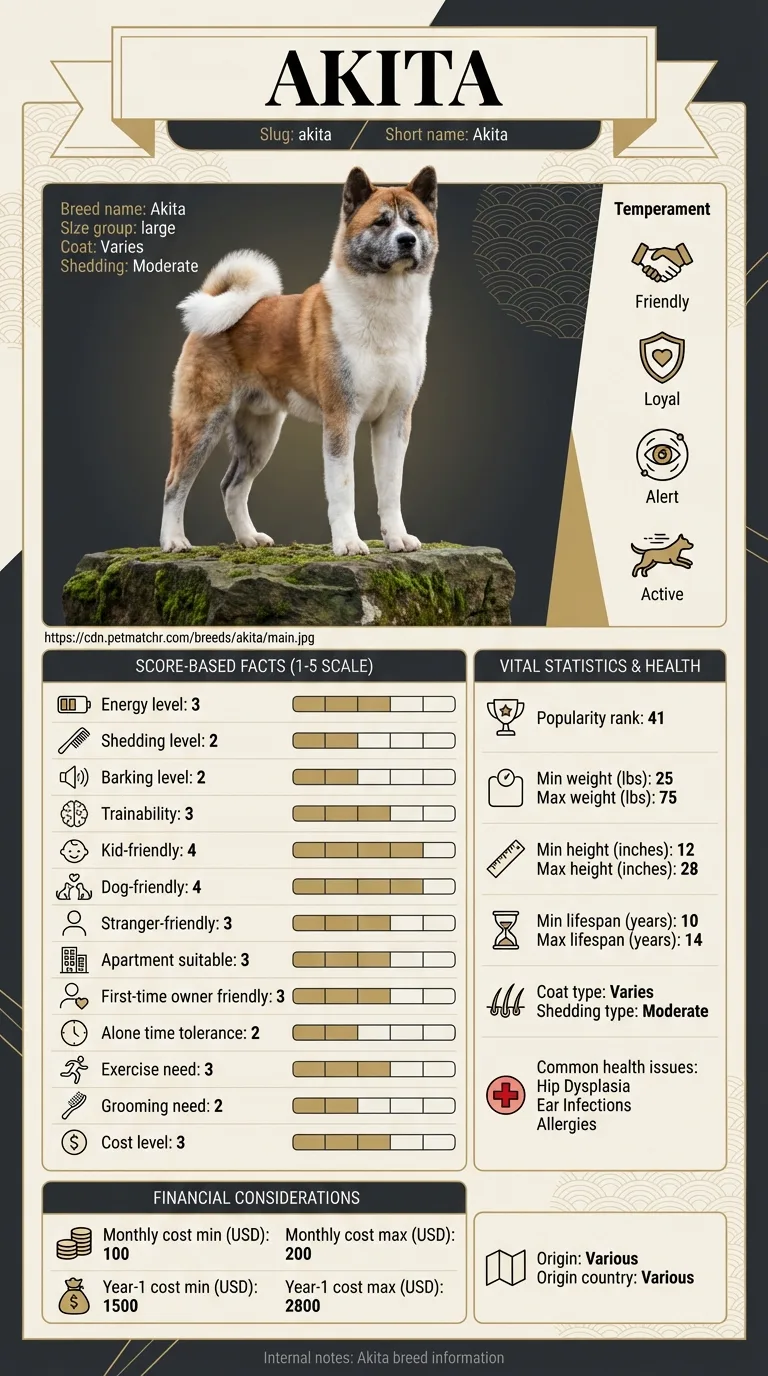
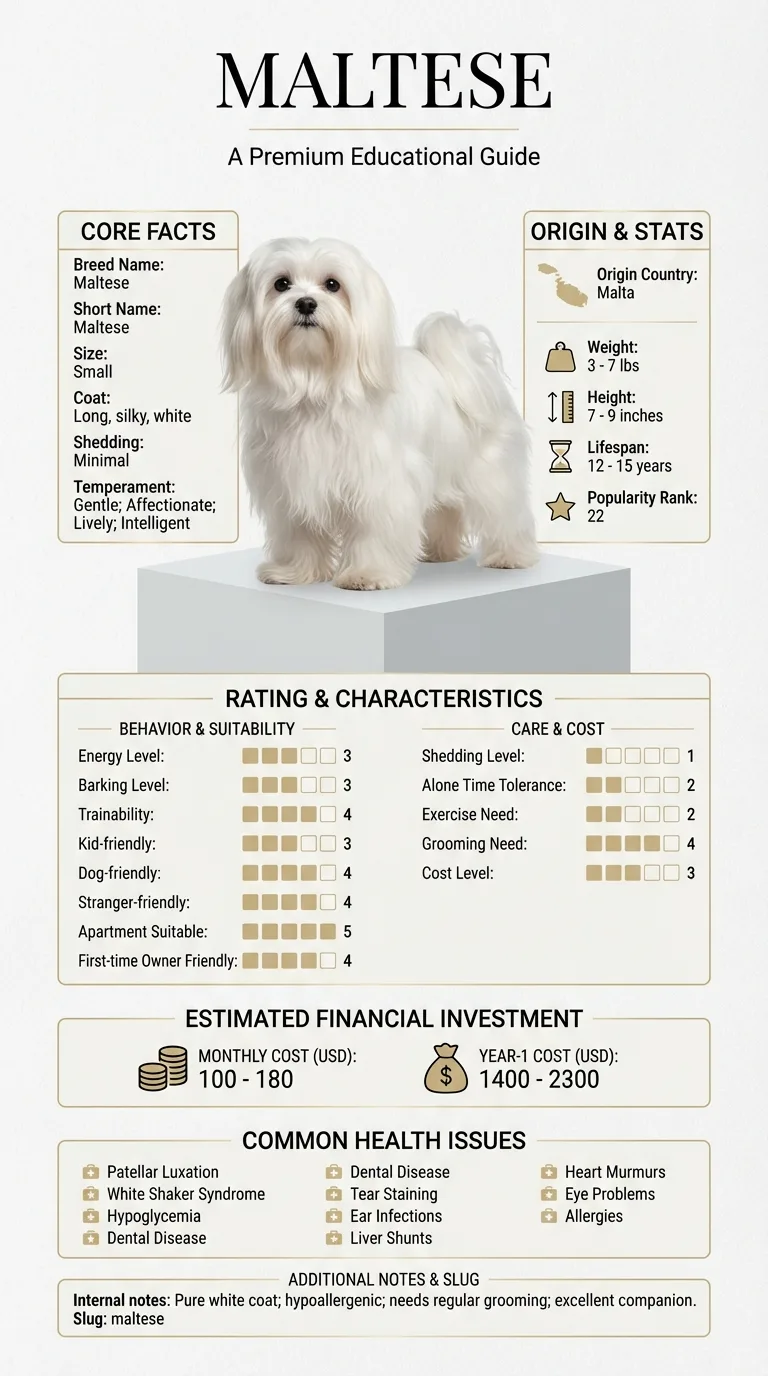
This page is for someone weighing an extremely small companion breed against a large guardian. It covers coat work and tear staining, the fragility that comes with three to seven pounds, dental and neurological conditions specific to the breed, and running costs.
The Maltese is a genuinely easy dog to house and a demanding one to maintain; the Akita is the reverse, needing space and judgement but almost no daily upkeep.
Choose the Akita if you want low daily maintenance and the house is often empty. It grooms at 3/5 against the Maltese's 4/5, barks at 2/5 against 3/5, and tolerates being alone at 3/5 against 2/5. You are accepting 5/5 shedding, 1/5 for first-time owners, 2/5 with other dogs and strangers, and up to 130 pounds.
Choose the Maltese if you live in a flat, want a small affectionate companion and can commit to daily coat care. It rates 5/5 for apartments, 4/5 for trainability, first-time owners, other dogs and strangers, sheds at 1/5 and lives 12 to 15 years. You are accepting fragility, dental work and a coat that mats in days.
| Feature | akita | maltese | Winner |
|---|---|---|---|
| Weight | 70–130 lbs | 3–7 lbs | Equal |
| Height | 24–28 in | 7–9 in | Equal |
| Lifespan | 10–13 years | 12–15 years | maltese |
| Coat | Dense double coat | Long, silky, white | Equal |
| Grooming need | Moderate (3/5) | High (4/5) | akita |
| Shedding | Very high (5/5) | Very low (1/5) | maltese |
| Energy level | Moderate (3/5) | Moderate (3/5) | Equal |
| Exercise need | Moderate (3/5) | Low (2/5) | maltese |
| Trainability | Moderate (3/5) | High (4/5) | maltese |
| Barking | Low (2/5) | Moderate (3/5) | akita |
| Good with kids | Moderate (3/5) | Moderate (3/5) | Equal |
| Good with other dogs | Low (2/5) | High (4/5) | maltese |
| Friendly to strangers | Low (2/5) | High (4/5) | maltese |
| Apartment suitability | Low (2/5) | Very high (5/5) | maltese |
| Good for first-time owners | Very low (1/5) | High (4/5) | maltese |
| Tolerates being alone | Moderate (3/5) | Low (2/5) | akita |
| Typical monthly cost | $110–$240 | $100–$180 | maltese |
| Typical first-year cost | $1,700–$3,200 | $1,400–$2,300 | maltese |
The Maltese coat is single, long and silky, with no undercoat, which is why it sheds so little and mats so readily.
Kept long, it needs brushing and combing through every day, particularly behind the ears, under the collar and in the armpits, plus regular bathing to keep a white coat white. It is a genuine commitment and the reason so many pet Maltese are kept in a short puppy clip instead, which is entirely respectable and cuts the work to a fraction.
Tear staining is the other visible maintenance issue. Reddish-brown streaks below the eyes are produced by porphyrins in tears sitting on white hair, and they show on this breed more than any other. Daily wiping, keeping the hair around the eyes trimmed, and investigating any genuine excess tear production with a vet — blocked ducts, entropion, irritation — are the useful responses. Cosmetic products that promise to remove staining should be treated sceptically.
The Akita's coat, by contrast, needs nothing daily. A weekly brush for ten months, then two or three weeks twice a year of raking out an undercoat at 5/5 shedding, and it never sees a groomer.
Very small dogs are not simply scaled-down versions of larger ones, and a few things change at this weight.
Hypoglycaemia is a genuine risk in Maltese puppies. A tiny body has almost no glycogen reserve, so a missed meal or a stressful day can drop blood sugar to the point of weakness, wobbling or collapse. Frequent small meals through the first months are the standard precaution, and any listless small-breed puppy should be seen quickly.
Patellar luxation — a kneecap slipping out of its groove, producing a skipping step — is the common orthopaedic issue and is often mild, though some dogs need surgery.
Injury risk is the everyday one. Being stepped on, sat on, jumped off furniture, or caught by a door are all realistic, which is why this breed suits a calm household better than a busy one.
The Akita has the opposite problem set: nothing about it is fragile, and everything about it is heavy. A hundred-pound dog that leans on a toddler causes a different kind of accident.
Dental disease sits high on the Maltese list and is the condition most likely to cost you money over fifteen years. A full complement of teeth in a very small jaw means crowding, rapid plaque accumulation and early extractions. Daily brushing genuinely extends this dog's healthy life and reduces the number of anaesthetics it will need.
White shaker syndrome is the distinctive one. Also called generalised tremor syndrome, it produces sudden whole-body tremors in a young adult dog, typically between one and two years old, often worse with excitement. It looks alarming and it is treatable — most dogs respond well to corticosteroid therapy, and many are eventually weaned off. It is not painful and not progressive in most cases.
Liver shunts appear here as they do in several small breeds: a blood vessel bypassing the liver, producing poor growth, disorientation after meals and excessive drinking. A bile acid test diagnoses it.
Heart murmurs, ear infections, eye problems and allergies complete the list.
The Akita's burden is autoimmune and endocrine, plus hip dysplasia and bloat, and it lives two to three years less.
The Maltese runs $100–$180 a month against the Akita's $110–$240, and $1,400–$2,300 against $1,700–$3,200 in the first year.
The gap is narrower than the size difference suggests, and grooming is why. A dog that needs a professional appointment every six to eight weeks across a fifteen-year life accumulates a substantial cost, and for a long-coated white breed that is closer to necessary than optional unless you keep it clipped short and do it yourself.
Dentistry is the second predictable line. Anaesthetic dental work every couple of years for a small breed is normal rather than exceptional, and daily brushing reduces its frequency more than any other single habit.
The Akita's costs are food-dominated and flat, with autoimmune disease and bloat as the expensive but uncertain risks.
On exercise the Maltese needs 2/5 against 3/5 — two short walks and indoor play cover it — and it rates 5/5 for apartments against 2/5.
Lifespan runs 12 to 15 years against 10 to 13.
The shedding row runs the full width of the scale: 1/5 against 5/5. For anyone whose objection to dogs is hair on furniture, that settles it.
The grooming row runs the other way, 4/5 against 3/5, and the two are the same fact stated twice. A coat that does not shed keeps its dead hair, and a long silky one mats within days if it is not brushed through.
Energy ties at 3/5 and children tie at 3/5. The children rating is worth explaining because it looks harsh for such a gentle breed: a three-to-seven-pound dog with fine bones is genuinely at risk from a toddler, and dogs that are handled roughly learn to defend themselves. It suits older, calmer children.
The Akita's advantages are quiet — 2/5 barking against 3/5 — and independence, 3/5 for solitude against 2/5.

4/5, and daily if the coat is kept long — brushing and combing through every day, with attention behind the ears, under the collar and in the armpits, plus regular bathing to keep white hair white. Most pet owners keep the dog in a short puppy clip instead, which cuts the work to a fraction and is entirely respectable.
Reddish-brown streaks below the eyes come from porphyrins in tears sitting on white hair, and they show on this breed more than any other. Wipe the area daily, keep the hair around the eyes trimmed, and have genuine excess tearing investigated — blocked ducts, entropion or irritation are all treatable causes.
Moderately, at 3/5 — the same rating as the Akita, for the opposite reason. A three-to-seven-pound dog with fine bones is genuinely at risk from a toddler, and a dog handled roughly learns to defend itself. It suits older, calmer children and a quiet household better than a busy one.
A generalised tremor syndrome producing sudden whole-body tremors in a young adult dog, usually between one and two years old and often worse with excitement. It looks alarming but it is treatable — most dogs respond well to corticosteroid therapy and many are eventually weaned off. It is not painful and usually not progressive.
Because a very small body has almost no glycogen reserve, so a missed meal or a stressful day can drop blood sugar enough to cause weakness, wobbling or collapse. Frequent small meals through the first months are the standard precaution, and any listless small-breed puppy should be seen quickly rather than watched.
The Maltese, at 1/5 against the Akita's 5/5 — the full width of the scale. The trade is grooming, 4/5 against 3/5: hair that does not fall out stays in a long single coat with no undercoat, and it mats within days if it is not combed through.
The Maltese, at $100–$180 a month against the Akita's $110–$240, though the gap is narrower than the size difference suggests. Grooming every six to eight weeks and regular anaesthetic dentistry are both predictable costs across a fifteen-year life.
The Maltese if you live in a flat, want a small affectionate companion and will commit to daily coat care. The Akita if you want low daily maintenance and a dog that copes with an empty house.
The Maltese runs $100–$180 a month and the Akita $110–$240, with first-year totals of $1,400–$2,300 and $1,700–$3,200. Add grooming and periodic dentistry for the Maltese.
The Akita at 2/5 against the Maltese's 3/5. Akitas bark only when something warrants it; a Maltese is alert and will announce visitors, though it is far from the noisiest small breed.
Tooth brushing. Dental disease is the condition most likely to cost money across a fifteen-year life, and daily brushing reduces the number of anaesthetics the dog will need more than anything else you can do.
Secure checkout on Stripe. We never see your card.
7-day money-back guarantee. Instant access.
Health information here is general and is not veterinary advice. If your dog shows pain, sudden behaviour change, or worsening symptoms, consult a licensed veterinarian.
Some links on this site are affiliate links. We may earn a commission at no extra cost to you, and we only suggest products we believe are helpful for dog owners.
We research and check what we publish, but we do not warrant that any figure, date, price, or statement is accurate, complete, or current, and we accept no liability for any loss, cost, injury, or other harm arising from the use of this site. Use it as one reference among several. You remain responsible for your own decisions and for your dog's care - confirm anything that matters with a licensed veterinarian or another qualified professional before you act on it. Full disclaimer.
Match your lifestyle to the right dog.
Take quizNot sure which breed is right for you? Take our 2-minute quiz to find out.
Take the quiz